
You’re standing outside the sauna with your water bottle, doing the math. Twenty minutes of warmth and quiet sounds like the closest thing to a spa day you’ll get this month, but the questions stack up faster than you can talk yourself into it: Will it hurt the baby? Will it dry up my milk? Am I about to sweat actual toxins into my boobs?
I’ve been there. So here’s the deal, straight up: the verdict is generally yes, with precautions, plus exact hydration numbers and session limits. And just as important, I’ll tell you honestly where the evidence ends, because nobody’s run clinical studies on infrared saunas and breastfeeding. What we have is reasoning, not research. Both matter, and you deserve both.
Key Takeaways
An infrared sauna is generally acceptable while breastfeeding if you’re healthy, your doctor has cleared you, and you follow basic precautions, but zero clinical studies on infrared sauna use while nursing exist.
The real supply risk isn’t heat, it’s dehydration: one session can cost you 16 to 32 oz of fluid, so drink 8 to 12 oz before, 8 to 12 oz during, and 24 to 32 oz after.
Wait 4 to 6 weeks postpartum before starting (longer after a C-section), begin with 10 to 15 minute sessions at 120°F to 140°F, and skip entirely if you have heavy bleeding, a fever, or signs of wound infection.
Table of Contents
Is it safe to use an infrared sauna while breastfeeding?
Yes, an infrared sauna is generally acceptable while breastfeeding when you’re healthy, your doctor has cleared you, and you’re taking basic precautions around hydration and timing.
Now the honest part. There are zero clinical studies on infrared sauna use while breastfeeding. None. Even the lactation resource that reviewed the topic came up empty, finding no research studies on it in their material.
So when I tell you it’s generally fine, that’s reasoning-based reassurance, not study-based. No one has found evidence of harm to your milk or your baby, and no one has studied it either way. Both of those things are true at the same time, and pretending otherwise would be doing you a disservice.
One thing that helped me put the anxiety down: in much of the world, saunas are just life. People use them through pregnancy, postpartum, breastfeeding, and everything in between. This isn’t some fringe wellness trend your grandmother would side-eye. That said, cultural practice isn’t medical proof, so let’s get into what we actually know.
Does sauna heat dry up breast milk? The dehydration question
Sauna heat itself has no strong evidence of drying up breast milk. Dehydration is the real risk, and it’s the one thing worth taking seriously here.
Here’s the number that changed how I think about this: a single sauna session can cost you 16 to 32 oz of fluid through sweat. That’s a lot. And supply dips from dehydration can show up a day or two later, which is exactly why so many moms blame the sauna. They’ll have a session on Saturday, notice supply feels off on Monday, and connect the dots to the wrong thing.
The sauna didn’t dry up the milk. The unmanaged fluid loss did. It’s a pattern lactation-focused sources flag, and once you see it, it’s easy to avoid.
The fix is unglamorous and effective:
- 8 to 12 oz of water before the session. Chug a glass before you go in.
- 8 to 12 oz during the session. Keep the bottle within reach.
- 24 to 32 oz after. This is the big one. You lose more than you think, so keep refilling long after you’ve toweled off.
- Daily baseline while breastfeeding: about 16 cups of fluid, plus an extra 24 to 32 oz for milk production. The sauna just adds to a target you’re already chasing.
- Electrolytes matter because they help your body actually absorb the water you’re drinking, restore nerve function, and replace the minerals you sweat out.
And the honest middle ground? Less stress and better circulation may support milk flow, if your hydration holds. No overnight supply boost, no supply sabotage. Just don’t let the water bottle be the thing you forget.
Can “detox” toxins from sweating reach your baby through breast milk?
No, there’s no evidence that toxins released by sauna sweating pass into breast milk. Your breastmilk is made from your blood supply, not your sweat glands. That’s the whole mechanism, and it’s the sentence I needed someone to say to me out loud.
Your body gets rid of waste through sweat, pee, and poop. And yes, crying counts. It’s not going through your milk on some detox detour.
The analogy that made this click for me: we already know it’s safe to breastfeed with a fever. Nobody blinks at that. A sauna raises your body temperature in a comparable way, so body heat itself isn’t the enemy here.
Now, the full argument landscape, because you deserve it:
- One sauna company, Saunaverse, advises waiting two hours after a session before nursing, on the theory that harmful waste could be present in your milk. That’s the vendor’s claim, and they don’t point to any cited research behind it. It sits against the position from multiple sources, including SweatHouz and LA Lactation, that no transfer occurs. If you want the buffer anyway, it’s a harmless one. Feed the baby first, wipe down, take your time. Just know it’s a choice, not a rule.
- No pump and dump needed.
- The one genuinely theoretical caveat: infrared heat could, in theory, mobilize stored toxins like heavy metals into your bloodstream. If known heavy metal toxicity is actually a concern for you, that’s a get-tested-and-talk-to-your-doctor situation. It’s not a sauna question, and it’s not a reason to worry if it’s not on your radar.
- One more honesty flag: a tip floating around that sweating within the first 10 minutes means your “drainage pathways are working” has no supporting data. You sweat early because you’re warm. That’s it.
How soon after giving birth can you use a sauna?
Most sources recommend waiting 4 to 6 weeks postpartum before using an infrared sauna, and longer after a C-section. Your body just did something enormous. The wait is respect, not restriction.
| Delivery type | When to start | Why |
|---|---|---|
| Vaginal delivery | 4 to 6 weeks | Perineal healing, muscle recovery |
| C-section | 6+ weeks or per your doctor | Incision and deep-tissue healing, incision fully healed |
For most people, clearance happens at the postpartum checkup, typically 6 weeks after a vaginal delivery or 8 weeks after a C-section. That’s when your OB confirms your uterus has shrunk back down (the medical term is uterine involution, but really it just means things are returning to their pre-baby real estate) and that you’re healing well.
Why the wait isn’t arbitrary
Heat widens your blood vessels, which is great for sore muscles and less great when your body is still shedding post-birth blood. That bleeding is called lochia, and it’s the thing nobody warned us about at the baby shower. If you’re still experiencing heavy lochia, skip the sauna entirely, because the heat can increase bleeding. Same goes for a high fever or signs of wound infection.
Two sequencing notes worth stealing: don’t go straight from nursing or a workout into the sauna, because the dehydration stacks, it’s worth knowing what health authorities like the NHS actually say about sauna use while breastfeeding rather than relying on anecdotal advice. And if you’re currently pregnant, you’re generally advised to skip infrared saunas altogether, but that’s a pregnancy rule. This article is about after.
One transparency note: much of the specific waiting-window guidance comes from sauna companies like Salus Saunas and Peak Saunas, so treat it as vendor guidance layered on top of your doctor’s actual advice. Your doctor wins ties.
How long and how hot should a session be while nursing?
Start with 10 to 15 minute sessions at 120°F to 140°F, and build to 20 to 30 minutes only if you feel good. Get out immediately if you’re lightheaded, nauseous, dizzy, overheated, or your heart is racing. No toughing it out. If you feel off, just get out.
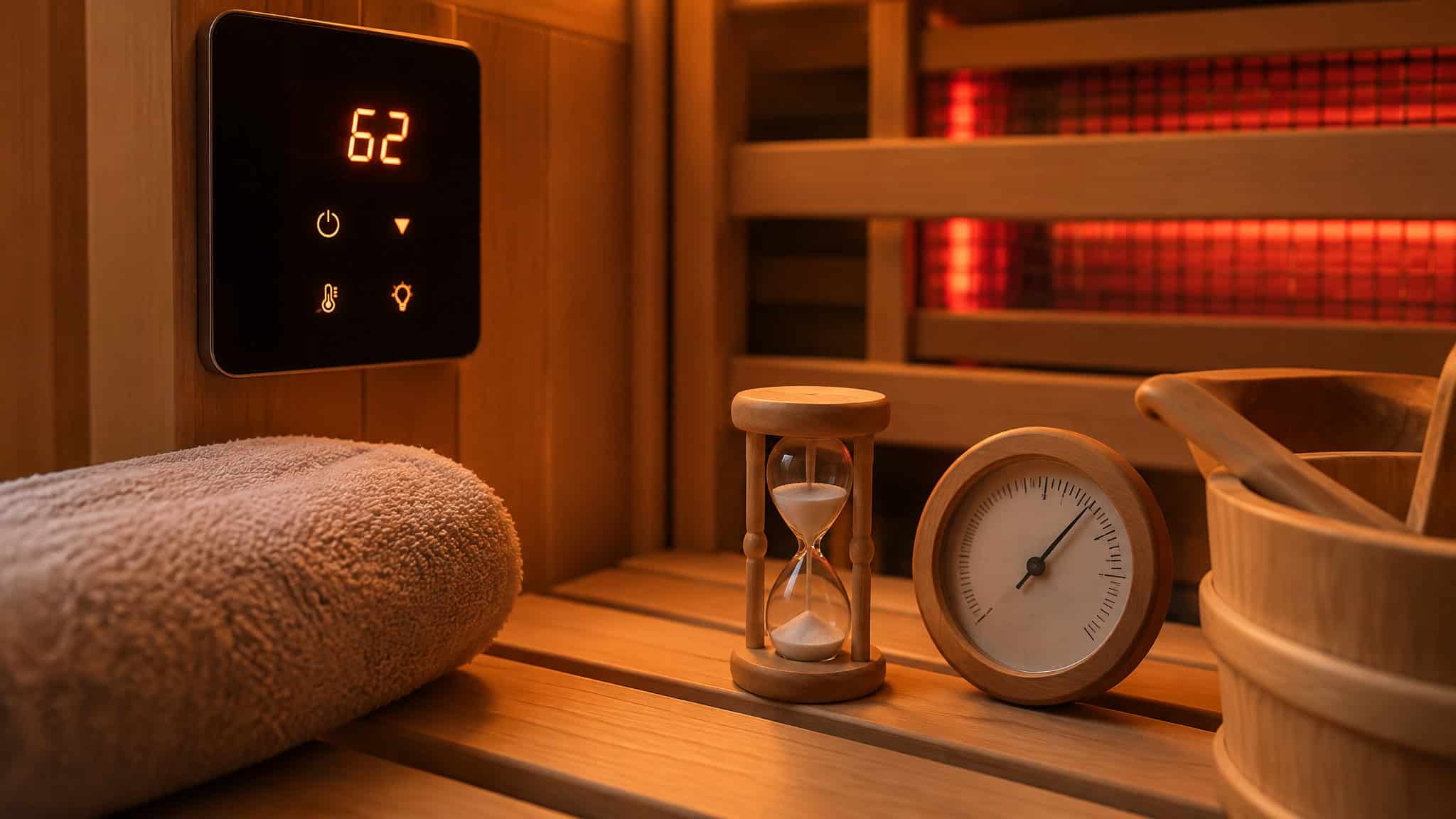
Here’s why your pre-pregnancy tolerance doesn’t carry over: your blood volume and cardiovascular function are still recalibrating postpartum. The 30-minute sessions you did before may not be the session you get now. In practice, new postpartum users who assume their old tolerance are the ones who hit unexpected lightheadedness, so treat yourself as a beginner even if you’re not.
Also, permission granted: some days you won’t feel up to it, and skipping is a win, not a failure. No two postpartum recoveries are the same, and comparing yours to anyone else’s sauna streak helps no one.
Why infrared differs from a traditional sauna
Infrared saunas use light waves to heat your body directly, warming you from the inside rather than sitting in a hot room. They run 110°F to 140°F, noticeably gentler than the roughly 200°F at your gym’s traditional sauna, because the heat reaches you by radiation instead of hot air or steam.
Two numbers worth knowing: the wavelengths reach up to 1.5 inches into muscles and joints, which is why sore carrier-shoulders feel better, and a session raises your core temperature by 1 to 3°F. Enough to matter, not enough to cook you. For the record, there are no direct comparative safety studies of infrared versus traditional saunas in lactation, so “gentler” describes the experience, not a proven safety verdict. If you want the practical version of all this, safe sauna practices for breastfeeding moms covers the prep checklist.
What the evidence says about postpartum recovery, sleep, and mood
The most relevant clinical data on infrared heat and postpartum recovery comes from wound therapy, not sauna sessions, and I’ll keep that distinction intact.
What infrared therapy studies show for postpartum healing
A January 2017 study by Dewi and Ayuningtyas, published in the International Journal of Research in Medical Sciences, followed 30 postpartum women with perineal tears. Small, yes, and I’m not going to pretend otherwise. But the results were striking: the infrared group averaged 31.7 improvement within two days versus 15.0 for the iodine group, and the researchers concluded infrared was better at boosting microcirculation and wound closure.
On the episiotomy side: 90.4% of women using far-infrared therapy reported mild to no pain by week six. That finding comes from Dr. SV Kakade, a statistics professor at Krishna Institute of Medical Sciences, who found infrared light therapy effective for episiotomy healing.
To be clear about what this is and isn’t: this is wound-therapy evidence. It’s about infrared light applied to healing tissue, not proof that sauna sessions while nursing are safe or that they’d do the same thing.
Cellular mechanisms behind the recovery claims
Here’s the short version of what happens inside you, translated as we go:
- Heat shock proteins (HSP70 and HSP90, your cells’ repair crew) get activated. They refold damaged proteins and clear cellular junk. Brian Richards of SaunaSpace has made the point that these proteins are built into our DNA to protect cells under stress, which is a vendor voice, not a study, but it’s a decent summary.
- Mitochondria, your cells’ power plants, multiply and pump out more ATP, which is your cells’ energy currency. More ATP means more fuel for tissue that’s still repairing after childbirth.
- Infrared prompts nitric oxide release, which widens blood vessels (one mention of “vasodilation,” and there it was). Better circulation means more oxygen and nutrients reaching recovering tissue, and helps clear metabolic waste. Reduced stress plus improved blood flow to breast tissue may also help with blocked ducts or mastitis, emphasis on may, and if actual mastitis hits, call your doctor. Warmth is a helper, never a standalone cure.
- Fibroblasts, the cells that keep skin springy, get stimulated to produce collagen and elastin, which may soften the look of stretch marks. That’s a “may,” and I mean it.
- Better microcirculation supports the lymphatic system, the body’s drainage plumbing, which may reduce postpartum swelling. Again: may.
- Inflammation signals, specifically IL-6 and TNF-α, went down in research, and one oxidative stress marker in urine dropped too.
Sleep, mood, and the cortisol caveat
The sleep data is genuinely tempting for anyone running on two-hour stretches: one survey found 83% of sauna users reported better sleep for up to two nights after a session, and a smaller study found a single session increased deep sleep by over 70%. Both hedged the way they deserve, but worth knowing. The mechanism is familiar: infrared raises then lowers your core temperature, nudging melatonin, the same trick as a warm bath before bed.
Mood-wise, infrared heat encourages release of beta-endorphins and serotonin, the same feel-good chemicals a good workout gives you, which may take the edge off postpartum anxiety and the baby blues. And higher levels of BDNF, a brain-health protein, have been linked to lower postpartum depression risk. Linked to, correlation language, not a treatment claim. According to BestHomeInfraredSauna.wiki, regular sauna bathing is associated in observational and small-trial literature with stress relief and evening relaxation, effects tied to heat dose and consistency rather than brand. Related reading if this is your lane: benefits of infrared saunas for postpartum and breastfeeding moms.
Now the wrinkle almost nobody mentions. A University of Jyväskylä study in Finland had team-sport athletes use infrared sauna after exercise, once or across a six-week training period. Soreness dropped and athletes felt more recovered, but in female athletes, the sessions initially raised nighttime heart rate and cortisol before things leveled out with regular use. Translation: your first sessions may feel stressful, not calming, and that’s a known pattern, not a sign something’s wrong. The researchers also noted the long-term benefits likely came from better training quality, not direct muscle changes, which is a tidy reminder that recovery tools support what you do, they don’t replace it.
Two smaller notes: a session raises your heart rate while you just sit there, which I’ll call the laziest cardio available and a legit small win when a walk feels impossible. And sauna mimicking a mild fever for immune function, plus reports of better hormone balance and less puffiness early postpartum, sit firmly in anecdote territory, so treat them accordingly.
One mom’s year-long protocol, and a monitoring checklist you can copy
After my second baby was born, I started using an infrared sauna, and I kept it up regularly for over a year while breastfeeding. Nothing bad happened to my supply or my baby. For what it’s worth. That’s one parent’s honest observation, not evidence for everyone, and I’d never hand you my experience as proof.
When I was deciding, I stopped trying to answer one giant scary question and split it into three: what’s the risk to my body, what’s the risk to the milk, and what’s the risk to the baby. Separating them made everything less foggy. My body was the one carrying the real risks (dehydration, overheating, bleeding if I went too early). The milk risk turned out to be mostly theoretical. The baby’s risk was largely downstream of mine.
Over that year, here’s what I actually noticed, kept honest and small: less tension and soreness from hauling and wearing a baby all day. Deeper sleep on sauna nights, and I’m writing that with appropriate longing. The warmth seemed to help milk flow, meaning letdown came easier, which is not the same as boosting supply overnight, and I want to be precise about that distinction because the difference between those two claims is the difference between honest and hype. A mental reset that counted as actual me-time.
Warmer hands and feet and more energy afterward. And a calmer mood after sessions.
How to verify your supply and baby are fine
Here’s the reassuring part: the monitoring is the same stuff you’re already tracking. Wet and dirty diapers, weight gain, signs baby’s getting enough, plus an eye on your own supply for changes. If those all look normal, you’re doing the verification. No sauna-specific protocol required.
From the lactation folks, the actually useful advice: don’t sit too long and overheat, stay hydrated, and wipe off your sweat before nursing. A warm sweaty chest isn’t fun for anyone, least of all the baby latched onto it.
And the scheduling reality: nursing intervals are unpredictable, so instead of timing some post-sauna waiting window, most mothers in practice feed first and then shower or wipe off. It’s simpler and it works. There’s also a whole roundup of what real moms say about infrared saunas while nursing if you want more voices beyond mine.
Who should wait, and the questions no evidence answers yet
Skip the sauna entirely if you have heavy postpartum bleeding, a fever, signs of wound infection, or an unhealed C-section incision. And if you have high blood pressure, a heart condition, or take medications, have a doctor conversation before your first session. If heavy metal exposure is a real concern for you, that’s a get-tested-and-talk-to-your-doctor situation, not a sauna question. More on the full list lives in contraindications for new moms.
The unanswered questions
Then there’s the honest boundary of what anyone knows. Nobody has evidence on sauna plus cold plunge while nursing. Nobody has evidence on red light therapy while breastfeeding either. These are real questions with an empty evidence base, and at most they’re answerable by analogy, which I won’t dress up as an answer.
The sauna and cold plunge question and the red light therapy question each get their own treatment if you want to see how far the reasoning stretches. Official health bodies like the NHS are largely quiet on sauna use while breastfeeding specifically, which is worth knowing when you go looking for a ruling.
Sauna blankets, pods, and suites: home options and what they can’t tell you
If you’re not ready for a cabin, there are apartment-friendly options. Quick context on where these reviews come from: talkSPORT tested products on ease of use, quality, and session effectiveness, rated out of 5. And the detox and fat-burn language in the marketing is promotional, not clinically validated. You’ve already read the evidence section above; the marketing words don’t change it.
HYDRAGUN HeatPod Sauna Blanket 2
£549, rated 4.5/5. It claims to be the hottest blanket on the market, with a 30 to 85°C range and hitting 60°C in about 5 minutes, and the fast heat-up genuinely matters when your free window is 20 minutes, maybe. Pros: heats fast, relaxing. Cons: one-sided zip, fiddly to close alone, pricey.
The reviewer tested it after a ski trip and needed a partner’s help zipping it, and a 20-minute session left them relaxed with marginally better sore muscles. Marginally is their word, and I respect it.
Gymproluxe tropical sauna pod
£265, down from £395, rated 4/5. This one’s a steam-based pop-up tent, not infrared, with 15 heat settings hitting 55°C in 10 minutes. Bonus: the steam clears lungs and sinuses. Cons: a pain to pack away, can feel claustrophobic, and steam escapes when the door opens. Reviewer Zoe Nicol set hers up by the kitchen window in freezing weather after watching the demo video about five times, and used it 10 to 15 minutes after runs, which sounds exactly right.
BON CHARGE Infrared Sauna Blanket
£549, rated 4/5. Lightweight, heats to about 80°C max in a few minutes, and holds a Beauty Shortlist award, which is nice but not proof of anything. Cons: a loud controller beeping (exactly what you need to know if you’ve got a sleeping baby in the next room), fiddly solo Velcro, and Velcro gaps that leak heat.
MiHIGH Infrared Sauna Blanket
£315, rated 4/5. Reviewer Aaron Dowler used it five times a week for four weeks, and his standout was muscle relaxation with DOMS melting away around the 25-minute mark, plus improved sleep and 5lbs lost over the month. He described wrapping up like a human burrito and called it a mini celebrity moment during 45-minute horizontal Netflix sessions, which is honestly the energy.
CurrentBody Wellness Infrared Sauna Blanket
£549.99, rated 4.5/5. Heats in about 5 minutes, weighs roughly 7.5kg, one of the lightest, with even heat and a heavy-duty zip that traps heat well. Comes with a foam pillow, towel, and accessories, so you can use it the day it arrives. Cons: no armholes and a short power cord, which will make you picture your outlet placement immediately. Reviewer Maxim Hancock is 6’1″ and still had room to spare.
SweatHouz
Not a home device but a suite option: SweatHouz runs private suites with Clearlight full-spectrum infrared saunas, customizable chromotherapy (fancy colored lights, nice ambiance, don’t overthink the science of it), and Vitamin-C-infused showers. Their claimed benefits, relaxation, circulation, recovery, sleep, are the company’s marketing, not independently verified results.
The through-line across every one of these formats: none of them carries breastfeeding-specific guidance. They’re built for general wellness, and whatever they say about sessions applies to you exactly the way the precautions above apply. Prices may vary, so check before you buy.
Cost check: Cabin, blanket, pod, or suite, none of them include breastfeeding-specific guidance or clinically validated claims — verify prices and benefits against the evidence above before buying.
Making the call: safety is a personal decision
Safety here isn’t a verdict I can hand you. It’s a personal decision you make with your doctor, and the useful version of that conversation is simple: bring your delivery type, your overall health, and your nursing status, and ask them directly.
For me, the benefits outweighed the risks, that was my conclusion, not a universal one, and by being intentional and cautious, sauna time became a genuinely supportive part of my breastfeeding journey. Your version of that call depends on your delivery type, your health, and where you are with nursing, which is exactly why it belongs to you and your doctor. If you’re extra cautious by nature, a quick chat with your doctor or midwife costs nothing and buys real peace of mind.
One last thing, said warmly and not lawyerly: this article is educational, not medical advice. Some links on this site may earn a commission, and prices change, so check before you buy. Now go drink your 24 to 32 oz and enjoy the quiet.
Frequently Asked Questions
Does red light therapy affect breastfeeding?
Nobody knows, honestly. There’s no clinical evidence on red light therapy while breastfeeding — the question sits in the same empty evidence base as infrared saunas and cold plunges, where the best anyone can offer is reasoning by analogy rather than research. If it’s on your radar, it’s a talk-to-your-doctor situation.
How soon postpartum can you go in a sauna?
Most sources recommend waiting 4 to 6 weeks after a vaginal delivery, and longer after a C-section — typically until your incision is fully healed and your doctor clears you at the postpartum checkup. Skip the sauna entirely if you’re still having heavy postpartum bleeding, a fever, or signs of wound infection, since heat can increase bleeding.
Can toxins released by sauna sweating pass into breast milk and harm my baby?
No — there’s no evidence that toxins released through sweat reach your baby through breast milk. Breastmilk is made from your blood supply, not your sweat glands, and your body sheds waste through sweat, pee, and poop instead. No pump and dump is needed. The one theoretical caveat: infrared heat could mobilize stored toxins like heavy metals into your bloodstream, which matters only if you have known heavy metal toxicity concerns.
Is an infrared sauna safer than a traditional sauna while breastfeeding?
Infrared is gentler in experience, not proven safer. Infrared units run 110°F to 140°F and heat your body directly with light waves, versus roughly 200°F hot air in a traditional sauna. But there are no direct comparative safety studies of infrared versus traditional saunas in lactation, so ‘gentler’ describes how it feels, not a verified safety verdict.