
There’s a very specific kind of longing that happens when you’re six weeks postpartum and someone mentions the sauna at their gym. You miss it. You miss feeling warm on purpose instead of because the baby is on your chest under three blankets. And the second you think about booking a session, the worry shows up: will the heat mess with my milk?
How long is too long? And what am I supposed to actually do before and after so this doesn’t backfire?
Those are the three questions this article answers: temperature, timing, and prep. The honest part first. General sauna research doesn’t address nursing mothers at all, so nothing here is breastfeeding-specific medical guidance. What follows takes well-studied general sauna safety parameters and applies them conservatively, with the nursing adjustments that follow from basic fluid math. Your actual green light should come from a provider who knows your recovery and your lactation situation.
That said, for a healthy postpartum mom who’s been cleared, sauna use is generally workable. The rules just change after pregnancy, and they change for a reason that has nothing to do with fearing heat.
Key Takeaways
A single 15-minute sauna session can cost you up to a pint of fluid in sweat, which is exactly why hydration, not heat avoidance, is the whole game while nursing.
Start at the beginner tier no matter how experienced you were pre-pregnancy: 5-10 minutes in a traditional sauna (150-195°F) or 10-15 minutes in infrared (110-140°F), 2-3 sessions a week with a rest day in between.
Feed the baby before you go in, drink a glass or two of water beforehand and again afterward, with electrolytes after, and leave the moment anything feels off, especially if you suddenly stop sweating.
Table of Contents
Yes, you can probably go in the sauna while breastfeeding. Here’s the honest version.
Yes, sauna use while breastfeeding is generally safe for healthy postpartum mothers once their provider has cleared them, provided sessions stay short and hydration is deliberate.
That condition isn’t a formality. Here’s the part most articles skip: the reason sauna rules change after pregnancy is that the risk changes. When you were pregnant, the concern was your baby’s core temperature. Now the baby’s outside, regulating their own temperature just fine, and the risk is yours.
Specifically, your fluid balance and your recovery status. The pregnancy-era rules don’t transfer unchanged, because the mechanism they were protecting against is gone.
What replaces them is mostly math. A 15-minute sauna session can shed up to a pint of sweat, and you’re already running a fluid deficit from making milk. That’s the entire reason hydration becomes the centerpiece of everything below.
One more thing, said plainly: no general sauna source addresses nursing specifically. So the nursing-specific clearance comes from your provider, ideally one who thinks in terms of lactation, not from a wellness article. Including this one.
Picking your temperature: the hotter the room, the shorter the session
The inverse rule is the simplest thing in this article: hotter room, shorter stay. Once you know the ranges, it stops feeling like guesswork.
Traditional sauna
Traditional saunas run roughly 150-195°F (66-91°C, topping out at 212°F). Translation: really hot, dry air. This is the hottest option on the menu, which for a nursing mom means the shortest session and the most careful hydration. It’s the right choice only if you love it and your provider is fine with it.
Infrared sauna
Infrared runs 110-140°F, and it works differently. Instead of heating the air, it warms your body directly, closer to sun on your skin than a hot room. Cooler and gentler, and it isn’t technically a “real” sauna by the Finnish definition, but it delivers similar benefits at lower temperatures. For a nursing mom, that’s genuinely good news: around 110-130°F, it’s the most forgiving place to restart.
Steam room
Steam rooms run 100-120°F with humidity up to 100%. Sounds mild. It isn’t. The moisture blocks your body’s evaporative cooling, which is why steam at 110°F can feel harsher than dry heat at 175°F.
Everyone who’s wandered into a steam room thinking “oh, it’s barely 100 degrees” has learned this personally. For a mom counting fluid losses, wet heat counts as heat exposure even at lower thermometer readings, and steam room sessions while nursing should sit at the short end too.
So the decision rule: favor infrared, which runs 110-140°F and warms you directly rather than heating the air, over a traditional sauna at 150-195°F, and sit at the low end of every range.
Two bits of color, because they explain why rooms that look identical can feel so different. Saunas come in a few flavors: wood-burning, electric, infrared, and old-school smoke saunas with no chimney. And the Finnish tradition of throwing water on the hot rocks, called löyly, is why a Finnish sauna feels more humid than the thermometer suggests, and why checking a hygrometer alongside the thermometer tells you what the room is actually like. None of this is gatekeeping trivia; it’s the reason the same number on two different gauges can hit completely differently.
And to be fully clear: no source establishes a medically proven “safe temperature for breastfeeding.” What you’re reading is a conservative adaptation of well-studied general parameters, chosen because lower heat plus careful hydration is the defensible entry point while nursing.
How long to stay in a sauna while nursing
A nursing mother’s starting session is 5-10 minutes in a traditional sauna or 10-15 minutes in infrared, with 15-20 minutes as the working sweet spot and 30 minutes as the absolute ceiling even for veterans.
Here’s the part competitors miss: even if you were a four-times-a-week sauna regular before pregnancy, restart at the beginner tier anyway. Your hydration status and heat tolerance changed. Your knowledge of saunas didn’t, but that’s not what’s being tested in there. In practice, the tell that someone came back too hard is finishing a session feeling drained instead of relaxed. Exhaustion isn’t the afterglow; it’s the signal you overshot.
Researchers studied sessions from 5 minutes up to 30. The American College of Sports Medicine and the American Sauna Society land in the same place: past 30 minutes, dehydration and overheating risk climbs even for experienced users. You’ll occasionally see a source suggesting 40 minutes in infrared. Treat it as the outlier it is, not the goal.
Then there’s the Finnish principle, which honestly beats any timer: leave when you feel hot enough. Heat tolerance isn’t fixed. It shifts session to session with hydration, sleep, and how feeding’s been going, which postpartum means it shifts a lot, and some days, when to hold off entirely matters more than how long to stay. Fixed durations work as a floor for beginners and a ceiling for everyone else. The sauna is for relaxing, not grinding out minutes.
On frequency: 2-3 sessions a week to start, with at least one rest day between sessions in the first weeks. If you want a concrete picture of what the studied beneficial setup looked like, it was about 20 minutes at roughly 174°F. And the unglamorous trick that keeps you honest: set a timer clock outside the sauna, or follow the posted time recommendations at a public sauna. You will lose track of time in there. Everyone does.
Can dehydration actually affect your milk supply?
No study establishes a direct sauna-to-supply link, and I won’t claim one. But the mechanism is clear enough to act on, and it’s worth understanding.
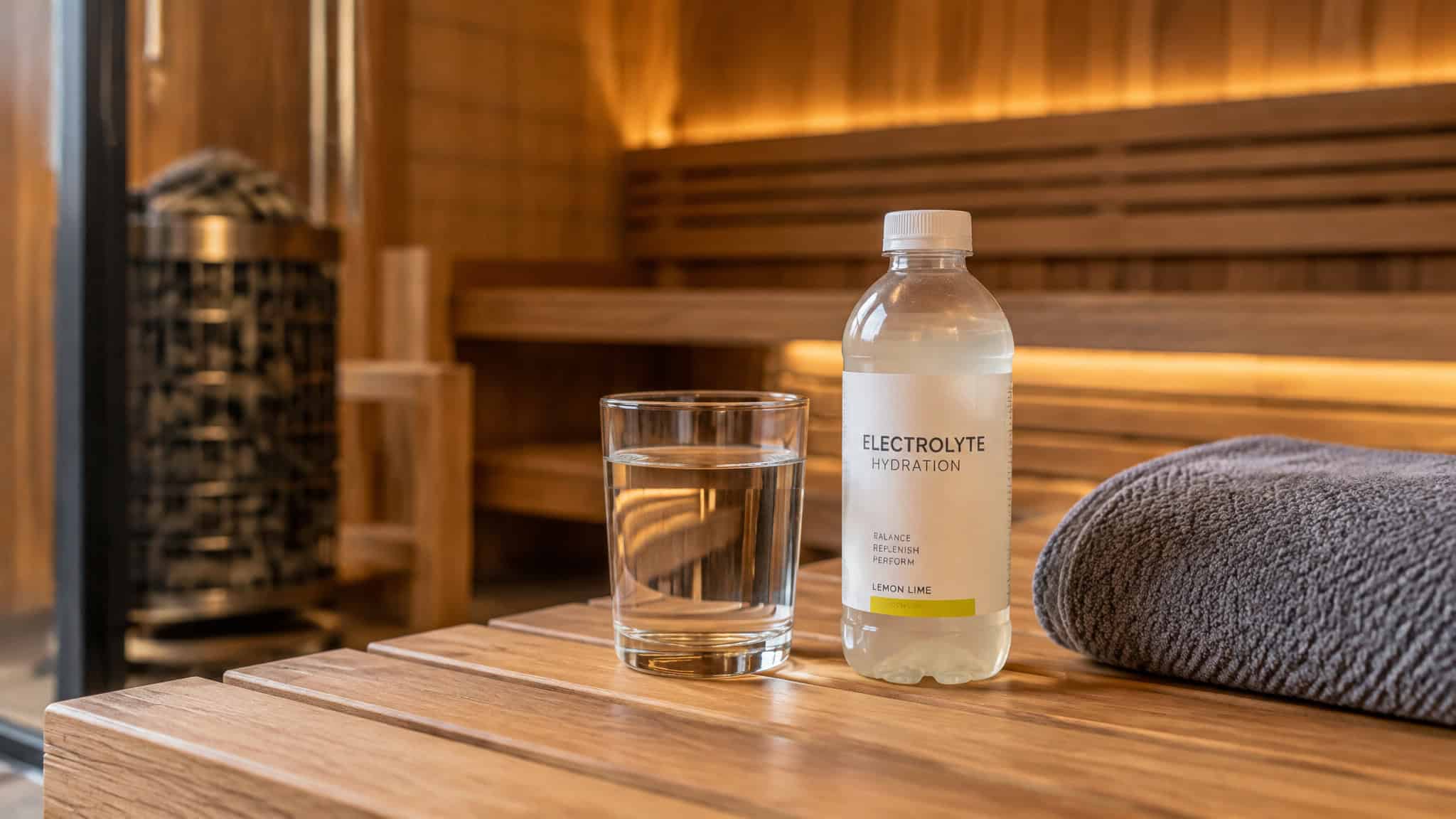
Here’s the chain. A 15-minute session can shed up to a pint of fluid. Sweat takes sodium mostly, plus some magnesium and potassium. And nursing mothers already run a fluid deficit because milk production itself pulls water.
Stack a pint of sweat on top of an existing deficit, and a temporary supply dip is the plausible outcome. That’s mechanism, not established fact, but the pint number makes the case on its own.
The protocol is simple and unglamorous, like packing the diaper bag: 1-2 glasses of water before every session and again after. Then electrolytes after the sauna, not before, because water alone doesn’t replace what sweat took. Sodium, magnesium, potassium: an electrolyte drink or tablet after a session covers it. Bonus: rehydrating properly also heads off that familiar post-sauna headache, the one parents know from every other dehydrated Tuesday.
Feed before or after? Feed first.
Nursing or pumping before a session is the practical choice. In practice it’s the thing most likely to end your session early, which is why my checklist puts feeding timing ahead of session length.
Many nursing mothers find the session gets cut short not by overheating but by engorgement or a letdown in the heat. Full breasts plus high heat plus a relaxed body is a recipe for discomfort or worse, our guide to infrared saunas while breastfeeding covers how heat affects milk supply and hydration. Feed first and you remove the most likely problem.
The rest of the timing logic:
- Feed the baby (or pump) before you go in.
- Hydrate between the session and the next feeding.
- If you feel breast discomfort or a letdown coming in the heat, step out. That’s the cue, not something to push through.
- Plan sessions around your baby’s longest sleep stretch, whatever that currently is. If that’s a 40-minute nap or a blessed 5-hour stretch, the sauna slots in wherever the gap is.
That’s it. This is comfort and logistics, nothing more. No heat changes your milk, no baby will refuse a feeding because you sat in warm air. Keep the plan boring and it works.
The before and after checklist
The routine comes down to real numbers: 1-2 glasses of water on each side, a 10-15 minute cooldown, and 10 minutes of rest before you sprint back to real life.
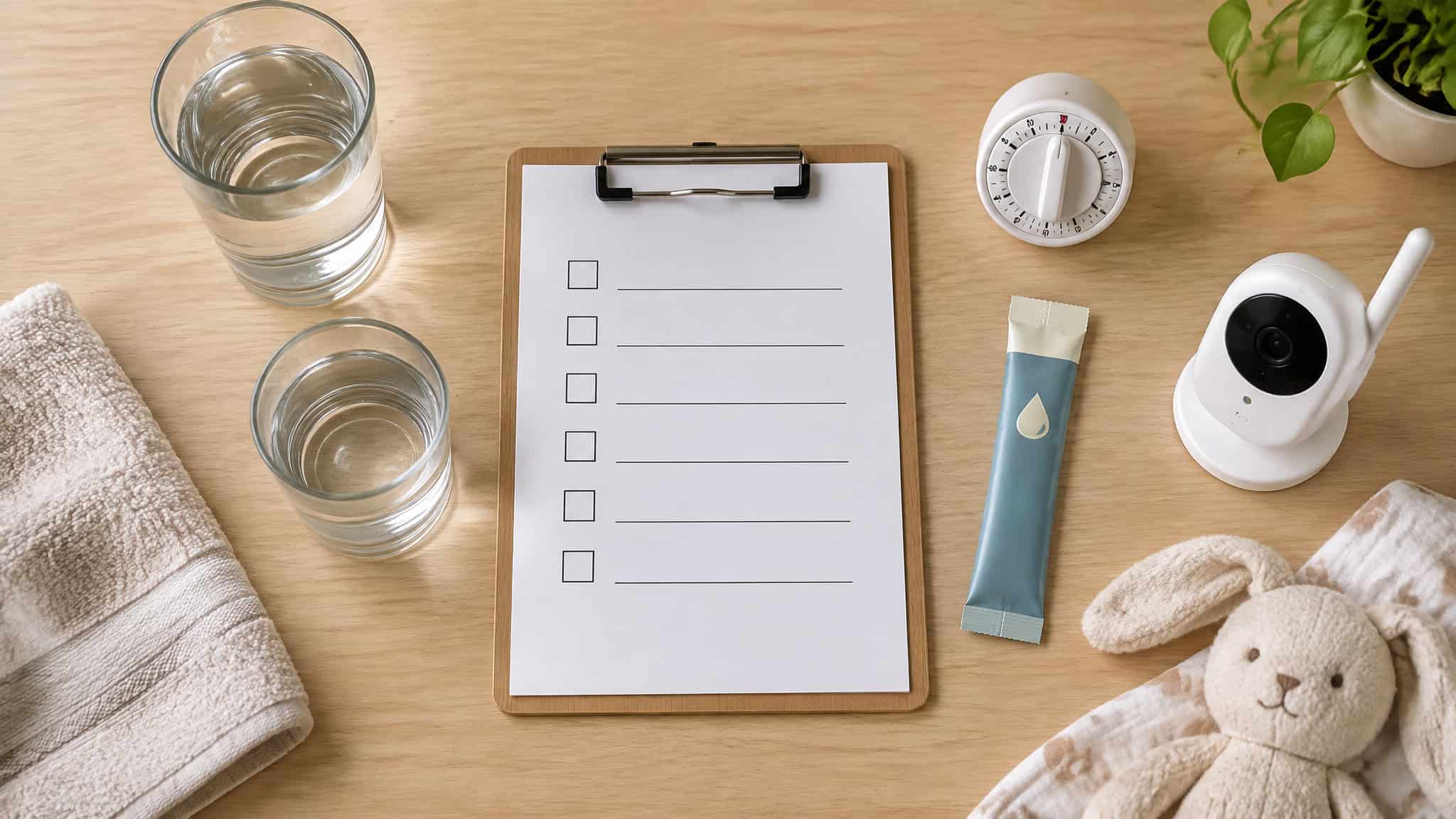
Before:
- Drink 1-2 glasses of water. Walk in already hydrated, not planning to catch up later.
- Shower and enter clean. Basic courtesy to everyone sharing the room.
- Feed the baby first.
- Skip alcohol (it impairs temperature regulation and multiplies dehydration risk) and skip the heavy meal right before. You know how that feels.
After:
- Cool down for 10-15 minutes at room temperature or under a lukewarm shower. Not a cold plunge; more on that below.
- Rinse off.
- Rehydrate, with electrolytes if the session ran long.
- Rest at least 10 minutes before rushing off. This is the part every parent skips, and it’s exactly why the post-sauna slump hits so hard.
- Ease out gradually. Don’t walk straight into cold outdoor air dripping sweat; your body needs the transition.
- Then nurse or pump whenever you’re comfortable.
One pattern worth naming, because it catches diligent people: the best pre-pregnancy hydrators often come back postpartum and underestimate their needs, because milk production adds fluid losses they’re not used to accounting for. The tell is lightheadedness in a session length they used to handle easily. If that’s you, it’s not a fitness failure. It’s a different equation now.
When to leave the sauna immediately
Leave immediately if you feel dizziness, nausea, lightheadedness, a rapid or irregular heartbeat, confusion, trouble breathing, an intense headache, unusual weakness, faintness, or if you suddenly stop sweating.
That last one is the paradoxical one most articles skip. If you’ve been sweating and suddenly stop, your body may be failing to cool itself, which is exactly the situation the sauna was supposed to be safe because of, a risk that proper attire choices, like whether you can wear boxers in a sauna, are meant to keep from making worse. That signal overrides everything else, including the timer, including “just two more minutes.”
The full list, in one place:
- Dizziness
- Nausea
- Lightheadedness
- Rapid or irregular heartbeat
- Confusion
- Trouble breathing
- Intense headache
- Unusual weakness
- Faintness
- Suddenly stopping sweating
After you exit: sit down, drink water, and get help if you feel anywhere near fainting. Calm and practical, no drama needed.
And remember: heat tolerance differs every session, especially postpartum, when sleep and hydration swing wildly. Your body’s signals beat the timer. If your heart is pounding and you feel rough early in a session, that’s your body saying “not yet.” Listen the first time. Breast discomfort or a letdown in the heat counts as a step-out cue too.
When can I go back postpartum, or after a C-section?
The defensible answer is clearance from your provider, not a week count. No source supports a week-by-week timeline, even though every part of you wants a number right now. Anyone selling you “you’re fine at 6 weeks” is making it up.
The why is worth understanding, though. Postpartum bleeding changes what your body can spare. A healing incision, especially a C-section, changes what heat and sitting do to you. And thermoregulation itself can run differently after birth. Any of those shifts the calculus, which is why the timeline belongs to someone who’s actually examined you.
The closest anchor we have is pregnancy guidance, which was deliberately conservative: pregnant women should avoid traditional hot saunas because a raised core temperature posed risks to the baby, and infrared and steam still required medical clearance even at lower temperatures. The mechanisms differ postpartum (the fluid math replaces the fetal temperature concern), but starting from the conservative side is the right instinct.
A few medical cautions, delivered as a heads-up, not a scare list. Sauna use temporarily lowers blood pressure, so anyone with low blood pressure, aortic stenosis, or heart failure needs extra caution. Worth a quick call with your doctor first if you have heart disease, arrhythmia, uncontrolled blood pressure, epilepsy, diabetes, kidney or circulation conditions, multiple sclerosis, asthma, or take medications that affect heat tolerance. One for the partners reading along: a possible temporary decrease in male fertility is also on the list of potential sauna risks. When in doubt, ask.
If your provider gives the OK, start with just five minutes and pay close attention to how you feel. And normalize asking: on-site staff at any decent sauna can tell you what to expect, and your own provider can tell you what your recovery allows. Neither expects you to show up knowing everything.
Hot tubs and cold plunges
The cold plunge is fine to skip while nursing, at least in the structured video-version form, because that setup requires good cardiovascular health and the transition itself is the risky part. Your blood vessels open up in the heat, then clamp down in the cold. Go straight from sauna to cold water and your blood pressure can drop fast enough to leave you dizzy. The fix is simple: wait 2-5 minutes between the sauna and any cold plunge. That pause is physiology, not superstition.
The full contrast therapy cycle (roughly 15 minutes of sauna heat, followed by a plunge or cold shower, then relaxation, repeated 2-3 rounds over roughly 45 minutes) is the version people have seen in cold-plunge videos. It’s a real ritual, but the hot-to-cold switching needs a healthy heart. That’s an honest caveat, not a killjoy one.
For the no-sauna crowd: hot baths may offer similar benefits. The studies used water at 104°F, shoulders under, for 20 minutes, and early research points to heat shock proteins (cell-repair stuff that gets a boost from heat) plus some brain and heart effects. Evidence is building but not settled. Hot showers do less, honestly, because your body never actually gets that hot.
One quick clarification since the terms get tangled: steam rooms get called “wet saunas,” but they aren’t saunas. “Sauna” is a Finnish word for the high-heat thing; a steam room is closer to a Turkish bath. The humidity is why 100-120°F feels brutal, and it’s the reason a steam room while nursing counts as a real heat session even at lower readings.
What sauna can and can’t do (the honest part)
Since we’re being straight with each other about the evidence, here’s both halves.
The observational data is genuinely impressive. Finnish cohort studies, including the 20-year study everyone cites from researcher Jari Laukkanen, linked frequent sauna use (4-7 sessions weekly, sessions over about 19 minutes at roughly 174°F with 10-20% humidity) to 50% lower cardiovascular death risk, compared with about 8% among those whose sessions ran 11 minutes. Longer-term research has also connected frequent bathing to reduced stroke risk in more than 1,600 Finnish adults, and a 2020 study of nearly 14,000 Finns associated more sauna use with lower dementia and Alzheimer’s risk, though nobody knows the cause yet. A 2022 study suggested sauna plus exercise may improve fitness, blood pressure, and cholesterol in sedentary adults.
The “may” stays in. Outlets like the Harvard Heart Letter have covered these findings, which is part of why the heart-health story spread so widely.
Now the other half. A 2023 randomized trial (41 people, mostly men averaging 62, with stable coronary artery disease) found no meaningful blood pressure or vascular improvements after eight weeks. And in September 2025, a review of 20 randomized trials of passive heating, covering saunas, hot baths, and hot yoga, found no improvement in cholesterol, inflammation, or arterial stiffness, with a possible ~4-point systolic drop overall (~2.5 points in higher-risk people) that isn’t well supported. Don’t bank on it.
Why the gap between the population studies and the trials? Probably a mix: the trials may not run long enough to capture benefits that take years, and frequent sauna users may simply be healthier and wealthier to start. Association isn’t causation; maybe sauna people also walk more and sleep better.
And the detox claim, gently: detoxing is your liver and kidneys’ job, not your sweat’s, a point researchers like Rhonda Patrick have helped popularize alongside the heat shock protein angle. There’s no magic sauna time for detox or weight loss, no matter what the wellness aisle says.
The verdict, delivered warmly: sauna is a pleasant recovery ritual and an adjunct to exercise, not a proven therapy. Prashant Rao, MBBS, keeps up his own habit of using his gym sauna after exercising, which is the right frame: a recovery ritual layered onto movement, not a stand-in for it. The dose-response data explains why 15-20 minutes is both the safety sweet spot and the range where the studied benefits showed up. The safe answer and the useful answer are the same answer.
The routine, start to finish
If you remember nothing else, remember this order: provider clearance first. Then infrared around 110-130°F. Restart at 5-10 minutes no matter what your pre-baby self could do. Feed the baby before you go in. Drink a glass or two of water beforehand and again afterward, plus electrolytes after. Cool down 10-15 minutes with a lukewarm shower, then rest 10. And let your body’s signals outrank the timer every single session.
The rule that makes all the numbers work is the Finnish one: leave when you feel hot enough. The numbers are scaffolding. Your body in that room, on that day, with that much sleep, is the actual measurement. Trust it.
Frequently Asked Questions
Is it safe to go in a sauna while breastfeeding?
Generally yes, for healthy postpartum mothers who’ve been cleared by their provider, as long as sessions stay short and hydration is deliberate. The risk isn’t heat harming your baby — the baby is outside now, regulating their own temperature — it’s your fluid balance and recovery status. A 15-minute session can shed up to a pint of sweat, and nursing already puts you in a fluid deficit.
What temperature should a sauna be for a breastfeeding mom?
There’s no medically proven ‘safe temperature for breastfeeding,’ so the defensible move is the conservative end of general ranges: infrared around 110-130°F is the most forgiving place to restart, while traditional saunas run 150-195°F and demand the shortest sessions. The inverse rule applies — the hotter the room, the shorter the stay.
How long can a nursing mother stay in a sauna safely?
Start at 5-10 minutes in a traditional sauna or 10-15 minutes in infrared, even if you were a sauna regular before pregnancy. The working sweet spot is 15-20 minutes, and 30 minutes is the absolute ceiling even for veterans — past that, dehydration and overheating risk climbs. If you finish feeling drained instead of relaxed, you overshot.
Can dehydration from a sauna affect breast milk supply?
No study establishes a direct sauna-to-supply link, but the mechanism is clear: a 15-minute session can shed up to a pint of sweat, and milk production already pulls water, so stacking the two can plausibly cause a temporary supply dip. The fix is unglamorous — 1-2 glasses of water before and after every session, plus electrolytes after, since water alone doesn’t replace the sodium, magnesium, and potassium sweat takes.
Should I breastfeed or pump before or after a sauna session?
Feed first. Nursing or pumping before you go in removes the most likely session-ender: engorgement or a letdown in the heat, which full breasts plus high heat plus a relaxed body makes very likely. If you feel breast discomfort or a letdown coming while you’re in there, step out — that’s a cue, not something to push through.
Sauna vs steam room while breastfeeding: which is safer for nursing moms?
Sauna, and specifically infrared. Steam rooms run 100-120°F with up to 100% humidity, which sounds mild but isn’t — the moisture blocks your body’s evaporative cooling, so steam at 110°F can feel harsher than dry heat at 175°F. Wet heat counts as real heat exposure even at lower thermometer readings, so if you do use a steam room, keep it at the short end.
What should I do before and after a sauna session while nursing?
Before: drink 1-2 glasses of water, shower, feed the baby, and skip alcohol and heavy meals. After: cool down 10-15 minutes at room temperature or under a lukewarm shower (not a cold plunge), rinse off, rehydrate with electrolytes if the session ran long, and rest at least 10 minutes before rushing back to real life. Then nurse or pump whenever you’re comfortable.
Can I do a cold plunge after the sauna while breastfeeding?
You can skip it, and it’s reasonable to. Going straight from sauna heat to cold water makes your blood vessels clamp down after they’ve opened, and your blood pressure can drop fast enough to leave you dizzy. If you do want the plunge, wait 2-5 minutes between the two — and the full contrast therapy cycle needs good cardiovascular health to begin with.