It’s 3 a.m., the baby’s finally asleep on your chest, and you’re lying there with one free hand googling whether the red light panel gathering dust in the closet is going to do something weird to your milk. Or maybe you’re pregnant again and wondering if you should pack the face mask away for nine months. Either way, you’re not the first person to type this question into a phone with one thumb.
So here’s the answer up front: LactMed, the National Institutes of Health’s Drugs and Lactation Database (it’s been around since 2006, quietly cataloging what’s safe while nursing), considers laser therapy and phototherapy acceptable during breastfeeding. The research behind it is real but small. Nobody has published baby-specific data. And pregnancy is the one clear “wait.” We’ll walk through what the trials actually show for sore nipples, milk supply, and mastitis, why a red light panel is not the same machine as the infrared sauna at your gym, and the single scenario where the light itself isn’t the problem at all.
Key Takeaways
LactMed, the NIH’s Drugs and Lactation Database, considers laser therapy and phototherapy acceptable during breastfeeding; the one exception is holding nursing for 24 hours after taking an oral psoralen (methoxsalen) pill.
The nipple-pain evidence is the strongest: a 2025 meta-analysis of 7 diode-laser studies found real pain relief for nipple trauma, and a randomized trial by Gaitero et al. (2026) found real laser beat a fake treatment for early-postpartum nipple pain.
Milk supply findings are promising but come from small studies (20 moms per group) of supplementing mothers, so “laser increases prolactin” isn’t settled science.
Doctors recommend waiting until after pregnancy to use red light therapy, not because harm is documented but because pregnancy studies barely exist.
Table of Contents
Red light therapy vs. infrared sauna: same neighborhood, different machines
These two get lumped together all the time, and they shouldn’t be. Red light therapy is low-power light signaling: the red wavelengths (roughly 620-700 nm) activate something called cytochrome c oxidase, which is basically the switch inside your cells that makes energy. That bumps up ATP, your cells’ fuel, and researchers think it also leads to less inflammation, less oxidative stress, and better blood flow. An infrared sauna is a different animal entirely: far-infrared thermal heat that makes you sweat. Nothing in common except the word “infrared.”
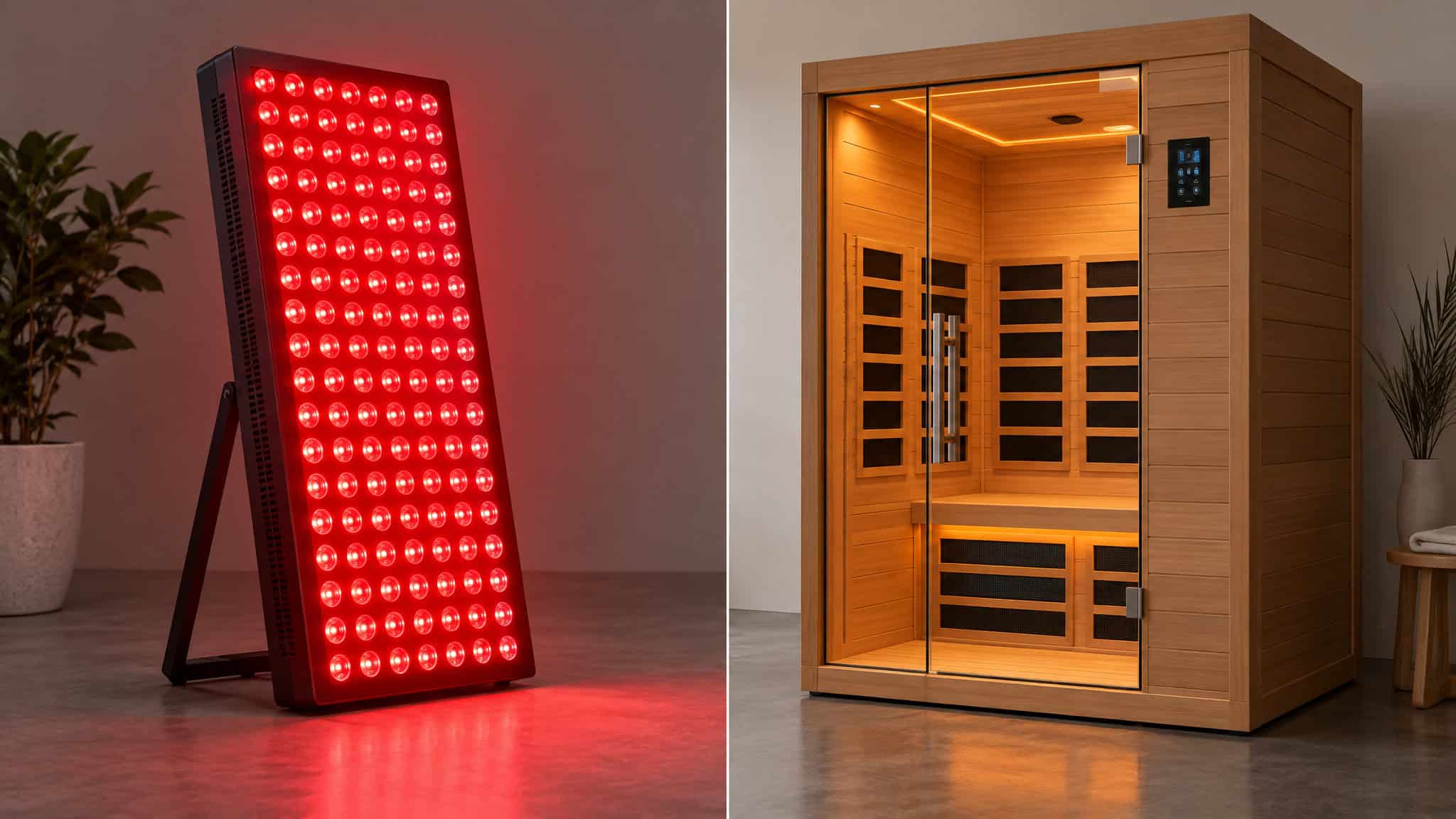
The confusion lives in the overlap zone. Red light sits around 620-700 nm, most therapeutic devices run somewhere in the 600-900 nm range, and near-infrared extends up to about 1,000 nm. Product pages throw around conflicting numbers, so if you’ve been spiraling over spec sheets, that’s why. Saunas use near-infrared too, which is where people start assuming the sauna’s lamps can deliver the same targeted treatment as a panel. They can’t, and the reverse confusion is just as common: applying sauna expectations (long sessions, dehydration worry) to a device that’s meant to run 5-20 minutes as a light signal.
One fear worth killing immediately: this is non-ionizing light with no UV, so it doesn’t carry the DNA-damage mechanism you get from tanning beds. Different animal, wrong worry.
The honest gap: nobody has studied sauna heat, dehydration, or milk supply during lactation directly, so we can’t tell you a sauna is safe or unsafe for nursing. That’s a separate question, and if you’re weighing it, our guide to infrared saunas while breastfeeding covers what’s known.
The LactMed verdict and its one real exception
LactMed’s summary is unusually direct for a government database: laser therapy and phototherapy are considered acceptable during breastfeeding. That’s the finding for nursing parents, full stop, with the usual reminder that even a great database doesn’t know your specific situation the way your own doctor does. It’s a resource, not a replacement for judgment.
The one documented exception has nothing to do with light hitting your skin. If you’re taking an oral psoralen (methoxsalen) as part of psoriasis phototherapy, the advice is to hold off nursing for 24 hours after taking the pill. Read that again: the pill is the problem, not the light. That medication makes your skin temporarily sensitive in a way that matters for breastfeeding, and it’s the only scenario in this entire article where waiting is the actual recommendation. It does not apply to a home red light panel, which involves no pill and no prescription.
Physicians echo that reassurance: Dr. Rodney and Dr. Downing, quoted by The Bump, put it plainly, red light therapy is likely fine while nursing and doesn’t affect breast milk or lactation. (Same doctors will also tell you it won’t meaningfully tighten a postpartum belly, which we’ll get to.)
Sore and cracked nipples: what the trials actually show
Nipple pain is where the evidence is strongest, but here’s the catch that doesn’t fit on a product page: a 2023 review found that a single application did not relieve pain, and every study that worked used repeated sessions, usually 12 of them. The research goes back to Soviet-era lasers in the 1980s and includes brand-new trials published this year.
The old studies came first: Russian and Austrian clinics used CO2 and soft lasers on nursing moms for mastitis and cracked nipples between 1984 and 2000. That’s genuine clinical history, though the studies weren’t well controlled. Then the modern stuff arrived. A randomized trial by Gaitero et al.
(2026) tested real laser against a fake treatment in early-postpartum moms, and the real laser won on pain relief. That matters because randomized, sham-controlled design is the kind of study that actually means something. A 2025 meta-analysis by de Oliveira Alves et al. pooled 7 diode-laser studies and found real pain relief for nipple trauma, which covers the cracks, fissures, abrasions, and erosions that the first weeks of breastfeeding can produce.
The detail almost nobody publishes: a 2024 Egyptian trial by Elseody et al. gave 12 photobiomodulation sessions to moms 1-2 weeks postpartum (the window when everything hurts) and compared it against a multi-oil cream applied after every feed. The laser group had lower pain scores, and their babies showed better weight gain at weeks 2, 3, and 4. Pain down and baby thriving are the two things every nursing mom actually tracks.
So the one-session pitch doesn’t hold up, the trials don’t back it. About 30% of moms in one study felt a tingling sensation in the nipple area afterward, attributed to increased microcirculation, which sounds weird but appears to be harmless.
Quick test: If a product promises pain relief from a single session, it’s contradicted by the trials — every successful protocol used repeated sessions, usually 12.
Milk supply: the prolactin trials and their limits
Promising, but not proven, and the difference matters. Three small trials form the whole case.
In 2017, El Taweel et al. ran 12 laser sessions over 3 weeks in 20 first-time moms who were supplementing with formula during the first month. The treated group had higher prolactin (the milk-making hormone), and their milk was richer, more lactose, protein, and fat, at both 3 weeks and 3 months. Everyone got the same lactation counseling from a blinded certified counselor, so the laser was the difference, not extra attention. In 2020, Maged et al. pitted laser against electroacupuncture for low supply, with all 60 moms (20 per group) also taking domperidone, a supply medication at 10 mg three times daily.
Laser beat the medication alone on prolactin, baby weight, and moms’ own sense of their supply, but electroacupuncture beat laser. And in 2009, Mokmeli et al. studied laser on C-section wounds: 15 minutes a day for 3 straight days, prolactin unchanged, but the incisions seemed to heal better.
The correction that gets lost when these findings get shared around: all of these were 20-mom studies of supplementing or mixed-feeding mothers, not exclusive nursers with normal supply. “Laser increased prolactin and milk production” gets passed around as settled fact, and it’s really a promising low-certainty signal from very small groups.
Consumer sites list a longer menu of possible benefits: better blood flow helping supply, anti-inflammatory effects easing engorgement, possible antibacterial properties for mastitis, serotonin and endorphin boosts. Some of that is plausible, but none of it is proven in humans, so we’ll keep the hedges doing actual work here.
Mastitis, clogged ducts, and C-section healing: helper, not hero
Yes, light helped with mastitis, but always alongside antibiotics and medical care, never instead of them. That condition is the whole story.
The main data comes from a 2016 Chinese study by Miao et al., which used high-intensity red light at 630 nm plus antibiotics. The combination beat antibiotics alone, both for healing mastitis and for keeping it from coming back. The wavelength matters if you’re the type to check device specs against the research, which you should be, at home too. That goes for a guide on how to use a red light mask or for comparing panels.
A 2021 study by Yao et al. used laser as one step in a 5-step treatment for plugged ducts and mastitis, which is exactly the framing that fits: one tool in a toolkit. Anyone who has felt that dreaded lump in the shower knows why this matters; mastitis costs you days flat on the couch and sometimes missed work.
The hard rule: in every study, light was tested on top of real treatment. Mastitis needs a provider, and ideally an IBCLC (an International Board Certified Lactation Consultant) in your corner. Light therapy works alongside that care, not in place of it.
Red flag: Mastitis is one of the situations when new moms should skip the sauna and call a provider instead — light therapy was only ever studied on top of antibiotics and medical care, never as a replacement.
And while we’re setting expectations honestly: no, red light therapy will not meaningfully tighten a postpartum belly. The legitimate version of the postpartum-recovery claim is C-section wound healing, where the 2009 study found healing seemed to improve while prolactin stayed exactly the same. Interesting, but small and poorly controlled, so hold it loosely.
What about the baby, and why pregnancy advice is the opposite
Red light therapy is considered acceptable while nursing, but what about the related trend of contrast therapy can you combine sauna and cold plunge while breastfeeding? When you ask what any of these exposures do to the actual baby, the honest answer is that nobody knows in detail. LactMed found no relevant published data on effects in breastfed infants as of its last revision. No reported adverse events, but also no dedicated baby studies.
The reason most people land on “low risk” is the mechanism: the light is local and non-ionizing, nothing gets ingested, nothing systemic reaches your milk, and it doesn’t penetrate deep or damage DNA. Absence of data isn’t proof of safety, and low-risk-by-mechanism is as far as the honest position goes. We’re not going to pretend that’s more certain than it is.
Pregnancy flips the script. The same device that’s “likely fine” while nursing gets a “wait” from four physicians. Christine Greves, MD, FACOG, Jennifer Wider, MD, Ife J. Rodney, MD, FAAD, and David Downing, MD, via The Bump, not because harm has been documented but because pregnancy studies are nearly nonexistent. Their concerns include melasma getting worse (that hormonal skin pigmentation pregnancy loves to hand out), inflammatory skin reactions on already-stressed skin, high-intensity beams on the abdomen, plus the ordinary burn and eye risks. A 2022 Journal of Pregnancy study suggested red light might support placental function in a specific preeclampsia context, but it’s preliminary and narrow, not a green light.
This applies to face masks too. The Bump’s editor, Natalie Gontcharova, used a red light panel while breastfeeding but stored her mask away during her fourth pregnancy to play it safe, which is about as tidy a real-person illustration of the split as you’ll find. Nursing is the different story; pregnancy is the one to wait out.
Where red light therapy sits among lactation-safe treatments
If you’re wondering whether light-based treatments rank among the safer options while nursing, the answer is yes, and there’s actual peer-reviewed tiering to back that up. A 2025 dermatology review by Carli D. Needle et al. in the International Journal of Dermatology (the literature search ran in November and December 2024) ranked hair-loss treatments by lactation safety, and low-level laser therapy made the safe list, alongside options like PRP, minoxidil, spironolactone, and ketoconazole 2% shampoo. The same review found excimer laser and NB-UVB generally safe in lactation too, with folate supplementation a consideration, and oral vitamin D safe up to 10,000 IU daily. At the other end of the spectrum, JAK inhibitors mean pausing breastfeeding, methotrexate and oral retinoids are out entirely, and mycophenolate mofetil and pioglitazone should be avoided.
The reason light sits so high on that list is simple: it’s non-systemic. Nothing gets ingested and transferred to milk, unlike the drugs lower on the list. That same logic answers the cosmetic-laser question: face and skin laser treatments, including things like laser hair removal discussions you’ve been putting off, fall under LactMed’s acceptable verdict, with the oral psoralen exception the one thing to flag to your provider.
One scope caveat so this doesn’t imply more than it says: that review covers hair loss, not milk supply or mastitis. It tells you where light ranks in a clinician’s safety hierarchy, not that it treats everything.
How to use it safely: a protocol that fits into a nap window
The workable version is simple: a device in the 600-900 nm range, used in short sessions a few times a week, at a sensible distance, with your eyes protected. Here’s the whole thing:
- Pick a device emitting 600-900 nm, the practical range for getting penetration into deeper tissue.
- Keep it a few inches from the breast rather than pressing it against skin.
- Run 5-20 minute sessions, 3-4 times a week, which fits inside a single nap window if you’re realistic about it.
- Wear the protective eyewear. The real medical risk is your eyes, especially from invisible infrared you can’t see coming. You get one set; don’t stare into the light.
- Read the manual, with one honest asterisk: most manufacturers offer zero breastfeeding-specific guidance, so postpartum buyers are improvising distance and duration on their own.
- Run it by your provider or an IBCLC before starting, especially for breast-area use. It’s a two-minute conversation, and worth knowing some providers aren’t caught up on light therapy yet, so bring the specifics.
Two expectation-setting notes. Effects take weeks to months of consistency, and there’s a dosing sweet spot where more isn’t better, so there’s no hack for this, just showing up. And before you spend money on light for nipple pain, know that nipple pain often comes from latch, infection, or engorgement, and light won’t fix a bad latch. Laid-back positions can help with that part. The biggest practical downside of the device itself is probably your wallet, which is worth knowing before you’re out a few hundred dollars.
How strong is the evidence, really?
Two things are true at once, and it’s worth holding them together. The nipple-pain literature is genuinely positive, with the 2025 meta-analysis and the 2026 randomized trial as its backbone. And it carries low-to-moderate certainty, with a placebo effect running around 30%, device-company funding behind some dermatology studies (in buyer terms: the people selling the panels sometimes paid for the studies), and no standardized protocols yet. The science is still getting its act together.
Where the evidence actually lives, quickly: strongest for skin, like wrinkles and some acne. Some support for knee arthritis, workout recovery, chronic wounds, and hair loss when used alongside minoxidil. Basically nothing for fibromyalgia. Throughout all of it, red light therapy is a sidekick to real treatment, not the hero, and direct studies in nursing moms remain limited. Multiple systematic reviews point the same general direction, but nobody’s claiming the science is finished.
One more grounding note since enthusiasm tends to run hot online: red light therapy doesn’t change breast size or deliver a breast lift, and there’s no “before and after” breast transformation in this literature. What it has shown is pain relief and healing support, which is a more modest and more honest promise.
The bottom line
Red light therapy is considered acceptable while breastfeeding, per the NIH’s own lactation database. The trials behind that verdict are real but small, the nipple-pain evidence is the strongest of the bunch, milk-supply findings are promising but small, and nobody has published data on the baby side, though the mechanism gives good reason for calm. Pregnancy is the one clear wait, and that’s about missing data, not known harm. One caveat on the threads you’ll find online: forum anecdotes about supply changes can’t be verified, so treat the actual trial record, like the Gaitero randomized trial on nipple pain, as your evidence base, not someone’s postpartum comment section. If you’re planning to use it on your breasts or anywhere near them, bring the question to your provider or an IBCLC first. Two minutes of conversation beats an hour of 3 a.m. googling, every time.
Frequently Asked Questions
Does red light help with clogged milk ducts?
Yes, but as a helper, not a hero. A 2021 study used laser as one step in a 5-step treatment for plugged ducts and mastitis, and a 2016 Chinese study combined high-intensity 630 nm red light with antibiotics — the combination beat antibiotics alone. In every study, light was tested on top of real medical care, never instead of it.
Is red light therapy safe and effective for the postpartum belly?
Safe while nursing, but don’t expect a belly transformation. Physicians quoted by The Bump say it won’t meaningfully tighten a postpartum belly, and there’s no ‘before and after’ body-change evidence. The legitimate postpartum-recovery claim is C-section wound healing, where a small 2009 study found healing seemed to improve — interesting, but small and poorly controlled.
Is red light therapy safe to use while breastfeeding?
Yes, per LactMed, the NIH’s Drugs and Lactation Database, which considers laser therapy and phototherapy acceptable during breastfeeding. The light is local and non-ionizing — nothing gets ingested or reaches your milk systemically. The only documented exception involves an oral psoralen pill, not a home panel.
Can red light therapy increase milk supply or affect prolactin levels?
Promising but not proven. Three small trials — including a 2017 study where treated moms had higher prolactin and richer milk — suggest a benefit, but all were 20-mom studies of supplementing or mixed-feeding mothers, not exclusive nursers with normal supply. ‘Laser increases prolactin’ gets passed around as settled fact, but it’s really a low-certainty signal.
Does red light therapy help with clogged milk ducts or mastitis?
It helped in studies, but always alongside antibiotics and medical care. The main data comes from a 2016 study using 630 nm red light plus antibiotics, which beat antibiotics alone for healing mastitis and preventing recurrence. Mastitis needs a provider, and ideally an IBCLC — light works alongside that care, not in place of it.
How is red light therapy different from an infrared sauna, and are both safe for nursing moms?
Red light therapy is low-power light signaling — red wavelengths around 620-700 nm activate cytochrome c oxidase to bump up cellular energy — while an infrared sauna is far-infrared thermal heat that makes you sweat. They share nothing but the word ‘infrared.’ Red light is considered acceptable while nursing; nobody has studied sauna heat, dehydration, or milk supply during lactation directly, so that’s an open question.