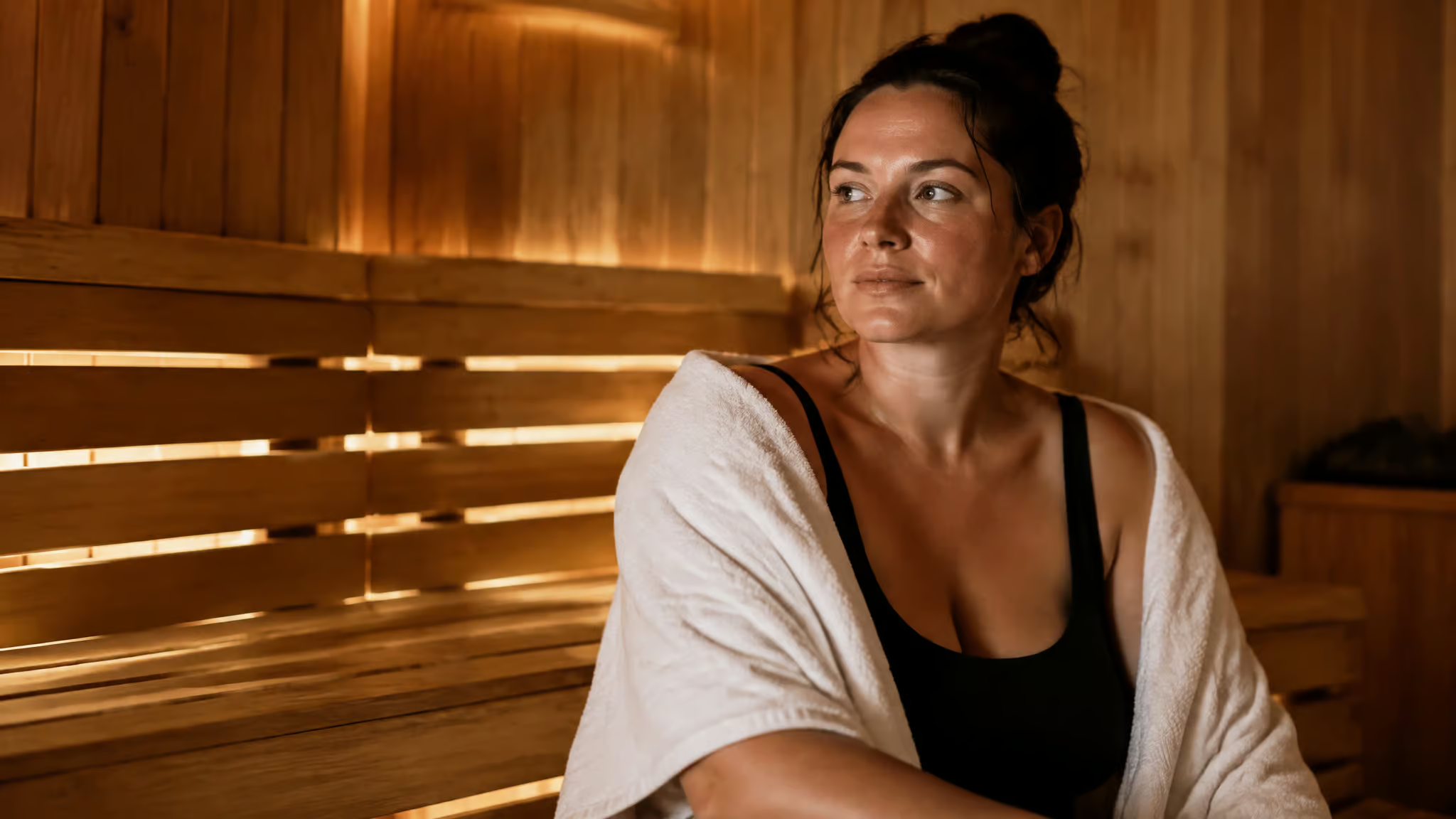
If you’re breastfeeding and wondering whether you can keep up the sauna-and-cold-plunge routine you keep seeing all over your feed, here’s the honest answer we keep coming back to: it’s commonly practiced, there’s no documented evidence of harm while nursing, and there’s also no proven evidence of safety. Nobody has ever run a clinical trial on cold exposure and lactation. Not one. So everything online right now, including this article, is extrapolation from physiology and tradition and anecdotes, with provider clearance after full postpartum healing as the real gate.
Marketing has sprinted way ahead of the data here: there’s a video on the Plunge channel titled “How Contrast Therapy Helps With Postpartum Recovery,” which sounds authoritative until you realize it’s a wellness brand talking about a body the research world has barely studied. Two things will organize everything below: the answer actually changes depending on your postpartum phase, and the milk supply reports split roughly 50/50. Which means the group chat is genuinely divided, and you deserve to know why.
Key Takeaways
No clinical trials have examined cold exposure in lactating women, so any advice you find (including this) is built from physiology, midwife tradition, and anecdote, with the anecdotes on milk supply splitting roughly 50/50.
Tradition and physiology favor heat while nursing: midwife traditions in Thailand and Cambodia recommend heat during breastfeeding, and warmth supports the vasodilation behind letdown, while cold is vasoconstrictive.
If your provider clears you, the general template is 15-20 minutes of sauna, then 2-3 minutes of cold plunge, 2-3 rounds, under 20 minutes total, scaled down for a nursing body and always after feeding or pumping.
Table of Contents
What heat does to a lactating body
If you’re going to lean one direction while nursing, tradition leans heat. That’s not a modern wellness take; it goes back generations. Midwives in Thailand and Cambodia have long recommended heat during breastfeeding as part of postpartum care, and the physiology behind it tracks: warmth promotes vasodilation, meaning your blood vessels open up, and letdown is a vasodilation-driven event. Warm blood flow to the chest is the mechanical story behind supply support, which is why heat therapy is the standard recommendation when nursing moms want to boost supply.
Here’s a small story that sums up the whole thing. A woman who had cold-plunged through her entire pregnancy, with her doctor’s okay, called to ask whether the rules changed now that she was nursing. The advice came back: switch to heat. She tried the sauna and said it was working well for her.
That’s it. That’s the whole data set on this question in miniature, and it’s honestly more than most people get.
The gentler way in
If a hot Finnish-style sauna sounds like a lot right now, an infrared sauna is a gentler entry point. It runs at lower intensity, and the same hydration rules still apply. We can’t resist this detail: one host on the podcasts we dug through received an infrared sauna as a push present from her husband, and he uses it too, so it’s apparently the rare push gift that doesn’t gather dust. That’s a sweet story, not a product endorsement.
The part that actually wrecks supply: dehydration
Here’s the real risk with heat while nursing, and it’s not some exotic hormone cascade. Sauna sweating plus breastfeeding’s fluid demands can tank your supply fast. Milk is made from fluid, and the sweating plus the nursing are draining the same tank. Fluids and electrolytes before and after any heat session are the actual gate here, not a footnote. This matters more than the sauna-versus-plunge debate, frankly.
Field note: Sweat plus milk production pull from the same fluid tank, so electrolytes before and after any heat session are the gate that protects supply.
What cold does to a lactating body
Cold does something genuinely interesting, and it’s worth understanding before you decide anything. Within seconds of intense cold, your body releases norepinephrine, which is the chemical signal telling the mitochondria in your brown fat cells and muscles to start breaking down sugars and lipids. Mitochondria are your cells’ little furnaces, and brown fat (brown adipose tissue, if you want the technical term) is the fat that actually burns energy, as opposed to white fat, the storage kind that’s linked to obesity and chronic conditions. Here’s the neat part: cold exposure can convert white fat into brown fat. And a recent study found that people with brown fat around the neck and clavicle carried a lower risk of diabetes and cardiovascular disease than people without it.
One human study found the body’s sugar-breakdown ability doubled over a four-week period in which participants spent two hours each day exposed to cold. Before you get excited, read those conditions again: two hours, daily, in cold suits, in a lab. That is not what happens in a two-minute home plunge, and the conditions are the whole story.
Where the theory and the anecdotes stop agreeing
Now the tension. Cold is vasoconstrictive, meaning it tightens blood vessels. That theoretically works against the vasodilation-driven letdown that heat supports. On paper, cold should be the enemy of supply.
And yet the anecdotes refuse to confirm the theory, which is exactly what the next section is about. Hold that weirdness with us for a minute.
Does cold plunging dry up or boost milk supply?
Straight answer: nobody has verified either direction. The reported outcomes split roughly 50/50.
Okay, so weird thing happened. A creator on the Where Is Briggs channel was 7 months postpartum and breastfeeding, and she spent her first week of cold plunging on holiday at her family’s house. She started leaking the way she had in the newborn days. Every breastfeeding parent knows exactly what that means.
She believes her supply went up. And here’s what makes her story worth telling instead of an embarrassment to it: her own reasoning said cold should do the opposite, because heat therapy is the standard supply recommendation. She also offered the confounder herself, which is the mark of an honest storyteller: maybe a week off work just lowered her stress, and stress relief is a known supply factor. She couldn’t find research or anyone seriously discussing this. She asked other nursing moms to share their experiences, and the answers that came back were all over the map.
That all-over-the-map part has a second witness. Candice Horbacz noticed that viewer comments on breastfeeding and cold exposure split roughly 50/50 on whether supply dried up. Not a statistic. Just a real pattern of real women reporting opposite outcomes, which suggests something simpler and more honest than any protocol: bodies just vary. Your body might just be your body on this one.
The skill worth taking from all this: when a viral supply story crosses your feed, check for confounders before filing it as a rule. Did her stress change, did her routine change, or is this just normal lactation fluctuation? A single account of supply going up or down tells you about one woman’s week, not about lactation.
The contrast-therapy trend: what rapid temperature swings claim to do
Contrast therapy just means hot, then cold, repeated. It’s all over your feed right now, from brand channels like Plunge to accounts like @slaterandstacie (Slater & Stacie). The enthusiast case comes from fitness channels like Live Lean TV, and the claims go like this: sauna, according to these channels, raises blood flow, growth hormone, and heat shock proteins, the latter being proteins that help repair cells under stress. Cold reduces inflammation, speeds recovery, and is claimed to raise dopamine, the mood and reward chemical, by up to 250%.
That last number is a claim, not settled fact, and you’re allowed to raise an eyebrow at it. The pitch also says contrast therapy trains your blood vessels, like a workout for your circulation.
Now the evidence quality, with the species labels out loud, because they matter:
- Rats kept at 39°F for a week showed lower levels of inflammation-related molecules. Rats, not people.
- Mice exposed to cold ate more, so their weight stayed flat despite burning more calories. Your body will negotiate. This is not a weight-loss hack.
- One small study of cold water swimmers saw some mood improvements, with the placebo effect noted as a possible explanation. Honestly, even if it’s placebo, feeling better is feeling better.
And the swing risk, which matters more for you than for the average gym bro: rapid hot-to-cold cycling stresses the cardiovascular system and can cause dizziness or fainting. In a postpartum, probably sleep-deprived body, that’s not a theoretical concern. As for that Plunge postpartum video, we know the title. We can’t verify anything beyond it, and the gap between a snappy title and any evidence for nursing moms is kind of the point of this whole article.
The phase switch: cold for pregnancy, heat for lactation
If the online advice feels contradictory, it’s usually because two people are talking about different phases. Thomas Seager gives phase-specific guidance, and he says outright that he’s not a medical doctor, so take it for what it is. His take: cold is terrific for pregnancy because it maintains insulin sensitivity, citing epidemiological data. Then after birth, go back to heat. Heat is avoided during pregnancy partly because it can be dangerous there, but it’s recommended while breastfeeding, a lean that traces back to midwife traditions in Thailand and Cambodia.
That midwife wisdom deserves respect rather than an eye-roll. It’s accumulated practical knowledge, and folk practices often get vindicated by science later; tradition generates the hypotheses that science eventually tests. It’s a hypothesis generator, not settled proof, and nobody’s done the study on heat while breastfeeding yet.
That phone call from earlier is the phase switch in real life: a woman who plunged through pregnancy with her doctor’s okay called asking about nursing, got told to switch to heat based on his reading plus folk wisdom, and the sauna worked well for her, though heat from a sauna isn’t the same as red light therapy for breastfeeding, which overlaps with infrared warmth but works differently and carries its own safety considerations for nursing moms. As for his pregnancy-side claims, like swollen ankles suggesting cold might help, high last-trimester protein needs being linked to preeclampsia, and cold possibly reducing gestational diabetes risk, those are his interpretations of the data, translated for you, hedged hard. They’re a perspective worth hearing, not a prenatal checklist.
Sequencing: cold plunge before or after sauna when nursing?
The standard order is sauna first, then plunge. Here’s the general template from Live Lean TV, written as the fitness version, not the nursing version:
- 15-20 minutes in the sauna.
- 2-3 minutes in the cold plunge.
- Repeat for 2-3 rounds total.
- Keep the whole thing under 20 minutes.
- Start slow and build tolerance. Don’t go full Viking on day one.
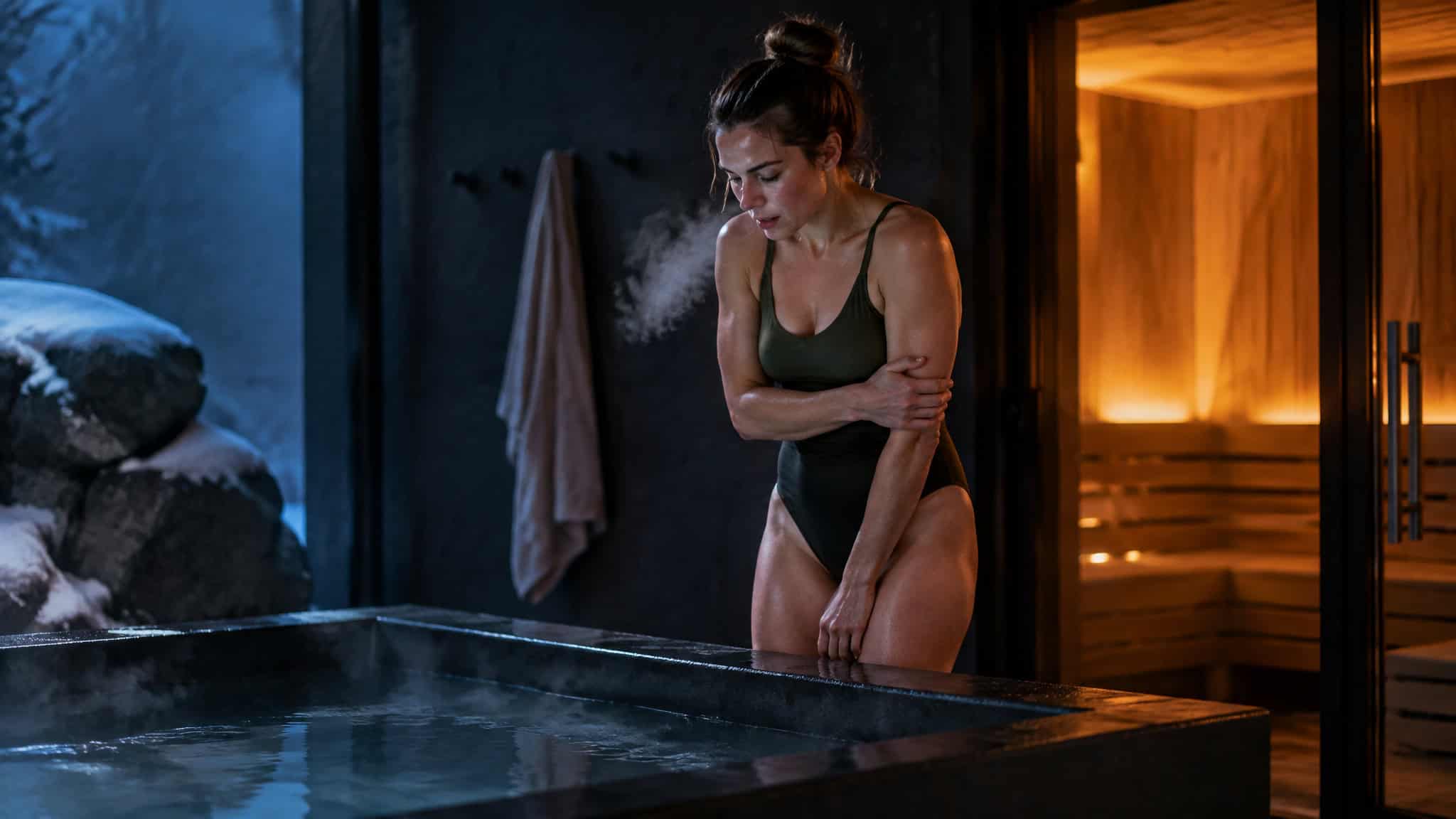
For comparison, here’s the influencer dose being copied. A creator on the Plunge channel, about 5 months postpartum, does 2-3 rounds daily, roughly 2 minutes each in about 45°F water, which is genuinely frigid, followed by a hot sauna and a workout. She calls it her daily routine and says it makes a huge difference, and it’s what works for her. Two minutes in 45°F water sounds short until you’re in it, and it’s a far cry from the ice-bath ordeal people imagine. But her rhythm is her rhythm, not a target, and it definitely fits her life in a way that it may not fit yours, especially with a baby attached to a schedule only a baby understands.
A conservative nursing adaptation
This is a conservative adaptation of a general fitness protocol, not a validated or provider-endorsed one, and it all waits on your provider’s approval:
- Feed or pump first, so you’re starting a session empty and comfortable.
- Shorten the heat exposure rather than extending it.
- If supply is your priority, consider ending on heat, so your last exposure is the vasodilating one.
- Scale down from the template, never up from nothing. The template is an upper bound.
The common failure mode is easy to picture: someone copies the influencer’s full routine before rebuilding any postpartum tolerance, feels drained or anxious about supply, and then cuts back anyway. You can skip that step.
One more sequencing note, because rapid swings matter more in a sleep-deprived body: the dizziness risk from hot-to-cold transitions is real, and standing up out of a cold plunge while running on four hours of sleep is not the moment to test your balance. Have a wall nearby. That’s the whole tip.
Why there is no definitive answer: the research gap
The vagueness isn’t laziness; it’s structural. Per a Wall Street Journal explainer, most human cold-exposure studies were done only in men. Women have more brown fat stores and their fat seems more active, so the benefits of cold may differ by gender, which means even the best available data doesn’t necessarily describe your body. On top of that, studies use wildly different protocols, so the needed dose of cold is unknown.
That’s why every headline contradicts the last one: different studies, different protocols, no shared baseline. And lactating women are a step further removed from the data entirely. There are no trials on cold exposure and lactation.
The common interpretation error is reading one anecdote of increased supply, or one dire warning, as a rule. The outcomes split roughly evenly, nobody has trial data, and the correct reading of any single story is: interesting, possibly confounded, not a law of nature.
Safety boundaries and who should wait
Quick real-talk before you try anything, friend to friend:
- Hypothermia is the real concern, and everyone’s threshold differs based on cold experience. Know your own limit, not a video’s.
- Unprotected hands and feet can develop non-freezing cold injuries that leave you hypersensitive to cold long-term. Cover your extremities. Sounds basic; it matters.
- Smaller people lose heat faster, pure surface-area-to-volume physics, no commentary attached.
- Cold can stress the heart, so if you have a heart condition, this is a check-with-your-doctor-first situation, not a maybe.
If you want to know how personal the limits are, a Wall Street Journal presenter did 3 minutes in near-freezing water and was visibly shivering by the end. This is hard for everyone. Your mileage will vary, and that’s fine.
Here’s the frustrating part: there’s no established evidence on when after birth it’s safe to start. We’re not going to invent a timeline, because nobody has one. And the doctor conversation is worth raising briefly at your next appointment, not because you’re fragile, but because postpartum bodies vary and your provider has actually seen yours.
Waiting until you finish breastfeeding before resuming cold plunging is a reasonable choice if your milk supply matters to you, not a failure of nerve. Candice Horbacz’s podcast host made exactly that call: she decided not to risk her supply, is waiting until she’s done breastfeeding to get back in the cold plunge, and plans to get hormone testing before and after so she has real data. Measure it instead of guessing is a genuinely good instinct, and skipping the question entirely is a legitimate call too.
Infrared sauna, steam room, cryotherapy: the same frame, fewer answers
Yes, an infrared sauna is the gentler heat option while breastfeeding. Heat is the traditionally recommended exposure while nursing, and infrared’s lower intensity makes it the easier entry point; hydration demands still fully apply. There’s more on the whole topic in our guide to using infrared saunas while breastfeeding.
One thing you should know before searching further: we found no medical-body guidance, NHS or equivalent, on sauna use while breastfeeding anywhere in the evidence we reviewed. That’s not a scandal, it’s just a vacuum. When you search this and find nothing official, it’s because there’s nothing there yet, not because the answer is being hidden from you. The upside-and-limits picture for new moms gets its own honest look in our piece on infrared sauna benefits postpartum.
Steam room: same heat logic, but humid, and the same hydration demands apply, maybe more than you’d expect because humid heat sneaks up on you. If you’re weighing steam room against sauna against cold for supply, the tradition-backed answer is heat of any kind over cold, since warmth is what supports letdown.
Cryotherapy: that’s extreme cold, and it carries exactly the same untested-in-lactation caveat as plunging. No trials, same vacuum, same unknowns.
If you only keep one question from this whole article, keep this one: is it heat or cold, and what phase am I in?
The honest ending
So here’s where we land: no lactation trials exist, and the anecdotes split roughly 50/50. Tradition and physiology favor heat while nursing, and cold is unverified in either direction, with real stories of supply up and supply dried up on both sides. Your actual decision framework: provider clearance once you’ve healed, your phase, hydration, sequencing, and a clear-eyed sense of which evidence is which. Physiology and tradition sit on one tier, anecdotes on another, and none of it is trial data.
Which means you can walk into your next appointment and have a real conversation. You can tell your provider exactly what’s known and what isn’t: that heat is the tradition-backed option, that cold has zero lactation research, that reported outcomes split down the middle. Instead of asking an unanswerable question, you’ll be asking a specific one. That’s a better appointment for both of you.
Frequently Asked Questions
Is it safe to use a sauna and cold plunge while breastfeeding?
It’s commonly practiced, and there’s no documented evidence of harm while nursing — but there’s also no proven evidence of safety, because no clinical trial has ever examined cold exposure in lactating women. Everything you’ll read, including physiology-based advice, is extrapolation. The real gate is provider clearance after full postpartum healing.
Does sauna dry up breast milk?
Heat itself is actually the traditionally recommended exposure while nursing — midwife traditions in Thailand and Cambodia favor it, and warmth supports the vasodilation behind letdown. The real supply risk with sauna is dehydration: sweat and milk production pull from the same fluid tank, so fluids and electrolytes before and after any heat session are what protect your supply.
Do you do a cold plunge before or after a sauna?
The standard order is sauna first, then plunge. A common template is 15–20 minutes in the sauna, 2–3 minutes in the cold plunge, repeated 2–3 rounds, kept under 20 minutes total. If milk supply is your priority, some suggest ending on heat so your last exposure is the vasodilating one — and always feed or pump first.
Does sauna or cold plunge use dry up breast milk supply?
Nobody has verified either direction — reported outcomes split roughly 50/50. On paper, cold should work against supply because it’s vasoconstrictive while letdown is vasodilation-driven, yet some nursing moms report increased supply after plunging and others report it drying up. The honest reading is that bodies just vary, and single anecdotes are often confounded by things like stress changes or normal lactation fluctuation.
Can you go in an infrared sauna while breastfeeding?
Yes, and it’s the gentler entry point. Heat is the traditionally recommended exposure while nursing, and infrared runs at lower intensity than a hot Finnish-style sauna, making it easier on a postpartum body. The hydration rules still fully apply — humid or dry, heat plus breastfeeding drains the same fluid tank.
What are the risks of cold plunging too soon after giving birth postpartum?
There’s no established evidence on when after birth it’s safe to start, so nobody can give you a validated timeline. Known risks include dizziness or fainting from rapid hot-to-cold swings — especially real in a sleep-deprived postpartum body — plus hypothermia, and cold stress on the heart if you have a cardiac condition. Provider clearance after full healing is the gate.
How long and how cold should a postpartum cold plunge be for beginners?
Scale down from the general template, never up from nothing — the template is an upper bound, not a starting point. For reference, one influencer about 5 months postpartum does 2–3 rounds of roughly 2 minutes in about 45°F water, but that’s her rhythm, not a target. Start slow, rebuild postpartum tolerance first, and keep a wall nearby for the dizziness risk.
Is a steam room or sauna better for milk supply compared to cold plunging?
The tradition-backed answer is heat of any kind over cold, since warmth supports the vasodilation behind letdown. A steam room follows the same heat logic as a sauna but is humid, and its hydration demands may sneak up on you even more. Cold plunging is unverified for supply in either direction, with no lactation trials behind it.
What are the proven benefits of contrast therapy for postpartum recovery?
Honestly, none are proven for postpartum or nursing bodies — no clinical trials exist on cold exposure and lactation. The enthusiast claims (raised blood flow, growth hormone, heat shock proteins, dopamine boosts up to 250%) come from fitness channels, and the supporting studies are in rats, mice, or small groups of cold-water swimmers, with placebo noted as a possible explanation. Marketing has sprinted well ahead of the data here.