There’s a moment that seems made for solitaire: the nap that actually held, the bedtime that went relatively smoothly, the quiet pocket of twenty minutes that suddenly exists when it wasn’t supposed to. And there’s always that little flicker of guilt right before I start dealing. I should be doing something productive with this surprise block of time. Shouldn’t I?
This guilt isn’t new. More than a century ago, a Victorian writer who went by Captain Crawley dismissed solo card games as “childish and simple,” something a person did when they’d given up on being useful. That judgment has hung over the game ever since. But people kept playing anyway.
Millions of us still open PlaySolitaire, or sit down with a deck, sometimes feeling like we’re hiding it. So what’s actually happening when we play? After spending some time digging into the game’s history and how it works, I’ve decided solitaire isn’t the quiet compulsion we feel guilty about. It’s the quiet thing we’ve been getting right.
Key Takeaways
The original name for solitaire was “patience,” and it’s a fair description: the game is literally about sitting still and waiting for the right move.
Solitaire is a real game, not a puzzle, because no two deals are the same; it gives you genuine choices, and its hardest moments demand judgment and resilience in a way that feels like a light brain workout.
The genre is far bigger than Klondike: the first recorded patience game was played by two people, and it’s a companion to a family of games where you can race the people next to you.
Table of Contents
What We Call It: Patience vs. Solitaire
The first thing to clear up is that solitaire has two names, and the difference tells you a lot about what you actually displayed here.
“Patience” is the original and it’s the umbrella term for the card game. It is a card game where you arrange the cards into a systematic order, such as matching columns, pairing, or stacking in suit. The word isn’t just a label; it describes what the game demands of you. You shuffle, you sort, you wait for the right moment to move. The name itself is the first clue that you’re not just passing time.
Then there’s solitaire. Technically, solitaire is any game one person can play alone. That includes cards, but it also covers the wooden peg game with the cross-shaped board that was a staple of coffee tables in the last century, some dominoes games, even that tiny puzzle. In Europe, solitaire often defaults to that board game, while in North America we almost always mean cards.
Since 1990 or so, somewhere in the middle, “solitaire” has come to mean one single game: Klondike, the one that ships on every computer with the Windows desk. It’s a marketing accident that made a whole genre go by the name of its single broad cousin, and if you’re looking to play solitaire online for free, that’s the version you’ll most likely encounter.
The Basic Goal: Order from Chaos
What are you actually trying to do? Simple macros: arrange the cards in a systematic order. With a shuffled, often messy deck of cards, you are trying to make sense out of chaos.
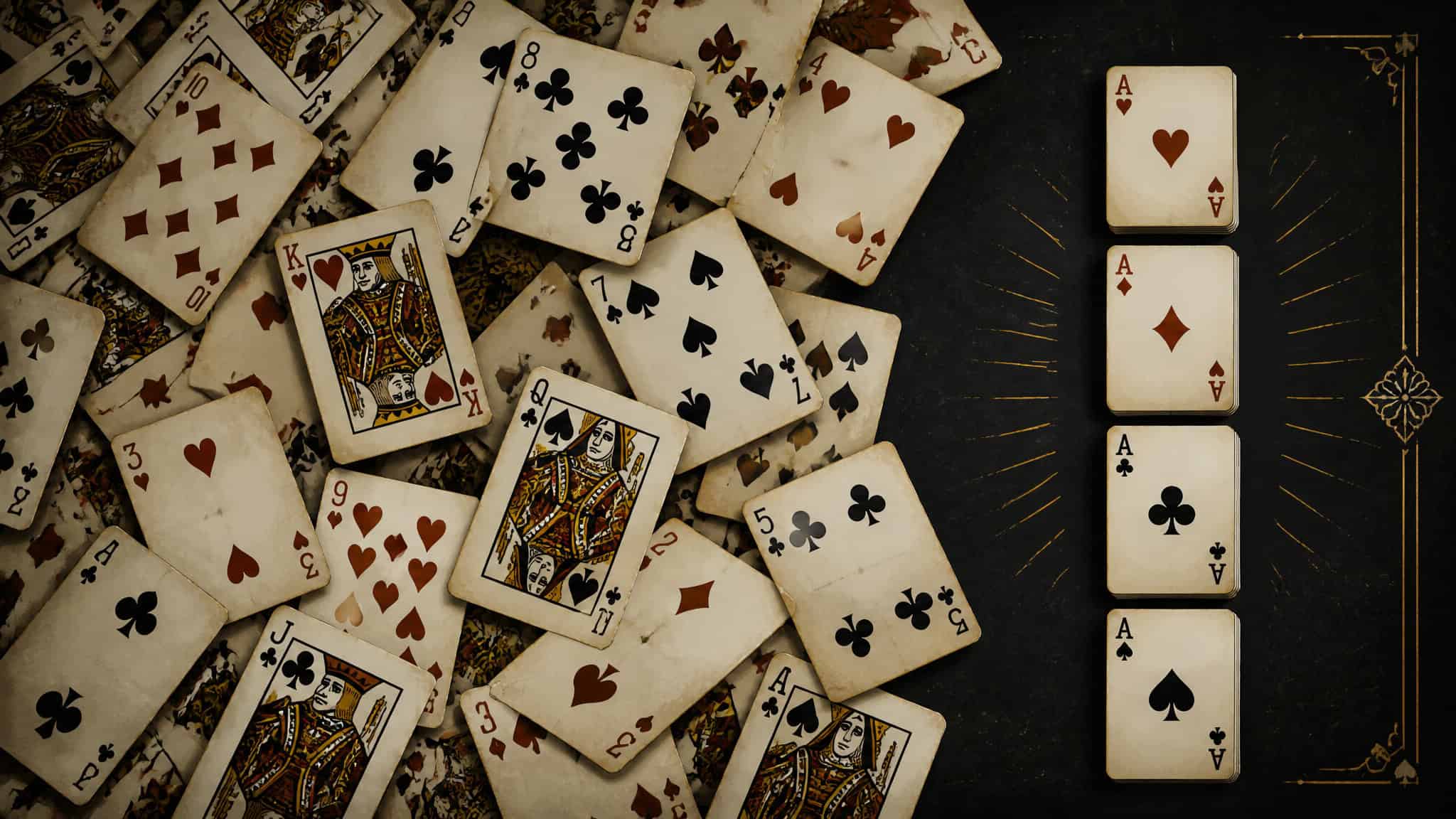
Most games follow a similar pattern. You’re dealt into a layout on the table, and you move cards around so that the kings, queens, knaves, and numbers land in the right order on the “foundation” piles in the center. Usually, you’re building aces up to kings. The first card that starts a sequence is the foundation or base card, and the whole game flows from there.
Some games have you pair cards together; others play with there; others discard cards whose values add up to something, like thirteen. But it all leads to a moment when the whole pack is out of the layout and into the foundations. That’s when you win.
Here’s the thing I didn’t understand for a long time. Most of those earlier games are hard. They are supposed to be difficult. You’ll lose often and sometimes you’ll lose when you’re one card, one move, one king away from a finished game. That drop, that frustration, isn’t a design bug.
It’s the entire premise, these were games that were seen as an exercise in patience because you have to try all over again, keep seeing the shuffled pack, keep finding your mistakes play and adjusting. You almost never truly finish, and that’s the point of it.
A Brief History: From Fortune-Telling to Windows
The story of solitaire starts in the late 1700s, likely in Germany or Scandinavia, long before any computer screen existed.
The Germanic Origin
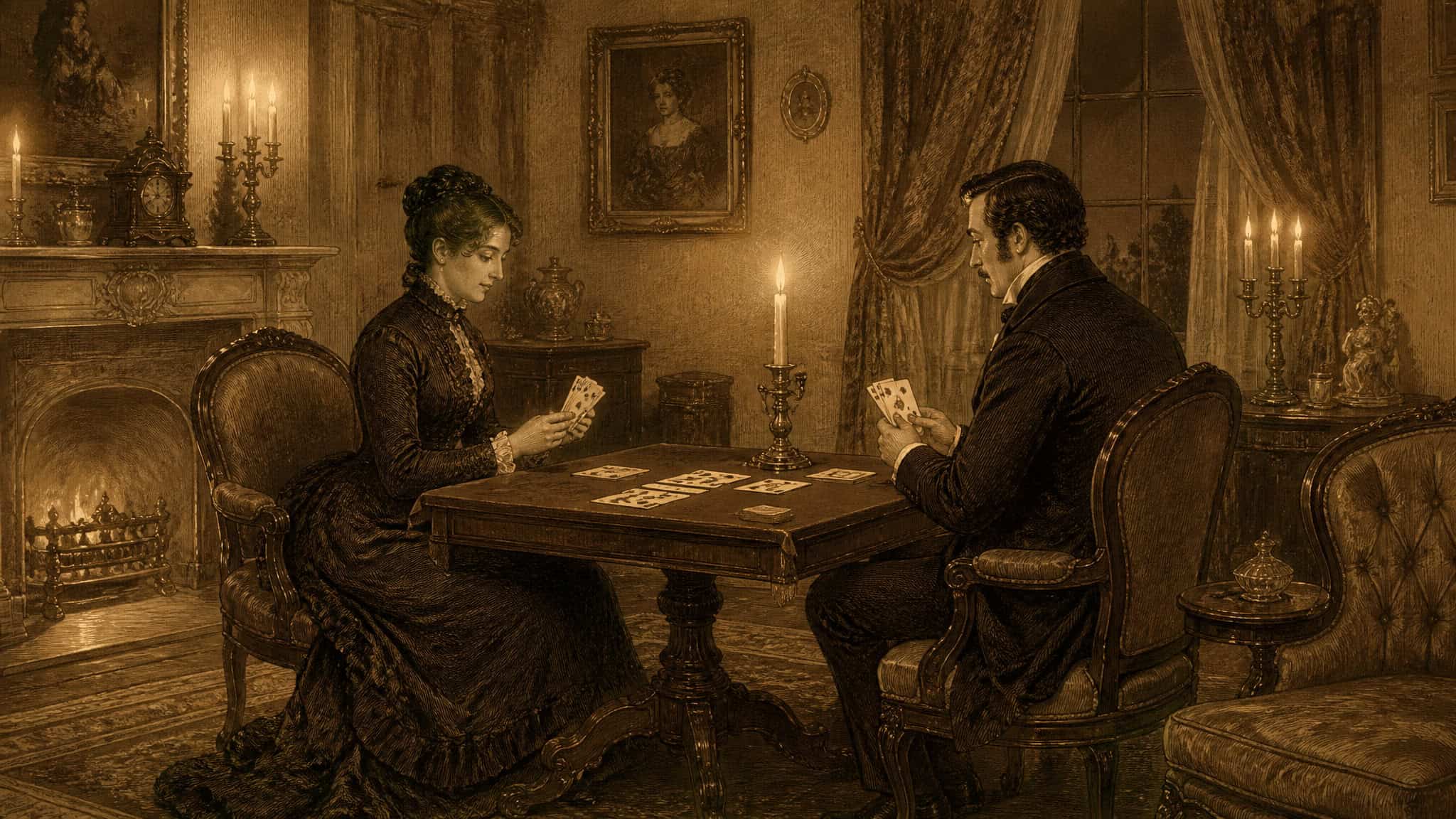
The earliest record we have of a patience game comes from a 1783 German anthology, and scientists suspect the game originated either there or in the Scandinavian countries. Before that, it doesn’t show up in any of the big collections. The 1783 book describes a game played between two players, a detail that will become interesting, and that is about the closest thing we get to a national story. From Germany, the game spread; it became very popular in France at the start of the 1800s, then landed in Britain and America in the second half of the century. The aristocratic drawing room and the career starter liked it for the same reason that person later loved it: it’s a small challenge you can play by yourself, at your own pace.
The Fortune-Telling Connection
There’s a spin the history takes that I wasn’t expecting. The game first appears in the literature very soon after card readers developed “cartomancy” layouts around (medium), and that’s a hard thing to call coincidence. In Danish and Norwegian, the game is called ./our, a word that echoes “cabala” and the mystical; the French name for some games is réussite, which directly means “success.” A lot of evidence points to the patience game as a way of laying cards out to explore what happens, loosely related to the fortune-telling part.
A few cultural corners retained a hint of it, with the Irish cozy name: fortune telling staying in a couple of different cultures. I love this kind of accidental meaning embedded in names.
The Victorian Book Boom
The era of the written collection narrows the main mark. For English speakers, Lady Adelaide Cadogan published kadoganIllustrated Games of Patience around 1870, and gets the credit for the first English-language collection. She actually was preceded by a book titled Patience written under the pen name “Perseverance,” actually William Henry Cremer, printed in London in 1860. That book has been lost, so you can’t go and look at it.
On the American side, Ednah Cheney wrote The First American Treatise to have published in 1869, before Cadogan. Then the floodgates opened: Dick’s Games of Patience, and a great stream of others. The most prolific of the authors was Mary Whitmore Jones, who documented up to 250 different games across her 1890s and turn-of-the-century later in her books. That’s the key moral: even though the cassette came with one variant, the genre has a hundred of thousands of faces.
One important myth to dispose of: Napoleon did not play a lot of solitaire. It’s a fun story as comfortable turn of the corner, but it comes out of an error.
Is It a Game or a Puzzle?
I used to wonder if solitaire was technically a puzzle, not a game. It has no opponent, no one going to defeat you. But David Parlett (who has written a number of famous books on the genre) described how Patience works like mental jogging, it aims to sharpen the mind and shake off unsociable mental laziness. That resonates. Jogging has no losing condition; it’s the act itself that’s valuable, a warm reminder of the solitaire brain benefits that make it a cozy workout, not a stressful task.
The reason it’s a game rather than a puzzle comes down to the shuffle. Each deal is a unique problem, and there’s no memorized, single solution. In a puzzle like peg solitaire, there’s a fixed answer; once you solve it, it’s done, the magic keeps away. Card solitaire is different: every shap is new, with new obstacles and new possibilities.
You don’t get a perfect path. You get to decide.
To understand what the game gives you, it helps to split it into two main levers: choice and information. What is the board shown? An “open” game, like Beleaguered Castle a variant with all the cards face up, lets you analyze and plan from the start, almost like chess. A “closed” game like Klondike, cards hidden face down, means you’re using judgment.
You make a call without knowing what’s next. That distinction between choice and information is what separates the games and makes solitaire actually engaging this. You’re not matching a pattern against a secret solution; you’re making the call twice, three times a hand, and dealing with it. If you’re new to the closed side of things, a gentle walk through solitaire rules for beginners can turn that first uncertain deal into a cozy, doable afternoon.
In this way, solitaire is a game of skill as much as luck. (See the full breakdown of that in our other article.)
How to Choose: The Many Faces of Solitaire
If Microsoft gave you Solitaire (Klondike) only, spend a while and you’ll know why I recommend branching out. The family has three fundamental structure types: building sequences (classic aces up to kings), pairing (discard cards that match), and totalling (discarding combination values to a target). Those are your emotional genres in the family.
The version of the game you’ll want depends on what kind of brain capacity you have. I take open games when I’ve got maybe a few minutes and a sharp mind: Beleaguered Castle gives me to see every card, so it feels like a card puzzle, a satisfying purity. Meanwhile, Klondike, the default, is more a tempella, draw your cards without seeing what’s coming; there’s a larger margin for judgement. In between are half-open games, which start with hidden cards and unfold as you go (the example is Spider, which is a bit of a mind-blower because everything builds on and you are partly in a frame arrangement, not into separate foundations). For a practical how to win solitaire strategy, focus on revealing hidden cards early and managing your tableau piles like little life hacks for a satisfying win, perfect for the busy mom who likes efficiency.
Pick a style to match you: closed for a feeling of a quick juice (can it work?), for someone to slow down and enjoy playing the best hand, or open for the intense problem-solving session. Open packers are a family of games where every card is face-up from the start, letting you plan every move with full knowledge. They differ so much that “solitaire” is less a game than a card game category.
Not Just Solo: You Don’t Have to Be Alone
Here’s something I only learned this week: the earliest kind of patience game mentioned, from German book 1783, was played by two people. The game is rarely purely solo by design.
Today, there’s a whole category of games called competitive solitaires, where all players use their own packs and race each other to complete the deck. Racing Demon, Russian Bank, Spite and Malice all have that genuine feel. They take the inner game of patience and turn it into a friendly melting pot of players with different hands spread in front of them, all racing to see their own progress. (It is the top game to play with a friend or family member, which gives a whole new reason to the name of your “solitaire”.)
This is the answer for those times I’m playing alone because it’s the deck I own. But the game itself, even then, is still patient with it.
The Digital Half-Life: How Microsoft Put Solitaire on Every Screen
A game that’s, above all, a shuffle-based, simple card layout is especially easy to put in a program. You can run it in software; you don’t need to worry about a player’s reaction actions, no dice, no opponents. After all, the web owe its job partly to it. If fits perfectly with the desktop tools, so the machines included and game every 1990, starting with Windows 3.0: Microsoft included Solitaire (Klondike) and made the default game for millions of PCs.
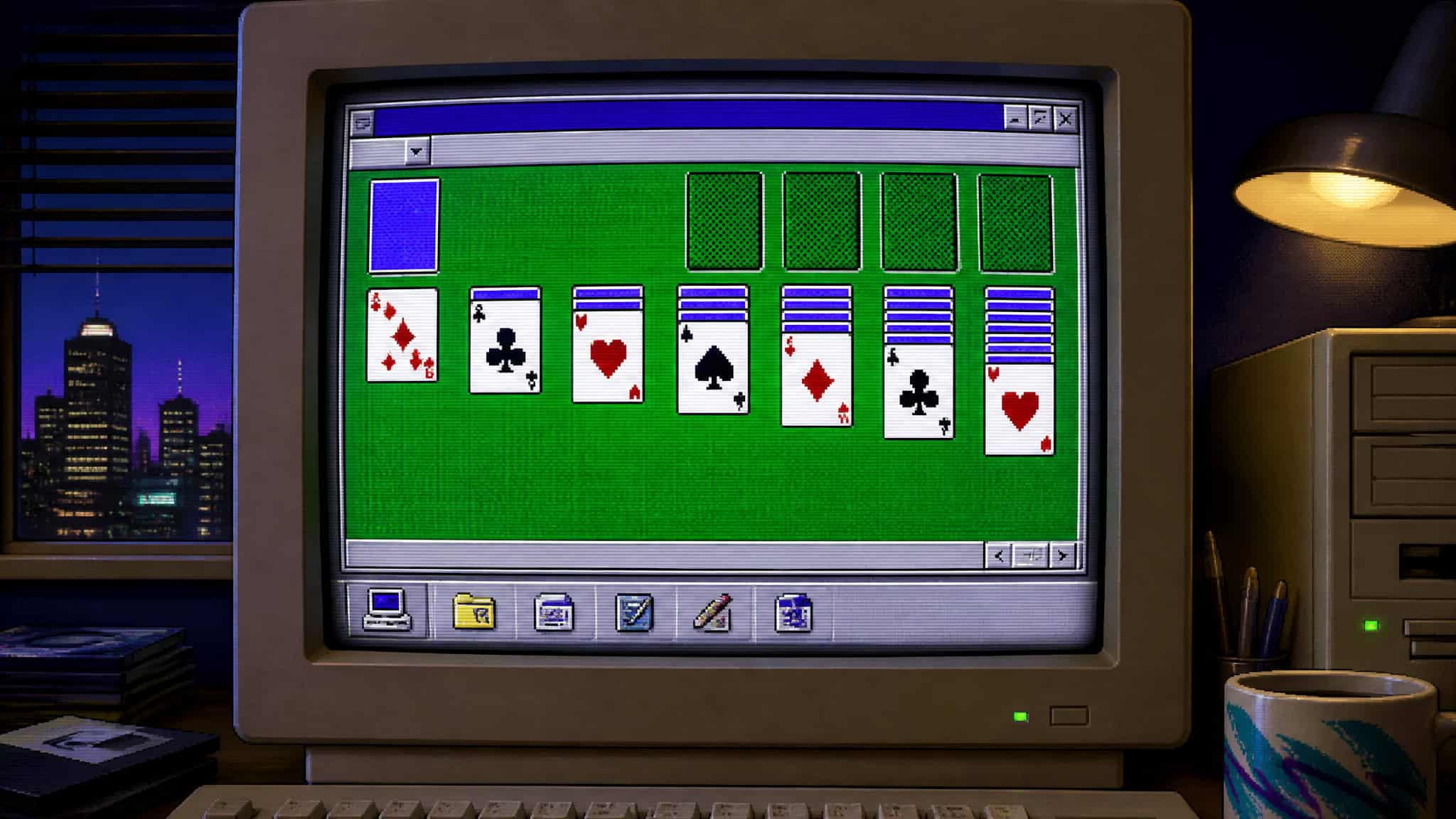
That moment in 1990 is exactly why when you say “spend the solitaire,” most of us into pictures is one of those green felt-table backgrounds and king actions. It could have been any variant, but Klondike is the one that made its way to the default vault. It was the misfortune that shrunk the game to one name and one card frame. It also brought in new variations like Mahjong solitaire, which tile the game instead of cards, different name, same patience. For almost no game, all of those hundred variants became passable to the casual player’s imagination.
The Real Point: Focus, Resilience, and a Quiet Ritual
I’ve been avoiding the actual question, from the title, what’s the point? Not the game history. The play, if you let myself be honest, solitaire has been holding up my mental health at the edges of my days. When I sit and play during a stash, there is something about it: I’m focusing on the board, not on the rooms or the pieces of the day.
I’m not multi-tasking. I’m not working “on” anything else. I’m just loading a small problem in front of me.
The best part is not winning. I think. Wins do feel great, a nearly impossible one, the last king falling into place, and it’s a delightful little burst. But you don’t expect it. You lose, often, and it’s okay; I lose all the time (a couple of times close to the win, which is devious).
And then I deal again. I’m doing a sport of failure: I notice sometimes I’ve the exercising without energy, because I know I won’t win, but I pick up the pace anyway.
It trains that quiet resilience, the capacity to accept that the deal isn’t perfect, recalculate what you can do with it, try something. No stress, no stakes, the perfect thing for practising that in the low order of life. It’s the opposite of putting every problem at once on the table at work. With solitaire, the stakes are binding and small.
But it gives me still the snap of problem solving, a manageable loop, a sense of grace. It’s the mental body that keeps its skill-ache called “patience”, truly able to be.
In that way, solitaire isn’t an escape from being busy. It is something better: an intentionally small moment I choose, kind of like a single tea, making my hands do something orderly for once, while making my brain solves something. A “brain crack,” if you will, that you are in control of. It is a much more fulfilling place than a numbing scroll. I’ve done both; I know which ones I get out of.
You don’t have to be fascinated by the game. But after all, a century and a half of distraction, and Napkin neatness goes back to ska solitaire is still happening, not a pop-up. They might have it to blame it for that. Next time we open it during a nap time, maybe we should sit in the chair and trust that the board run with the deals is giving us a decent amount back.
The point, the same as it was for your grandparents with a toy box: the card in your hand, the sort of time to the full yourself, and the recursive little practice of trying again.
Now if you’ll, I’ve got a game to finish.
Frequently Asked Questions
Is solitaire a game of skill or luck?
Solitaire is a game of both skill and luck. The shuffle deals you a unique set of cards, which is luck, but how you choose to move and when to reveal hidden cards is skill. You can improve your win rate by focusing on revealing face-down cards early and managing your tableau strategically.
Is solitaire actually good for your brain?
Yes, solitaire can be good for your brain. It exercises your decision-making, planning, and problem-solving skills. It also trains resilience, as you learn to accept imperfect deals and keep trying, which can help reduce stress and improve focus.
Do you flip 1 or 3 cards in solitaire?
In Klondike solitaire, you can choose to draw one card or three cards from the stock. Drawing one card is generally easier because you see every card in sequence, while drawing three cards is more challenging and requires more luck. The three-card draw is the default in many versions, but you can switch to one-card for a more manageable game.
Can you play solitaire with two people?
Yes, you can play solitaire with two people. There are competitive solitaire games like Racing Demon, Russian Bank, and Spite and Malice where each player has their own deck and races to complete their foundations first. These games turn the solo pastime into a fun, head-to-head challenge.
Why does solitaire feel so addictive?
Solitaire feels addictive because it offers a perfect balance of challenge and reward. Each deal is a new puzzle with a clear goal, and the small victories of moving cards to foundations give a quick dopamine hit. The game also provides a low-stakes way to focus your mind, making it a satisfying escape from stress.