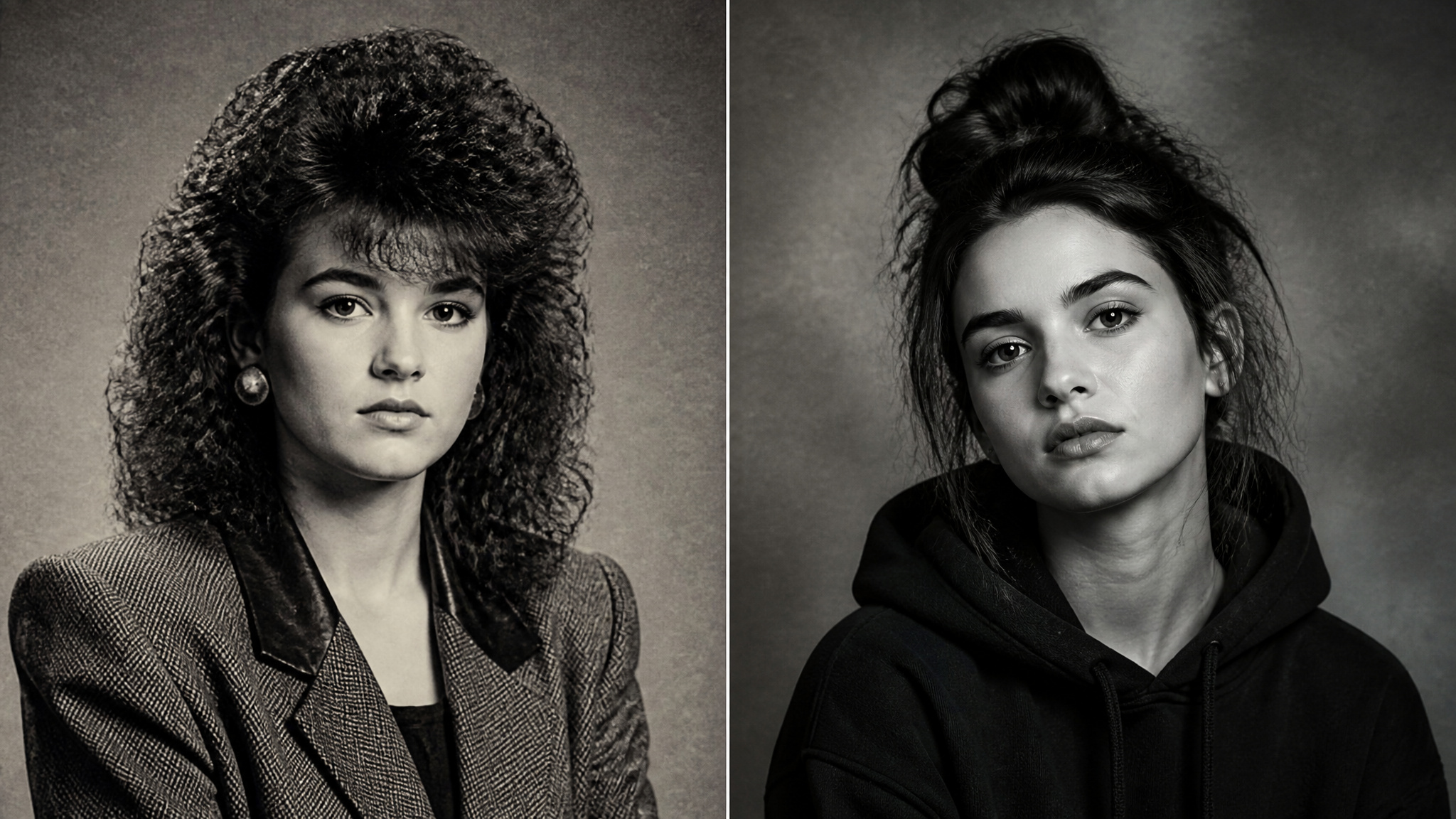
I pulled out my senior yearbook photo the other night. My mom was visiting, and my 18-year-old son was sprawled on the couch, hoodie up, playing something on his phone. I held the photo up, then looked at him. Then back at the photo. Then back at him.
The kid in that yearbook looked like he could’ve been my dad. Permed hair, chunky blazer, a face that already had a mortgage and a midlife crisis. My son, meanwhile, looks like he should be asking a chaperone to sign a permission slip for a field trip, not voting in his first presidential election.
My mom couldn’t stop laughing. “You looked 30 at 18,” she said, “but your kid looks 15.” Then she added, “You look more like his grandmother.” Thanks, Mom.
You look at yearbooks from the 1980s or 1990s and every single teenager looks like a real estate agent in the making. You look at the kids in a high school cafeteria today and they look like fifth graders in giant hoodies. It’s not just your imagination, and it’s not just the hair.
Key Takeaways
We see people in old photos as older because we associate their outdated clothes and haircuts with “old people,” an effect Steve Stevens from Vsauce calls “retrospective aging.”
Genetics play a role, but not exclusively: studies show perceived age heritability is about 61% for facial images and 51% for passport-style shots, but environmental factors like sun exposure and skincare also drive how old your face looks.
Today’s 18-year-olds benefit from healthier lifestyles, a youth-obsessed fashion culture, dormbed routines, and a “soft boy/girl” aesthetic that de-ages them emotionally and physically, so the 30-year-old who looks 25 is kind of the new norm.
Table of Contents
The first clue: Tom Hardy and the friendly neighborhood clone
In October 2024, Tom Hardy, 48, showed up with his 18-year-old son Louis at the Venom: The last Dance premiere. Louis, who is the son of Tom Hardy and ex-girlfriend Rachael Speed, is mostly out of the spotlight, but he single-handedly broke brains in the crowd and online. He’s a clone of his father. Same cheekbones, same gaze, same everything. You look at him and you think “that’s Tom Hardy in 2005” and then you remember that Tom Hardy in 2005 was in films that were just starting to feel hard and bruised, and yes, our context of what a man looks like at 18 versus at 48 has gone weird.
What struck me wasn’t the genetic mosaicism but that Louis looks young. Not “barely legal adult” young, but “not quite graduated high school” young. Meanwhile, 48-year-old Tom Hardy is still making fans say he’s “aging like a vine.”
The man who plays a literal symbiote in movies is simultaneously the father and the not-father. Tom has said fatherhood gave him purpose, and Louis even influenced Tom’s decision to play Venom. But the dissonance is the point: same gene pool as 18 years ago, yet the 18-year-old gets carded.
There’s also a woman who is the feminine version of this going around, and she is a writer for Scale (or actually Vogue). There’s a piece by a 30-year-old author who got mistaken for a teenager at a supermarket. She was at the customer service desk, hasn’t ID, and the cashier refused to sell her pre-mixed martinis. Wait.
She couldn’t legally buy the alcohol. She wrote about how millennials are criticized for not “growing up” traditionally and how that might be why we look younger. Being told you look 15 at 30 is a slap, but it’s also a window into what parents see in these 18-year-olds.
Is it a trick of the eye? The graphic Ho effect
When we look at a yearbook from the Class of 1965, or a photo of a 1980s prom couple, we immediately think “old.” The giveaway isn’t their skin or bones; it’s the outdated fashion, hair, and slang that our brains associate with older generations.
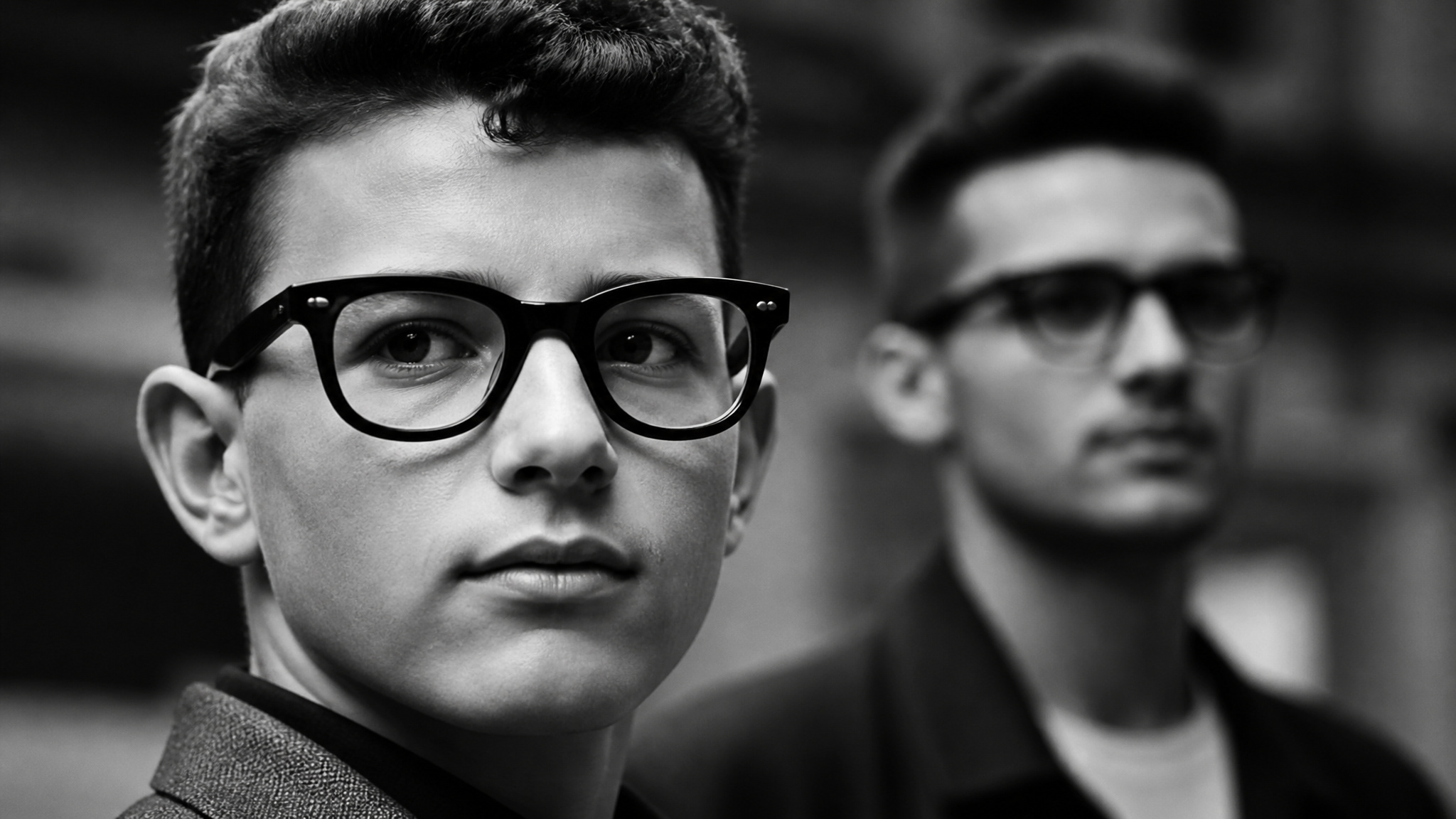
This is the “retrospective aging” effect, explained by educator Michael Stevens (Vsauce). His canonical example is a 1950s teen with Buddy Holly glasses. Take that exact pair of thick black frames and short-cut hair and put it on a 1990s kid, and people would call them “hipster” or “cool.” Put that same style on a 1950s 18-year-old, who was at the peak of that fashion moment, and today’s ours looks at that photo and sees a 65-year-old farmer with a grandad’s wardrobe.
Not because the photo itself has aged, but because that style is, to us, written 100% with the ink of the generation that kept wearing it. The children who wore that style at 20, continued at 40, at 50. So now the style has been contaminated.
Same with a 1960s hippie’s tie-dye, once a rebellion, now reads as a “before” photo in a maturity ad. Stevens also points out the “Dorian Gray effect” and the “name matching effect.”
The Dorian Gray effect: cultural stereotypes attached to a name get projected onto your face. A name like Ethel or Francine carries an old-person archetype, so people subconsciously project that vibe and you look older. A name like Mackenzie reads young. The “name matching effect” says people whose faces “match” their names are perceived more positively.
That’s a rabbit hole of not-proven science, but it’s a tongue-in-cheek way of saying that our brains are not neutral scoreboards with age. We are at the mercy of cultural association.
So, yes, a big chunk of “why do they look younger” is us looking at old photos and misreading them. Maybe genetics.
Twin studies: the research on what actually makes a face young
But you can’t just “test” that with twin studies. I dug into the research, and it’s a wild ride. There is a study that looked at 102 pairs of female Danish twins, all of them 59 to 81, and 162 British women started with them being 45 to 75.
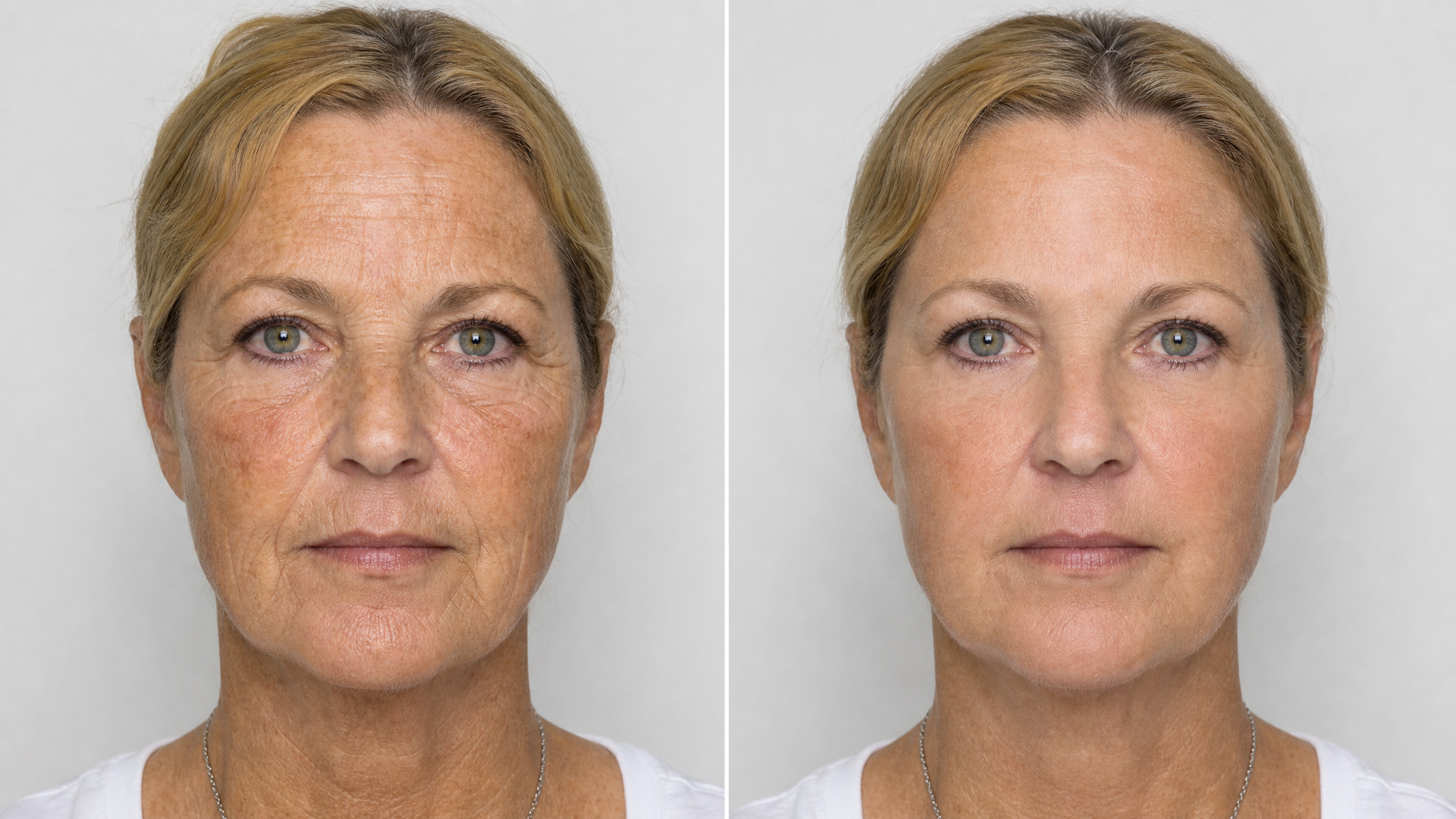
Huge panels of independent raters, an average of 71 assessors for each twins pair, were given the task of guessing age. This is not sex politics; this is science.
The first finding: “perceived” age is a measurable biomarker, correlated with actual aging features and health.
It’s not an illusion. The heritability, how much variation is genes vs. environment, was 61% for facial scales and 51% for passport-type scales. Roughly a coin flip: half the deck your parents dealt, half how you live.
Specific features matter: hair graying is 90% genetic, hair thinning 0% genetic.
Environmental. Lip height, a proxy for fullness, is 66% genetic, and larger lips read as younger. Male pattern baldness?
About 80% genetic, so they have a chance. But skin wrinkling is the single strongest predictor of perceived age. Sun damage works mostly through wrinkles*. A sun-damaged face is an old face.
When adjusted for age, pigmented spots weren’t the main factor, wrinkles were.
Spots are a red herring.
But wait, there’s a variable. The other measure: when those women had “passport style” photos taken, shirt, neutral background, not “facial” scraped bare, the women who used hair colorant looked 1.69 years younger than those who didn’t. And the twins themselves looked 4.16 years old in bare facial images than in styled passport photos. That’s a number, and it raises a broader question about why do teens look younger nowadays when we compare decades of yearbook photos and fashion cycles, though digital filters also muddy those perceptions. That’s with hair dye, makeup, and clothing, styling, shave off, at minimum, a four-year difference.
This is where I nod at my own motivation. My genes gave me my face, but my sunscreen (or lack of it), my skincare routine, those are my four years. My kid has a retinol serum nearby.
People in the past actually did age faster
Vsauce clears this up: people in the past did age faster on the inside. That’s not a conspiracy of vintage style. In the mid-20th century, there was industrialized smoking, sun baths without sunscreen in summer, a rudimentary healthcare system that didn’t catch things early, and diets that were much less varied than our frozen burrito menu. The results, a “smokeface” with sun-damaged skin, is a visually old face even with the exact same skin that didn’t have the wrinkle.
So yes, the vintage 18-year-old prom queen looks like the mother of the bride at 40. She aged in public because she had what she needed and nothing more. Not everyone has the luxury of “wellness.”
And there’s another tie-in: in the 1980s, the average 18-year-old face is a different animal. Those kids smoked at 14 and sunned at 15. Generation Z?
They passive-sunscreen but sunscreen is the sun is still the maybe. even the culture. There’s so much less outside time for some of them, and a quarantine, yes, but that’s a different, darker story.
The “tweakment” and skincare tidal wave
Here’s the part where your grandmother’s “a bar of soap” woeful is gone. When I was 18, I had, maybe, a Clinique 3-step and a bar-olive soap. That’s the “Skincare routine” that defined my generation. My son has a shelf.
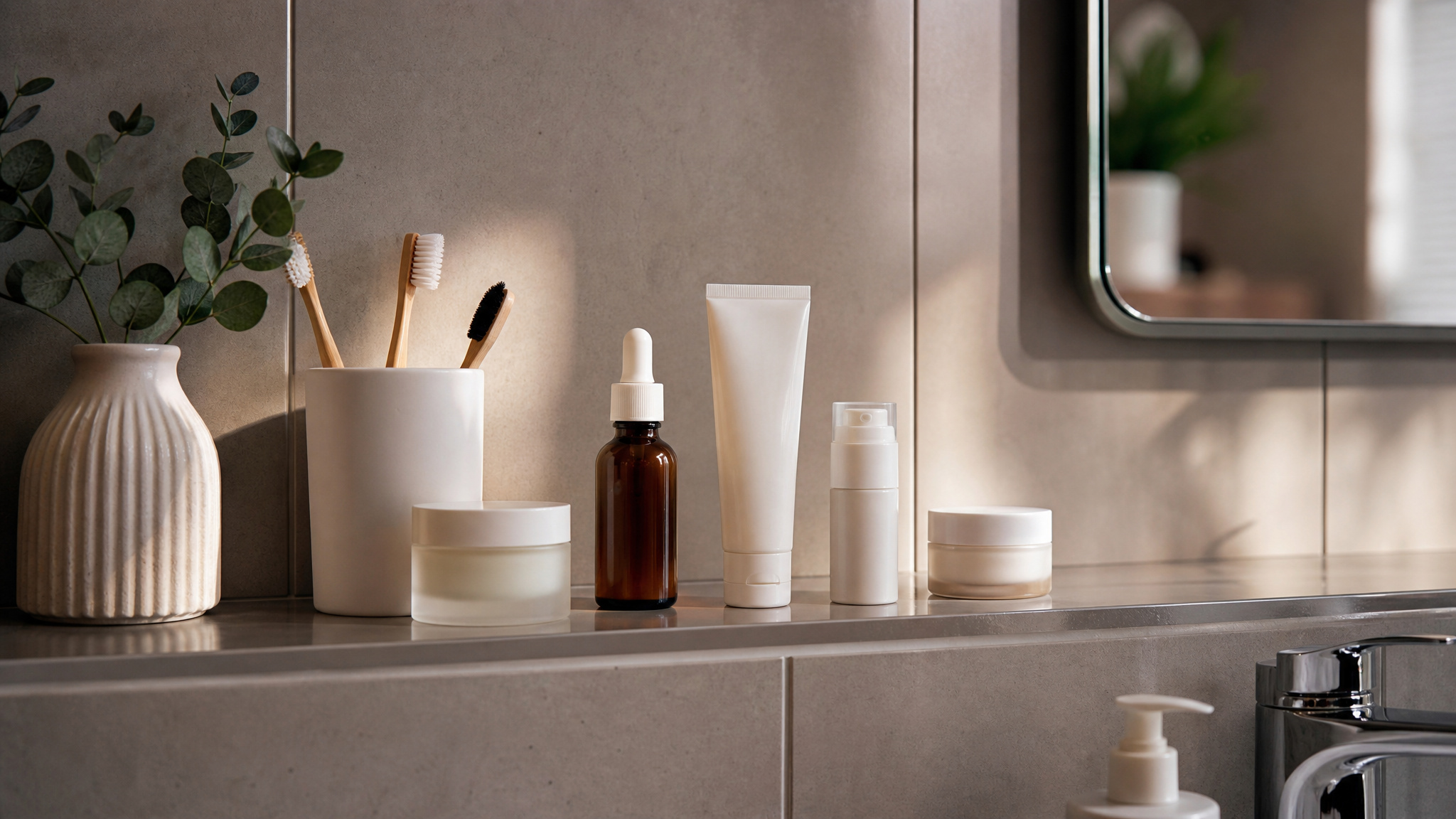
A full wall of ceramic bottles and serums, some of them mine. He has retinol, nightly moisturizer, SPF 50, and is borrowing my eye cream for dark circles.
And it’s not just the young ones. There’s a “tweakment” culture now. Younger generations have unprecedented access to fillers and botox, once for the rich or actresses. Now 20-somethings get “preventative botox” as a stimulus check.
The Vogue writer on TikTok hypothesized that injectables and neuromodulators have become more affordable and accessible than a decade ago, changing today’s high schoolers compared to 1984. Some joke millennials are depressives who stay inside, but that’s not a lifestyle answer.
Then there’s the madness: prevention beats correction. The 18-year-old applies retinoid to prevent lines they don’t have yet. My skin didn’t see sunscreen until I was 28, and that’s why I have a serazine question. My son has SPF 50 in his backpack.
The numb of “soft boy/girl” and the de-aging wardrobe
And within the generations, there’s a “soft boy/girl” aesthetic. My kid (and his dormmates) are.
College culture and “soft boy” fashion = oversized, baggy, pastel, soft, comfortable. Hoodie shoulders down, sleeves to the knuckles, a university sloth that reads “innocent” and “youthful.” You know the vibe: gentle, almost quiet, oversized sweaters, pastel tees, rounder face from lack of chisel.
It’s designed to read as not-legal-adult. It’s a fashion signal of “innocent,” “playful,” “cared for”, the opposite of the tough masculinity that aged 80s teen boys. In the Vogue article, the writer notes millennials are criticized for not embracing traditional adulthood, drawing parallels to cultural “toddlerhood.” The markers: athletic wear, digital communication, and a non-gendered softness. That directly interacts with “looking younger.” The 18-year-old has the same hype-beast.
And let’s be clear: these styles will look “old” in 20 years. There will be a “#Why-did-we-wear-that” moment. But during the era, the styles are so wrapped up with “the decreased” that they read as “young,” regardless of actual age. It’s the reverse of the Buddy Holly glasses.
The glasses are “grayness,” but the sadness? The same is not here.
And this is where “name matching” comes in: the “soft boy/girl” name-sound (I don’t have a study for this but trust me) is associated with being “cheeky,” “warm,” “not-old,” “not-anadult.”
The dark side: when “looking young” gets weaponized
But with the “young skin = looking skin” there’s a side that gets dark fast.
Megyn Kelly, on the November 12th, on her show said that wasn’t a pedophilebut he was into ‘barely legal’ types. Rapist. Specifically, she said “15-year-old girls.”
The backlash was necessary, raw, and hateback. Actress Cynthia Nixon on Instagram asked if Kelly would be comfortable with a 15-year-old daughter with Epstein. “15 is 100% illegal.”
Regardless of age-of-consent (typically 16 or 18, not 15), a 15-year-old is a child, universally, not “barely legal.” Christina Ricci posted that Kelly is “a danger to children.” Valerie Bertinelli shared a photo of herself at 15 in 1975, noting this was the age in question. A 14-year-old girl named Eloise (@cheeringforchange) responded directly, saying adults defending a predator by debating age are protecting the predator, not the truth.
Called “a reality check from an actual child.” That broke my heart.
Then eight Epstein survivors, with the World Without Exploitation program, posted a national PSA using their own photos from ages 14 to 17. The photo caption: This is what a survivor looks like. They called for release of all Epstein files, with the Epstein Files Transparency Act. That’s the dark “down-view.”
The cultural paranoia of “looking young” is not just about your girlne or lipstick. When “looking young” becomes a way to soften the line between child and adult, the obsession with “adorable” becomes dangerous. We can’t have a cultural obsession with “barely legal” as soft porn while complaining that a “legal” 18-year-old is a child. Our 18-year-olds are children.
That’s the phrase to say. Our 18-year-olds are children, and their look is the “child” factor.
The money: 18-year-old tables in 1990s
The other “you can’t overlook” is the extended college adolescent. In Wisconsin in 1997, a one-bedroom apartment was under $500 a month. That same apartment? At least two thousand dollars.
Rent used to ~cap at ~30% of a person’s income (which was the “poverty housing standards” and then), now that standard is “beautiful” if you rost. A single “hot beer” with tip? A dollar beer night was actual*. My grandmother had a fridge, has it still. It lasted 30 years.
Modern appliances have a 10-year “sell-by” and aren’t worth repair. My son lives at home because we’re supporting his college years. “Out of house at 18” is the old era.
That “extended adolescence” = extended “youth.” And “youth” = “look young.”
One physical “why do 18 look younger” is that they have to look young because they are “young” in society. They’re not “adults” yet financially, not head-of-households, not mortgage-holders, not wedding planners. When you’re not the adult, the face doesn’t have to do the “adult” work.
It’s time to look like “college” because they are in the “golden egg” of college. And “18-year-old look young” is not about biology, it’s about the socio.
So have you been? It’s a mix: perception of the past, genetic base, preventive skincare, cosmetic “tweakments” boom, soft-boy/girl “cult,” and an economic delay. We look at an “18 in 1925” and see a mind in a “mid-degree” with “smoke-face.”
And we look at our 17-year-old in the “graduate-year photo” and see a 5th-grader in high school. The mirror is multiple.
So, no single * smoked* answer.
But the counterculture is the youth. The mom says “you’re at 30, your kid at 15.” That is not a conspiracy. It is.
My grandparents give you the forehead, the jaw, the smiling eyes. The rest is a ~20-year addition: sunscreen, and “don’t worry the house.”
Will the 18-year-old change? Will Gen Alpha look at their high school photos and think “I was a lot of kids”? Probably yes, and have their own “why do 30-year-olds look 15” moment.
It cycles. The waves. But for now, I’m going to enjoy the timeline. My mom looked at me and I looked at my adult. My now is “your father.”
My son is “the boy I know.” And I think that’s cute.
Frequently Asked Questions
Why is the age 18 so special?
It’s the legal threshold for voting, military service, and signing contracts in most places, but it’s not a biological switch to full maturity. The cultural weight of 18 has also changed—it used to mark the start of independent adult life, whereas now it often just means ‘legal adult’ while still being in a prolonged youth phase.
Why is Gen Z aging so fast?
Actually, the perception is backwards—Gen Z often looks younger than previous generations at the same age, not older. The confusion comes from comparing old photos where outdated styles and habits like smoking and sun exposure made teens look older. Gen Z’s skincare routines, healthier habits, and soft fashion aesthetics de-age them visually.
What is the retrospective aging effect?
It’s the brain’s trick of associating outdated clothing, hairstyles, and accessories with older people, so when you see a 1950s yearbook photo, you automatically think ‘old’ even if the person was 18. The same style on a modern teen would be called ‘hipster’ or ‘vintage,’ not ‘grandpa.’
How much of perceived age is genetic versus environmental?
Twin studies suggest heritability is around 61% for facial images and 51% for passport-style photos—so it’s roughly a coin flip. The rest comes down to environment: sun exposure, smoking, skincare, and lifestyle choices. Wrinkles are the strongest predictor of perceived age, and they’re largely driven by sun damage.
Can skincare and Botox actually make you look younger for longer?
Yes, prevention beats correction. Younger generations are using SPF, retinoids, and even ‘preventative Botox’ in their 20s, which slows wrinkle formation before it starts. This is a major reason why today’s 18-year-olds look younger than their parents did at the same age—they’re protecting their skin decades earlier.
What’s the difference between looking young and being ‘barely legal’?
Looking young is a neutral or positive trait—it’s about appearance. ‘Barely legal’ is a dangerous cultural fixation that blurs the line between child and adult, often used to justify predatory behavior. An 18-year-old may look 15, but that doesn’t change the fact that a 15-year-old is a child, not a legal adult.