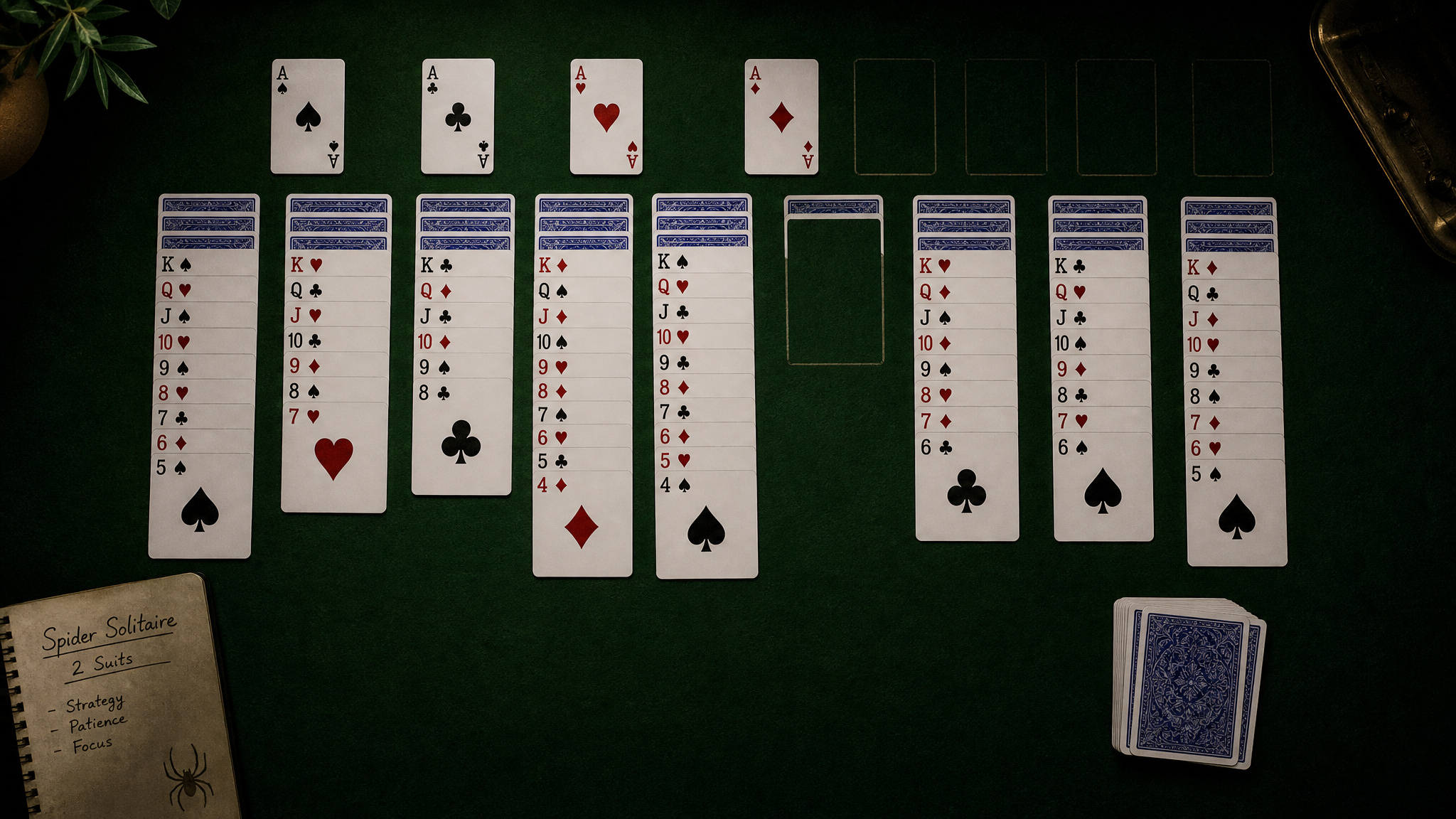
You’ve beaten Klondike. You know the drill: build those four piles up from Ace, flip through the draw pile, feel that little rush when everything finally clicks. And then you win, and you think… is that it?
That’s the exact moment Spider Solitaire is waiting for you.
Spider is the natural next step for anyone who’s outgrown the basic game. It’s played with two standard 52-card decks, so 104 cards total, and the goal is to build and clear eight full King-to-Ace sequences in the same suit. The name comes from those eight foundation piles, like a spider’s eight legs, or maybe the eight columns, depending on who’s telling the story. Microsoft Windows popularized it, so millions of people grew up with that little spider icon on their desktops.
Here’s the honest part: even good players win about 1 in 3 games. That’s not a typo. Spider is friendlier than it looks, harder than it pretends, and absolutely worth learning. Come sit down, let me show you.
Key Takeaways
Spider Solitaire uses 104 cards (two decks) and the goal is clearing eight full King-to-Ace sequences in the same suit, which is different from Klondike’s Ace-to-King upward builds.
Even with good play, you’ll win roughly 1 in 3 games, and not every deal is solvable, so losing is often the deal’s fault, not yours.
The three main difficulty levels, 1-suit, 2-suit, and 4-suit, change the strategy completely because they control which card sequences you can move together.
Table of Contents
The Objective: What You’re Actually Trying to Do
You win Spider by clearing all 104 cards. That’s it. You build 13-card sequences from King down to Ace in the same suit, and when a full suit is assembled, it lifts off the tableau and disappears from the game. You win when all eight suits are cleared.
Here’s the part that trips up Klondike players: completed sequences move to the foundation automatically. You never place cards there yourself. One moment you’re looking at a full King-to-Ace run of Spades, the next it’s gone, and you’re one suit closer to done.
This is the lightbulb moment. In Klondike, you build foundations upward from Ace. In Spider, you’re building downward in the tableau, and the finished product just vanishes. Simple to say, not always simple to do.
Setup and the Starting Layout
You’ll need two decks without the jokers, shuffled together. That’s 104 cards. Deal 54 into 10 tableau piles: the first 4 piles get 6 cards, the remaining 6 get 5. Only the top card of each pile is face-up.
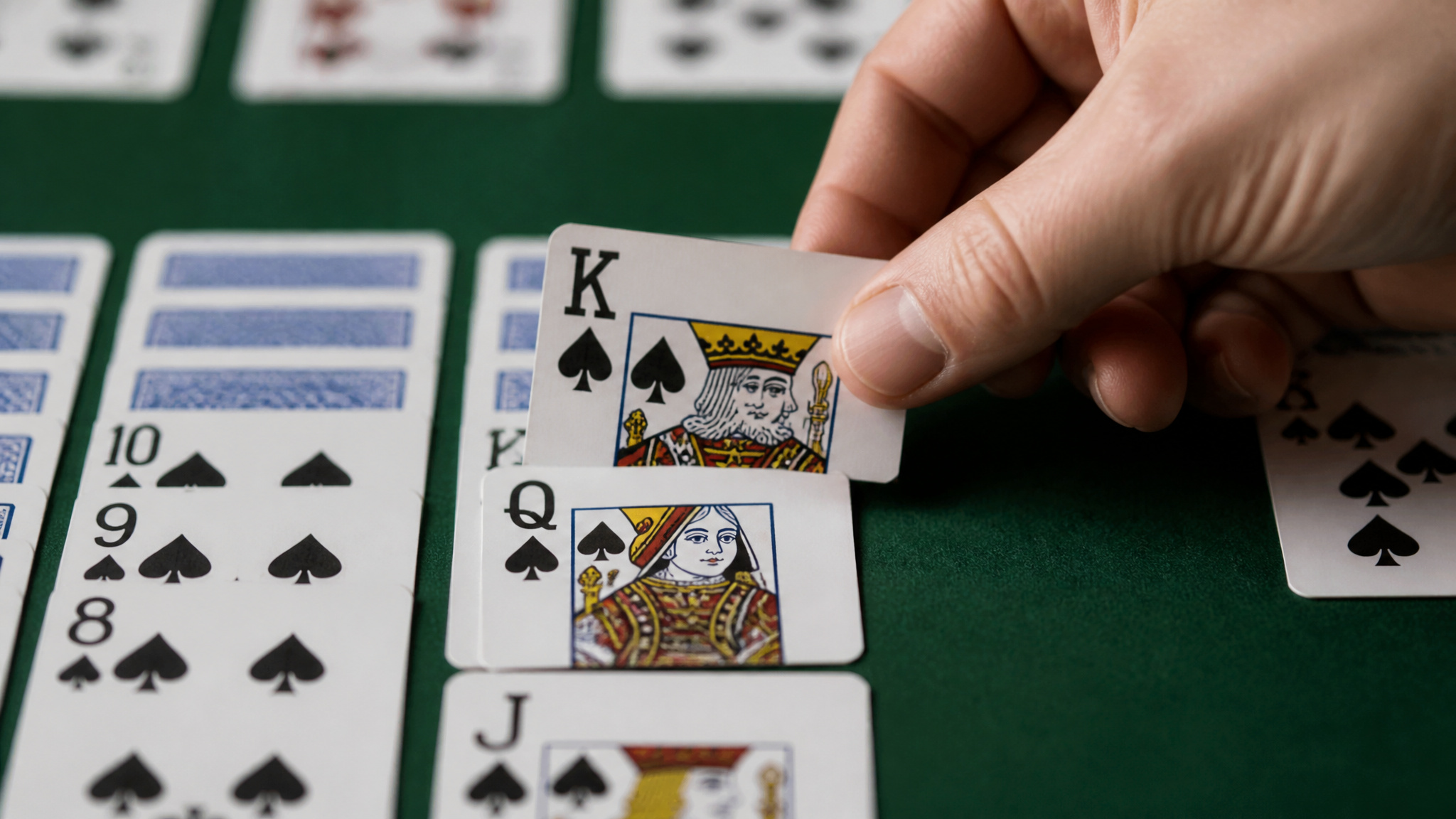
The other 50 cards form the stock, sitting face-down to the side. The stock contains 50 undealt cards, which you’ll draw from in groups of 10 during play.
Understanding the Tableau
The tableau is your main playing area: 10 columns where cards build down in rank. At the start, you’ve got 54 cards spread across those columns, with only the top card of each pile visible. Everything else is a mystery until you move things around.
Cards stack in descending order, so a 7 can go on an 8, a 9 on a 10, and so on. But here’s the catch: you can place cards of different suits in descending order, but moving a group together requires that the group forms a same-suit descending sequence. That single rule drives everything else in the game.
The Stock: Your Lifeline or Your Downfall
The stock holds 50 cards, and you deal 10 at a time, one to each column. But you can only deal when all 10 piles contain at least one card. No empty piles allowed. The final deal is only 4 cards, placed on the first four piles.
When you’re stuck, you deal another row of 10 face-up cards. That’s your resource. But here’s the strategic catch: dealing early can clutter the board and bury the sequences you’re building. It’s a decision, not a panic button.
The Core Rules: How to Move Cards
You can move multiple cards at once, but only when every card in the sequence is the same suit and in descending order. Single cards, though, can move anywhere one rank down, regardless of suit. Any 7 on any 8. That’s the basic move.
Single Cards vs. Sequences
A single card can go on any card one rank higher, no matter the suit. So a 7 of Hearts can land on an 8 of Clubs. Simple.
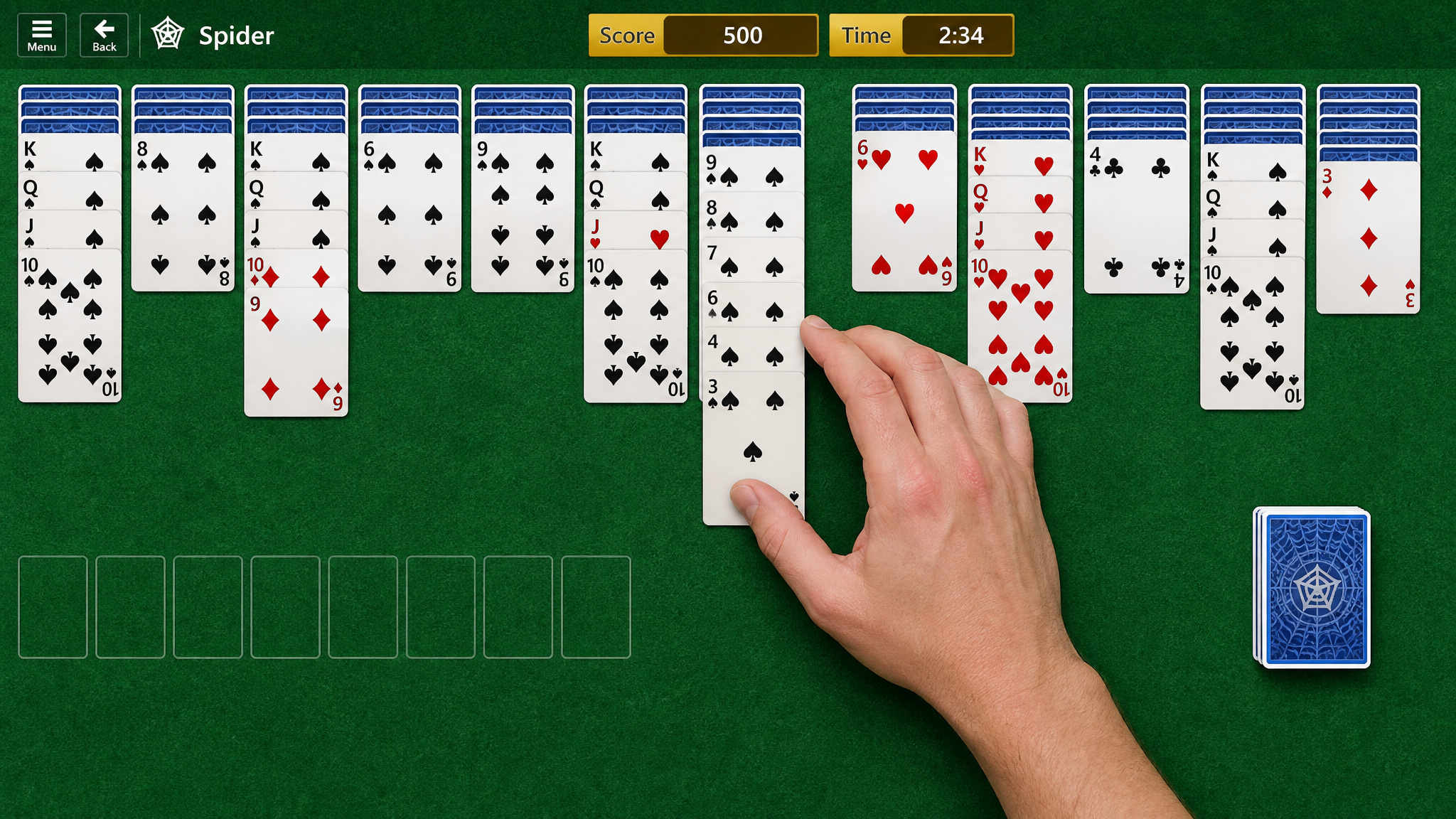
A sequence moves together only if all the cards are the same suit and in descending order. For instance, a 10, 9, and 8 of Hearts can be moved together onto any open Jack. The bottom card of the unit you’re moving determines where it can land.
Breaking Sequences
This is the spot most guides mess up, so pay attention. You can split a run at any point. Consider a pile whose visible cards are 4, 5, 6, 7 from top to bottom. You can move just the 4, the 4-5, or the 4-5-6 as a unit. But the 7 is stuck until the covering three cards are removed.
That’s the rule in action. You’re never forced to move a whole sequence. You can peel off the top cards and leave the rest.
Empty Spaces and the King Rule
An empty pile can be filled with any movable unit or any single card. That’s your flexibility, your chance to rearrange.
Kings are the exception. Kings can only move to empty spaces. No exceptions. So when you see a King sitting on top of a pile, it’s stuck there until you open up a space.
Revealing Face-Down Cards
When all face-up cards leave a pile, the next card underneath flips over automatically and becomes playable. Move a card off the top of a column, and the card beneath it turns face-up. That’s how you discover new options.
Field note: The King rule is the one that surprises new players most. A King is not a playable card unless an empty column exists.
Stock Management and Timing Your Deals
The stock deals 10 cards, one to each column, and all columns must have at least one card before you can deal. The final deal is only 4 cards on the first four piles.
But here’s the thing: dealing early hurts you. A typical mistake is reaching for the stock when you’re stuck instead of rearranging what you have. The tell is columns full of mixed-suit stacks with no empty column to use as a buffer.
Before you deal the next 10 cards, try to reveal as many cards as possible and arrange them in suit order. If you don’t prepare before dealing, your chances of winning drop significantly. The stock cards can open up new possibilities, yet they might also obstruct some of your tableau piles.
The Variants: Choosing Your Difficulty
The core choice is 1-suit, 2-suit, or 4-suit. Each step adds suit restrictions, which changes the strategy completely.
One-Suit (Easiest)
In 1 Suit, all cards are treated as Spades. Any descending group can move together, regardless of what suit the cards actually show. A 6 of Spades, 5 of Diamonds, and 4 of Clubs can move as a unit onto any open card. It’s the most forgiving version, perfect for learning the mechanics.
Two-Suit (Intermediate)
In 2 Suit, you’re playing with Spades and Hearts. All reds count as one suit, all blacks as another. Same-color sequences move together. A 9 of Hearts or 10 of Diamonds can go onto any open Jack.
Red King-to-Ace sequences get removed. It’s a popular step up, more challenging but still manageable.
Four-Suit (Hardest)
In 4 Suit, all four suits are in play, and only strict same-suit sequences can move together. A King of Spades down to Ace of Spades gets removed to win. This ranks among the hardest solitaire variants. The rules are the same, but the challenge is entirely different.
Spiderette and Other One-Deck Variants
Spiderette uses one pack and a Klondike layout with 7 stacks of 1 to 7 cards. It’s a smaller game than standard Spider, 7 tableau columns and 52 cards.
Will o’ the Wisp, invented by Geoffrey Mott-Smith, plays like Spiderette but deals 21 cards into seven columns of three, with only the top card of each column face-up.
Simple Simon is another one-deck Spider variant. Mrs. Mop deals all cards face-up from the start, so no hidden cards to worry about. Black Widow uses one deck and simplified movement rules, making it more accessible.
Gigantic Spider and Relaxed Spider
Gigantic Spider uses three or more decks, with over 150 cards in play. It’s one of the most challenging solitaire variants out there.
Relaxed Spider removes some restrictions, like needing all spaces filled before redealing. You don’t have to fill every space before dealing again, and you get unlimited undos, making the game more forgiving and less stressful. If you want to mix things up, try Spider Solitaire or Hearts for a quick break that helps you relax and think.
Turn Variants and Arcade Mode
Turn 1 Spider deals one card at a time from the stockpile. That’s the standard. Turn 3 Spider deals three cards at a time, which changes the pace of the game.
Arcade Mode adds power-ups and special abilities like removing any card, auto-sorting a column, or peeking at face-down cards. It’s a fun twist on the classic.
Scoring Systems: What Counts and Why It Matters
There’s no single “Spider score.” Your score depends on where you’re playing, and different platforms reward different play styles.
Spider Palace scoring works like this. In 1 Suit, completing a sequence gives you +50, revealing a card +2, combining same-suit cards +1, each unused Joker +3, each undo -1, and solving the game +300. In 2 Suit, those numbers jump to +100 for a sequence, +3 for revealing, +2 for combining, and +400 for solving. In 4 Suit, it’s +150 for a sequence, +4 for revealing, +3 for combining, and +500 for solving. A round ends when all players solve it, time runs out, or nobody can move.
Windows scoring starts you at 500. Each move, including undos, subtracts one point. You get 100 points for each in-suit stack completed. Fewer moves mean a better score.
Sun Microsystems scoring from the 1989 version gives you 10 points for each face-down card revealed, 15 additional points per column cleared of face-down cards, 2 points for each card that rests on the next higher card of its own suit, and 50 points per completed suit removed. The maximum score is 990, or 1000 if you win with all 8 suits still in the tableau.
So what does this mean for you? If you’re on Windows, efficiency matters most. If you’re on Spider Palace, revealing cards and solving big are the goals, but what’s the point of solitaire goes deeper than the game itself.
Strategy: How to Win More Often
The core tension in Spider is building same-suit sequences, which move as units, versus creating empty columns, which give you flexibility. Good Spider play balances both.
Build Same-Suit Sequences
When you have a choice, build in suit. That’s a natural build, and it’s the smarter move. Natural builds can be moved as a unit, which helps you expose hidden cards or empty piles. Moving a natural build lets you flip over a hidden card or open up an empty pile. That’s the payoff.
Expose Hidden Cards First
Uncovering hidden cards opens up new moves. That’s the whole point. Exposing hidden cards is also a way to get an empty pile, which is a useful goal. Move cards from tableaus that have fewer cards to clear piles faster.
Create Empty Piles Early
Try to make empty piles as early as possible. They give you flexibility. Use empty piles as temporary storage when rearranging sequences into natural builds. Move cards to empty spaces to turn over more cards. That’s a simple way to keep the game moving.
Build on Higher Cards First
This one’s counterintuitive. Among out-of-suit builds, start with the highest ranks. You can’t move out-of-suit builds as a unit, so they’ll be broken apart later anyway. Starting with higher cards lets you get the most advantage from them before they get dismantled.
Manage the Stock Wisely
Before dealing the next 10 cards, try to expose as many cards as possible and arrange them in suit order. If you don’t prepare before dealing, your chances of winning drop significantly. The choice of solitaire card flip 1 or 3 changes how much luck versus skill determines that outcome, so weigh it against your experience level. After removing a suit, rearrange the remaining cards into natural builds.
Minimize Moves and Use Undo Thoughtfully
Minimizing your moves is key to a good score. You’ll usually see your turn count at the bottom of the screen. Fewer moves can significantly improve your score. There’s no limit to turns, but too many will hurt your score.
Undo costs points on most platforms. Treat it as a tradeoff, not a do-over. Use it when you realize you made a mistake, but don’t lean on it.
Advanced Tips
Plan moves concurrently. Think in combinations, not single moves. Move with a purpose; avoid obvious moves that may cause later problems. A non-Ace card that is exposed is not a lasting asset, because using it removes it from play. Use vacant columns to move cards between columns advantageously. Shift strategy when stuck; forgo building a suit unless completing it vacates a column.
The typical stuck board has mixed-suit stacks everywhere and no empty column. The fix is always the same: create an empty column early, use it to rearrange into natural builds.
Bottom line: If you only remember one strategy, make it this — an empty column is worth more than a dozen random moves.
Spider vs. Other Solitaire Games
Yes, Spider is generally harder than Klondike, and here’s why.
Spider vs. Klondike
Klondike uses one standard 52-card deck. Spider uses two complete decks, so 104 cards. In Klondike, you construct four foundation piles in ascending order by suit, from Ace to King. In Spider, you create descending sequences in the tableau, King to Ace, and completed suits are removed automatically.
Spider has no draw pile. Your decisions matter more, so it’s more skill-based. There’s no luck of the draw to save you.
Spider vs. Scorpion
Spider and Scorpion look similar but play differently. In Spider, moving cards to a target requires same suit. In Scorpion, you can use different suits. In Spider, only Kings or sequences starting with Kings can go on empty piles.
In Scorpion, any card works. Spider only lets you deal from the stock when all piles have at least one card. Scorpion lets you deal anytime. And in Spider, moving multiple cards requires same suit and order. In Scorpion, only the card directly on the target needs to match, the rest can be anything.
Solvability: The 1-in-3 Reality
Here’s the uncomfortable truth: not every Spider deal can be solved. Software studies have analyzed solvability, and even with good play, you’ll win about 1 in 3 games.
That’s not a knock on your skills. Some deals are just unwinnable. Losing is often the deal’s fault, not yours.
But here’s the liberating part: you can stop blaming yourself when a deal goes sideways. And when you do win, you know it was skill. You can’t win on luck alone in Spider.
Where to Play: Platforms and Online Options
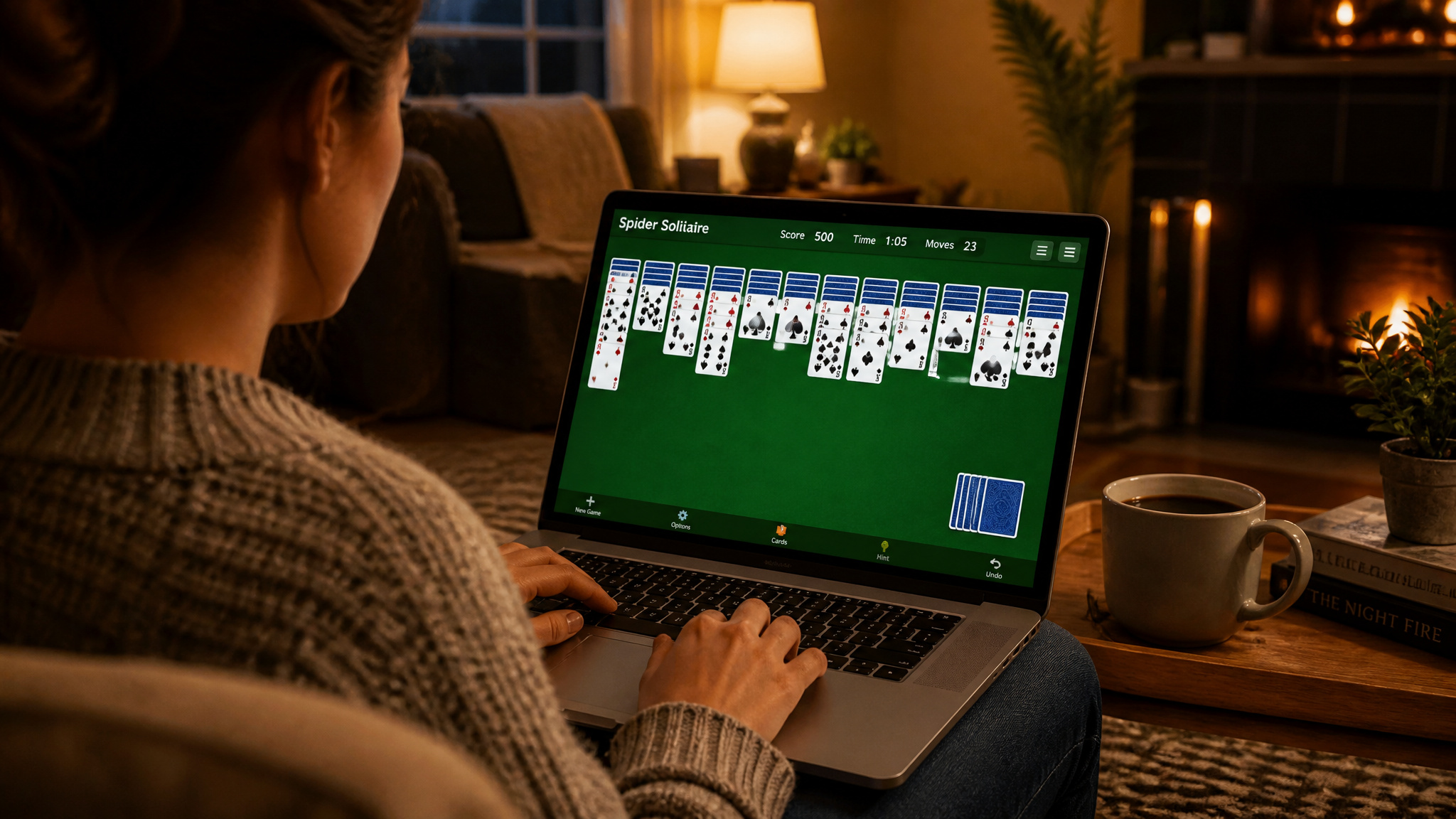
The modern answer is browser-based HTML5 versions that work everywhere, no download needed. You can play on computers and mobile devices without installing anything.
The Microsoft Connection
Spider Solitaire originated in 1949. Microsoft introduced it in the Plus! 98 pack for Windows 98, and it came bundled with Windows 7, Vista, ME, and XP. The game offers three difficulty levels: 1, 2, or 4 suits.
Early Software Versions
John A. Junod, the original developer of WS_FTP, wrote a version for Windows 3.x in 1991, plus an MS-DOS version called EGA-Spider. Ian Heath, a computer science professor, released a similar game called Arachnid for Windows 3.x in 1991, later rewritten for 32-bit systems as Arachnid 32.
An early version was developed at Sun Microsystems around 1989. Spider also comes bundled with KDE and GNOME desktop environments on Linux and BSD, under names like KPatience and AisleRiot.
Online and Mobile Play
You can find Spider on numerous online gaming sites, including Pogo, CrazyGames, and Spider FRVR. Pogo lets you play free games online without downloading software, right in your browser. One popular option is Pogo’s Payday FreeCell HD, which offers a polished, high-definition version of the classic card game.
Pogo’s Gamified Experience
Pogo offers free browser play with badges, statistics tracking, and performance comparison. Rainy Day Spider Solitaire HD provides enhanced graphics and difficulty levels. Other Pogo variants include Solitaire Blitz with a countdown clock and Home Story Solitaire with daily curated puzzles that are guaranteed solvable.
Custom Rules and Multiplayer Options
Spider doesn’t have to be a solo game. Platforms like Spider Palace let you play in real time against others and tweak the rules.
Understanding the Custom Rule Options
Spider Palace offers several custom rules. Joker mode gives you three Jokers per player, and picking a pile automatically places a matching card. Unused Jokers add +3 each. Undo Off disables the undo feature for a tougher game.
Fast mode shortens the standard playtime. Relaxed mode starts you with a fully revealed tableau, no hidden cards. Easy mode lets you deal stock even with empty piles. Scorpion mode uses different movement rules. Training mode has no league impact.
Multiplayer Spider
In multiplayer, you play in real time against people worldwide. Opponents’ progress displays above the field. You can give up via a white flag without leaving the table. A table ends after the set number of rounds, and the highest total score wins.
Why Play Spider: Cognitive Benefits
Spider exercises your working memory as you track face-down cards and the stock, strengthens problem-solving abilities, and builds strategic thinking and planning skills. It’s a brain workout that’s as cozy as a cup of tea, not another stressful task.
You’re constantly holding multiple possibilities in your head: what’s face-down, what’s in the stock, what sequences you could build if you just had an empty column. That’s genuine mental exercise.
Common Mistakes to Avoid
We’ve all made these. Here’s what to stop doing.
Moving cards without considering suit implications blocks your sequences. Using the stock too early clutters the tableau. Neglecting empty columns leaves you with no flexibility when you need it. Overusing undo wastes points and sometimes causes analysis paralysis.
And then there’s the “innocuous move” trap. A harmless-looking 6 of Hearts onto a 7 of Hearts can leave you stuck later with no empty column. Move with a purpose, not just because you can.
Conclusion: Play, Lose, Learn, Repeat
Here’s where we land. You’re building descending piles from King to Ace across 10 tableau piles. Kings are highest, Aces lowest. Stock cards are your reserve, and once they’re gone, it’s over. One wrong move can leave you with an unplayable board. Strategy is essential, you can’t win on luck alone.
I lost more games than I won when I started. That’s not failure, it’s Spider. The 1-in-3 odds are part of the honest appeal. When you do win, you know it was skill.
That’s the thing about this game. It rewards patience and planning over luck, and it doesn’t pretend otherwise. The rules are simple once you understand the logic. The challenge, and the fun, is in the strategy.
At Tidbits of Experience, we share what we’ve learned because someone shared it with us. So here’s the pass-along: play, lose, learn, repeat. The wins will come, and they’ll feel earned.
Frequently Asked Questions
What is the trick to Spider Solitaire?
The core trick is to build same-suit descending sequences whenever possible, because those can be moved as a unit. Also, prioritize creating empty columns early—they give you flexibility to rearrange cards and expose hidden ones. Avoid dealing from the stock too early, as it can clutter the tableau.
Is there a solution to every Spider-Solitaire game?
No, not every deal is solvable. Software studies have shown that even with perfect play, you’ll win about 1 in 3 games. Some deals are simply unwinnable, so losing is often the deal’s fault, not yours.
How does Spider Solitaire differ from Klondike?
Spider uses two decks (104 cards) and builds descending King-to-Ace sequences in the tableau, which are removed automatically when completed. Klondike uses one deck and builds ascending Ace-to-King foundations. Spider has no draw pile, so your decisions matter more and luck plays a smaller role.
What is the difference between 1-suit, 2-suit, and 4-suit Spider?
The number of suits changes how freely you can move sequences. In 1-suit, any descending group moves together regardless of suit. In 2-suit, same-color sequences move together. In 4-suit, only strict same-suit sequences can move as a unit, making it the hardest variant.
Can you move a King in Spider Solitaire?
Kings can only move to empty columns—they cannot be placed on any other card. This rule often surprises new players, so if a King is on top of a pile, it’s stuck until you open up a space.
Why is Spider Solitaire considered a game of skill?
Because there’s no draw pile to save you, every move matters. You must plan ahead, manage the stock wisely, and build same-suit sequences to win. While luck determines whether a deal is solvable, winning requires strategic thinking and careful decision-making.