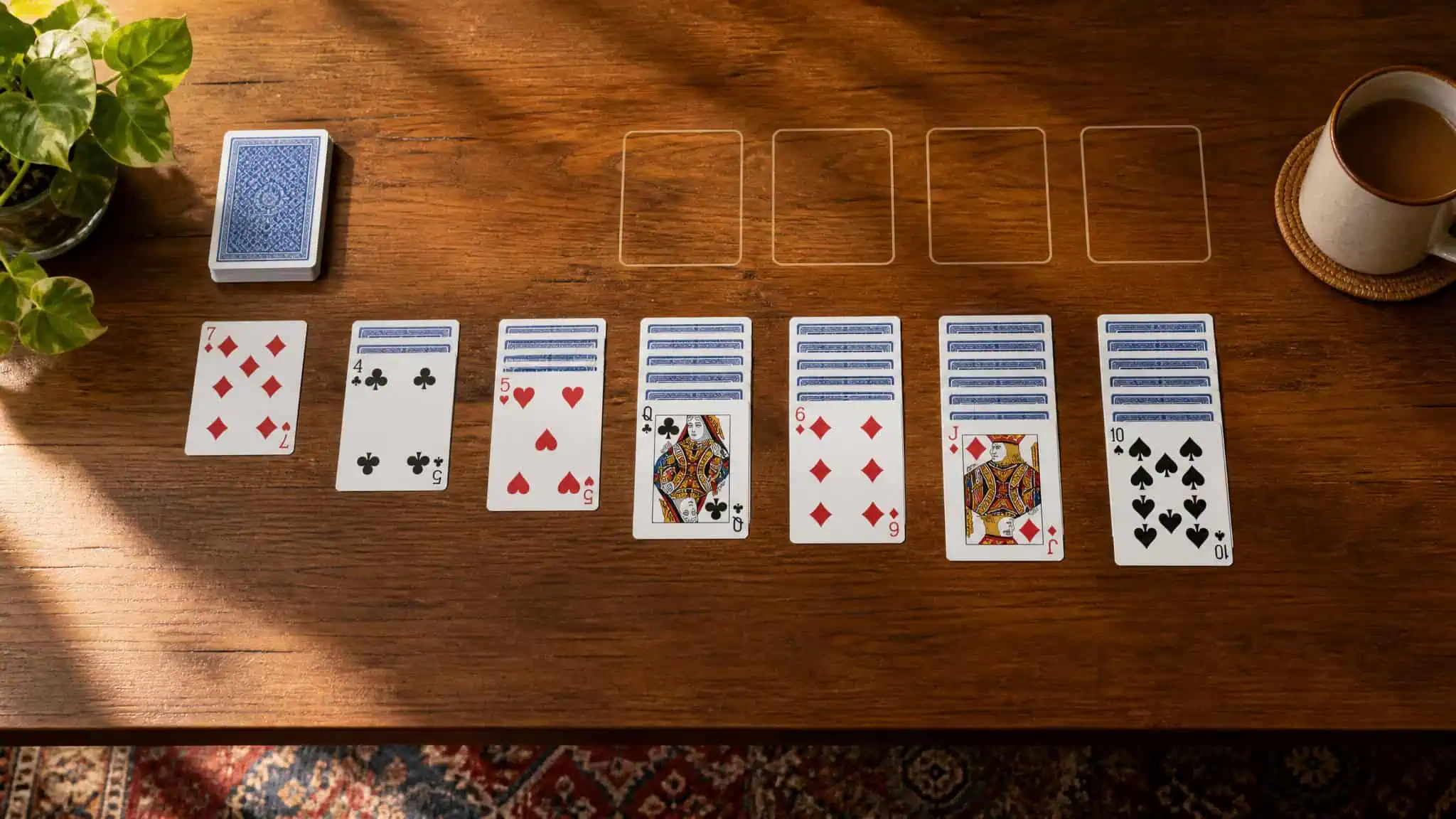
The kid is finally asleep, or at least deeply committed to a show, and you’ve got fifteen minutes that are technically yours. You pull open the kitchen drawer, slide the deck of cards out from under the takeout menus, and sit down at the table. You know this feeling. Solitaire is the game.
The one in the default Windows folder. The one that comes pre-installed on every phone. And yet the first time you actually sit down to play with a real deck, it feels like everyone else in the world knows a secret you don’t.
This is for that moment. Here’s the whole thing, from the first shuffle to the win screen you’re hoping for. I’ll cover the setup, the moves that are legal, the ones that aren’t, and the little decisions that help you actually finish a game now and then. And before you get too deep into your own head about it, let me just say this: you’re not the only one who loses most games.
It’s honestly built into the design. Even the experts lose more than they win. So we’ll get you set up, and then we’ll see where the cards fall.
Key Takeaways
Klondike is the solitaire you mean. Your one goal: stack all four suits from Ace to King in the top-right foundation piles.
For your first games, use the Turn 1 rule, drawing one card from the stock at a time, which wins about 52% of the time for an algorithm; Turn 3 drops that to roughly 18%.
You win by making all four foundations, but you’ll often lose because you ran out of meaningful moves, not because the cards were truly impossible.
Table of Contents
What Is Klondike Solitaire?
Let’s get this out of the way: when we say “solitaire,” we mean this game. The one with the seven piles in front of you, the deck up top, and the ace waiting to start a stack. If you’re in the US or Canada, “solitaire” just means Klondike, no extra words needed.
In the UK, they call it “Patience,” which honestly sounds fancier, and sometimes “American Patience” elsewhere. And if you’ve seen it mislabeled as Canfield somewhere, that’s a different game entirely. It doesn’t matter tonight. WhenI say solitaire, I almost always mean this one.
The Basics: What You Need and What You Want
First, the equipment. You only need a standard 52-card deck, no jokers. A rickety old deck from the kitchen drawer is perfect. You just need the four suits (spades, clubs, hearts, diamonds), each with all 13 ranks, from Ace up to King.
The entire point is to get those suits stacked into four piles. An Ace starts your foundation, and you build up from there: Ace, 2, 3, 4, all the way to Jack, Queen, King. In Klondike, the Ace is always low, never wild. When all four foundation piles are built, all 52 cards are in their proper stacks and you’ve won. That’s the frame for everything else.
Setting Up the Game: The Tableau
Here’s the most-fumbled part of the game, so if the first time gets messy, you’re in good company. One of the classic first mistakes is misdealing the tableau; but we’ll get the pattern right.
- Shuffle the deck, then deal seven piles from left to right.
- The first pile gets just one card, the second gets two, the third three, and so on. The seventh pile gets seven.
- That’s 1 + 2 + 3 + 4 + 5 + 6 + 7 equal to 28 cards total.
- Only the top card of each pile is flipped face-up. The cards underneath are face-down, waiting to be freed.
- The remaining 24 cards go face-down in the top-left corner; that’s your stock.
- Leave four empty spaces at the top right; those are the foundations.
You’ll know you got it right when your layout is a staircase of hidden cards with just the top card of each column visible. The game is yours from here.
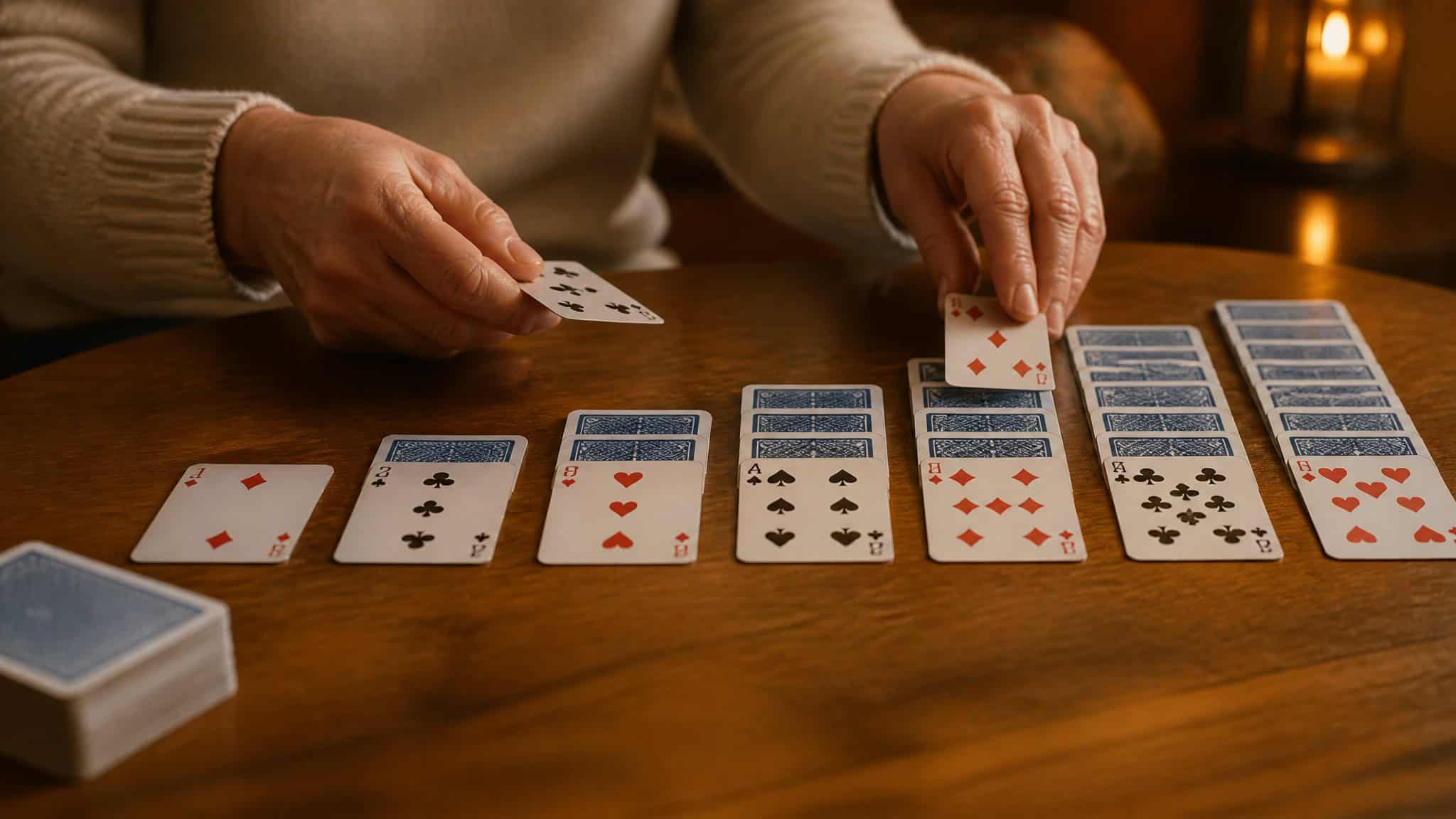
The Four Playing Areas, Laid Out Simply
Here’s the map: four different zones, and keeping them straight makes the whole game clear.
- Tableau: the seven piles in front of you. This is where the main action happens.
- Stock: the 24 face-down cards in the upper left. This is your draw pile.
- Waste: the face-up pile right next to the stock. Every card you draw from the stock lands here.
- Foundations: the four empty spots at the top right. These are your goal.
A time-saver for a lot of players: the waste isn’t another source of fresh cards. It’s a waiting area for the cards you’ve already skimmed off the stock. The main card you cleared is on top, the rest are under it, waiting their turn.
Core Gameplay: How to Move Cards in the Tableau
Now we’re playing. In the tableau, you build down in descending order, alternating colors. A black 5 can go on a red 6, because it’s lower rank and the other color. A red Jack can go on a black Queen. That red/black pattern is the rule: you can’t stack two of the same color together.

You can move one card at a time, or if you have a run that’s built down in descending order with alternating colors, you can move the whole pile as a unit. That’s a big help. Foundation cards are off-limits in standard rules; once a card goes to a foundation stack, it’s stuck there, no take-backs. It stays.
Building Down, and the King-Only Rule
Empty tableau spaces are precious, and you’ve probably guessed there’s a rule. Only a King, or a sequence starting with a King, can fill an empty tableau spot. It’s not a suggestion, it’s the law. If you free up a column for a King, it gives you some room to organize, but you can’t fill it with your four when you’re trying to reorder the stack.
When you clear all the face-up cards off a pile, you automatically flip the top face-down card over. Now you’ve got a new playable card.
Revealing Face-Down Cards
The hidden cards are the ones you actually want. The whole inner game of Klondike is digging into those face-downs. When there are no face-up cards left on a pile, that flip reveals a new card, making it available to play. It’s the central action that grows your options. You can’t move a card to a foundation unless it’s face-up, so those buried cards block your entire win until you free them.
Once you get this, you start realizing that a “good” move isn’t just the one that puts a card where it fits in the moment. It’s the one that digs out a face-down card early.
Mastering the Stock and Waste
Most of the right things to do in a run come down to feeding your tableau. When you aren’t drawing from the stock, you have run that out of stock round. When you’re out of moves in the tableau, you draw from the stock.
You flip either one card at a time (Turn 1) or three cards at a time (Turn 3) into the waste pile. Only the top card of the waste pile is available to move right away, so you’re always watching what’s exposed. When the stock cards run out, flip the waste face-down to make the stock. No shuffling, that just starts a fresh pass through the deck.
So what happens when you run out of moves? You flip the waste into the stock and go again. Different apps allow different passes, no shuffling. Some let you go forever, while others limit you to three; that’s called “Max 3 Cycles.” It’s cheap to see the same cards over and over.
Draw Rules: Turn 1 vs Turn 3
Here’s the big toggle, and it’s a real one. Do you flip one or three cards? It’s the single most important choice you’ll make before dealing.
- Turn 1: draw one card from the stock at a time, and every card in the stock eventually becomes available. That’s the easy setting. An algorithm using smart search typically wins about 52% of Turn 1 games.
- Turn 3: draw three at once, but only the top is playable. That means some cards might stay buried forever that deal, unreachable. Algorithms win only about 18% of Turn 3 games.
If you’re learning the game, switch that toggle to “Turn 1.” You immediately improve your odds and your sanity. Many apps default to Turn 3, which frustrates newcomers before they even learn the rules. Turn 1 is the beginner’s move, and it doesn’t make you less of a player.
How to Win, and When It’s Actually Lost
The goal is crystal: you win when all four foundations are built, Ace up through King in each suit.
You lose when you can’t make any more moves. But here’s the thing most players miss: it’s “no meaningful moves.” Sometimes you have a legal move but it’s just moving a card from one pile to another, leaving you staring at the same face-down cards. That’s usually a signal that you’re stuck.
The takeaway: before you shuffle and re-deal, look once more. There’s often one sequence of moves you haven’t seen that unlocks a hidden card, and a solid how to win solitaire strategy can help you spot it. Sometimes the round genuinely isn’t winnable, and you can surrender anytime, no one’s judging. But give the tableau one last good scan before you fold.
Realistic Odds. So You Know It’s Not You
Let’s talk real expectations, because the math is actually kind of fun. And it’s great comfort.
Nobody truly knows the exact odds of winning with perfect play. Mathematician Persi Diaconis famously called it “one of the embarrassments of applied probability,” which is the only mathematical phrase I’ve ever laughed at. Every card position in a “Thoughtful Solitaire” game shows an upper bound win rate around 82%, but that’s not the actual game. So, is solitaire a game of skill or luck? That’s knowing every card’s hiding spot, which changes the answer entirely.
In real, random games, here’s the honest picture:
- An AI using Monte Carlo tree search solved only 35% of random games.
- A different algorithm won 52% of its Turn 1 starts.
- For Turn 3, that same algorithm drops to about 18%.
- A skilled human player won 43% of their games.
- An old Hoyle’s rulebook suggests you might win 1 in 30 games if you only get one pass through the deck.
Losing deals is statistically normal. Even AI agents lose. It’s not you, and it’s definitely not your luck. The game is built with real randomness that often isn’t fair.
Common Beginner Mistakes and How to Dodge Them
Most losses aren’t just bad luck; they’re a series of good-looking moves that starve the board. Start avoiding these.
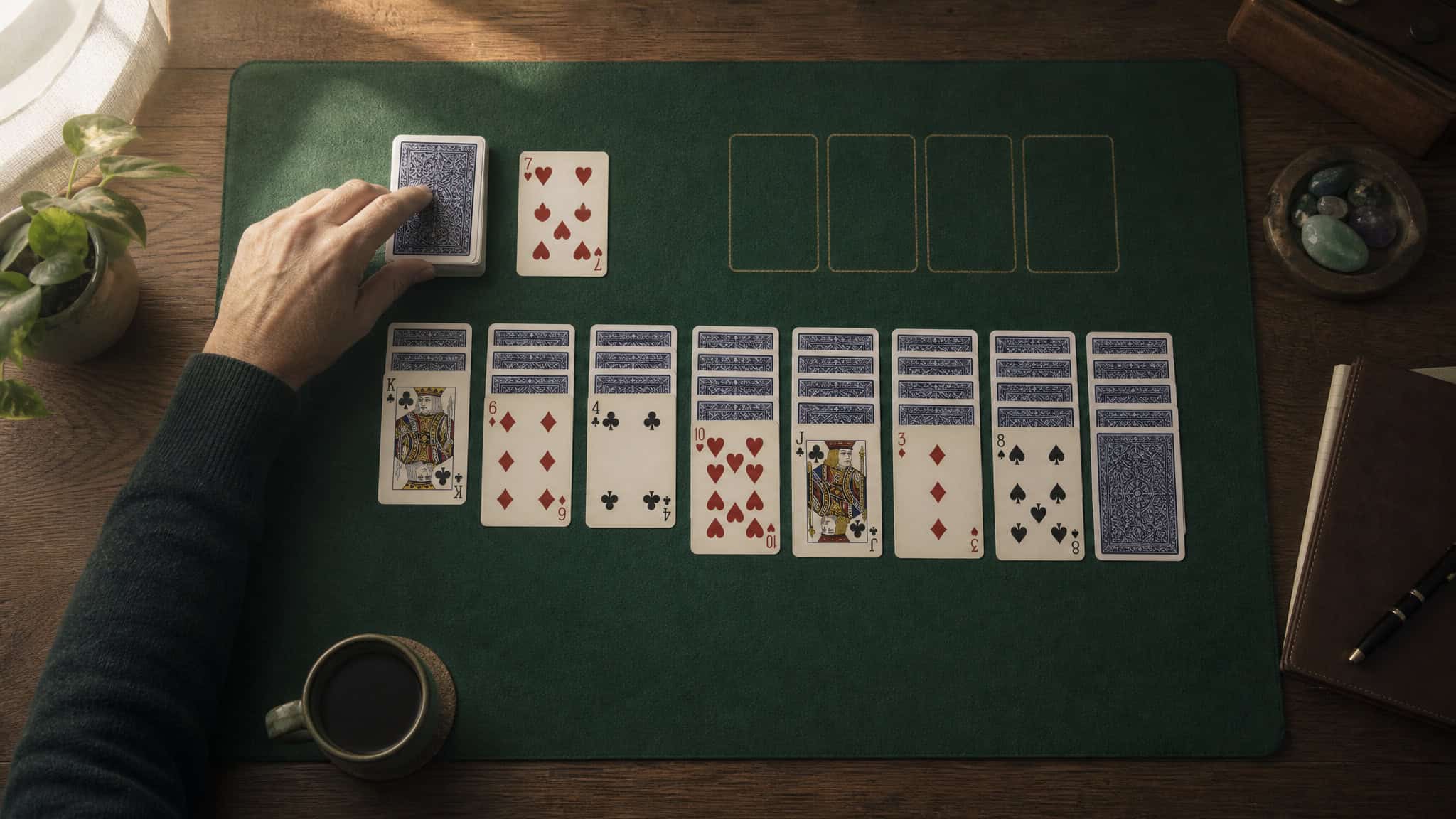
Rushing the foundations. Moving that 2 of Hearts up to the foundation feels great, but it can bury a card that should have been uncovering the tableau. If you’re in doubt, wait, especially if you’re playing one of the top classic card games to enjoy alone, where the objective is simply to move all cards to the foundation piles in sequence by suit. The foundation will still be there.
Not checking the waste first. When you’re in Turn 3, the card you need might be turning over in the waste pile, not one hidden in the stock. Look there before you start planning anything.
Breaking the King-only rule. When an empty column appears, don’t waste it on just any card. That’s your spot to park a King. Using it for a 7 is friendly, but it might be giving up the game’s biggest flex later.
Quitting too early. We said it already, that one last scan. Most games don’t end in a dramatic dead-end, they end because a player saw no legal moves at the current moment and stopped looking.
Starving the tableau. Building long sequences that feel neat is satisfying, but if you’re not freeing up hidden cards, you’re just prettying up a losing board.
Beginner Strategy: Play That Makes Winning More Likely
Let’s flip the negatives into five filters you can apply your next game.
- Make your moves that reveal face-down cards early. Exposing new cards is the best move in the game, even more valuable than scoring a foundation card sometimes.
- Save those empty columns for Kings. It gives you a landing spot to reorganize.
- Watch the waste pile carefully, especially if you’re on Turn 3. Plan your draws based on what you see coming up.
- Delay foundation moves until the card isn’t needed for tableau progress. If that card is the bridge to a hidden card, keep it in play, even if it’s tempting to clear it.
- Prioritize uncovering moves over pure stacking. Your first five moves should be about looking, not collecting.
Think of your first moves as a surveyor, not a collector. The game gets easier when you’re looking for options, not just building stacks.
Scoring. How the Apps Count Points
If you’re playing on a screen, the score ticker can be distracting. Here’s how the classics count it.
The Microsoft Windows Solitaire baseline is your default:
- Waste to Tableau: +5 points
- Waste to Foundation: +10 points
- Tableau to Foundation: +10 points
- Turning over a face-down card: +5 points
- Taking a card from Foundation back to Tableau: -15 points
- Recycling the waste when playing Turn 1: -100 points
Solitaire Palace has its own numbers: +5 for foundation, +2 for revealing a card, -2 for browsing stock again, -1 for undo, +1 for solving a round, and a +1 bonus for each player you beat in multiplayer.
The big point: scoreboards don’t all match. If you’re chasing points, know the settings of your app. If you’re playing to finish, ignore them both.
Custom Rules and Game Modes You’ll Encounter
Digital versions throw menu options at you. Here’s your translator.
- Turn Three: yes, that’s the draw-three-at-a-time rule, just faster.
- Joker: your three Jokers change the game in the “auto-place” mode.
- Undo Off: disables the undo button entirely. For when you want to be extra hard on yourself.
- Max 3 Cycles: limits your recycles through the stock.
- Fast: speeds up the clock because someone is always in a hurry.
- Relaxed mode: shows all tableau cards face-up from the start, great for no-pressure learning.
- Easy: lets any card, not just a King, fill an empty spot.
- Double: play with two decks, a different game entirely.
- Training: no scoring, no pressure, just the play.
If you just want to play and breathe, reload the menus and pick “Turn 1, no timer, relaxed mode.” That’s the friendly on-ramp.
Variants. Other Games in the Klondike Family
Once you know Klondike, there’s a whole family to meet, though it’s fine to stay here for a while. If you want an easier version for practice, you’ll love Easthaven. It deals only 21 cards into seven piles of three, and you only deal a new card when you’re stuck. That’s a lot less pressure.
If you’re curious about the branching: Agnes deal bails the stock in batches of seven. Nine Across gives you nine columns and lets you pick the foundations. Thumb and Pouch lets any card fill an empty spot and builds in a more relaxed way. Whitehead deals all cards face-up and lets you move same-suit sequences as a block. They each trade the rulebook around a little, but they’re clearly family.
A Quick History: Why Klondike Is “The” Solitaire
So why is everyone playing this exact game? The name probably comes from the Klondike Gold Rush in the 1890s, but there’s no solid proof. Nice story though.
The earliest known rules came out in the 1907 Hoyle’s Games book as “Seven-Card Klondike.” By 1913, it was just called Klondike, and the game changed to draw one instead of draw three. Then in the 1990s, Microsoft encouraged it into Windows. That’s the moment it became “the” solitaire, man. It’s been the most-used Windows app for years, and why everyone knows this one by heart.
Canfield’s a different game, so you can stop looking for those moments where they mix it up.
Where to Play Online (and on Your Phone)
If you don’t have an actual deck handy, you might not need to leave the browser to get that card fix. You’ll find decent digital options.
TheSolitaire.com is a good starting point. It’s free browser-based, no registration, and works on your phone. It supports both Turn 1 and Turn 3, and includes undo, hints, and saved progress. No ads, which is rare.
Solitaire Palace offers online multiplayer if you’re into it, plus custom rules and its own scoring. Both sites work well on a phone, so you’re covered no matter your break.
Conclusion: Let the Quiet Win
The kid’s still asleep, you’re at a table with a deck of cards and a new rulebook now. You know the map: the setup, the seven-pile tableau, the stock and waste, four foundations awaiting a king. The real goal is to get all four from Ace to King, and sometimes it’s going to happen.
A lot of times, it’s not. Even the AI wins under half, and that’s completely okay to you lose most games, that’s everything you typed. That’s just the deal.
So start small. Play Turn 1, turn the score off, open easy mode and just play. Maybe you win, maybe you don’t, but you got all in fifteen minutes of quiet focus to be your own, without anyone asking for a snack. That’s the point.
Frequently Asked Questions
Do you flip 1 or 3 cards in solitaire?
In Klondike solitaire, you can choose to draw one card at a time (Turn 1) or three cards at a time (Turn 3) from the stock. Turn 1 is easier because every card in the stock eventually becomes playable, while in Turn 3, only the top card of the waste pile is available, and some cards may stay buried for the whole game.
What are the most common solitaire mistakes?
Common mistakes include rushing to move cards to the foundation piles too early, not checking the waste pile for playable cards, using empty tableau columns for non-Kings, and quitting too soon without scanning for hidden moves. The biggest one is starving the tableau by not prioritizing moves that reveal face-down cards.
What is the easiest solitaire to play?
Klondike with the Turn 1 draw rule is the easiest version of the classic game. You can also enable ‘Relaxed mode’ or ‘Easy’ settings in many apps, which show all cards face-up or allow any card to fill an empty spot, making it much simpler for beginners.
What is the difference between Turn 1 and Turn 3 in solitaire?
Turn 1 means you draw one card from the stock at a time, making every card eventually available to play. Turn 3 means you draw three cards at once, but only the top card of the waste pile is playable, which makes the game significantly harder—algorithms win about 52% of Turn 1 games but only 18% of Turn 3 games.
Can you move cards from the foundation back to the tableau in solitaire?
In standard Klondike rules, no—once a card is placed on a foundation pile, it cannot be moved back. However, some digital versions allow this as a custom rule, but it usually costs points (e.g., -15 points in Microsoft Solitaire) and is not part of the classic game.
How many times can you go through the stock in solitaire?
It depends on the version you’re playing. Many apps allow unlimited passes through the stock, while others limit you to three cycles (often called ‘Max 3 Cycles’). In traditional rules, you might only get one pass, which makes winning much harder—Hoyle’s suggests you might win only 1 in 30 games that way.
What is the best strategy for winning solitaire?
The best strategy is to prioritize moves that reveal face-down cards, save empty tableau columns for Kings, and avoid moving cards to the foundation too early if they’re needed to uncover hidden cards. Also, always check the waste pile before making a move, especially in Turn 3, and don’t quit without scanning the board one more time.