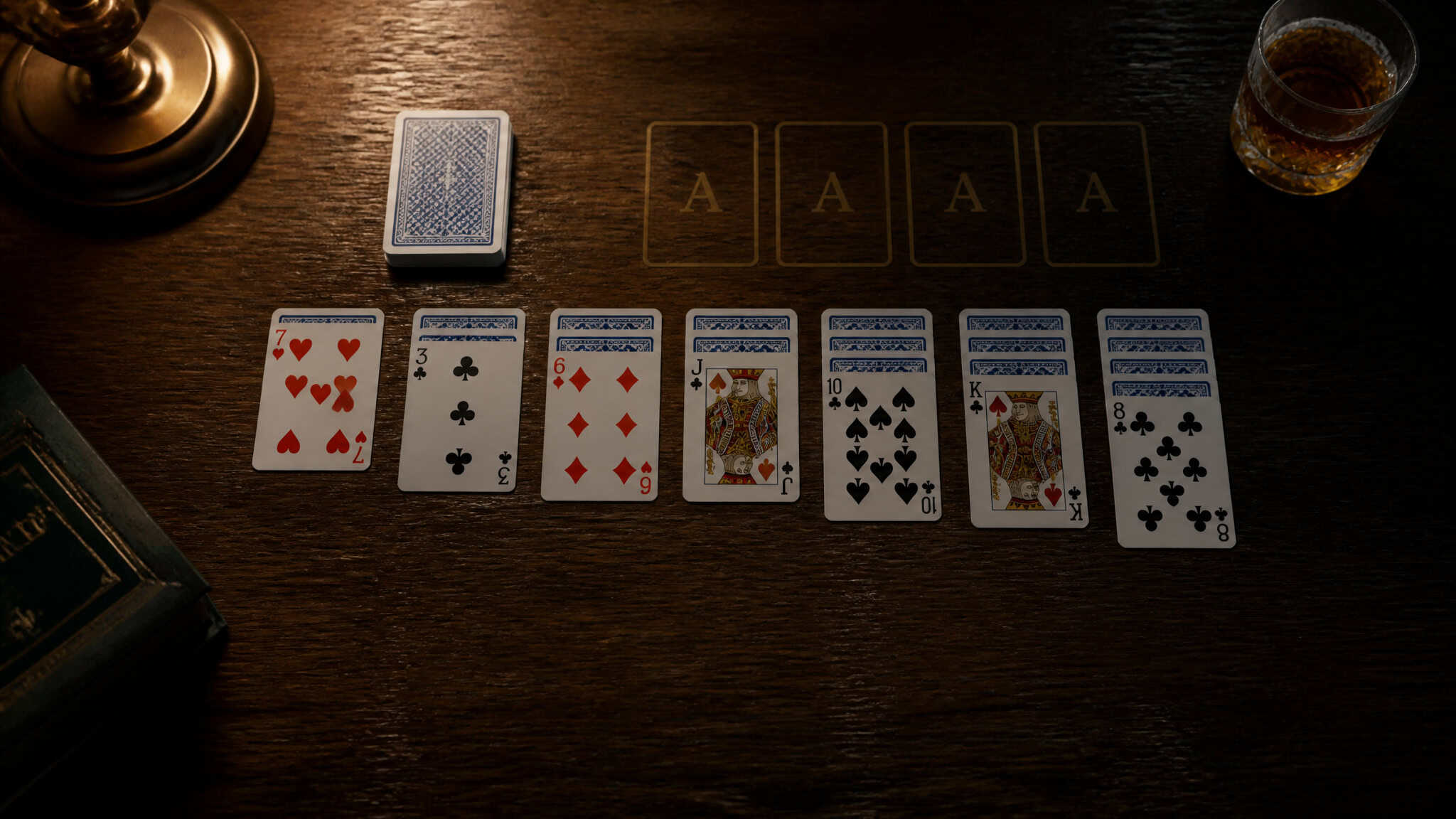
You know the feeling. You’ve got ten minutes before someone wakes up, the house is quiet, and you open solitaire on your phone. You make a few moves, the tableau starts looking messy, and suddenly you’re staring at a wall of unflipped cards with nowhere to go. The deal is lost, and you didn’t even see it coming.
Here’s the freeing part: that game was probably lost before you ever touched a card. And once you understand why, you can stop blaming yourself and start actually winning the games that are winnable.
Key Takeaways
Most Klondike deals are unwinnable from the first shuffle; even a skilled player only wins about 43% of games, meaning the goal is to stop losing the ones that had a chance.
The core principle is simple: every move should be aimed at flipping face-down tableau cards, and the deck is your tool for that, not a random pile to click through.
The most common tip you’ll see, “always move aces immediately,” is actually backwards; aces usually belong in the deck until they help you uncover a hidden card.
Table of Contents
The Truth About Winning Klondike
Let’s get the hard part out of the way: most Klondike games are just not winnable. It’s not you. The cards are dealt in a way where you can’t turn over all the tableau cards, no matter how clever you are.
This is the thing that separates people who get frustrated from people who actually enjoy the game. Strategy doesn’t guarantee wins, but it maximizes the winnable ones.
In one actual experiment, a skilled human player won 189 out of 442 games. That’s about 43%. Not 90%, not even half. And Klondike isn’t just the best-known solitaire variant, it’s also one of the most challenging ones out there. So if you’re losing games, you’re in good company.
The goal isn’t to win every game. The goal is to stop losing the games that were actually winnable. That’s a much more achievable, and honestly more satisfying, target.
Klondike 101: The Layout and Rules You’re Actually Playing By
Before we get into strategy, here’s the quick refresher you already know but might not have thought about in years.
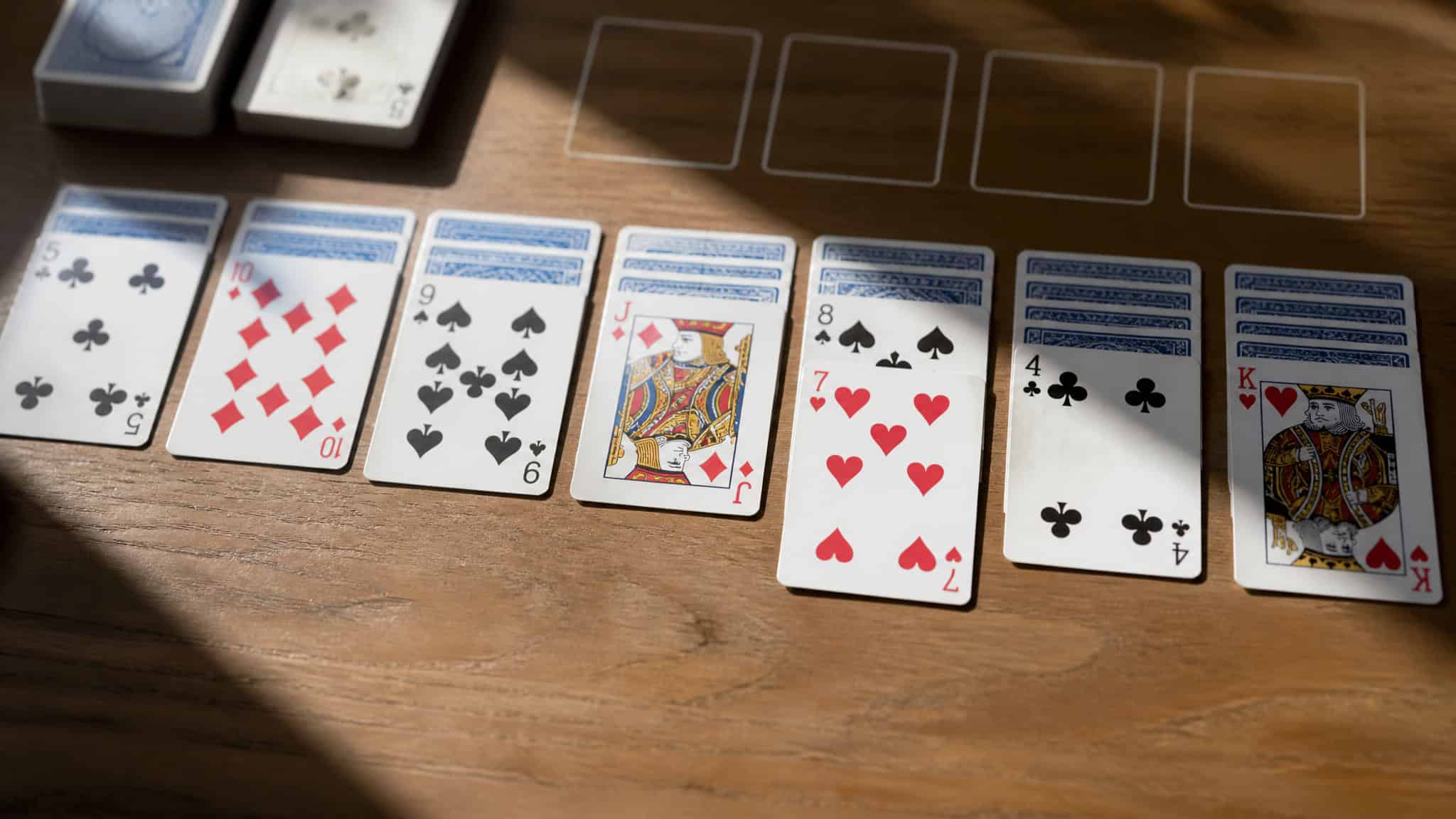
You’re playing with a standard 52-card deck, no jokers. The seven piles in front of you are the tableau, and the first pile has one card, the second has two, and so on. Only the top card of each pile faces up.
The four foundations in the corner build up by suit from Ace to King. The tableau piles are built down by alternating colors, so a red seven goes on a black eight. Empty tableau piles accept only a King or a sequence that begins with a King.
You win when all four foundations reach Ace to King. You lose when there are no more meaningful moves to make.
That’s it. Everything below is about making more meaningful moves.
The One Principle That Changes Everything: Flip Face-Down Cards First
Move face-up cards and streaks to flip face-down tableau cards.
That’s the whole secret. Every move should be in service of that goal. Those big stacks of face-down cards are where games go to die. You’re not trying to clear the tableau for its own sake. You’re trying to get at what’s underneath.
Most games are lost because you can’t turn over all the tableau cards, not because you made one dramatic, avoidable mistake. So when you have a choice between two moves, always pick the one that reveals a face-down card. And if both moves flip a card, pick the one in the column with the most hidden cards. That’s where the action is.
This even applies to aces and twos. Don’t move them to the foundation just because they’re there. Play them when they help free up space and uncover cards. If they don’t serve the flip-first principle, they can wait.
How to Use the Deck (Without Sabotaging Yourself)
The deck isn’t just a random pile. It’s a tool. Use it to help you flip those tableau cards.
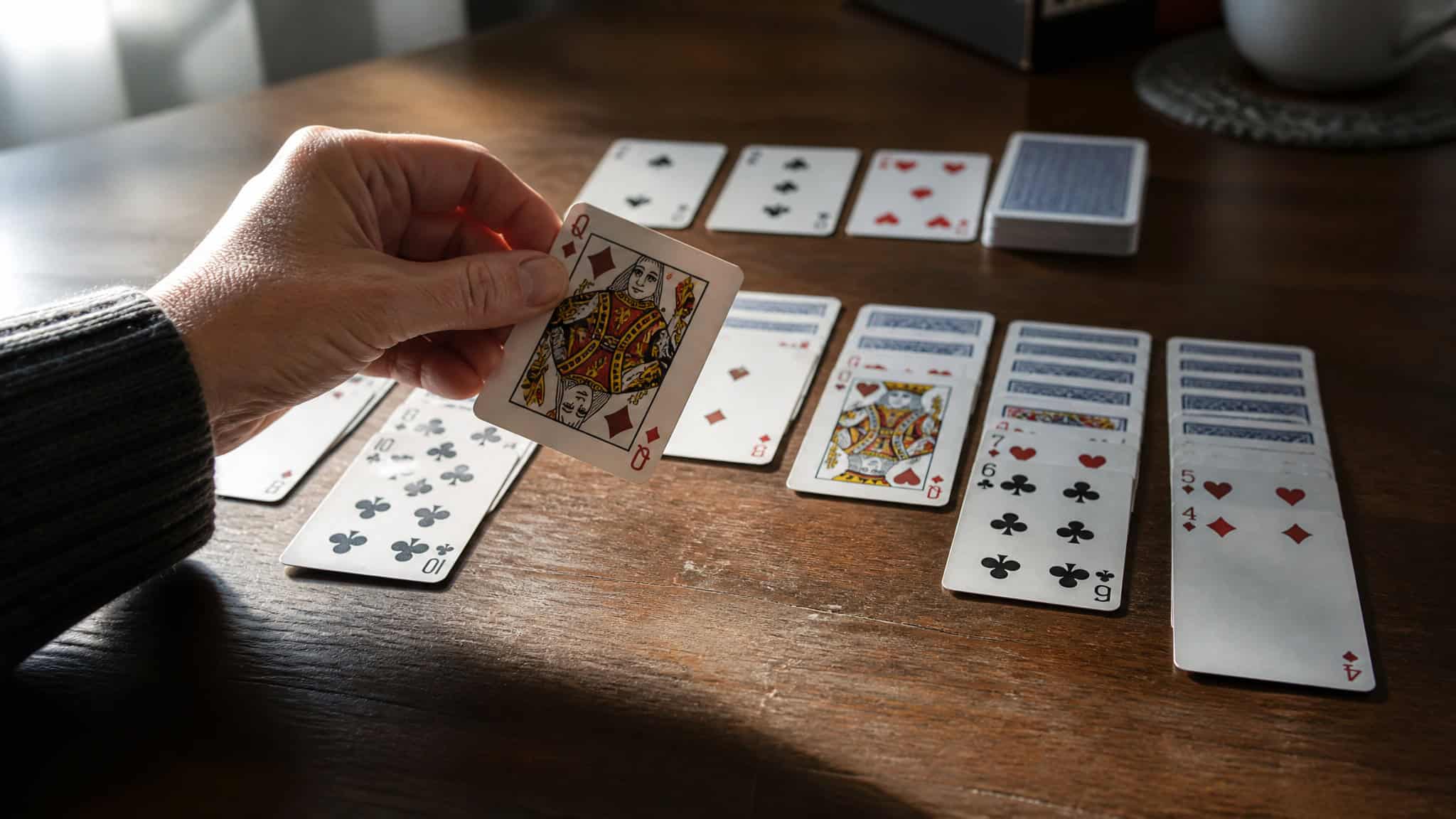
Here’s the mistake most people make: they see a card in the deck that can go on the tableau, and they slap it down because they can. Don’t do that. A deck card should only move to the tableau if it’s helping you flip a face-down card.
Why? Because that card you just placed might be the exact card you needed to move a tableau card later. Randomly placing deck cards can mess up your tableau and make things worse. You might block a spot that a same-color-and-number card needs down the line.
One of the best things you can do is flip through the entire deck at the start of the game. Just see what you’re working with. Knowing what’s in the deck helps you make better decisions about flipping tableau cards.
If you’re playing draw-three mode, there’s a nice trick: cards in positions that are multiples of 3, like the 3rd, 6th, and 9th, are playable without you having to manipulate the deck. Play those first before you start messing with the front of the deck.
Also, watch out for the first few cards in the deck. They can be tricky. Say you’ve got a ten of diamonds, then a ten of hearts, then a nine of clubs. That nine of clubs is stuck because the red tens are buried.
You might be able to build the club foundation up to the eight to free that nine, but honestly, it’s not likely. That’s a dead game.
Here’s a practical preference rule: if you can either move a tableau streak to flip a card, or place a deck card on that streak, go with the tableau move. Unless the deck is almost stuck. If not placing that deck card will completely stall the deck, then placing it might be the better move to free things up. And if you have two same-color-and-number cards from the deck that can go on a tableau card, play the earlier one. It changes the deck order more, which can help.
The Ace Question: Why You Shouldn’t Move Aces Immediately
The most common piece of solitaire advice is strategically wrong. “Always move aces and twos immediately” might sound logical, but it’s not serving your actual goal.
Don’t move aces from the deck to the foundation unless they help flip a tableau card. That’s it. Aces can almost always be placed on the foundation later. Moving them early can block the exact moves you need.
Here’s a concrete example. Say you have a two of clubs face-up on a tableau column, and the ace of clubs shows up in the deck. You might want to hold off on moving that ace. Moving it to the foundation might block flipping the card beneath that two.
The exception, of course, is if the ace is near the front of the deck and will be hard to get to later. Then keep it in the deck. Don’t feel pressured to move it right away just because you can.
Foundation balance matters too. Don’t build up one suit way ahead of the others. If you build one suit up too much, it gets harder to flip cards of the opposite color in the tableau. You might need those cards later.
When is it safe to move a card to the foundation? If a face-up tableau card isn’t needed to flip other cards, you can move it without worrying. An ace facing up is a no-brainer. But sometimes, understanding card game strategy helps, for instance, classic card games to enjoy alone often rely on such tactical moves.
Building foundation piles actually helps you flip tableau cards. Removing a five of clubs might require building the club foundation from ace to four first. It’s a means to an end.
Choosing Between Moves: The Tableau Decision Rules
When a card can go on either of two tableau cards, choose the one that keeps the suits alternating. It’s a small thing that matters more than you’d think.
Here’s the example: say you have a seven of diamonds. It can go on a streak ending with an eight of clubs, like ten of spades, nine of hearts, eight of clubs. Or it can go on one ending with eight of spades, like nine of diamonds, eight of spades. Choose the spades one.
Why? Because you might need to build foundation piles to flip a card, and having matching suits helps you do that.
Prefer moving tableau streaks over placing deck cards on those streaks, unless the deck is almost stuck. And arrange your columns so same-colored cards in each pile are matching suits. If you have a red seven of hearts, a black six of spades, and you have the choice between a five of hearts and a five of diamonds, choose the five of hearts to match the seven.
Move cards purposefully with future moves in mind. Don’t shuffle cards just because you can. Every move should be opening up other moves or exposing hidden cards.
Empty Columns and Kings: When to Create Space, When to Wait
An empty column without a king is wasted space. That’s the whole section right there.
If a tableau column has no face-down cards, don’t waste effort trying to clear it out. Move a card from a column like that only when you have a king to put there, whether face-up in the tableau or in the deck.
And here’s the thing: avoid opening an empty column without a king ready to occupy it. Remember, an empty column requires a King or a King-led sequence. If you create one and you’ve got nothing to put in it, you’ve just wasted a column.
The color of the king matters, too. A red king necessitates a black queen, which in turn requires a red jack, and so forth. A black king forces a red queen, then a black jack. So when deciding which king to place in an empty column, look at the color of the cards blocking your hidden cards.
If a red jack is blocking the cards you need, pick the red king and wait for a black queen. Match the colors to what you’re trying to clear.
The Mistakes That Lose Winnable Games
The game is lost in the aggregate of small decisions, not one big dramatic error. Here’s what I’ve learned to watch for.
Moving cards to the foundation too early limits later tableau moves. We covered that with aces, but it applies to other cards too. If you need the four of clubs to move a three of hearts, don’t put that four in the foundation. Premature moves are the silent killer.
Building foundation piles unevenly reduces available cards of the opposite color. If you’ve got a red five of hearts in the foundation while other foundations only have twos, that’s a clue you’re progressing too fast. You might need that red five, four, or three of hearts for later moves.
Creating empty columns without a king wastes space. We just talked about that. Don’t do it.
Moving deck cards to the tableau without purpose blocks needed cards. We covered that too. Every card placement should have a reason.
Playing too quickly without seeing obvious moves is a big one. Slow down. Look at the whole board before you click. And if you’re playing on a computer, use the undo button.
It’s not cheating. It’s a practice tool. Try different choices and maximize your chances of winning the winnable games.
The Real Odds: What the Math Says About Your Chances
Nobody actually knows the exact probability of winning Klondike with perfect play. A famous statistician called it “one of the embarrassments of applied probability.” That’s right, even the math people don’t have this one figured out.
But we have some numbers to set your expectations. In “Thoughtful Klondike,” a modified version where you can see all the card locations, the win rate with draw-three is about 81.9%. That’s the upper bound. Regular Klondike is lower because you don’t know what’s under those face-down cards.
A computer program using a specific search algorithm solved up to 35% of random games. Another algorithm wins about 52% of games in turn-one mode and 18% in turn-three mode. And a skilled human player won 189 out of 442 games, which is about 43%. Hoyle’s Rules of Games suggests you might win 1 in 30 games with one pass through the deck.
The takeaway? If you’re winning close to half your games, you’re playing at a high level. If you’re winning one in thirty, the cards aren’t cooperating, and that’s not your fault, though understanding what’s the point of solitaire might help reframe those losing streaks as part of the game’s quiet rhythm.
One-Card vs. Three-Card Draw: Which Should You Play?
If you want to win more often, play one-card draw. That’s the honest answer.
The AI data backs this up: 52% win rate in turn-one mode versus 18% in turn-three. That’s a huge difference. Draw-three requires you to pay close attention to deck order, and cards in positions that are multiples of 3 are the ones you can access without manipulating the deck. Turn-one mode offers more options per draw, just fewer cards per draw.
So if you’re playing for the win, one-card draw is the way to go. Three-card is for when you want a challenge, or when you’re fine losing more often.
Your First Move: How to Open Any Game
Before you touch the stockpile, move cards on the tableau. This creates options: building foundation piles, opening columns for kings, and uncovering cards.
Here’s a concrete example. You have an ace in the first pile and a king in another column. Move the ace to the foundation, then move the king to the empty column. Simple, right?
If no aces are showing, use numeral cards to create an empty column. Say the first column has a seven of clubs and the third column has an eight of hearts. Move the seven onto the eight to create an empty column for a king. Then look for a black nine to move the entire column.
After making tableau moves, check the stockpile. Drawing a useful card might open up opportunities to move cards to the tableau or foundation. And before you make any other moves, turn up the first card off the deck. It increases your options and gives you a better choice of what to do.
Don’t make unimportant moves. The best move is one that opens up other moves or exposes hidden cards.
Beyond Klondike: Variants That Change the Rules
Each variant changes the strategic calculus, sometimes in surprising ways. Here’s a quick tour.
Agnes deals the stock in batches of seven onto reserve piles, and the foundations depend on the twenty-ninth card. Easthaven deals twenty-one cards into seven piles of three, with two face-down and one face-up, and you deal seven new cards to the tableau when play stalls. Nine Across gives you nine columns instead of seven, and you get to choose which cards form the foundations. Somerset, or Usk, is like Klondike but all cards are dealt out, ten in the first row, nine in the second, and so on.
Thumb and Pouch lets you build a card on another of any suit except the same suit, and any card or sequence can occupy empty spaces. Whitehead deals all cards face up, building is by color, and a sequence of the same suit moves as a unit. Westcliff deals thirty cards into ten piles of three. Kuipers is like Klondike but with eight columns, one card at a time, with no limit on passes through the deck.
There’s also Las Vegas Solitaire, where you pay to play and the house pays per card to the foundations. Joker Solitaire, created by Joli Quentin Kansil, adds two jokers as limited wild cards. And Double Solitaire for two players, each with their own pack but sharing the foundations. All 52 cards in each deck are in play, and the strategic shifts come from the altered dealing and building rules.
The point is, what works for Klondike won’t always work elsewhere. The same strategic instincts, like planning ahead and understanding suit patterns, transfer. But the rules change the calculus entirely.
Scoring Strategy: How Microsoft Solitaire Rewards Certain Moves
The scoring system in Microsoft Solitaire rewards a specific play pattern, and it’s the same one that wins games.
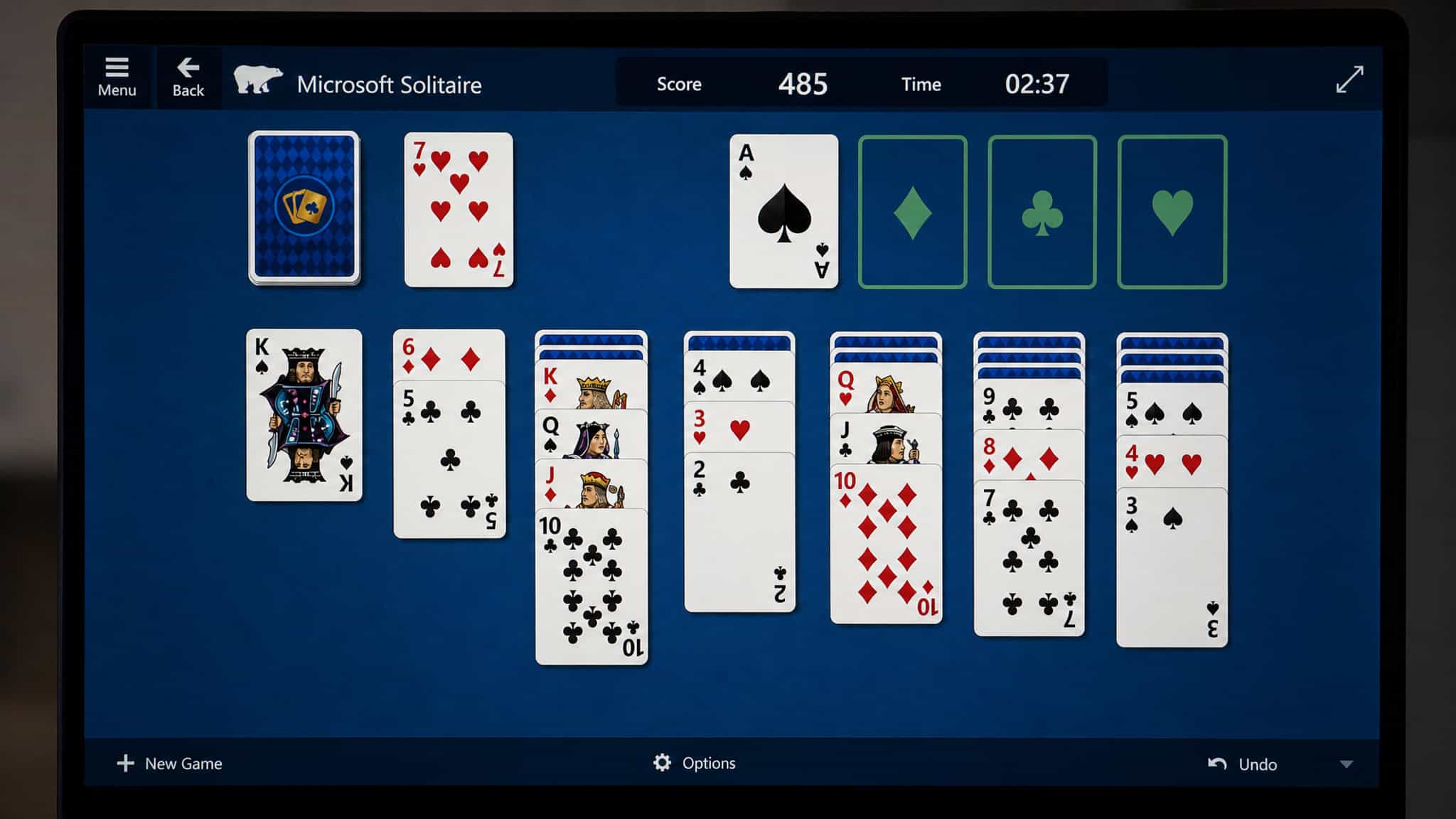
Moving a card from the waste to the tableau gives you 5 points. Moving a card from the waste to the foundation gives you 10 points. Moving a card from the tableau to the foundation gives you 10 points. Turning over a tableau card gives you 5 points.
Moving a card from the foundation back to the tableau costs you 15 points. And recycling the waste when playing by ones costs you 100 points, with a minimum score of 0.
Notice the pattern. You get 5 points for moving a card from waste to tableau, then 10 points for moving it from tableau to foundation. That’s 15 total, versus 10 for moving it directly from waste to foundation. The scoring system rewards routing through the tableau, which is also the winning pattern. It’s not a coincidence.
In timed games, you lose 2 points every 10 seconds. The bonus formula is 700,000 divided by your seconds to finish, if you finish in at least 30 seconds. If you finish faster, the bonus is capped. So don’t rush. Accuracy matters more than speed, and the game rewards finishing under 30 seconds with a capped bonus.
Digital Solitaire: Why the Computer Version Made It Famous
Klondike’s popularity boost came from being included in Microsoft Windows in the 1990s. Microsoft included Solitaire starting with Windows 3.0 in 1990, initially as a diversion, but also to teach people how to use a mouse. It worked. By 1994, Microsoft said Solitaire was the most-used application for Windows.
There were earlier digital versions, like Atari Program Exchange’s Solitaire by Mark Reid in 1981, and Michael A. Casteel’s Macintosh shareware version in 1984. Klondike was also added to Nintendo’s Clubhouse Games series. But Windows is what made it a household name.
The practical advantage of digital play is the unlimited undo feature. Use it. It’s a practice tool that lets you try different choices and maximize your chances of winning.
A Quick History: Why It’s Called Klondike
The name “Klondike” might come from the Klondike Gold Rush, but there’s no real evidence for that. The earliest rules we know of are from 1907, in Hoyle’s Games, listed under “Seven-Card Klondike.” By 1913, the Official Rules of Card Games called it “Klondike” with a one-card deal modification, which means going through the deck one card at a time instead of three.
Fun fact: Klondike was historically called Canfield in America. The original Canfield himself called his game “Klondike.” And today, Canfield is more usually the American name for the patience game that England calls “Demon.” It’s a naming tangle, but that’s history for you.
When people in the US and Canada say “solitaire,” they usually mean Klondike. In the UK, it’s often just known as “Patience.”
Related Games: When Klondike Strategy Doesn’t Transfer
There are other games that look like Klondike but play completely differently. Addiction Solitaire, for example, eliminates aces, introduces voids, and gives you one reshuffle per game. The strategy emphasizes planning and location sense over chance, with a focus on one suit at a time and using blank spaces as lifelines. Reserve your reshuffle for stuck situations, and remember that the mental agility this demands offers solitaire brain benefits that go beyond mere luck.
Solitaire Klondike Classic Fun, the mobile app, features a hint system where each hint counts as an additional move, and league promotion where the top 15 players get promoted every two days. It’s a polished version with customization options, though it has intrusive ads at the start and end of games, and occasional connectivity glitches.
The key takeaway from all of this is that the same strategic instincts, things like planning ahead, thinking about future moves, and understanding suit patterns, do transfer. But the rules can change the calculus entirely. What works for Klondike won’t always work elsewhere.
Every deal is a puzzle to solve as far as it will go, not a win to force. The principles in this article won’t make you win every game, because nothing will. But they’ll help you stop losing games that were actually winnable.
And sometimes that’s the best you can do. In solitaire, as in parenting, the win is often just not making it worse. Prioritize the hidden cards, not the obvious ones. It’s a pretty good life lesson, honestly.
Frequently Asked Questions
What is the best tactic to win Solitaire?
The core tactic is to prioritize flipping face-down tableau cards above everything else. Every move you make should serve that goal, whether it’s moving a streak, placing a deck card, or building a foundation. If a move doesn’t help uncover a hidden card, it’s probably not the best move.
What are the most common Solitaire mistakes?
The biggest mistakes are moving aces and twos to the foundation too early, placing deck cards on the tableau without a clear purpose, and creating empty columns without a king ready to fill them. These moves can block the exact cards you need to flip face-down tableau cards and turn a winnable game into a lost one.
Is there a trick to winning solitaire cash?
The trick is to play one-card draw instead of three-card draw, as it offers a significantly higher win rate. Also, focus on the flip-first principle: every move should be aimed at uncovering face-down tableau cards, not just clearing obvious moves. Winning cash games requires maximizing your win rate on the deals that are actually winnable.
How to never get stuck in Solitaire?
You can’t never get stuck, because most Klondike deals are unwinnable from the start. However, you can avoid getting stuck on winnable games by flipping through the entire deck at the start to know what you’re working with, and by prioritizing moves that reveal face-down cards over moves that just seem convenient.
What’s the difference between one-card and three-card draw in Solitaire?
One-card draw offers a much higher win rate, with computer algorithms winning about 52% of games compared to just 18% in three-card mode. Three-card draw is more challenging because you have fewer options per draw and must pay close attention to deck order, specifically which cards are in positions that are multiples of 3.
Can you win every game of Solitaire?
No, you cannot win every game of Solitaire. Most deals are unwinnable from the start, and even the best players only win around 43% of games. The goal isn’t to win every game, but to stop losing the games that were actually winnable by making the right strategic moves.