
Weight loss injections are everywhere right now. Your feed, your group chats, the checkout line magazine rack. And the coverage of prescription weight management injections splits into two camps that both make my eyes glaze over: either it’s a glowing ad or it’s a scary headline about stomach paralysis. Neither one answers the question women actually whisper to each other, which isn’t “does it work.” It’s “do I have to take it forever?”
So here’s the honest arc, all of it. These injections copy hormones your body already makes, the ones that tell your brain “food’s here, you’re full.” That’s the whole trick, and we’ll get into how it works. But this article isn’t just the upside.
We’ll cover who actually qualifies, what the side effects are really like, and what happens when you stop (spoiler: this part just sucks, and you deserve to know before you start). Not because I’m trying to talk anyone out of anything. Because the fine print is where the real decisions live.
Key Takeaways
Your body’s natural GLP-1 fullness signal sticks around for only about two minutes; the drug version keeps it going roughly five days, per Deborah B. Horn of UT Physicians.
The drugs work alongside lifestyle change, not instead of it: in the trials, everyone also received lifestyle counseling.
Weight regain after stopping is the norm: about two-thirds of lost weight came back within a year in the STEP 1 extension, and a 2026 Oxford meta-analysis found regain of roughly 0.8 kg (about 2 lb) a month.
Table of Contents
How weight loss injections work in your body
Short version: the injections mimic natural gut hormones called GLP-1 and GIP. (GLP-1 stands for glucagon-like peptide-1, and GIP is glucose-dependent insulinotropic polypeptide, but please don’t let that scare you off. They’re hormones your gut releases when you eat, to tell your brain “food’s here, you’re full.”) The drugs copy those signals, which cuts appetite, makes food feel less exciting, slows stomach emptying, and nudges insulin up.
Here’s the fact I have now told approximately everyone I know. When you eat something, your body releases GLP-1 to signal fullness, and that signal fades after roughly two minutes as your body breaks it down. Two minutes. The drug version keeps that fullness signal going for about five days.
That’s per Deborah B. Horn, an obesity medicine specialist with UT Physicians, and it’s the entire trick behind easier portions and quieter cravings. Your body already does this. The shot just does it for way, way longer.
The brain part
The drugs act on two areas in your brain. One is the hypothalamus, which is the appetite control center. The other is the mesolimbic pathway, which is the reward circuit, the reason a warm chocolate chip cookie feels like a hug.
This is where “food noise” comes from, the term you’ve probably seen all over social media. It’s not marketing, it’s real neuroscience: the background hum of thinking about food, planning food, wanting food even when you’re not hungry. When the reward circuit quiets down, that hum fades. Not zero hunger, not a robot state. Just less mental real estate spent on snacks.
And can I validate something: some people find the quiet weird, even a little sad. Food is celebration and comfort and Friday night pizza, and when it stops hitting the same, that’s a genuine loss for some folks. It’s okay to feel that and still be glad about the results.
The gut part
Your stomach empties slower on these drugs, so fullness sticks around after meals. Think of it as the meal that keeps giving. You eat a normal-ish plate and you’re still satisfied two hours later, which for a lot of people is a genuinely new experience.
That slower emptying is also why nausea is the number one side effect. Your stomach is holding food longer, so an overstuffed or greasy meal sits there making its opinions known. We’ll come back to that.
The pancreas part
The drugs also tell your pancreas to release more insulin (the hormone that moves sugar out of your blood) and less glucagon (the hormone that raises blood sugar back up). More insulin, less glucagon, steadier blood sugar.
And now the “oh, that makes sense” beat: this is why these drugs started as diabetes treatments. Exenatide, sold as Byetta, was the first, FDA-approved back in 2006. Then Ozempic‘s 2017 approval made the whole class famous, mostly because doctors and patients noticed people were losing significant weight on a diabetes drug. The weight loss was the discovered effect, not the original purpose. All of it, the appetite quieting, the steadier blood sugar, comes down to hormones your gut releases every time you eat.
Why one drug has two names: Ozempic, Wegovy, Mounjaro, and Zepbound
If the brand names feel like alphabet soup, that’s because the pharmaceutical industry did something genuinely confusing: it sells the same molecule under different names depending on what it’s approved to treat. Horn herself has said the differences and similarities between these drugs and all their brand names are legitimately confusing, which is deeply validating for the rest of us.
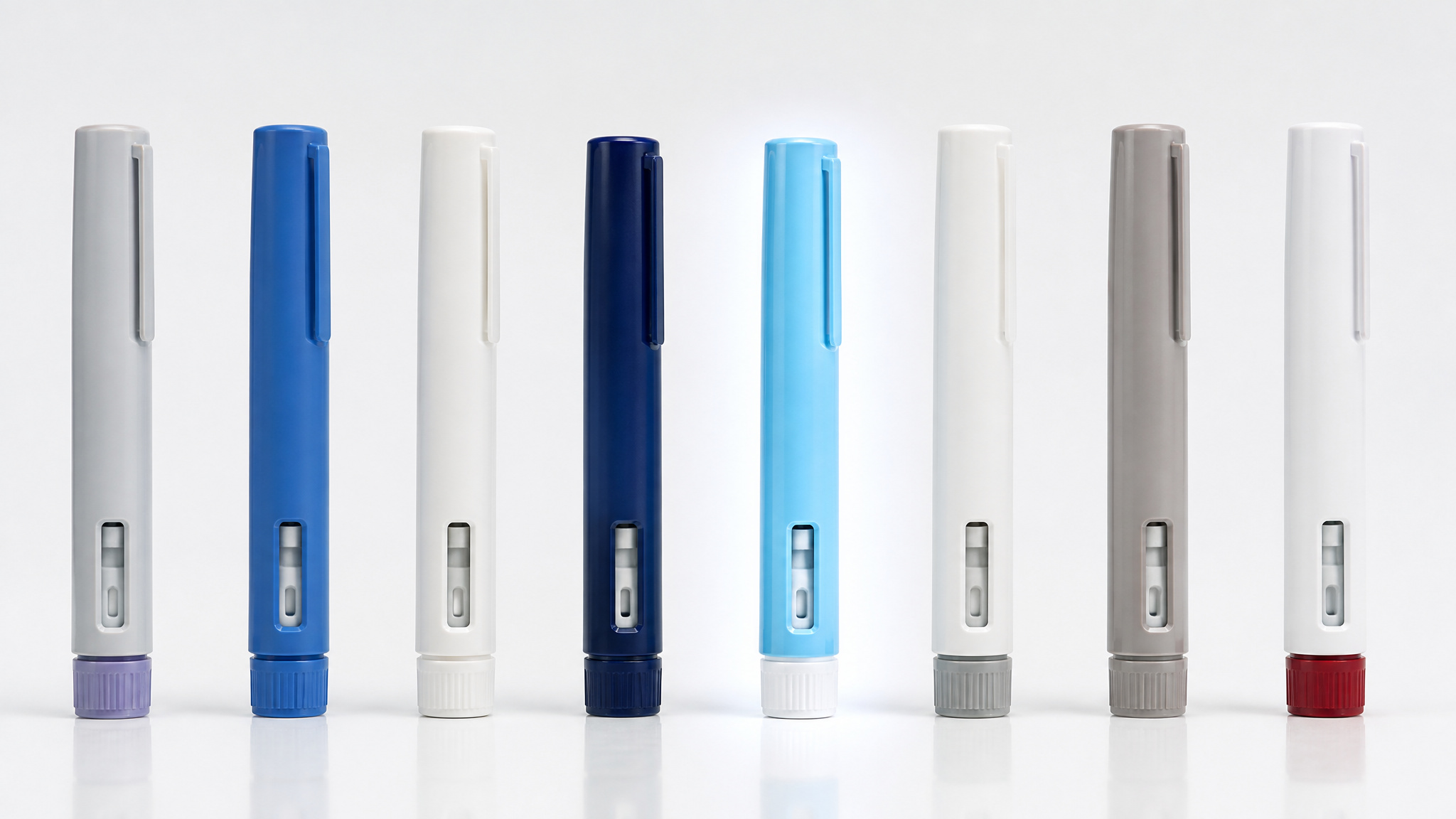
The map: Ozempic and Wegovy are both semaglutide. Victoza and Saxenda are both liraglutide. Mounjaro and Zepbound are both tirzepatide. Same drug, different brand, different approved use.
Ozempic is approved for type 2 diabetes (kidney protection in diabetes is covered too), not for weight management. That’s just a fact, not a judgment on anyone using it off-label. Wegovy is the semaglutide brand approved for weight.
There are two camps here. The GLP-1-only drugs are liraglutide and semaglutide. Tirzepatide is the exception: it hits both GLP-1 and GIP. That’s the headline, not the chemistry: it copies two fullness hormones instead of one.
And because pills keep coming up in the same conversation: oral semaglutide exists, but it’s a bit of a diva drug. You take it with no more than four sips of water, then wait 30 minutes before eating or drinking anything else, because less than 1% of it actually gets absorbed. The pill coming next, orforglipron, has none of those restrictions, which is a big part of why it’s getting so much attention.
The studies behind the headlines
You’ve seen the percentages in headlines. Here’s where they came from, trial by trial, with the caveat that individual results vary a lot, more than any of these averages suggest.
- Liraglutide (Saxenda), the SCALE trial: about 8% average body weight lost over 56 weeks, versus 2.6% on placebo.
- Semaglutide (Wegovy), the STEP 1 trial: about 15 kg (roughly 33 lb) average over 68 weeks, about 14.9% of body weight, and 86.4% of participants lost at least 5%.
- Tirzepatide (Zepbound), the SURMOUNT-1 trial: up to about 21% average loss, with results stepping up as the dose does. In the head-to-head SURMOUNT-5 trial over 72 weeks, tirzepatide averaged 20.2% loss versus semaglutide’s 13.7%.
- Retatrutide, still in trials: around 30% average loss in Phase 2. Important asterisks: that’s manufacturer data, not peer reviewed, the drug isn’t approved, and it probably won’t be before 2027.
So if you’re trying to figure out the “best” injection right now, the honest answer is the ladder goes liraglutide, then semaglutide, then tirzepatide, then (eventually, maybe) retatrutide, and the best one for any individual depends on eligibility, tolerance, and cost. There are no generics yet, which is the entire cost story in one sentence. (We have a whole article on what the best injection for weight loss at home looks like if you want the comparison in depth.)
Who actually qualifies, and are they safe
These injections are proven, FDA-approved tools for treating obesity, and in the US they fit people with a BMI of 30 or higher, or a BMI of 27 or higher with a weight-related health condition. But what is the best injection for weight loss at home? That’s really a question for your doctor, who does the actual math and weighs the options, those are the criteria.

The list of qualifying conditions is long. Over 250 of them count, including heart disease, type 2 diabetes, elevated blood pressure, elevated cholesterol, arthritis, lymphedema, and depression. The breadth surprises people. And per Horn’s estimate, roughly half of Americans qualify to use these injections to improve their health and reduce the risks that come with obesity.
Half. Let that sit a second, and before you do, the natural next question is Are Weight Loss Injections Safe?, a question worth answering given how many people now qualify.
For readers elsewhere, the rules differ:
- Australia: The TGA (that’s their medicines regulator) approves these for chronic weight management when paired with eating changes and increased physical activity, at BMI 30 or higher, or 27 to under 30 alongside a weight-related health condition. Wegovy is also approved for adolescents over 60 kg at or above the 95th BMI percentile, and also for reducing heart risk.
- UK: NHS criteria are stricter. Semaglutide on the NHS mostly means BMI 35 and up, and Mounjaro access is expanding but varies a lot depending on where you live.
Beyond weight, these drugs carry other approvals too, which is worth knowing because it reframes what they are. GLP-1s are approved for cardiovascular disease, sleep apnea, and MASLD (formerly called fatty liver disease) when obesity is present. The big one is the SELECT trial: over 17,000 people with obesity and heart disease but no diabetes saw about 20% fewer major cardiac events over roughly three years. These are not vanity drugs. They’re heart drugs that also shrink appetite.
The part almost nobody covers: eligibility is a conversation, not a number
Here’s something I only learned from reading the clinical sources, and I think every mom reading this should know before any appointment. A good provider doesn’t just check your BMI. They screen your history and your relationship with food, because appetite suppression in the wrong situation, like an active eating disorder, can enable genuinely dangerous habits.
One concrete thing to expect: doctors often ask “What has been your highest weight?” It sounds like small talk. It’s actually a screening tool for eating-disorder and misuse risk. Knowing that beforehand means it won’t catch you off guard, and if a provider skips this kind of screening entirely and just hands over a prescription, that’s a sign to look elsewhere, not a convenience.
And one calm sentence on kids and teens, since parents will read this twice: semaglutide is FDA-approved for adolescents 12 and up with obesity, and tirzepatide for ages 10 and up with type 2 diabetes. Facts, no alarm, no encouragement. That’s a conversation with your child’s pediatrician, not an article.
Timelines, plateaus, and the people it doesn’t work for
The first thing to know is that the starting dose is deliberately low. Not “not working yet” low. Intentionally, on-purpose-below-the-effective-dose low, to keep nausea down while your body adjusts. A commonly reported pattern is frustration in the first month, “why am I paying for this if nothing’s happening,” before learning the mildness was the design. So if your early weeks feel quiet, that’s the plan working, not failing.
Then the calendar. Weight Loss Injections: How Long Does It Take to Work, most people see the first slowdown around months 4 to 6. A full plateau typically lands at 12 to 18 months. And here’s the reframe that matters: at the plateau, the drug isn’t failing.
It’s maintaining your lower weight, which is exactly what it’s supposed to do. Stanford’s Azagury frames this as universal biology. If the scale hasn’t moved in two months and you’re panicking, you’re not broken. You’ve arrived.
If your weight loss genuinely stops early, plateau biology is one explanation, but there’s another one nobody puts on the brochure: some people just don’t respond. About 10 to 15% of trial participants didn’t respond to the drugs at all. Fourteen percent of the original semaglutide group lost less than 5% of their body weight after more than a year, and the rate runs higher for people with type 2 diabetes. Why? It’s usually a tangle of things, genetics, behaviour and lifestyle habits, mental health, whether the medication’s actually being taken consistently, and the psychosocial drivers behind eating. Stanford’s Sun Kim has been honest that there’s no reliable way to predict who responds.
If that’s you, it’s the data, not a character flaw. And notably, even non-responders with diabetes often see real blood-sugar improvements, so “working” can mean more than the scale says.
One more real-world truth: about half of adults who start GLP-1s stop within a year. Cost is usually the reason, sometimes side effects, sometimes just life. If that happens, you’re in enormous company, not in a failures column.
The last piece ties it together: the shot doesn’t replace lifestyle change, it makes it physiologically possible. In the trials, everyone, including the placebo group, also received lifestyle counseling. The drug lowers the barrier so following through stops feeling like white-knuckling it. It doesn’t remove the work, and nobody’s promising a lose-20-pounds-by-June timeline, because the honest answer to “how long does this take” is: months, with a plateau in the middle, and it varies person to person. (There’s a full timeline article if you want the month-by-month version, plus an honest rundown of the Downsides of Taking Weight Loss Injections so you can weigh the full picture before starting.)
Side effects, honestly: from nausea to the rare serious stuff
Let’s set expectations like a friend would: most people get some gut stuff, and it’s usually manageable. The common list, grouped the way it actually shows up in a week: nausea, vomiting, constipation, diarrhea, bloating, reflux, plus headache, fatigue, and dizziness. They’re usually mild to moderate, related to dose, and temporary. But they’re real.
Between 6 and 13.5% of trial participants quit over them, mostly the gut, gallbladder, eye, or mental-health effects. Quitting because it’s too rough is common, not weak.
Now the candid part. The leaflets say roughly 1 in 10 people get nausea. But clinicians who see these patients every day, like Dr. Pratt, whose surgical patients include many on these medications, describe nausea as near-universal in the early weeks. That’s not a contradiction so much as an under-reporting signal: the leaflet rate and the clinic waiting room don’t match up. I’d rather you walk in expecting rough-ish and be pleasantly surprised than the reverse.
The serious-but-rare stuff
You deserve the full picture, so here it is plainly. Gallstone risk goes up, partly because of rapid weight loss itself, not just the drug. Pancreatitis, which is a painful inflammation of the pancreas, happens in roughly 2 to 3 per 1,000 patients (UK leaflets put it as high as 1 in 100). And there are rare case reports, including a 2024 case report, of complete gastroparesis, which means the stomach basically stops moving. Rare means rare; it’s not the headline, but it’s not buried either.
Thyroid: tumors showed up in rodent studies, but after GLP-1s have been used in diabetes care for over ten years, there are no confirmed human cases. However, these drugs are off the table entirely for anyone with MEN2 (a rare genetic syndrome) or a family history of medullary thyroid cancer. Eyes: a 2024 JAMA Ophthalmology study by Hathaway et al. found an association between semaglutide and NAION, nonarteritic anterior ischemic optic neuropathy, a rare condition where blood flow to the optic nerve is cut off. Association isn’t causation, and that’s still unresolved. We don’t know yet is the honest answer, and any vision change means call your doctor, full stop.
Mental health, gently: appetite loss can mask a serious illness, and the changes in how food feels and what brings pleasure may worsen depression or suicidal thoughts for some people. It’s an active research area, an open question, not a settled verdict: one meta-analysis of suicide and self-harm outcomes registered with PROSPERO (CRD42023399654) exists precisely because researchers wanted a rigorous answer. Worth a conversation with your provider if you have a history there.
Two UK flags worth knowing wherever you live: Mounjaro may reduce the effectiveness of oral contraceptives (the recommendation is a non-oral backup), and heavy fluid loss from vomiting or illness can get dangerous fast on these drugs.
Managing the rough weeks, and the filter for the horror stories
What actually helps: smaller meals, skipping the heavy greasy stuff, and drinking water. If GI effects get rough, your doctor can lower or hold the dose; that’s normal, not failure. Stopping immediately (with your doctor) is reserved for pancreatitis, gastroparesis, or serious mental-health effects. That one’s non-negotiable.
And the media literacy beat, taught gently: millions of people take these drugs, so coincidences will always surface online. Stanford’s Azagury has a hypothetical that makes the point: if your first injection were followed by a car accident, it wouldn’t be the injection’s fault. “Ozempic face” is weight loss, not a drug side effect. The posts aren’t lying exactly; they just aren’t evidence.
Using the injections: pens, doses, missed days, and the rules nobody mentions
These are taken as injections under the skin, semaglutide and tirzepatide once a week on the same day each week and liraglutide daily. If you miss a dose, the rule of thumb is take it if your next dose is more than 2 days away, skip it if it’s sooner, and never double up. Now the practical detail, because parents skim:
- You’ll inject into your stomach, thigh, or upper arm with a pen injector.
- Some pens come with needles included; some make you buy them separately. The kind of thing you learn at the pharmacy counter.
- Priming: liraglutide and semaglutide pens get primed once before first use. Tirzepatide gets primed before every dose. (Priming just means squirting a tiny test amount to make sure the pen is ready.)
- Storage: refrigerate pens when not in use. In-use pens can sit at room temperature, and here the sources genuinely disagree: Australian guidance says 4 to 6 weeks, US leaflets say 28 days. The honest advice is follow your own pen’s leaflet.
- Missed dose: the 2-day rule above, and if it’s been 2 or more weeks, check with your care team before restarting. Life happens. No guilt.
- You’ll also need a plan for disposing of used needles, because the sharps question is the unglamorous detail nobody puts on the brochure.
- Pregnancy: these aren’t used during pregnancy or breastfeeding, and there’s a specific washout window. Stop liraglutide 1 month before trying to conceive, semaglutide and tirzepatide 2 months before. Screenshot that one if it’s relevant to your life stage. (There’s more on safety overall in our piece on whether weight loss injections are safe.)
The surgery-fasting rule nobody told you about
This one closes the loop from the gut mechanism way back at the top, and it’s the detail I’d put on a fridge magnet if that weren’t deeply weird. Remember that the drugs slow your stomach emptying? That means the standard “don’t eat after midnight” fasting instruction may not be enough before general anesthesia or deep sedation. The recommended prep is clear fluids for 24 hours plus the usual 6-hour fast, and you should tell every single care team you have that you’re on one of these injections.
Before any procedure, any scope, anything. Confirm the specifics with your own team, but the flag itself is yours to raise.
What happens when you stop: regain is the norm
Yes, regain is the norm, and you deserve the numbers before you start rather than after.
In the STEP 1 extension, a year after people stopped semaglutide, the share keeping at least 5% of their weight off fell from 86.4% to 48.2%. Roughly two-thirds of the lost weight came back within a year. A 2026 Oxford meta-analysis in the BMJ, covering 37 studies and 9,341 people, found regain of about 0.8 kg (roughly 2 lb) a month after medication, and a separate 2026 US analysis of more than 9,000 patients found similar. Meanwhile, the blood pressure, cholesterol, and blood-sugar improvements fade within about 1.4 years of stopping. A preprint (early research, not yet peer reviewed) suggests regain plateaus around 75% of the weight lost. Different studies, different groups, but they’re telling complementary versions of the same story.
Here’s the frame that makes it click, from Horn: think of it like blood pressure medication. The shot supports your body’s physiology. Take the support away, and your body goes back to doing what it does on its own, which for obesity is regaining. Because obesity is a chronic, progressive condition, these drugs were built for long-term use, and the FDA approved them for exactly that. Hitting your goal weight is not the stop line, even though that’s the misconception clinicians spend real time gently correcting.
There is an honest exception: about 20% of Kim’s patients do maintain their loss after stopping, usually after a major life change, and people who lost more tend to hold onto more. Not a rule. Just the pattern.
Practical close: if you come off, taper slowly with your provider rather than quitting cold, and if weight starts creeping back during a taper, the move (Horn’s protocol) is returning to the last dose that worked and staying there. The UK’s NICE guidance recommends at least a year of support after stopping, which is a useful benchmark for readers anywhere: what does your after-plan look like? (We go deeper in our article on what happens when you stop weight loss injections.)
Making it work: protecting muscle while the shots do theirs
One thing regain has in common across analyses: the weight that comes back can be proportionally more fat than muscle, which carries its own health risks. And rapid loss can worsen low muscle mass and nutrient gaps that many people already start with, which is why sarcopenia, the age-related loss of muscle mass and strength, is a real concern when the scale drops fast. So protecting muscle isn’t a gym-bro side quest. It’s part of the job, during treatment and after.
The specifics: aim for roughly 0.5 to 0.7 grams of protein per pound of body weight daily. For a 200-pound person, that’s 100 to 140 grams. In real food, that looks like eggs or cottage cheese at breakfast, Greek yogurt as a snack, a chicken breast at lunch, salmon at dinner. Doable, but it takes attention, especially when your appetite has gone quiet and nothing sounds good. Pair the protein with resistance training (any kind of strength work), plus calcium and vitamin D, fiber, and hydration.
The genuinely encouraging part: muscle loss on these drugs appears largely preventable with that kind of support. Ask your care team what it should look like for you specifically, especially since a good plan also watches for the nutrient gaps and disordered-eating patterns that fast weight loss can stir up.
The money problem: cost is the real long-term variable
Let’s talk about what this actually costs, because the brochure price and your reality may be very different, and because cost is a major factor in whether people stay on these drugs long-term. In Australia, none of these drugs are subsidized for weight management through the PBS (the Pharmaceutical Benefits Scheme, Australia’s program for subsidizing prescription medicines); it only covers them for type 2 diabetes, so weight-loss use means full price: hundreds of dollars a month out of pocket, though some private health policies chip in a partial rebate. Check yours before you assume anything. In the US, insurance coverage is the biggest hurdle, though a new Medicare program offers Zepbound or Wegovy at $50 a month for qualifying older adults.
Here’s why the price matters more than it seems: this is a chronic-use drug. The monthly cost is effectively a subscription, and cost is one of the biggest reasons people stop, which hands you straight into the regain problem from the last section. If you’re budget-sensitive, waiting until you can sustain the cost can save real money and real regret, because starting and stopping in cycles isn’t doing your body or your wallet any favors.
And one honest line on equity, no political essay attached: who gets these drugs often comes down to money, and that widens health gaps. It’s worth knowing that about the landscape.
So what’s the “best” injection for weight loss right now, accounting for all of it? It’s the one you qualify for, tolerate, and can afford to stay on. Eligibility, tolerance, and cost change the math for everyone. (Our cost breakdown article has the full picture if your wallet needs its own deep dive.)
Where to start, and where injections fit next to surgery
Bariatric surgery is still the single most effective weight-loss intervention out there, with average losses of 20 to 35% or more, while the injections average 15 to 20% plus (and the not-yet-approved retatrutide posted around 30% in trials). But surgery demands months of preparation and real psychological readiness, so it’s not a contest, it’s two different paths. They’re actually complementary: surgery raises your natural GLP-1 even more than the drugs do (that discovery is how GLP-1’s importance was figured out in the first place), and combining the two can push losses to 150 or even 200 pounds. The right choice depends on severity, readiness, and honestly, preference.
Which brings me to the actual first step, and it’s refreshingly unglamorous: a conversation with your own provider. Horn puts it plainly: have that conversation about your choices, what the right decision is for you, and what it means to stay on the medications long term. Three questions worth bringing: What do I qualify for, and what are my options beyond injections? What does “long-term” actually mean in my case, including the cost? And what happens if I need to stop or take a break?
One last transparency note, because trust is the whole point of this site: the key clinical source behind this article is peer reviewed and was finalized in October 2025, with declared industry ties (speaker fees from Nestlé, Eli Lilly, and others). I’m telling you because sources have biases, and knowing that beats pretending they don’t.
And that’s really what Tidbits of Experience is for: translating the fine print so you walk into the doctor’s office smarter than the brochure left you. The shot isn’t a shortcut. It’s a tool that makes change physiologically possible, with real tradeoffs attached. Honest tradeoffs beat hacks, every time.
Frequently Asked Questions
What is the downside of taking weight loss injections?
The most common downside is gut trouble: nausea, vomiting, constipation, diarrhea, bloating, and reflux, usually mild to moderate and dose-related, though between 6 and 13.5% of trial participants quit over side effects. Nausea is the number one complaint because the drugs slow stomach emptying, so food sits longer. Serious-but-rare risks include gallstones, pancreatitis (roughly 2 to 3 per 1,000 patients), and rare case reports of gastroparesis. And the biggest structural downside: regain after stopping is the norm, with about two-thirds of lost weight returning within a year.
How much weight do you lose a week on weight loss injections?
The trials report averages over many months, not weekly numbers. Wegovy (semaglutide) averaged about 15 kg (roughly 33 lb), or 14.9% of body weight, over 68 weeks in the STEP 1 trial; Zepbound (tirzepatide) averaged up to about 21% over 72 weeks; liraglutide (Saxenda) averaged about 8% over 56 weeks. Individual results vary a lot more than those averages suggest, and the first month is intentionally quiet because the starting dose is deliberately below the effective dose to keep nausea down.
What is the difference between Ozempic, Wegovy, Mounjaro and Zepbound?
Ozempic and Wegovy are the same molecule, semaglutide; Mounjaro and Zepbound are both tirzepatide. The difference is approval and branding: Ozempic is approved for type 2 diabetes, while Wegovy is the semaglutide brand approved for weight management. Tirzepatide is chemically different because it copies two fullness hormones (GLP-1 and GIP) instead of one, and in the head-to-head SURMOUNT-5 trial it averaged 20.2% weight loss versus semaglutide’s 13.7% over 72 weeks.
Are weight loss injections safe and who qualifies for them?
They’re FDA-approved, proven tools for treating obesity, and in the US they fit people with a BMI of 30 or higher, or a BMI of 27 or higher with a weight-related health condition (over 250 conditions count). Beyond weight, GLP-1s carry approvals for cardiovascular disease, sleep apnea, and fatty liver disease, and the SELECT trial found about 20% fewer major cardiac events. Safety tradeoffs exist: mostly gut side effects, plus rare risks like pancreatitis and gallstones, and they’re off the table entirely for anyone with MEN2 or a family history of medullary thyroid cancer. Eligibility is a conversation with a provider, not just a number.