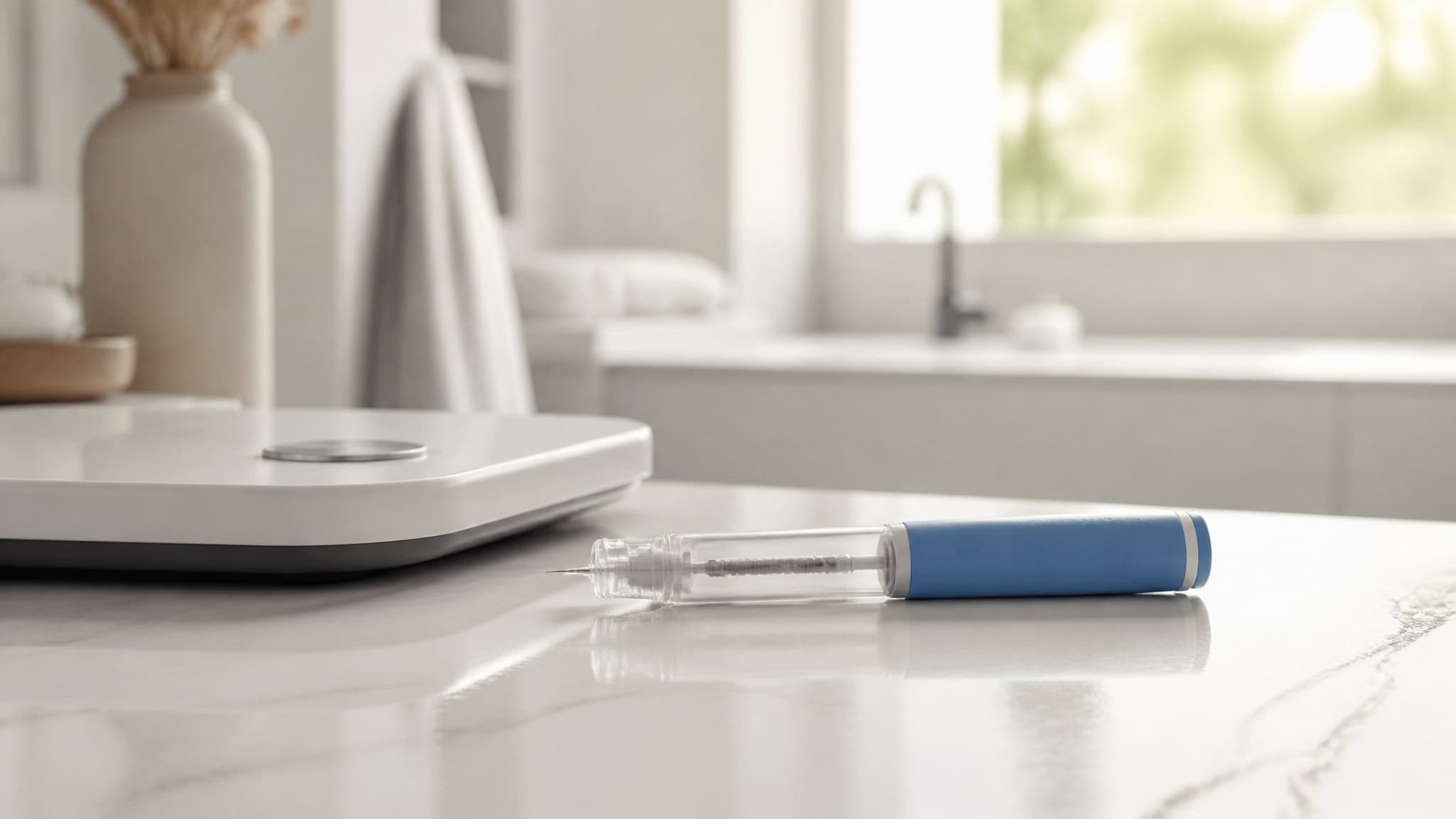
The text came in on a Tuesday: “Two weeks on the shot and the scale hasn’t moved. Should I quit?”
If you’ve asked a version of that question, here’s the answer you actually need: for most people who respond to weight loss injections like semaglutide (Ozempic, Wegovy) and tirzepatide (Mounjaro, Zepbound), appetite changes show up within 1 to 3 weeks and meaningful weight loss by 8 to 12 weeks, with the biggest changes coming later, between months 3 and 12. That’s not a flaw in you or the drug; it’s how the whole thing is designed.
Dr. W. Scott Butsch, an obesity medicine specialist at Cleveland Clinic, explains why: a once-weekly injection peaks in your body about 72 hours after each dose. The medication is working long before the scale agrees to say so. So here’s the clock, hour one to year one, so you can stop confusing “the drug isn’t working” with “the results haven’t arrived yet.”
Key Takeaways
Each weekly dose of semaglutide or tirzepatide peaks in the body about 72 hours after injection, but visible weight loss usually takes 8 to 12 weeks to show up.
The first month is a tolerability phase by design: you start at the lowest dose and step up over 4 to 8 weeks, so early weeks are about handling side effects, not losing weight.
Trial benchmarks (15 to 21% loss over roughly 72 weeks) come from full obesity doses plus diet and activity support; real-world results, like the 2023 White et al. cohort averaging 2.2% at 72 weeks, are far more modest.
Table of Contents
How weight loss injections work, and why the drug is active before results show
Each weekly dose reaches its maximum drug effect in about 72 hours, so the medication starts doing its job within days of your first shot. What you notice, though, usually arrives later. Appetite reduction often shows up within the first 1 to 3 weeks, and some people don’t feel much until several doses in. Both are normal.
Here’s the one-breath science. These drugs are GLP-1 receptor agonists, which is a fancy way of saying they mimic a hormone called GLP-1 (glucagon-like peptide-1) that your gut and brain already make. (If you want the longer version of how they work in the body, there’s a whole explainer on how weight loss injections work.) The drugs turn up your “you’re full” signals, empty the stomach slower, quiet the brain’s appetite centers, and help insulin work better. That last part is why Ozempic exists for type 2 diabetes, by the way.
And that 72-hour number has a handy payoff: it explains why some people feel appetite changes or stomach effects mid-week, a few days after injection day. Per Dr. Butsch, “The effects can be experienced within the first few days, whether that’s an effect on your appetite or side effects like nausea, vomiting or diarrhea.” Some people feel it within days; others feel nothing until several doses in. Both are normal.
Weeks 1 to 4: tolerability, not transformation
The first month of semaglutide or tirzepatide is about your body learning to handle the medication, not about weight loss, and that’s the plan working as intended. You start at the lowest possible dose on purpose, to keep nausea down, then step up over the first 4 to 8 weeks. Titration, if you want the clinical word; the slow dose step-up your provider does on purpose.

The catch, and it’s a big one: that starting dose may do nothing. Dr. Butsch describes patients who hit exactly this wall. “This has occurred in some of my patients, where the drug has no effect,” he says, and “They get frustrated because it takes several months to escalate the dose to the highest level and see the benefits.” He’s not wrong about the frustration either. This is the single most common quit point, and it usually starts with judging a starter dose by the scale.
What appetite changes look like in weeks 1-3
For a lot of people, the first sign the medication is doing something isn’t a number on the scale. It’s this: the food you’ve craved your whole life suddenly doesn’t call your name. People on tirzepatide in their first few weeks report that old favorite snacks seem weirdly unappealing, or too rich to finish. Hunger just gets quieter. Not everyone gets this in week one, and a predicted schedule would be a lie, but when it shows up, it’s usually the earliest signal that the med is on the job.
Why the first dose may feel like nothing
Some people feel zilch from dose one and need several doses before the full effect lands. That’s not failure and it doesn’t mean you’re a “non-responder,” it means the drug builds. Add in the deliberate slow ramp from your lowest dose, and month one quietly becomes a tolerability rehearsal. If nothing’s happening yet, that’s by design, not by defect.
The side-effect clock: when nausea peaks and when it ends
Yes, side effects can start within days of your first dose, because it’s the same 72-hour pharmacology that delivers the appetite benefits. The good news, which almost nobody tells you: they run on their own clock, and there’s an end date. GI side effects like nausea and constipation typically peak around weeks 2 to 5 and mostly resolve by weeks 7 or 8.
Practical bits that help: water, smaller meals, eating slowly. Not glamorous, but they earn their keep.
If you’re still genuinely rough past week 8, that’s not a badge of honor to tough out. It’s a provider conversation. There’s also a full rundown of side effects of weight loss injections if you want the longer version.
Red flag: Still genuinely rough past week 8? That’s a provider conversation, not something to tough out.
Weeks 5 to 12: titration continues, and the scale finally moves
In the Mounjaro trials, people lost 6 to 8% or more of their body weight by 8 to 12 weeks. Hold that loosely: it’s a benchmark from trials, not a bar every human clears, and real-world data is humbler (more on that below). By 8 to 12 weeks, most people who respond see clear, visible progress. Months 2 and 3 are often when it clicks: appetite control feels consistent, clothes fit differently, energy steadies out, blood sugar evens off.
That stretch runs on three parallel tracks:
- The scale. Meaningful progress usually shows by 8 to 12 weeks, often when you’re at or near higher doses.
- Side effects. Resolving by week 8 for most people. The rough patch ends.
- The mental shift. Quieter food obsession, easier meal planning, a weaker pull toward emotional eating. One commercial guide (more on the caveats in a second) puts this settling in around week 12.
The trial benchmarks, honestly labeled
On tirzepatide, trials show 15 to 22% of starting weight gone by 6 months. Semaglutide’s program lands around 5 to 10% down by months 3 to 6 mid-trial. Those are averages from people on full doses with structured support. Not quotas.
The vendor numbers to treat cautiously
One company, PlexusDx, projects 2 to 4 pounds per week in weeks 4 to 8, 8 to 16 pounds total by week 12, and 20 to 30 pounds by week 16 on tirzepatide. Those numbers exceed what peer-reviewed research shows, and they come from a vendor selling the drugs. Treat them as marketing projection, not data. The honest benchmarks come from published trials, full stop.
Months 3 to 6: the peak window, and “is my pace normal?”
The biggest changes of the whole process land between months 3 and 12. In that window, the trial mid-points look like this: roughly 5 to 10% of body weight down by months 3 to 6 in the semaglutide STEP program, and 15 to 22% of starting weight by 6 months in tirzepatide trials. And a 5 to 10% loss isn’t a consolation prize. Health-wise, it’s a genuine win. Tirzepatide losses in trials keep climbing past week 24, even for slower responders.

Trial benchmarks for months 3-6
The big end-of-study numbers, so you know where this road goes: STEP 1 found about 15% average loss at 68 weeks on semaglutide 2.4 mg, versus 2.4% on placebo. (That trial was in adults with overweight or obesity, without diabetes, so the numbers describe that population.) If you’ve ever done everything right, strict macros, brutal boot camp, and still watched the scale barely move, that gap between trial conditions and real life is exactly why options like semaglutide telehealth programs exist. SURMOUNT-1, the top-dose tirzepatide trial, averaged about 21% at 72 weeks, with 50 to 57% of people losing at least 20% versus 3% on placebo, and meta-analyses put tirzepatide as high as 22.5%. Why trials look better than real life: those numbers came from step-up dosing to full obesity doses, plus reduced-calorie eating and activity support, support most of us don’t actually get.
The milestone that predicts keeping it off
Here’s the genuinely useful checkpoint. Research cited by Dr. Butsch found that losing more than 5% of body weight in the first 3 to 4 months predicts better maintenance at 12 months. On tirzepatide, losing 10 to 15% by 6 months predicts keeping the weight off after a year. How the first few months go is information, not a verdict. Bring it to your provider as a data point, not a pass/fail grade.
And the honest calibration, because you deserve it: real-world results are way more modest. In a study of more than 2,400 people with type 2 diabetes, published in the journal Obesity (White et al., 2023), the average loss was 1.1% at 8 weeks and 2.2% at 72 weeks. Only about a third lost 5% or more. The gap isn’t about anyone being lazy. It’s lower doses, insurance interruptions, less structured support, the messy logistics of actual life. If your numbers trail the trial headlines, check which yardstick applies to you: the trials assumed full obesity doses plus support most people never get.
Months 6 to 12 and beyond: plateaus and the stop-start trap
Usually, yes: stop the medication and the appetite comes back, and the weight tends to come back with it. In the SURMOUNT-4 trial, people who kept taking tirzepatide held about 20% loss. The group switched to placebo regained weight. On semaglutide, the STEP 5 trial showed about 15% average loss still holding at 104 weeks. Continued treatment is what holds the line.
Why slowing down is normal
Loss keeps going through months 6 to 12, just gentler. One semaglutide trial (STEP 4) showed about 10.6% lost during a 20-week run-in, then another 7.9% over the following year. Ongoing, just quieter.
And then, commonly around the one-year mark, comes the plateau. Talk a friend off the ledge here, because this is the misread that costs people the most: the scale freezing does not mean the medication quit. Your body is settling at its new weight, adapting its metabolism and energy needs to a smaller you. It’s biology, not failure. In practice, the plateau misread, “it stopped working,” is one of the most common and most consequential mistakes people make on these meds.
The stop-start trap
Here’s the part almost nobody mentions. A 2026 study by Son et al., published in JCI Insight, found that repeated stop-start cycling makes the body respond progressively less to the medication over time. Restarting doesn’t just reset the clock; it may blunt your future response. Consistency matters, and that’s the whole honest argument for it.
Any decision to pause or stop belongs with your provider, not in a vacuum of frustration. (There’s a deeper dive in what happens when you stop weight loss injections.)
Why results vary: dose, drug, and body
On trial numbers, yes, tirzepatide works faster and bigger than semaglutide. It hits two appetite pathways (GLP-1 plus GIP) instead of one, which is why it’s sometimes described as a “GLP-Squared” injection, and it has consistently outperformed single-pathway drugs, averaging up to about 21 to 22.5% loss in trials versus roughly 15% for semaglutide 2.4 mg. But the gap is narrowing as doses climb, and the real point stands: the best drug is the one you tolerate, can access, and actually take consistently. Not a winner’s podium.
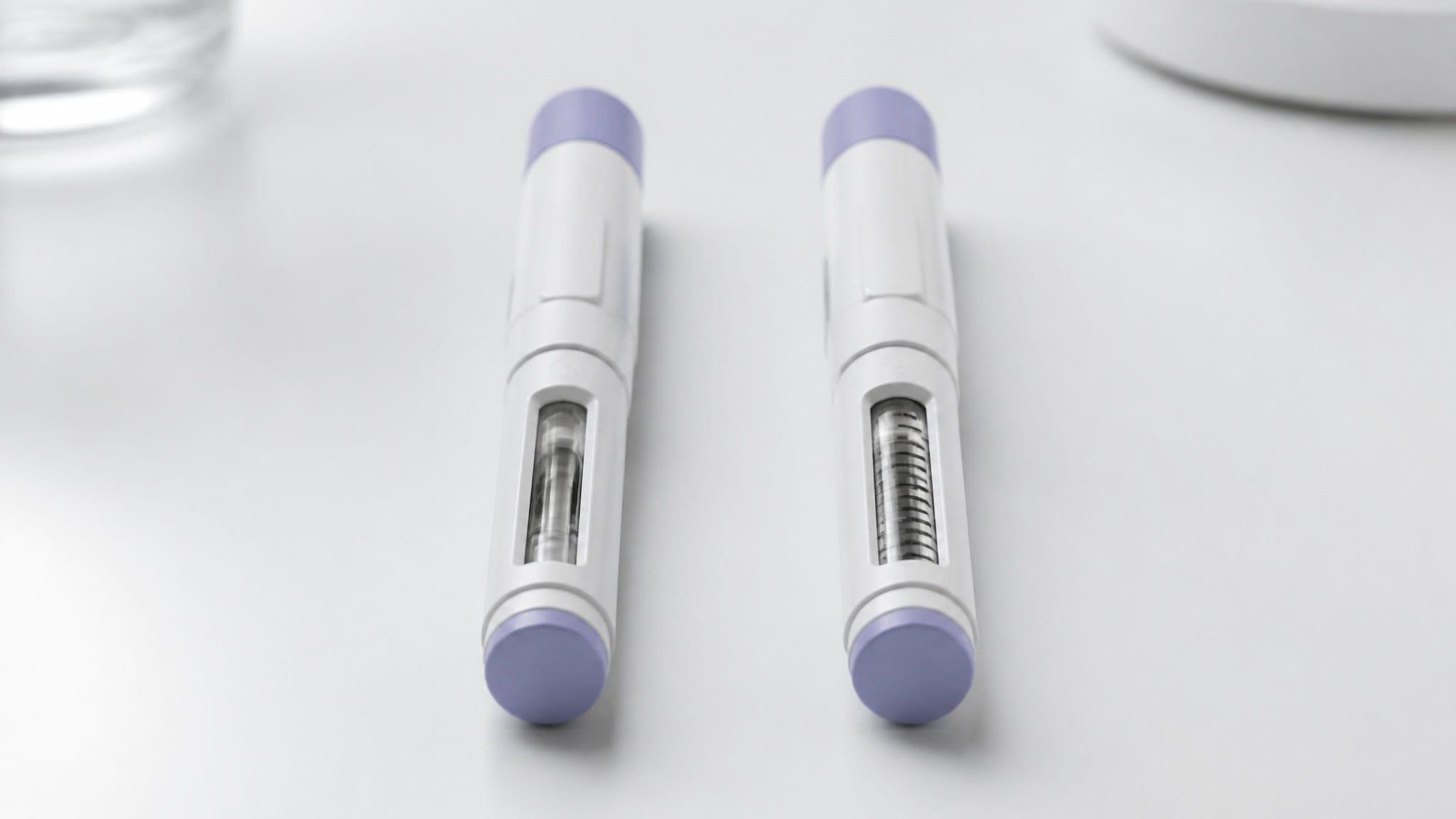
Quick decoder so the trial names stop feeling like alphabet soup: STEP is the semaglutide research program (the drug Novo Nordisk makes as Ozempic and Wegovy), SURMOUNT is tirzepatide’s (Eli Lilly’s Mounjaro and Zepbound), and ATTAIN is the oral pill program.
Diabetes dose vs. obesity dose
This is the hidden variable almost everyone misses: the same molecule comes in different doses for different purposes. Ozempic tops out at 1 mg weekly, a diabetes dose. Wegovy goes up to 7.2 mg weekly for obesity, including the newer 7.2 mg version called Wegovy HD, which hit about 19% loss at 72 weeks in the STEP UP trial versus about 16% for the 2.4 mg dose and 4% on placebo. Tirzepatide’s full obesity doses run 10 to 15 mg.
Higher doses consistently mean bigger losses, so “mine isn’t working” is very often a dose question, not a wrong-drug question. Context, not a nudge: escalating is your provider’s call, never a DIY project.
Does the drug change the clock?
Faster by mechanism, yes, and it shows up in the early benchmarks: that 6 to 8% by 8 to 12 weeks figure was a tirzepatide number. But both drugs follow the same broad arc, active within 72 hours, visible by 8 to 12 weeks, biggest in months 3 to 12. And the field is moving: high-dose semaglutide 7.2 mg now lands in the same 18 to 21% range as high-dose tirzepatide over roughly 72 weeks, which closes a lot of the gap the earlier data showed.
Worth one mention without hype: there’s a needle-free option coming along. Orforglipron, an oral pill (brand name Foundayo), averaged about 12% loss, roughly 27 pounds, over 72 weeks versus about 1% for placebo in the ATTAIN-1 trial, published in the New England Journal of Medicine in 2025. Good news if needles aren’t your thing.
What else blunts results
People vary, and Dr. Butsch says the trials show it plainly: “We see in clinical trials that there’s a variation in the amount of weight someone loses, a variation in their appetite and a variation in unwanted side effects.” Genetics, starting weight, how fast your dose goes up, what you’re eating, movement, sleep, stress, other medications, and conditions like hypothyroidism or PCOS (polycystic ovary syndrome) all shape your results. No fault assigned to any of it. If something feels off, that’s a provider conversation, not a self-diagnosis project.
When the scale hasn’t moved by weeks 8-12, and which numbers online to trust
If you’re a few weeks in on Ozempic or any of these meds and the scale is silent, the most likely answer is that it’s simply too early, and the second most likely is that your dose hasn’t reached a therapeutic level yet. Both are expected. Dr. Butsch sees this frustration constantly, and it traces back to the same thing: months of dose escalation before the full benefits arrive. And if you’re further along and things have stalled, that’s a provider conversation too, clinicians may bump the dose toward a therapeutic range, look for sneaky calorie creep in your diet, and nudge you toward exercise that keeps your muscle while the fat goes.
Five calm reasons the scale might be stalled:
- It’s early. The real-world average is around 1% loss by week 8. You’re not behind; you’re on schedule.
- Your dose isn’t therapeutic yet. That’s the slow titration again, and it’s expected.
- Calories sneak in. Quieter appetite doesn’t mean zero calories. Liquid calories and grazing count. No shame, just worth a look.
- Something medical is working against you. Other meds or conditions like thyroid issues or PCOS. Provider conversation.
- The hopeful one: inches and clothing sizes often change before the scale does. The jeans know before the scale does.
For a true stall, keep yourself in the provider lane. A clinician might review or raise the dose if it’s below the therapeutic range, look at calorie creep together with you, and encourage resistance plus cardio movement to protect muscle while you lose.
Vendor timelines vs. published research
One thing worth protecting yourself from: those week-by-week pound charts that get shared around online often come from companies selling the drugs, and their projections exceed peer-reviewed rates. That PlexusDx timeline we flagged earlier is one example. Benchmark against published trial data instead.
Quick test: Before trusting any week-by-week chart, ask who published it. Vendor projections often exceed peer-reviewed trial rates.
For completeness, since some of you will look them up: PlexusDx also sells compounded tirzepatide, $289 a month or $249 a month on a 6-month plan, flat pricing across dose tiers, seven protocols available in all 50 states (as of June 2026), plus a $298 genetic test covering 14 pathways and 49 peptides. Two honest disclosures to go with that. First, compounded tirzepatide and semaglutide from 503A compounding pharmacies aren’t FDA-approved and aren’t the same as Wegovy, Ozempic, Zepbound, or Mounjaro. Second, the genetic variants those tests cite, like GIPR rs1800437, FTO rs9939609, and MC4R rs17782313, are pathway-level associations, not predictions of how you personally will respond. Association, not destiny.
Making the timeline work: what to do during the quiet months
What helps most is consistency under your provider’s guidance, everything else follows from that. But here’s the reframe that makes the quiet months worth something: those low-dose, low-results months are exactly when habit-building has zero competition. The medication isn’t doing the heavy lifting yet, so whatever sleep, food, and movement habits you build now get installed by the time the months 3 to 12 peak window arrives.
The big trials paired the medication with reduced-calorie eating and activity guidance, so the basics still count while you’re on it. Poor sleep and chronic stress can quietly blunt results too, per Cleveland Clinic. Not a wellness sermon, just the honest edges of the picture.
Two more things worth knowing:
- Your body composition changes. These meds reduce fat and muscle both. Resistance exercise helps protect the muscle, and in tirzepatide analyses, holding onto muscle while losing fat was linked to better metabolic outcomes. Nothing fancy required; some strength work a couple of times a week does the job.
- Non-scale wins count. Inches and clothing sizes changing first isn’t a consolation prize. It’s the same process, measured differently.
And the line that caps all of it: never change or stop your dose without your provider. Not out of fear, just because it’s genuinely their department.
The plateau that shows up most commonly around the one-year mark is normal. It’s your metabolism settling at your new weight, not the medication failing, and not you failing. If a stall is real rather than a plateau, a clinician has options: reviewing or raising a dose that’s below therapeutic range, reassessing your diet together, adjusting movement to protect muscle.
So here’s the clock one last time: appetite cues in 1 to 3 weeks, meaningful loss by 8 to 12 weeks, biggest changes between months 3 and 12. Visible loss often starts within the first 1 to 2 months; the dramatic changes build over 6 to 12. And the one honest lever, the boring-but-true one: staying on an adequate, tolerable dose long enough, with nutrition and activity support, under your provider’s guidance. No hack beats that. It’s just the truth.
People Also Ask
How quickly do you lose weight on injections?
Appetite changes often show up within 1 to 3 weeks of starting semaglutide or tirzepatide, but meaningful weight loss usually takes 8 to 12 weeks. The biggest changes tend to land between months 3 and 12. Early on, the priority is tolerability, not transformation — the first month is a deliberate low-dose ramp-up.
Does tirzepatide work faster than semaglutide for weight loss?
On trial numbers, yes — tirzepatide hits two appetite pathways (GLP-1 plus GIP) instead of one, and shows 6 to 8% loss by 8 to 12 weeks versus semaglutide’s 5 to 10% by months 3 to 6. But the gap is narrowing as doses climb: high-dose semaglutide 7.2 mg now lands in the same 18 to 21% range over roughly 72 weeks. The best drug is the one you tolerate, can access, and take consistently.
When does GLP-1 start suppressing appetite after the first injection?
Each weekly dose peaks in your body about 72 hours after injection, so appetite effects can show up within the first few days — that’s why some people notice changes or side effects mid-week. For most people, appetite reduction appears within 1 to 3 weeks, though some don’t feel much until several doses in. Both timelines are normal.
What should I expect during the first month of semaglutide or tirzepatide?
Expect a tolerability phase, not weight loss. You start at the lowest dose to keep nausea down, then step up over 4 to 8 weeks, so the starting dose may do little for the scale. GI side effects like nausea typically peak around weeks 2 to 5 and mostly resolve by weeks 7 or 8 — smaller meals, slow eating, and water help. The first sign the medication is working is usually quieter hunger or food cravings losing their pull, not a number on the scale.