
A toddler chanting “mama, mama” at your elbow usually lands you on a jumbled results page mixing a Halloween story-song, infant peekaboo verses, toddler action songs, picture books, and a gaming meme. If you are looking for the main “where is mommy” story, the exact match is “Where Is My Mommy? | Find Mommy Monster & Rabbit | Pinkfong Halloween” on the Baby Shark – Pinkfong Kids’ Songs & Stories YouTube channel. Both storylines are retold below in scene order with their singable refrains, alongside the four channel search games, screen-free ways to play them, and a quick sorter for the other mommy songs and books.
Key Takeaways
Pinkfong’s 218-segment “Where Is My Mommy?” video pairs two lost-and-found stories: Baby Zombie and Baby Vampire searching on Halloween night, followed by Police Pinkfong helping Baby Rabbit verify three candidates at the mart against a drawn picture of protruding teeth, two long ears, and a round tail.
Four major YouTube versions run a candidate-testing search game with different rules: Pinkfong checks a three-feature sketch, BabyBus’s ten little dinosaurs test four mothers by physical traits before confirming T-Rex, D Billions plays a yes-or-no guessing game with four baby animals, and Super Sumo’s train tests eight animal mothers by sound.
For younger toddlers who aren’t ready for Pinkfong’s brief wolf-impostor arrest scene, CoComelon’s 59-segment “Peek A Boo” swaps the separation plot for a threat-free hide-and-reveal cycle (“Where is daddy?”, “Where is mommy?”, “Where is baby?”) answered with “I see you” and baby laughter.
Table of contents
Table of Contents
The ‘Where Is My Mommy?’ Halloween story, scene by scene
Spanning a 218-segment English transcript, Pinkfong’s Where Is My Mommy? pairs a Halloween monster search for mom with Baby Rabbit’s mart rescue in a two-part musical narrative, published as Where Is My Mommy? | Find Mommy Monster & Rabbit | Pinkfong Halloween on the Baby Shark – Pinkfong Kids’ Songs & Stories YouTube channel. Standard call-and-response nursery rhymes keep the missing parent just behind a pair of hands, whereas this story lets the separation stretch across false leads before the reunion lands. Every verse turns on the chanted refrain:
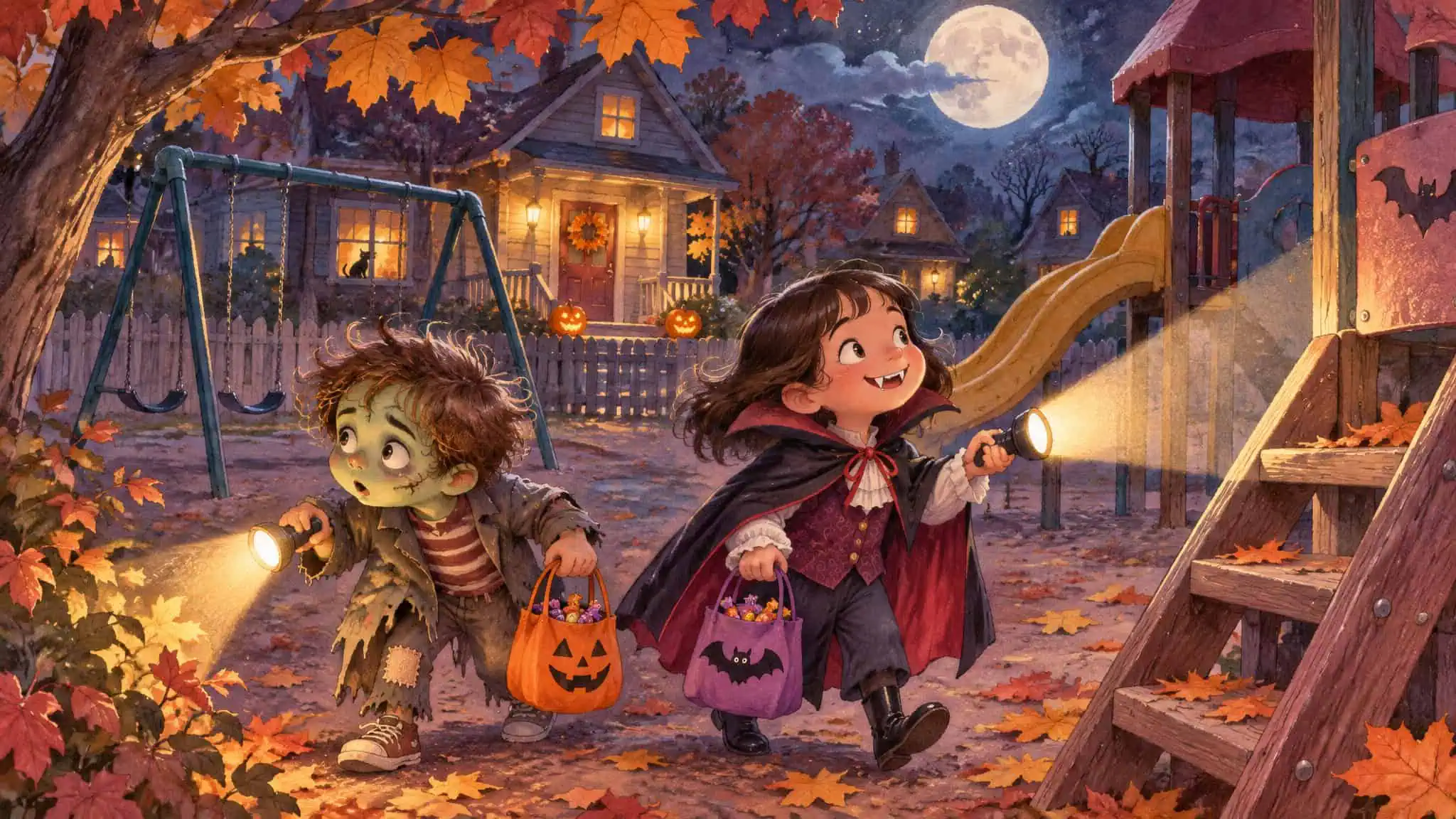
Mama, mama, zombie mama, mama, [music] mama, where’s my mama? Mama, mama, zombie mama, can you find my mama?
That question eventually resolves into the reunion line, Mama, mama, it’s my mama. I finally found my mama.
Baby Zombie loses his mama on Halloween night
The first act opens with a ding-dong doorbell and Baby Zombie crying in the street. It’s Halloween night, time for trick or treats, and he was walking down the street looking for yummy sweets when his mom went out of sight. He’s still clutching his candy bag tight as he calls out for her to come back. Helpers step in right away to tell Baby Zombie not to worry and promise they’ll help find his mom, launching the repeating “zombie mama” chorus that carries the search from block to block.
False leads: Baby Vampire and the closer-look verses
Soon you find out Baby Zombie isn’t the only one separated from his grown-up. Baby Vampire has lost his mama too, swapping the refrain to “vampire mama” as the group checks the neighborhood and keeps hitting false leads. They spot shapes at the playground and in the trees, asking if that’s her by the slide (“No, that’s not her”) and if that’s her hanging upside down (“Maybe”).
This is the part kids love to act out across the living room rug. The helpers warn everyone not to go near, then suggest taking a closer look, just one step or two, because the baby monsters miss their mamas and have to ask if it is really her. Every attempt brings a brief disappointment as the search comes up empty and they keep wondering where the mothers went. A verse hinting at a witch traces similar clues, looking behind a pod where she turns out not to be, and checking whether she is flying on a broom.
They take another closer look, one step or two, hoping this time it’s really her mama as she cries, right as the mid-search confusion variant kicks in (“which mama? Can you find my mama?”) and a voice finally answers that Mama is here.
The reunion: ‘Baby, you’re here. Mama, you’re there.’
Before the monsters wrap up their search, the song lets the late-night worry sit for a beat. The night is getting late, she’s still out of sight, and the little monster admits that Halloween isn’t fun anymore without his mama, wondering where she could be, what he missed, and pleading for her to come back because he’s so scared. Then the two spot each other across the dark. They trade the spotting lines (“Baby, you’re here” and “Mama, you’re there”, followed by “Mama!”, “Baby?”, and “Oh, that’s my mama”) and launch into the resolution chorus (“it’s my mama, I finally found my mama”), which the mothers answer with “Baby, baby, it’s my baby.”
The Mommy Rabbit rescue: three rounds at the mart
Baby Rabbit proves she found the real Mommy Rabbit at the mart by drawing a reference picture of three identifying features (protruding teeth, two long ears, and a round tail) and checking every candidate against that sketch over three rounds. The second storyline starts when a helper introduces himself as Police Pinkfong alongside Minnie Mouse, ready to help anyone in need. They hear Baby Rabbit crying in the mart after she wandered off to grab a toy and came back to find her mommy gone. She asks if they can really find her mom, Police Pinkfong says of course, and he invites viewers at home to help before setting off to the chant, “Mommy Rabbit, Mommy Rabbit, where are you?
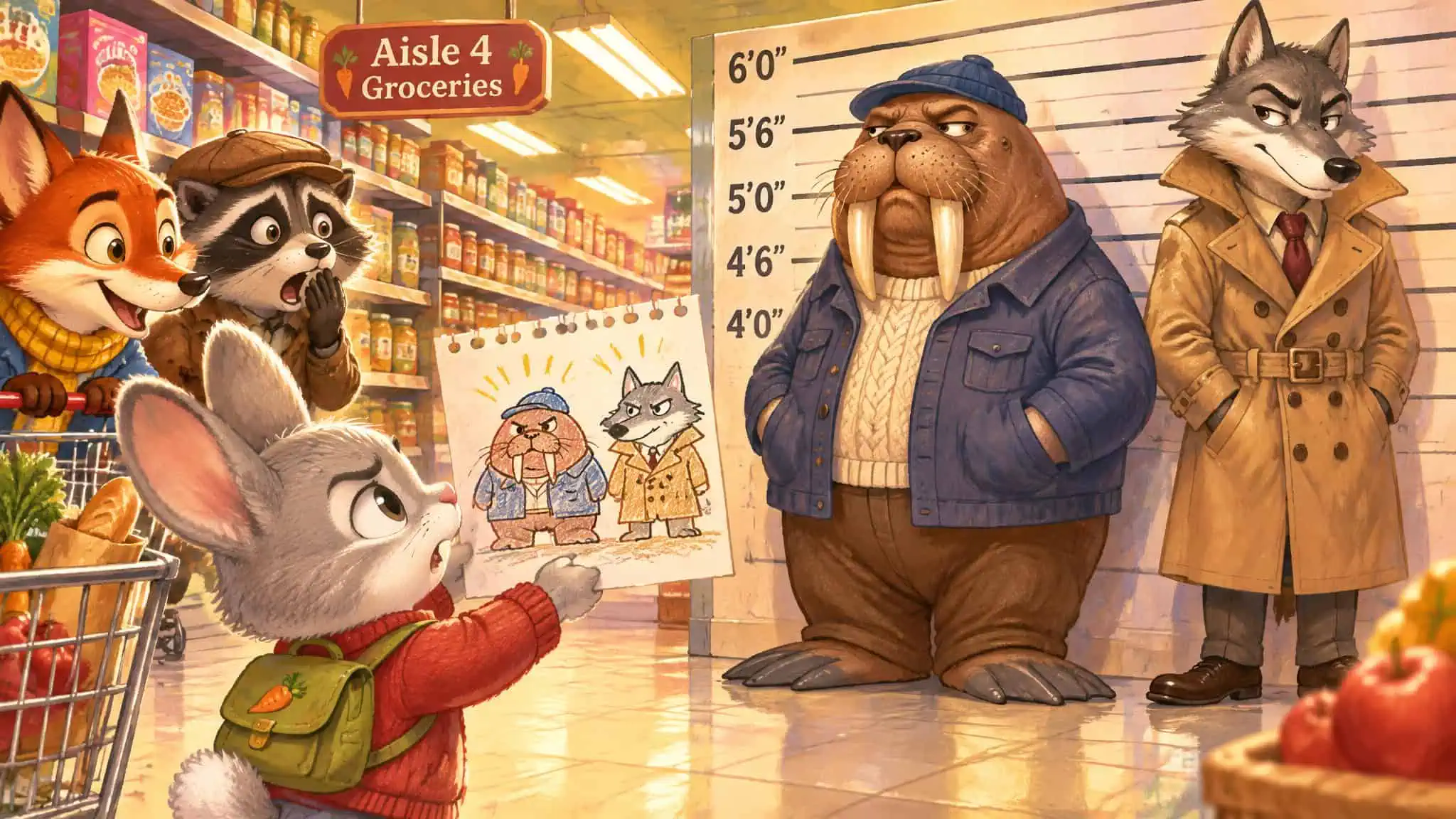
Are you here? Are you there?” while Baby Rabbit pleads for someone to find her mommy.
Drawing Mommy Rabbit: the three-feature picture
Before checking the aisles, Police Pinkfong sets up a verification ritual (“let’s check our picture”). Baby Rabbit describes her dear, loving mommy by three traits: protruding teeth, two long ears, and a round tail. The first sketch of the ears gets rejected because they look weird and aren’t her mom’s ears, so they redraw them and add the round tail until Baby Rabbit says it looks just like her mom, giving the team a perfect drawing of Mommy Rabbit.
Round 1: the walrus fails the picture check
In the first round, the team spots protruding teeth in a long line and thinks they’ve found Mommy Rabbit. When they pull out the reference picture, the teeth do protrude, but they’re way too big, and the shopper has no long ears or round tail. She turns around and explains plainly that she is not a Mommy Rabbit, she is a walrus, then comforts the crying little rabbit and tells them to try somewhere else.
Round 2: the wolf impostor is arrested
Round two looks much closer at first: the candidate has two long ears and a round tail, and steps forward claiming to be Mommy Rabbit and coaxing Baby Rabbit to come closer. Baby Rabbit checks the third feature and freezes, pointing out that Mommy Rabbit’s teeth aren’t that scary and backing away in fear because that isn’t her mommy. The disguise drops to reveal a wolf who complains about how close he came to having Baby Rabbit for dinner, and Police Pinkfong immediately places the bad wolf under arrest, wiping his brow afterward because that was dangerous.
Round 3: the escalator reunion
In round three, Baby Rabbit hears a voice calling out for her baby and recognizes her mom’s voice right away near the mart’s escalator, where a lot of animals are passing by. They check all three features against the drawing one last time: protruding teeth, long ears that look the same, and a perfect round tail. Baby Rabbit runs to her, Mommy Rabbit asks where she has been after looking all over for her, and the family thanks “Police Pinkfong and Hogi” (the captions switch the partner’s name from the intro’s Minnie Mouse to Hogi here) before the video wraps with a mission-complete celebration and an end-card prompt to click subscribe and search for Pinkfong on YouTube.
The lesson inside the story: hold on to your mommy
The “Where Is My Mommy?” video teaches a two-part child safety lesson built directly into its story dialogue: stay physically connected to your caregiver in public, and verify a grown-up by multiple features rather than a single look-alike trait. Standard lost-child storylines in preschool cartoons usually treat separation as a simple game of hide-and-seek where the first matching silhouette turns out to be mom. Pinkfong adds a real-world wrinkle by having a disguised stranger match two out of three traits before Police Pinkfong arrests the wolf impostor (“YOU BAD WOLF. YOU ARE UNDER ARREST.”) and delivers the closing rule to hold on to your mommy when you’re outside, which Baby Rabbit promises to do.
Anyone who has turned around in a supermarket aisle to find their three-year-old ten feet away staring at the wrong pair of jeans knows how fast a kid locks onto a single detail. A toddler sees a familiar coat or hair color and assumes the whole person matches. The mart story turns that exact habit into a game kids actually understand. Because the wolf passes on the two long ears and the round tail, the whole rescue hinges on not stopping at the first two matches. It’s Baby Rabbit’s own observation, not the police helper’s, that catches the scary teeth by comparing the stranger to the three-feature reference picture.
Without feeling like a lecture, the drawing ritual works as “know three things about your grown-up” practice. And when Mommy Rabbit hugs her child by the escalator and asks where she’s been because she has been looking all over for her, the script lets kids hear the parent’s side of getting separated, right before Police Pinkfong asks for the promise to hold on outside.
Is the wolf scene too scary for toddlers?
Whether the wolf scene is too scary for your toddler comes down to how they handle a brief predator-and-arrest beat in the middle of a cartoon. Unlike the Halloween first half, where Baby Zombie and Baby Vampire stay playful even when they say they’re scared, the mart segment includes a genuine near-abduction when the wolf admits Baby Rabbit could have been his dinner and Police Pinkfong calls out how dangerous the close call was.
The moment moves fast, the wolf is arrested on the spot, and both storylines end in warm, safe reunions, which is enough reassurance for many preschoolers. If your child is sensitive to big teeth or costumed villains, stick to infant peekaboo songs until they’re a little older.
Four ‘where is mommy’ songs, four matching games
Across Pinkfong, BabyBus, D Billions, and Super Sumo, the Where Is Mommy? songs work as four distinct guessing games that turn getting lost into a matching puzzle, whereas CoComelon’s Peek A Boo skips the candidate lineup for simple hide-and-seek. Popular nursery rhymes across preschool channels often introduce family members and animal mothers, but these four uploads make ruling out the wrong mommies the whole point of the song, each using a different rule to test the lineup.
The four matching games, channel by channel
- Pinkfong (“Where Is My Mommy? | Find Mommy Monster & Rabbit | Pinkfong Halloween”): Matches candidates feature by feature against a three-part drawn reference picture (protruding teeth, two long ears, round tail), testing three candidates at the mart (rejecting the walrus and arresting the wolf before confirming Mommy Rabbit at the escalator) inside a two-story Halloween upload.
- BabyBus (“Where is Mommy? | Ten Little Dinosaurs | Animals Song | Nursery Rhymes & Kids Songs | BabyBus”): Matches by shared physical traits and abilities as ten little dinosaurs count 1 to 10 looking for their mommy with help from the child character Neo (also transcribed as “Neil”). They test four candidate mother dinosaurs, eliminating Pachycephalosaurus because the babies don’t have hard heads, Spinosaurus because they can’t swim, and Pterosaur (“terasa” in the captions) because they can’t fly, which is why T-Rex is confirmed as their comfy, loving mommy; clicking play starts a long compilation with an egg errand, a T-Rex toothache moral, and a toy-bath medley.
- D Billions (“Where is your Mommy with New Heroes | D Billions Kids Songs”): Runs a rapid yes-or-no visual guessing game across a 35-segment transcript on the D Billions channel, where four baby animals, baby tiger, baby eagle, baby turtle, and baby penguin, ask where their mommy is; tiger and penguin land “yeah” confirmations while eagle and turtle get “no” answers, bundled with pool safety rules, a shark color rescue, and a gentle-play song.
- Super Sumo (“Where is Mommy? | Dinosaur Stories for Kids | Animals Song | Super Sumo Nursery Rhymes & Kids Songs”): Matches by animal sound in a train song (“Here comes the train. Choo choo choo choo. Who’s your mom?”) that tests eight candidate mothers in order: goat (baa, rejected), donkey (he-haw, rejected), pig (oink, explicitly confirmed as “That’s my pig”), horse (neigh, rejected), cow (moo, explicitly confirmed as “That’s her”), duck (quack, rejected), hen (cluck, rejected), and dog (woof, queued in the pig-cow-dog sequence with its confirmation left implicit in the captions), before rolling into dinosaur songs, Bingo, and Baa Baa Black Sheep.
Which game fits which kid
If you’re choosing between Pinkfong’s “Where Is My Mommy?” and CoComelon’s “Peek A Boo” for a two-year-old, the deciding factor is whether your kid wants a story with mild suspense or a pure game of hide-and-reveal. CoComelon has zero threat, no wrong candidates, and constant baby laughter cues, while Pinkfong brings in Halloween monsters and the wolf’s arrest. Keep an eye on the progress bar with the other channels too: BabyBus, D Billions, and Super Sumo package their mommy searches as the opening track of longer compilations that keep rolling into unrelated cartoons.
CoComelon’s Peek A Boo: ‘Where is mommy? I see you’
CoComelon’s “Peek A Boo” song is a 59-segment infant hide-and-reveal nursery rhyme on the Cocomelon – Nursery Rhymes YouTube channel that cycles through three question verses in exact order, asking for daddy, mommy, and baby, each answered with “Peek a boo” and “I see you.” While traditional peekaboo songs leave the pacing and responses up to the caregiver playing along, this version embeds those cues straight into the sound and subtitles. Nearly every chorus line triggers a caption noting baby laughter, both parents cheer happily during the closing verse for the baby, and the song ends with a subtitle cue of the whole family laughing together.
Because the very first verse starts with “Where is daddy?” before moving to “Where is mommy?”, this single video answers both parent searches at once. It’s the true baby-and-young-toddler entry in the lineup, giving you gentle mommy songs for babies with no separation plot and no wrong candidates to sort through.
What plays after the mommy song
Across the five transcripts, 1,194 subtitle segments combined, only CoComelon (59 segments) and Pinkfong (218 segments) stick strictly to their title premise; BabyBus (545 segments on BabyBus – Preschool Songs & Learning Cartoons), D Billions (35 sparse segments), and Super Sumo (337 segments) launch right into multi-song compilation bundles.

BabyBus’s compilation: the egg errand and the toy bath
Daddy sends Neo to the checkout with three eggs, a dino surprise egg machine distracts him despite warnings to stop running around, and the eggs break down to one over Humpty Dumpty alongside Argentinosaurus and Triceratops sightings until they make dino scrambled eggs. Next comes a song where the tyrant lizard king T-Rex gets a cavity from sugary treats and learns to brush his teeth after eating sweets, followed by My Pet Dinosaur (T-Rex, fast-running Struthiomimus, long-necked Brachiosaurus), a washing-machine Wheels on the Bus medley with lion, rabbit, elephant, and monkey buses teaching that toys need regular baths too, Old MacDonald (chicks, cows, sheep, bees), and Row Your Boat ending with a warning that staying in the water too long can give you a cold.
Pool rules, shark color rescue, and gentle play
In the D Billions compilation, following a 1-to-5 swim count and a 5-to-0-to-5 “Five Little Ducks” countdown rescued by Mother Duck, D Billions New Heroes Neo, Nia, Zuu, and Grace learn four pool safety rules (sunscreen, walk slowly on slippery poolside tiles, no diving from high places until older, stay in the shallow end rather than the deep end) after Zuu gets dizzy from the sun and has a life-jacket near-miss. Then Daddy helps Neo bathe with colorful sharks, restoring red, yellow, and blue with keys, a magnet, and a puzzle piece after picking red gloves by mistake, plus rainbow shards, before Zuu scares five characters (little bunny, rabbit, hedgehog, mice, baby) in the “Little Cabin” song and learns from Neo to apologize and play gently.
Super Sumo’s compilation: dinosaurs, Bingo, and rainbow popcorn
After the train song, Super Sumo runs a five-dinosaur call-and-response twice (roaring T-Rex, gliding Pterodactyl, leaf-eating Brachiosaurus, charging Triceratops, tail-swinging Stegosaurus), a jungle adventure escaping a T-Rex, “Bingo” (spelling B-I-N-G-O), a five-balloon finger color song (pink, yellow, blue, green, red), a policemen-are-heroes song, “Baa Baa Black Sheep” (three bags full for the master, dame, and little boy), “Rain Rain Go Away” (cows, “sheeps”, ducks, dogs, animals), and a sweet-and-salty rainbow popcorn finale (“Sizzle, sizzle, pop, pop. Fizzle, fizzle, pop, pop”).
Caption quirks worth a second watch
If you watch with subtitles on, you’ll spot three fun transcript quirks: Pinkfong’s helper shifts from “Minnie Mouse” in the intro to “Hogi” in the closing thanks, Nia is credited with learning animal care while Neo also appears as “Neil”, and Super Sumo’s eighth train candidate (the dog) never gets an explicit yes or no in the captions.
Sing along off-video: the refrains kids keep chanting
Yes, you can easily retell the “Where Is My Mommy?” story at bedtime without the video, as long as you keep the two-act scene order (Halloween monsters first, Baby Rabbit at the mart second) and let your child jump in on the repeating call-and-response refrains. Once a song lands in heavy rotation at your house, those lines don’t stay on YouTube. They pop up during hide-and-seek behind the curtains, when you step into the hallway to grab laundry, or when your toddler stalls at lights-out, and answering with the song’s exact response line usually settles the chant right away.

Call and response: the question and the answer
You only need four quick exchanges to run these songs out loud in the car or kitchen:
- When your kid chants the “zombie mama” or “vampire mama” question, answer with the reunion lines: “Baby, you’re here. Mama, you’re there.”
- Pinkfong’s mart helper prompt: Kick off a search for a missing stuffed animal by asking if your friends can help find the baby rabbit’s mom, then chant, “Mommy Rabbit, Mommy Rabbit, where are you? Are you here? Are you there?”
- Super Sumo’s dinosaur check-in: Call out any dinosaur name twice, like T-Rex or Brachiosaurus, asking where it could be, let your kid answer “Here I am, here I am,” and ask what it does so they can roar or stretch their neck.
- CoComelon’s peekaboo cue: Take turns asking for daddy, mommy, and baby while hiding behind a towel, replying to each turn with “Peek a boo, I see you.”
Counting frames: dinosaurs and ducks
Two counting songs from the compilations also double as easy, screen-free waiting games. You can count up from 1 to 10 in groups of three using BabyBus’s rhythm (1, 2, 3 little dinosaurs, 4, 5, 6 little dinosaurs, 7, 8, 9 little dinosaurs, 10 dinosaurs look for mommy), or count down on your fingers from 5 to 0 with D Billions’ “Five Little Ducks” as each swimmer goes over the hills and far away, until Mother Duck goes swimming with a “quack, quack, quack, quack” and all five little ducks come back. At bedtime, walk verbally through the Halloween false leads (by the slide, hanging upside down, on a broom) and the mart’s three picture checks (walrus, wolf, escalator) while trading the chorus lines in the dark.
Which ‘mommy song’ do you mean? Sorting the mixed results
If your kid is singing “Mommy, mommy, mommy, look at my tummy,” that is a separate toddler action song rather than Pinkfong’s Halloween story, and if they are singing “where are you? / Here I am” on their hands, they want the Finger Family nursery rhyme, where the daddy finger is the thumb. Here at Tidbits of Experience, we’ve sat with a toddler chanting half a lyric while trying to sort out a search results page that lumps six completely different things under the same few words.
Here is how we route the rest of those searches so you land on the right track on the first try:
- Pinkfong’s Halloween and mart rescue story-song: The video covered on this page, unmistakable once your child drops “zombie mama,” “vampire mama,” or “Mommy Rabbit” into the chant.
- CoComelon’s Peek A Boo and family tracks: If your baby or young toddler is waiting for “I see you” and giggling, you want the Peek A Boo verse above or the other CoComelon mommy songs and episodes on the channel.
- The “look at my tummy” toddler song: When a child repeats the triple “Mommy, mommy, mommy” hook followed by pointing at their belly, head over to our breakdown of the ‘Mommy, Mommy, Mommy, look at my tummy’ song lyrics or check out sweet celebrate-mom tracks like ‘My Mommy Is the Best’.
- The Finger Family song: Built around the call-and-response opener Daddy finger, daddy finger, where are you? / Here I am, here I am, this hand-play rhyme puts daddy finger on the thumb and mommy finger on the index finger.
- Search-for-mommy picture books: Print stories that share the exact title words and matching game, covered in the bedtime section right below.
- Non-toddler games and memes: Search results also mix in Cocobi’s park-safety “Where is Mommy?” song, the retro indie Steam adventure game Where Is Mommy by Calm Hyena Interactive (about a lost child in a shifting bazaar), and the SSundee ‘Mommy, mommy, mommy’ gaming meme song, which connects to Poppy Playtime rather than preschool nursery rhymes.
The picture-book shelf: the same search at bedtime
“Where Is Mommy?” picture books are children’s board and story books, including Pat Cummings’s Where is Mommy?, which surfaces right alongside the YouTube songs in search results, that belong to the classic Are You My Mother? search-for-mommy storytelling tradition. While the videos lean on call-and-response chants and compilation medleys to hold a toddler’s attention, the print versions slow the exact same premise down to page-turn pace for winding down at night. Just like Baby Rabbit checking her three-feature sketch against the walrus and the wolf, or BabyBus’s little dinosaurs ruling out mothers who swim or fly, these bedtime stories follow a young child or baby animal testing look-alike candidates feature by feature until the real mother turns up on the final pages.
If you’re ready to swap the tablet for a paper book at lights-out, you can explore the classic ‘Are You My Mother?’ searching-for-mommy story tradition or browse our by-age shelf of ‘Where Is My Mommy?’ picture books for bedtime here on Tidbits of Experience to find the right read-aloud match for your kid.
Frequently Asked Questions
What happens in the Pinkfong Where Is My Mommy story?
The video splits into two lost-and-found musical acts: first, Baby Zombie and Baby Vampire lose their moms while trick-or-treating on Halloween night and check false leads around the playground and trees before reuniting in the dark. Next, Police Pinkfong helps a crying Baby Rabbit at the mart draw a three-feature sketch of her mom, test three shoppers against the picture, arrest a disguised wolf, and find the real Mommy Rabbit by the escalator.
How does Baby Rabbit prove she found the real Mommy Rabbit at the mart?
Before searching the aisles with Police Pinkfong, Baby Rabbit creates a reference drawing of her mom’s three defining traits: protruding teeth, two long ears, and a round tail. Across three rounds, she checks every candidate against all three features—ruling out a walrus whose teeth are too large and catching a disguised wolf whose teeth are too scary—before confirming the real Mommy Rabbit by her voice and matching all three traits near the escalator.
What does the Where Is My Mommy song teach kids about getting lost?
The mart storyline teaches kids two practical safety habits: hold on to your caregiver when you are out in public, and check multiple features rather than trusting a single familiar detail. Because the wolf impostor matches two out of three traits with long ears and a round tail, Baby Rabbit only stays safe by checking the third feature on her reference drawing before Police Pinkfong arrests the wolf.