
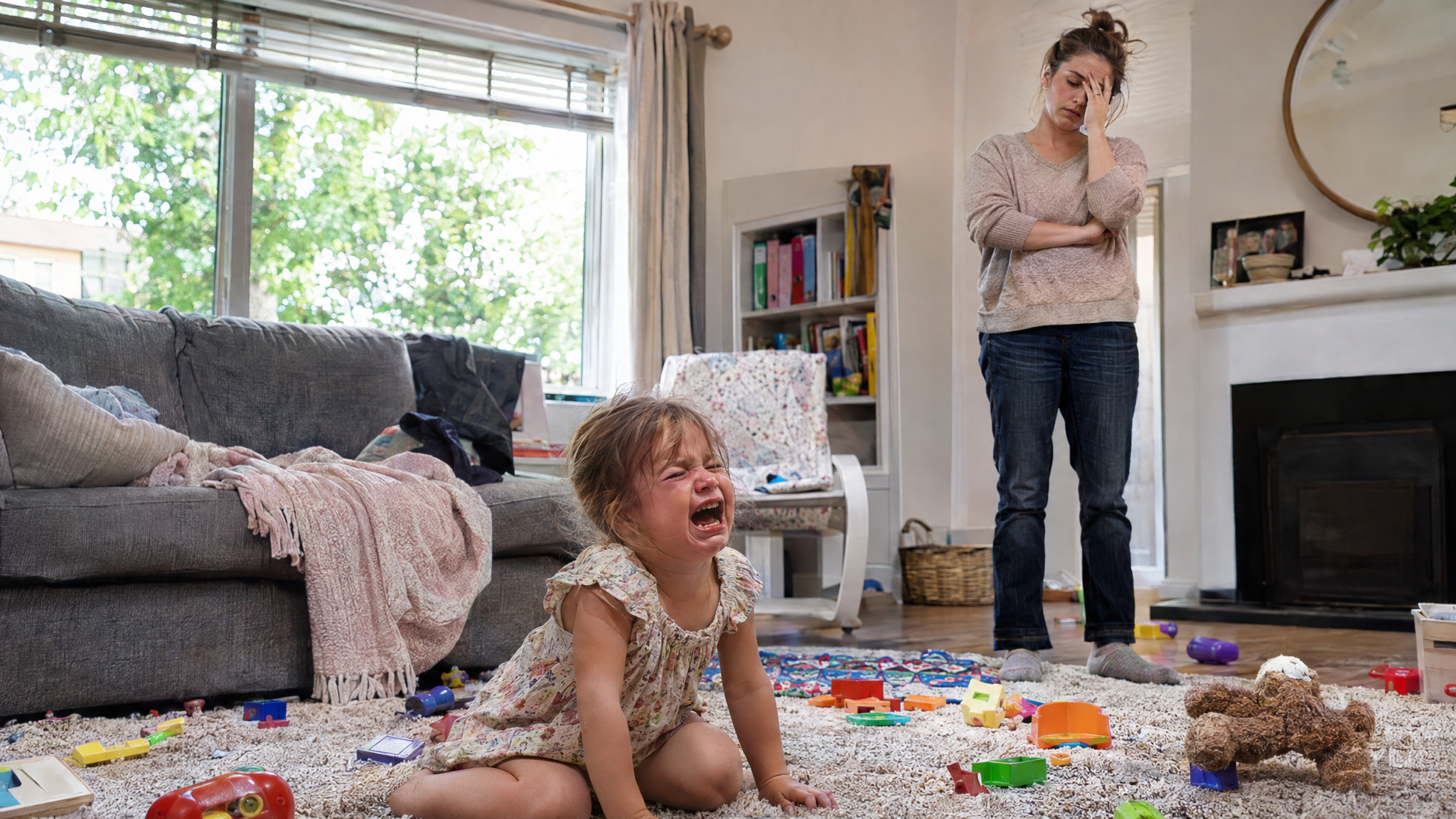
The worst part of realizing you don’t like your child isn’t the afternoon meltdown that pushed you over the edge. It’s the quiet ten minutes after bedtime when the thought lands in your head and you’re terrified to breathe a word of it to another living soul.
Here at Tidbits of Experience, many parents have confided this exact feeling to us. In our inbox and comments, the parents who reach out often have a few kids and frequently don’t like one of them at all.
Trauma and attachment educator Robyn Gobbel hosts The Baffling Behavior Show (also called Parenting After Trauma) at RobynGobbel.com. She says most parents she knows have thought they don’t like their child, and parents raising kids with big baffling behaviors, dysregulation (when a nervous system can’t settle itself), or attachment trauma have thought it more than once. She once sat in a single conference ballroom with literally hundreds of foster-adoptive parents carrying that secret in horrified silence. Feeling this way is awful, but you aren’t an awful person, and keeping a shameful topic quiet only convinces you it’s too shameful to survive.
Key Takeaways
Admitting to yourself and a safe confidant or therapist that you don’t like your child decreases the feeling’s intensity and duration, according to therapist Deb at Midlands Psychological Associates. Just never say it to the child.
Deb warns parents never to say, “I love you, but I don’t like what you do.” A child cannot separate what they do from who they are.
Difficult behaviors often come from a child’s survival-wired nervous system or mirror a parent’s own unhealed childhood, and rebuilding connection starts with dropping constant criticism while keeping household accountability intact.
Table of contents
Table of Contents
Is it normal to not like your child sometimes?
Parents who don’t like their child at times are experiencing a widespread, normal reaction to intense relational stress rather than a moral failure. Feeling a deep sense of dislike toward your own kid is heavily stigmatized and leaves you stuck in loneliness, yet talking about it in safe clinical and community spaces reveals how common the struggle actually is, especially when a child’s behavior is relentless.

Gobbel watched hundreds of adoptive parents sit together with this exact secret in one conference ballroom, and parents of children with attachment and relationship trauma feel it repeatedly. Reading every parenting book on the shelf often makes the shame worse: well-read parents experience an expertise-guilt inversion, telling Gobbel that because they understand why their child is struggling and have learned all the trauma-informed tools, disliking their kid makes them extra awful.
You can understand your child’s brain completely and still hate being in the same room with them by 4 p.m. Parenting is hard even on the good days. When a child’s daily behavior pushes every button you have, your brain registers the misery even if your heart knows the theory.
In the clinical practice of therapist Deb at Midlands Psychological Associates, people rarely state dislike of family members directly. Instead, they complain. Spouses, parents, and children take the brunt of those complaints, with bosses or colleagues mixed in, because complaining is socially acceptable while saying “I don’t like my eight-year-old” feels like detonating a bomb in the carpool line.
Our own reader comments and emails back this up: plenty of parents love their family as a whole, have several kids, and secretly don’t like one specific child at all. The stage of childhood matters, too.
Of 53 posters reporting their own experience in discussion threads on how old the child was when they felt this way, 35 say 3 to 5, 7 say under 3, 6 say 13 or older, and 5 say 6 to 12. That heavy cluster in the preschool years makes sense when you consider how loud, irrational, and physically exhausting three-to-five-year-olds can be before their brains develop impulse control. Carrying shame over that exhaustion only drains the energy you need to parent, which is why trading self-judgment for self-compassion is the only way forward.
Can you love your child but not like them?
Loving your kid is something you do; liking them is a reaction to who they are day to day. Parents under constant stress often separate the child they love as a human being from the exhausting friction of parenting them, because love is a decision rather than a warm mood.
Writer Annemarie Scobey-Polacheck, who has four children with her husband, Bill, wrote about this divide in a faith-based parenting essay published June 19, 2019 on U.S. Catholic (uscatholic.org) and originally printed in the May 2009 issue of At Home with our Faith. Being “in love” is an emotion closer to infatuation, she explains, while real love means doing what’s best for your child right now, even when it doesn’t involve hugs or kind words. As Deb at Midlands Psychological Associates points out, love is blind, but liking or disliking isn’t, and loving someone without liking them creates real blind spots.
Scobey-Polacheck shares the story of Julie, a mother of two who hated giving her five-year-old daughter time-outs and worried the little girl would think she wasn’t loved. Julie kept holding the line anyway, realizing that giving in would teach her daughter she always needed her own way, making the discipline an act of long-term love. Gobbel separates your feelings, your actions, and your child’s worth in the same way: a feeling can exist without turning into mistreatment, and you can dislike being around your kid today while still taking care of them and believing 100 percent that infinite worth and adoration are their birthright.
Why do I feel like I don’t like my kid?
Parental dislike is a protective emotional response triggered by unresolved hurt, chronic conflict, or a child’s survival-driven nervous system behaviors. Intense aversion toward a child’s actions usually grows out of daily battles, high-sensitivity stress, or unaddressed family wounds rather than a lack of maternal or paternal instinct. In the clinical practice of therapist Deb at Midlands Psychological Associates, dislike is almost always rooted in some kind of loss and the hurt that came with it. Recognizing those feelings can take months or years, if it happens at all, and it’s hardest to admit when the person is your own child.
- Profound differences in persuasion, values, and beliefs.
- Projection of other disliked people of similar persuasion onto the child.
- Long-term dislike that has never been seen, expressed, or resolved.
- Outrageous behavior that is tolerated, but not effectively tolerated.
- A genuine intellectual, physical, or emotional impediment that gets in the way of social engagement.
- Envy of the other person’s possessions or opportunities.
- Loving the person deeply even though you do not like them.
The seven causes of disliking a family member
Those seven causes from Deb’s practice show how quietly resentment builds when you’re stuck in the same house with behaviors you don’t know how to stop. Tolerating outrageous behavior without having an effective way to handle it slowly drains your goodwill until every sigh at the dinner table grates on your nerves. Because children are the hardest family members of all to admit disliking, parents often spend years burying the hurt of lost peace or unmet expectations under daily irritation.
What disliking a child actually looks like
In Deb’s practice, the children parents struggle to like are rarely dealing with minor phases. In one clinical example, a child molested several other children, tested intellectually several years below his physical age, had his school on alert, and left his family barred from returning to their church with him. Another case involved a nine-year-old who tested intellectually far ahead of his physical years and yells, screams, breaks things, and rolls on the floor whenever he’s told no. A third child is nearly nonverbal about his thoughts and feelings, plays on his computer for hours, and ignores questions.
Other cases include a girl whose parents had to put a lock on the refrigerator door and pantry to stop her from stealing food, and a child who clogs the toilet with feces and leaves the bowl full without telling anyone. After failed plunging and parents cleaning up with towels, that child hid the dirty towels in a closet where they sat for days. Deb also describes a routinely dishonest child who lies about school, likes, whereabouts, and feelings (and in one combined pattern, a child steals food behind a locked fridge, clogs the toilet and hides the dirty towels, and tells small everyday lies).
None of these kids is intrinsically likable on a given Tuesday, yet their parents still yell, demean, punish, and complain while finding it nearly impossible to say “I don’t like him.” Ordinary days can wear you down, too. Scobey-Polacheck describes 10-year-old Liam having an overtired wailing meltdown on the couch when denied Cocoa Krispies under a weekend-only sugared-cereal rule. His mother ignored him, showed him googled pictures of starving children, and finally sent him to his room, furious at his selfishness and lack of compassion.
The behavior is nervous-system-driven, not character
Neurodivergent wiring and trauma history often sit underneath those exhausting days. Of 23 posters reporting their own experience in discussion threads on whether the child received a formal diagnosis, 14 say ADHD, 5 say another diagnosis, 2 say no diagnosis, 1 says autism, and 1 says ADHD and autism. Gobbel explains that a child’s baffling behaviors make complete sense when you look at their nervous system state, their level of felt-safety (how safe they actually feel inside their body, which isn’t always the same as being physically safe), and what helped them survive in the past. Sometimes a child’s best survival move is pushing away close relationships, and being in a relationship with someone wired to reject connection can itself be traumatic for a parent who can’t just walk away.
When a kid has a hair-trigger stress response and lacks co-regulation (borrowing a calm adult’s nervous system to settle down), living with them feels like walking on eggshells, turning parents into tiptoeing hostages in their own homes. Some kids with trauma histories even do things parents find genuinely disgusting, and because disgust is a built-in reflex designed to push us away from its source, feeling it toward your own child manufactures instant shame.
When the dislike is a mirror of your own childhood
Yes, your own childhood can directly drive this feeling when your child’s traits mirror your unhealed insecurities or your nervous system broadcasts hidden threat. Parental projection happens when a trait you couldn’t stand in your younger self shows up in your kid, setting off your internal alarm and making you want to fix the child instead of facing your old pain.

Elain’s call: the Ugly Duckling mirror
On The Dr. John Delony Show on YouTube, a caller named Elain admitted she loved her 12-year-old daughter (who was turning 13 the next month and was a really good kid) but didn’t like or enjoy her, noting that hugs felt forced with her even though hugging her younger boys was easy, and half-joking that her kids were ready to get away from her at the end of summer. Elain, recently diagnosed with ADHD and estranged from her toxic mother, saw her own “Ugly Duckling” childhood copied into her daughter: Elain grew up poor without cool clothes, wearing big thick glasses with crooked teeth and cavities that went unfixed until high school, and her daughter was now “the extra one” bouncing between friend groups without a best friend.
After a year and a half in therapy and “10 years or 11 years of screaming” and blaming her kids, Elain was learning to control her emotions, though her daughter’s nervous system had accurately labeled her as reactive (some kids calm a reactive “dragon” parent by getting straight A’s and being perfect, while others pull away). Dr. John Delony told Elain that her daughter’s awkwardness was setting off her body’s internal GPS alarm, and instead of trying to fix her daughter, Elain needed to sit in the feeling and go back to being awkward at 12 again.
Delony’s own hug-refusal story
Children also read our unspoken stress through neuroception, a child’s subconscious 24/7 radar that constantly asks whether they belong and whether they’re safe. Delony’s own daughter, now 8, refused to hug him from ages 6 to 7 until about a year before the call, even though he never yelled, swore, or hit. His wife explained that their daughter felt his unspoken stress like a nuclear reactor in his chest, which pushed Delony into about six months of intensive trauma therapy in Nashville, Tennessee, saying things out loud he had never told a soul.
A parent’s childhood memories can also warp how they read a kid’s social life today. When Delony finally stopped nagging his middle-school son about wearing his shirt inside out and backwards every day and released him to the middle school wolves, the boy paid zero social penalty, even though that outfit would have earned brutal taunts when Delony was a kid.
Is it bad to admit I don’t like my kid out loud?
No, admitting you don’t like your child is not bad when you say it privately to yourself and a proven-safe confidant or therapist, except when spoken to the child, who must never hear it. Speaking honestly in a confidential space lets you untangle heavy emotions without guilt, whereas hiding the thought keeps it running the show.
In Deb’s clinical practice at Midlands Psychological Associates, helping parents of difficult kids admit they don’t like them actually shrinks the dislike’s intensity and duration. That honesty replaces a blanket “I don’t like my kid” with disliking specific behaviors, which frees you up to encourage and challenge them appropriately. At the same time, Deb warns parents never to tell a child, “I love you, but I don’t like what you do,” because a child cannot distinguish between what they do and who they are.
Gobbel agrees that the only way out of the shame is to be seen in a safe place by people who have earned your trust. Sitting on the secret usually leaks out as constant complaining or trying to compensate by forcing extra time together, which Deb notes only makes the resentment worse. Instead, Deb outlines four steps for handling the feeling safely:
- Admit the dislike to yourself first, and accept that you can love someone you don’t like.
- Differentiate what you actually like about your child from what you don’t, because you may like more than you realize.
- Confide the truth to at least one safe person, such as a trusted confidant or a therapist, and never say it to the child.
- Create careful breathing room so the dislike doesn’t curdle into hate or disgust.
What to do when you don’t enjoy being around your child
When you don’t enjoy your child’s company, start by dropping the self-judgment. You can borrow support from adults who delight in your child and in you, and work with a therapist if the resentment hangs on or leaves you isolated. Stepping out of survival mode requires treating your own exhaustion as real suffering rather than a character flaw, especially when you don’t have a safe friend who understands high-needs parenting.

Gobbel applies Dr. Kristin Neff’s self-compassion framework to this exact moment: take a breath and tell yourself that not liking your kid is painful, that this is a moment of suffering, and that suffering deserves compassion. She also prescribes a two-way antidote for burnt-out families:
- Find other adults in your child’s life who look at your kid with genuine delight.
- Find adults in your own life (including yourself) who look at you with delight, because adoring a hard kid requires having people who adore you first.
Gobbel pushes back hard on the cliché that parenting isn’t about you. Parenting is a relationship, and even though you’re the adult with more emotional regulation capacity, you’re still a human being with legitimate needs for ease, delight, and love in return.
When the heaviness won’t lift or you lack a safe confidant, both Deb and Gobbel point to a therapist as the right place to unpack it, even though clinical sources don’t set a rigid timetable for when to book that appointment. Parents in the trenches use a mix of supports: of 14 posters reporting their own experience in discussion threads on whether they got professional help for their feelings about parenting, 6 say therapy, 4 say medication, and 4 say no professional help.
When looking at what shifted the dynamic overall, of 13 posters reporting what change helped most in their own case, 9 say medication, 2 say therapy, 1 says sports or structured activities, and 1 says exercise or time away. For parents decoding behavior driven by trauma, toxic stress, or sensory and neuroimmune vulnerability, Gobbel shares connection and co-regulation tools on The Baffling Behavior Show on Apple Podcasts and Spotify, offers a free masterclass (What Behavior Really Is…and How to Change It) at RobynGobbel.com/masterclass alongside a free attachment ebook at RobynGobbel.com/FreeResources, and runs a periodic waitlist membership community called The Club.
How to rebuild a connection with a child you’ve drifted from
Rebuilding connection with a child you’ve drifted from requires stopping constant micro-criticism first so connection can come before correction, followed by a face-to-face apology and low-pressure rituals that keep household rules intact. When we feel distant from a kid, our typical reflex is to correct their posture, their chores, or their attitude even harder, which only drives them further into avoidance.
Stop the constant criticism first
Delony’s wife gave him a wake-up call that changed his parenting: focus on “just being likable,” meaning someone your child actually wants to be in the room with. Being likable doesn’t mean becoming a pushover; it means letting go of commentary on crazy hair, weird shoes, too-short pants, or a stained shirt, because nobody wants to hang out with a boss or a parent who critiques them the second they walk through the door. Lowering the volume matters just as much when kids actually misbehave: in Scobey-Polacheck’s U.S. Catholic piece, Sandra, a mother of four, realized her kids needed a calm, rational, assertive mom rather than a scary yelling one, and she credited going to the sacrament of confession more often and God’s grace with helping her discipline without losing her temper.
Own your fault, face-to-face
When you’re ready to reset the relationship, don’t do it from the front seat of the minivan. Delony points out that car talks don’t count as intentional connection because sitting shoulder-to-shoulder avoids eye contact.
Sit down face-to-face, look your child in the eye, and skip vague lines like “I want us to do better”, a kid hears it as “you need to fix yourself.” Instead, use Delony’s own-your-part script: tell your kid “I’ve messed this up,” that you made all your interactions about criticism, that you aren’t going to do that anymore because you love them too much, and that you’ll be right there in their corner when the middle school vultures come after them.
Build bridges and keep accountability
After the apology, build small, predictable bridges into their world while keeping normal chores and family rules in place. Delony coached Elain to set up a regular weekly one-on-one breakfast, bring out Questions for Humans conversation cards (which come in parents/kids and elementary, middle, or high school editions), and read whatever dragon, fantasy, or vampire book her daughter loved, right down to joking about being Team Edward from Twilight.
You still challenge your kid when they don’t pull their weight around the house, because rupture and repair (messing up, owning it, and reconnecting) is how kids learn relationships are sturdy. Months after Delony traded constant critique for laughter and steady accountability, he found himself saying a sentence he’d never uttered before, “Josephine, get off of me”, because his eight-year-old daughter had turned him into a human jungle gym, proving it’s not too late for a child’s nervous system to register you as safe again.
When the dislike is aimed at your spouse or a relative
Disliking a spouse or extended relative calls for honest repair or careful boundaries, while disliking one child among siblings requires urgent attention to prevent favoritism. Deb notes that a spouse should be a friend first, a lover second, and a partner third, yet many couples build love, sex, and partnership without friendship, leaving years of mere tolerance that are steep to undo (one wife at intake demanded an hour just to list her husband’s faults, then asked for a second hour).
With an intrusive father-in-law, a mother-in-law, an alcoholic relative, or family split over religion or politics (Deb notes many people now separate from extended family over whether someone loves or hates Trump), she advises loving them at a safe distance in geography, frequency, or intensity. Here at Tidbits of Experience, my kids have moments where they make me very angry, though overall I like them a lot, unlike the parents in our comments and emails who have several kids and don’t like one at all; Deb warns that when one child is harmed and a sibling is favored, they grow up in “completely different families,” illustrated in her practice by a woman who cut off her biological family in hurt and a sister who falsely accused her brother of molestation before admitting it was their father, still lacking the courage to apologize.
What your child needs while you work on this
Your child needs you to keep showing up for rupture and repair while remembering that they are a work in progress and this hard season isn’t permanent. Struggling kids are trapped between craving connection and feeling it isn’t safe, Gobbel notes. She once worried that talking openly about this would hurt adult adoptees and former big-behavior kids, especially after a negatively titled workbook on her dining table horrified her son, but a former foster youth who watched those hundreds of trying parents emailed to say she wished she’d had parents like them.
Scobey-Polacheck’s U.S. Catholic essay grounds love in Jesus’ commands and notes how easy kids are to love when they’re sleeping, cuddly, or writing love poems. In that piece, Samantha, a mom of two older teens, regrets riding her daughter so hard during a stressful 16th year as if the phase would last forever. Parent discussion threads back up that perspective: of 19 posters reporting whether a difficult phase improved, 12 say yes, 4 say partially, and 3 say no.
Frequently Asked Questions
How do I stop criticizing my child all the time?
Start by aiming to be someone your kid actually wants to share a room with, which means biting your tongue over harmless choices like weird shoes, crazy hair, or a stained shirt. Next, sit down face-to-face—not shoulder-to-shoulder in the car—and apologize directly for making all of your interactions about nitpicking. You still keep normal household rules and chores intact, but putting connection ahead of correction lets your child’s nervous system register you as safe again.
Can you love your child but not like them?
Yes, because parental love is a steady commitment to a child’s well-being and worth, while liking is just your day-to-day reaction to their personality and behavior. As writer Annemarie Scobey-Polacheck notes, real love is a decision to do what is best for your kid—even when that means enforcing a hated time-out—rather than a warm, infatuated mood. Still, therapist Deb warns that loving someone you do not like creates blind spots, so you have to separate what you genuinely appreciate about your child from the specific habits driving you crazy.