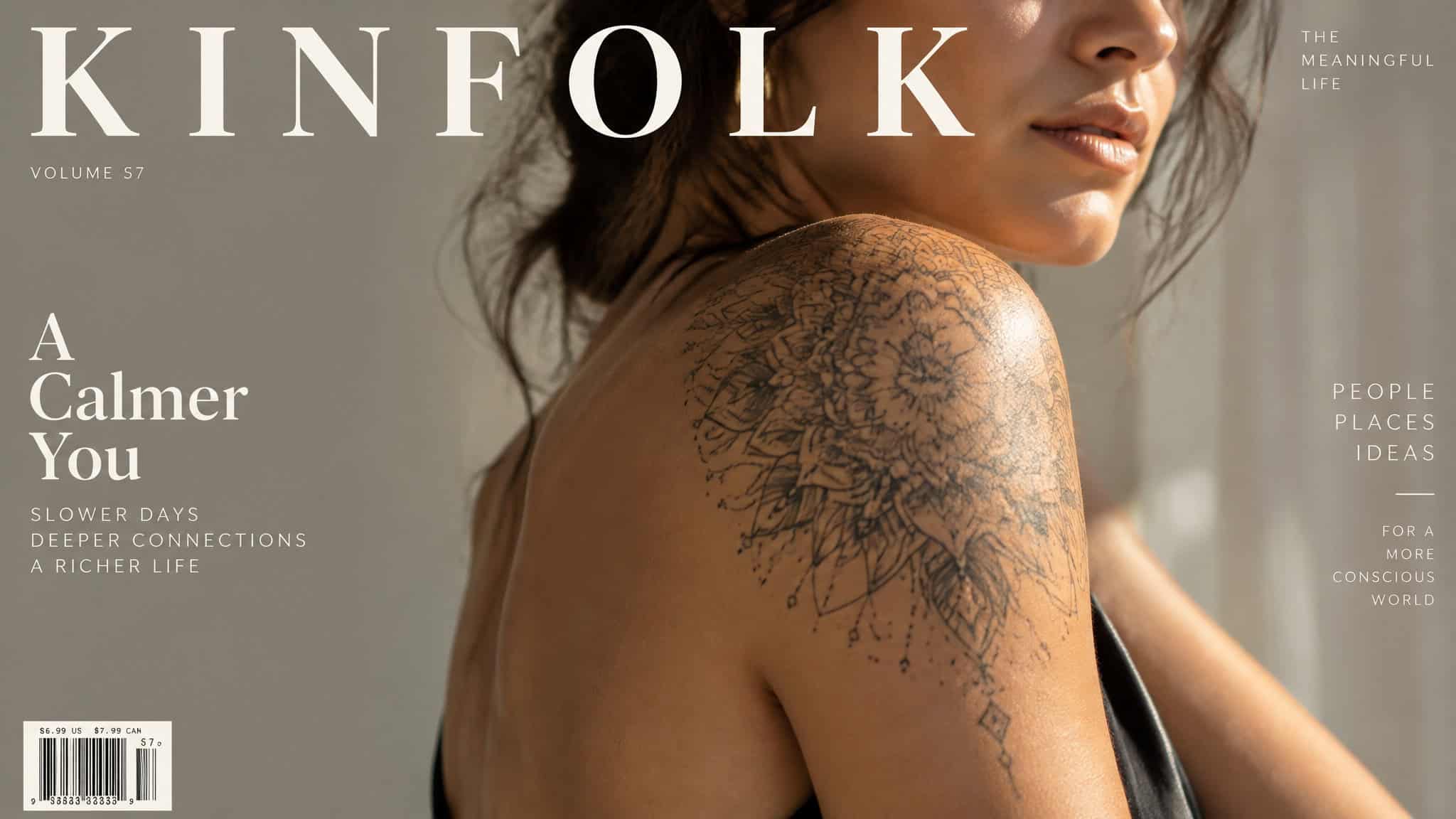
The strap kept sliding in the fitting room mirror, and every time it did, it exposed the exact patch of shoulder I’d been mentally reserving for a tattoo. That’s when I realized I’d been thinking about this backwards. I had a folder full of designs and no idea which of them would survive the round curve of an actual shoulder. I’d already chosen the spot. The spot was the decision.
If you’ve picked the shoulder too, here’s the part nobody says out loud: the placement is part of the meaning. Ink along the shoulder bone reads as a statement in a strappy or off-the-shoulder cut, and it’s just as gone under a work T-shirt. That dial, the one only you get to turn, says something about who this tattoo is for. I’d frame it as interpretation rather than some established cultural rule, but it holds up either way.
I went looking for tattoo ideas for women with meaning of life shoulder and found plenty of symbol lists and no placement thinking. So this article does the opposite: each idea below gets a verdict on how it fits this canvas, plus honest notes on pain, visibility, and how the ink holds up over decades.
Key Takeaways
The shoulder cap and shoulder blade suit small tattoos, roughly a centimeter up to palm-sized, and radial designs like mandalas and wings wrap the round deltoid better than anything flat.
One creator, Nyje’ Symone, rated her shoulder tattoo about a 3 out of 10 at the shoulder bone and a 4 out of 10 overall, with the bony front point hurting more than the fleshy back.
The shoulder doesn’t appear on the lists of spots most prone to stretching from weight change, and a shoulder cap piece is the natural anchor of a future half sleeve.
Table of Contents
Meaningful shoulder tattoo ideas, each with a fit verdict
Artists describe the same failure over and over: someone picks a quote or a detailed symbol sized for a flat forearm, brings it to the round shoulder cap, and the lettering distorts over the curve.
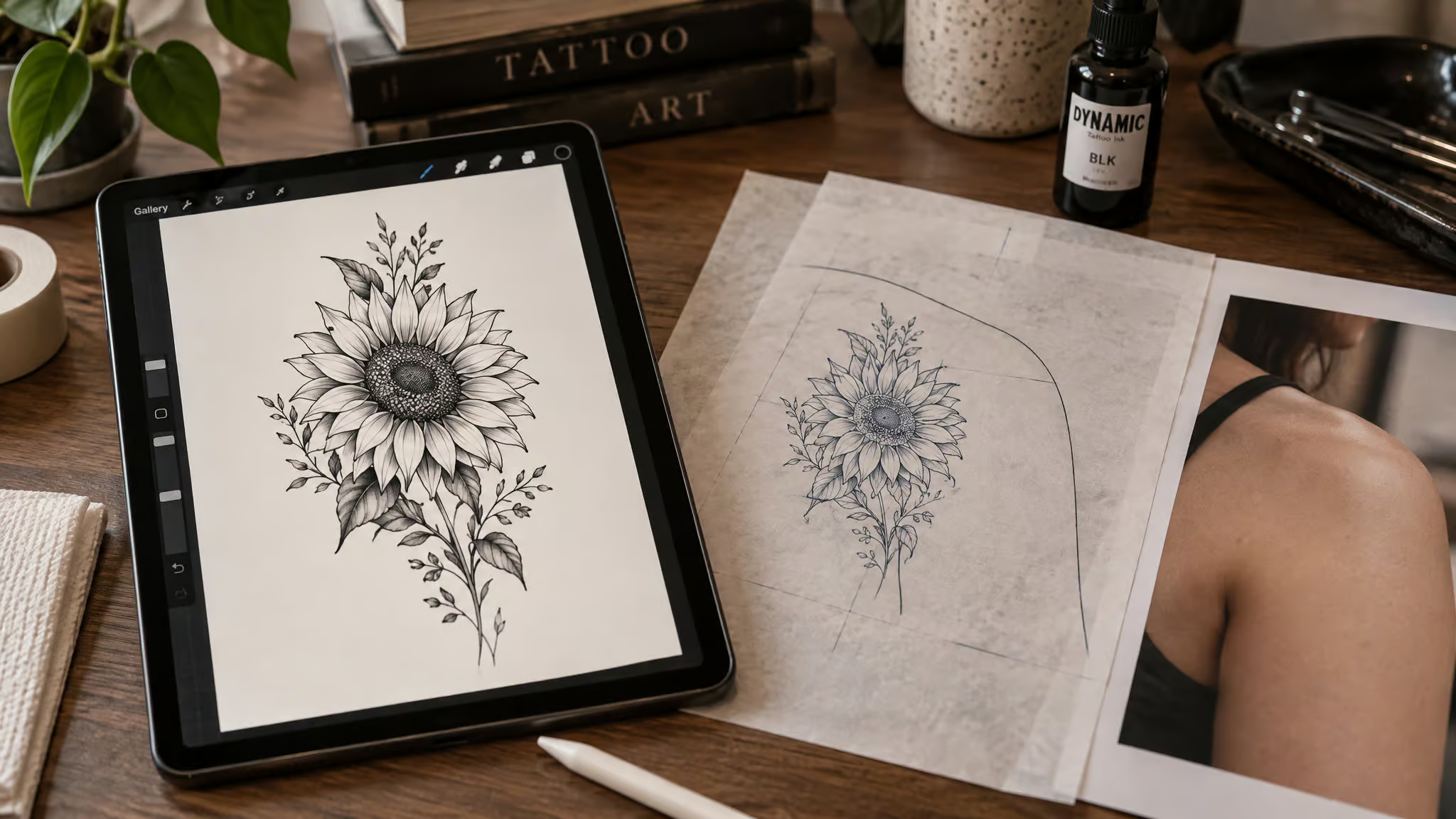
The artist logic behind every verdict below is simple. Follow the muscle flow: round the deltoid, down the tricep, wrapping toward the front of the arm. Orient the design for your body standing relaxed, arms down. If your design has faces, they should point toward the front of the body where possible.
One tattooer, hayleetattooer, calls this aesthetic feng shui, there’s no functional reason for it, it just looks right. And these guidelines are general and meant to be broken, so treat them as a starting point, not a rulebook.
On size: the shoulder cap and shoulder blade sit on the small-tattoo list, which runs from about a centimeter up to palm-sized. A piece that fills the whole upper arm, including the inner bicep, is a different, medium-tier commitment. Decide which one you’re making before you book.
Mandala
The meaning people commonly attach to mandalas is wholeness and balance, the idea that everything connects in one pattern. Size-wise, you want at least palm-sized here; the fine radial detail blurs if you shrink it too far. And this is the design the shoulder cap was arguably built for. A mandala is radial, the deltoid is round, and the pattern wraps the curve instead of fighting it. Verdict: wraps the cap beautifully.
Wings
To actually read as wings, plan on palm-sized or wider; anything smaller turns into abstract feathering. The meaning people reach for is freedom, protection, being carried through something hard. Along with mandalas, wings are the canonical match for the round cap because they’re built to spread across a curve. Verdict: the feathers can flow off the cap and down the tricep, which is exactly how this spot wants to work.
Tree of life
Growth, roots, cycles, the connection between where you came from and where you’re going. A tree needs vertical room for trunk and branches, and the shoulder blade gives you that in a way the cap doesn’t. The blade is a flatter, roomier panel, and the roots can spread. Verdict: better on the shoulder blade than the cap. If the cap is non-negotiable, keep the tree compact.
Lotus
This one stays genuinely small: coin-sized to palm-sized. Lotuses grow up through murky water and open into a bloom, which is why people reach for them for renewal and new beginnings. The petals even echo the round shape of the cap, so the design and the canvas agree with each other. Verdict: sits nicely on the cap, and it’s a strong pick if you want something small and private.
Unalome
The unalome is a spiral that straightens into a line, commonly read as the winding path of life eventually finding clarity. It’s a small design by nature, a few centimeters, and the spiral portion sits surprisingly well on the curve of the cap. Verdict: keep it delicate and let the spiral do the work. It’s one of the few linear symbols that doesn’t distort on a round surface, because the line is already curvy.
Moon phases
Moon phases stand for cycles, change, and the reminder that everything passes. The classic layout is a short arc of five phases, and an arc is precisely what the shoulder bone offers you. Set them along the line from collarbone to shoulder so the design follows your body. Verdict: made for that curve. This is one of the most naturally fitting designs on the whole list.
Sunflower
Here’s proof that meaning can be private and psychological rather than dictionary material. Nyje’ Symone chose sunflowers because the flower calms her during spells of depression and anxiety. That’s it. That’s the meaning, and it doesn’t need a symbolic footnote to be real.
Her sunflowers covered the cap and carried down the arm, so plan medium: the flower face rounds the cap and the petals flow off it. Verdict: a flower face loves a round surface. It cost her more than her other tattoos, and she’s said it was worth it.
Butterfly
Butterflies are the shorthand symbol for transformation, and Ariana Grande’s statement butterflies running from her shoulder down her arm show how the design uses this exact canvas. Verdict: it works because butterflies in flight follow the arm’s natural flow. (Her Manchester tribute sits behind her ear, a different spot entirely, so don’t mix the two up when you’re collecting references.)
Phoenix
Rebirth, starting over, rising from what burned down. A phoenix is a lot of bird: wings, tail, the whole dramatic arc. That means it needs more flat real estate than the cap gives you. Verdict: the shoulder blade can host a compact phoenix, but this is really a design that wants to extend down the arm. If you’re drawn to this one, it’s worth reading a dedicated phoenix guide before committing to the placement.
Small, classy cap symbols
The cap handles coin-to-palm-sized pieces without complaint, and the roundness even flatters simple shapes. That’s the range where classy shoulder tattoos for women usually live: a single flower, a short word, a tiny symbol with meaning only you can explain. Verdict: the cap’s best low-commitment option. Just check any lettering against the curve before you commit, because small script distorts the same way big script does.
Quote and script ideas that follow the collarbone
Curved lettering suits the shoulder because it tracks the body’s natural lines, and the line you have here is the collarbone-to-shoulder arc. One artist’s go-to examples of this flow include lettering curved along the collarbone. Steal that principle: curve the baseline along the bone.
The rule that keeps script looking intentional is that quote length has to match the arc. A short phrase, a few words, sits along the shoulder bone and follows it. A longer quote sized for a flat forearm will distort over the round cap, and that failure pattern applies doubly to lettering, because the eye catches warped text faster than warped imagery.
So the practical playbook: pick a phrase short enough to ride the arc, ask your artist to curve the baseline along the bone, and resist the urge to shrink a long quote to fit. If the words you love won’t fit the line, the words aren’t wrong, but the shoulder might be.
What the shoulder actually feels like
The shoulder is not one pain zone. The fleshy back portion and the shoulder blade are manageable, and the pain concentrates where the design crosses the bony point at the front of the shoulder. Most articles just say “moderate,” which tells you nothing about where it’ll bite.
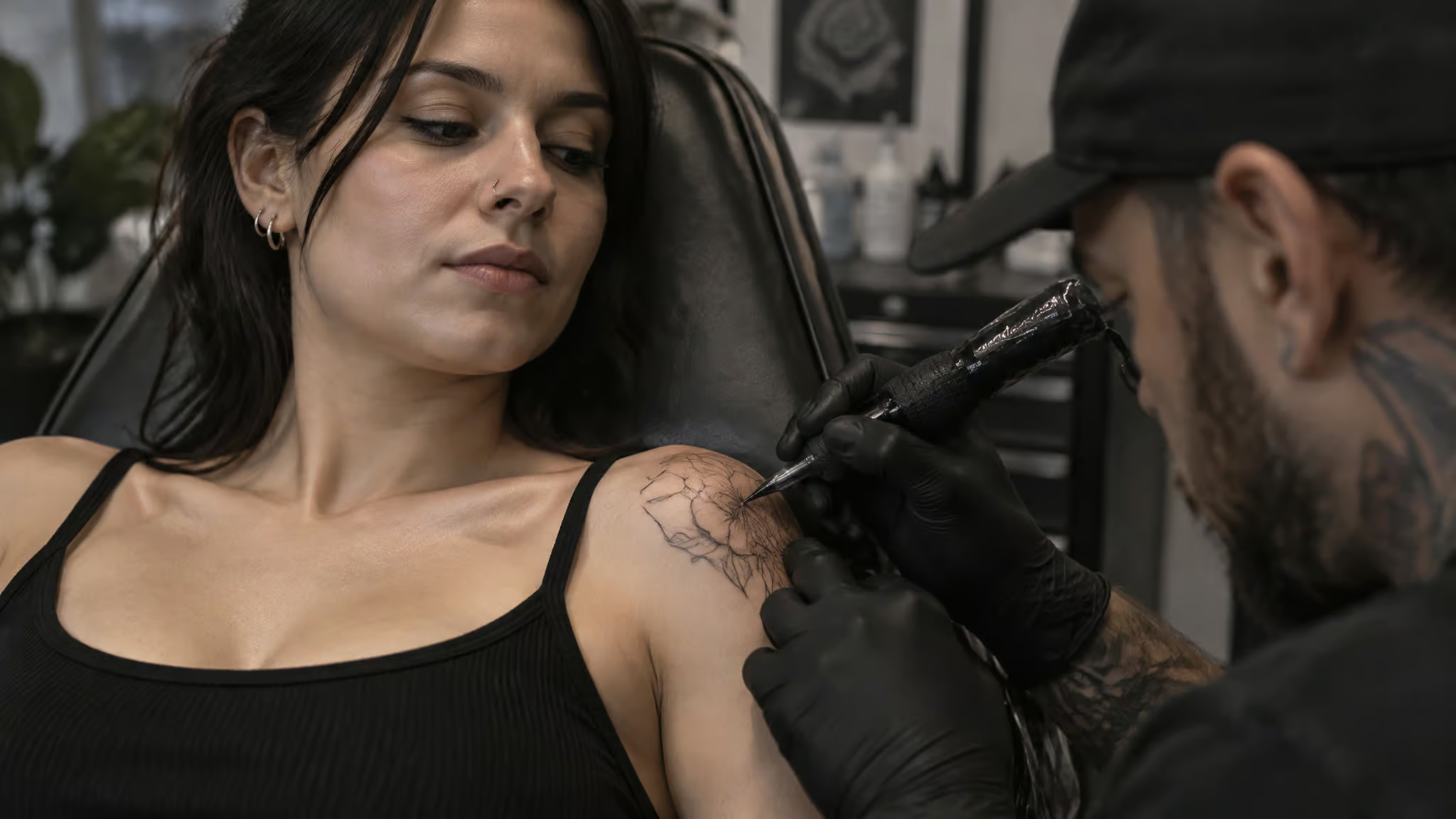
The best evidence is one person’s first-hand report, and pain varies person to person, so take it as a data point, not a prediction. Nyje’ Symone rated her shoulder tattoo about a 3 out of 10 at the shoulder bone and about a 4 out of 10 overall, with more pain near the front shoulder bone than the back. Her comparison anchor makes the numbers mean something: her spine tattoo sits right on the bone and nearly made her cry. The shoulder was a lot milder than that. Her appointment ran from 12 to 4, about four hours.
The why, in plain English: the spots that hurt most have thin skin, lots of nerve endings, or sit close to bone or joints. The front point of the shoulder checks that box. The back of the cap mostly doesn’t.
Quick test: Expect the bite at the front bony point only; the fleshy back of the cap stays comparatively easy.
Most first-shoulder-tattoo stories go the same way: people brace for the whole cap to hurt equally, then find that only the front bony point bites. Yeah, that part just sucks, and there’s no hack for it. It’s a few centimeters of unpleasant, and then it’s over.
Who sees it, and what the placement says
The shoulder is a visibility dial, and you’re the one who turns it. In an off-shoulder cut it’s a statement; under a T-shirt it’s gone. Same tattoo, same day, your call.
Picking a spot you can cover or reveal says something about who the tattoo is for, meaning revealed by choice rather than broadcast. Again, that’s an interpretation, not a cultural fact, but it’s the reading that makes the placement make sense: some things don’t need an audience to matter.
The real-life version: Nyje’ Symone walked into work with her sleeve up a few hours after her appointment, and coworkers complimented it right away. Not a promise that everyone will adore your tattoo, just a small, happy data point about how this plays out on an ordinary Tuesday.
Making the meaning last
If you’re wondering whether a life-symbol tattoo on the shoulder will stretch, the reassuring answer is that it isn’t on the lists of spots most prone to distortion from weight change. The spots those lists do name are the stomach, ribs, lower back, love handles, breast area, underneath the bicep, and inner thighs, and one artist, Cody Pratt, adds the lower back, stomach, and biceps. The shoulder’s absence from those lists is the answer, with the honest caveat that effects vary by individual, so no spot is distortion-proof.
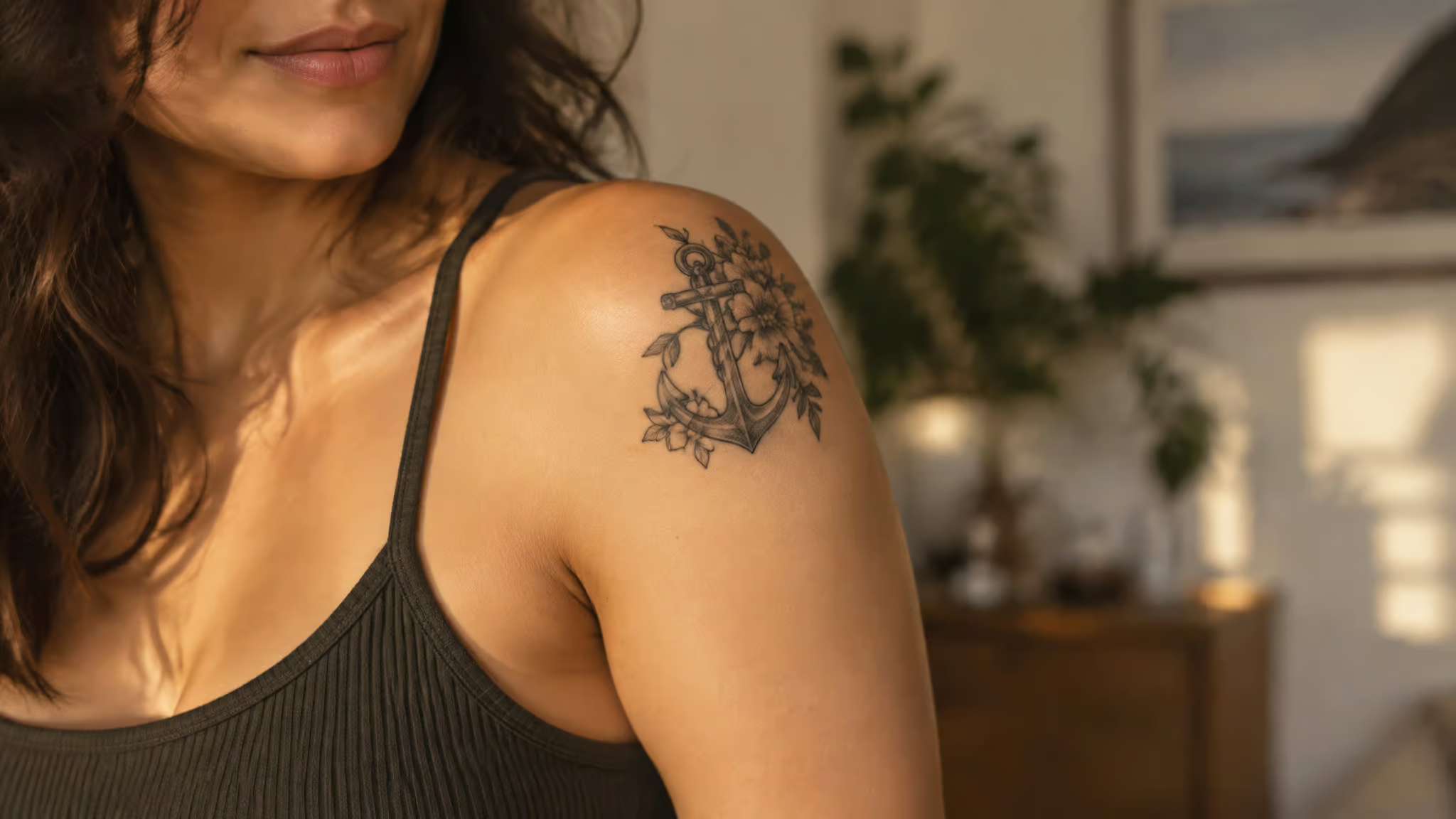
Field note: Prone-to-stretch lists name the stomach, ribs, lower back, love handles, breast area, under-bicep, and inner thighs. The shoulder isn’t on them.
Pratt’s longevity framing is worth keeping: flat, broad areas with low daily friction let intricate designs age well, and how a tattoo looks at 10, 20, and 50 years matters. A meaningful tattoo that distorts defeats its purpose. If a big weight change is planned, the kind, practical note is that it may be worth waiting on the prone spots. That’s not a gatekeeping rule, just information.
Pregnancy affects certain placements, including the lower stomach, hips, around the belly button, and some sternum pieces. The shoulder isn’t on that list either.
The second job here is future-proofing. A shoulder cap piece isn’t just a tattoo. It’s the natural anchor of an upper half sleeve, shoulder through inner bicep, and the edges and orientation you choose now determine what can grow from it later. The single most important tip from the placement guidance: think about where future tattoos might go before the first one. The cautionary example is an arm band that later has to be covered or incorporated into a full sleeve.
Erin Odea of Crossed Keys Society in Fort Lauderdale has traditionally suggested starting at the top of the arm and working down, though she’s noticed more clients starting lower now that visible tattoos are more accepted by employers. If you do imagine a sleeve someday: start with the three or four largest, most important images and let the spaces between dictate smaller filler pieces. Fillers in small spots stay simple, flowers, stars, dots. And if you mix styles across a sleeve, sticking to black and gray throughout helps the pieces read as one.
Working with your artist on a feeling
People often arrive with a feeling, not a design, and the session works when the artist translates that feeling directly onto the actual placement. This is a common way meaningful tattoos actually get made, and there’s a complete documented example to walk through.
Nyje’ Symone booked her appointment one to two weeks out knowing only that she wanted sunflowers, her favorite flower, the one that brings her peace and mellows her out during spells of depression and anxiety. Her artist, Callie at Magnum Opus Tattoo Collective in South Jersey, photographed the placement, uploaded it to her iPad, and built a custom design from the reference pictures. Mid-session, Symone asked to add a flower at the front, and Callie took it in stride, even suggesting butterflies. The whole thing ran about four hours.
The lesson isn’t that you should change your mind freely. It’s that the design didn’t exist until the artist translated the feeling onto the real spot, and it’s okay to speak up in the chair. There’s also a small craft detail that shows what a professional brings: Becca Genné-Bacon of Kings Avenue in New York City takes accurate tracings of the exact spot and draws organic-edged designs to fill that spot perfectly.
So show up with the feeling and your reference pictures, pick someone collaborative, and expect the design to be built on your actual shoulder rather than pulled from a template. The meaning you’re carrying and the curve it lands on are both part of the design. A good artist treats them that way.
Frequently Asked Questions
What are some meaningful shoulder tattoos for women?
Mandalas, wings, moon phases, lotus flowers, unalomes, tree of life, butterflies, and phoenixes are all popular picks, each carrying a common meaning like balance, freedom, renewal, or transformation. The catch is fit: radial designs like mandalas and wings wrap the round shoulder cap best, while tree of life and phoenix pieces do better on the flatter shoulder blade. Small coin-to-palm-sized symbols also work well on the cap.
What does a shoulder tattoo mean for a woman?
One reading is that the placement itself is part of the meaning: a shoulder tattoo is a visibility dial you control, a statement in an off-shoulder cut and invisible under a work T-shirt. That suggests the tattoo is for you rather than an audience, meaning revealed by choice rather than broadcast. It’s an interpretation, not an established cultural rule, but it’s what makes the placement make sense.
What is the most meaningful tattoo for females?
There’s no single most meaningful design, and the best proof is that meaning can be entirely private. One creator chose sunflowers simply because the flower calms her during spells of depression and anxiety, no symbolic footnote required. The meaningful tattoo is the one whose story is yours, placed where the design and the canvas actually agree.
Do mandala or wing designs fit the shoulder curve better than quote tattoos?
Yes, by a wide margin. Mandalas and wings are radial designs built to spread across a curve, so they wrap the round deltoid instead of fighting it, and wing feathers can flow naturally off the cap and down the tricep. Quotes are the opposite problem: lettering sized for a flat forearm distorts over the round cap, and the eye catches warped text faster than warped imagery.
How painful is a shoulder tattoo compared to a spine tattoo?
The shoulder is categorically milder. One creator rated her shoulder tattoo about a 3 out of 10 at the shoulder bone and a 4 out of 10 overall, while her spine tattoo, sitting right on the bone, nearly made her cry. On the shoulder, pain concentrates at the bony front point; the fleshy back of the cap stays comparatively easy.