Every list I found while researching lucky tattoos said the same three things: four-leaf clover, hamsa, lucky cat. None of them said where the symbols come from, what the four leaves actually stand for, or why one Vastu expert’s list includes a symbol most Western articles never explain at all. That gap is the whole reason this piece exists. If you’re about to get something permanent because you want it to carry luck, you deserve to know what you’re wearing and who it belongs to.
Key Takeaways
A Vastu expert posting as Tarot by Dhwani on Instagram named seven tattoo designs considered good for money and luck: Om, dream catcher, four-leaf clover, hamsa, Trishakti, moon phases, and Celtic knots.
Symbols split into two groups: ones whose meaning survives shrinking (a single clover, a tiny evil eye) and ones whose meaning lives in internal details (a hamsa’s central eye, a Celtic knot’s gaps) that disappear when miniaturized.
Every luck claim here is a belief, not a mechanism. What matters is the tradition a tattoo comes from and the story you’re willing to wear forever.
Table of Contents
The shortlist of traditionally lucky designs
The designs that come up again and again as lucky tattoos for women are the four-leaf clover, hamsa, evil eye, elephant, ladybug, horseshoe, number 7, maneki-neko, and moon phases. That’s the honest shortlist, and it comes from two different buckets.
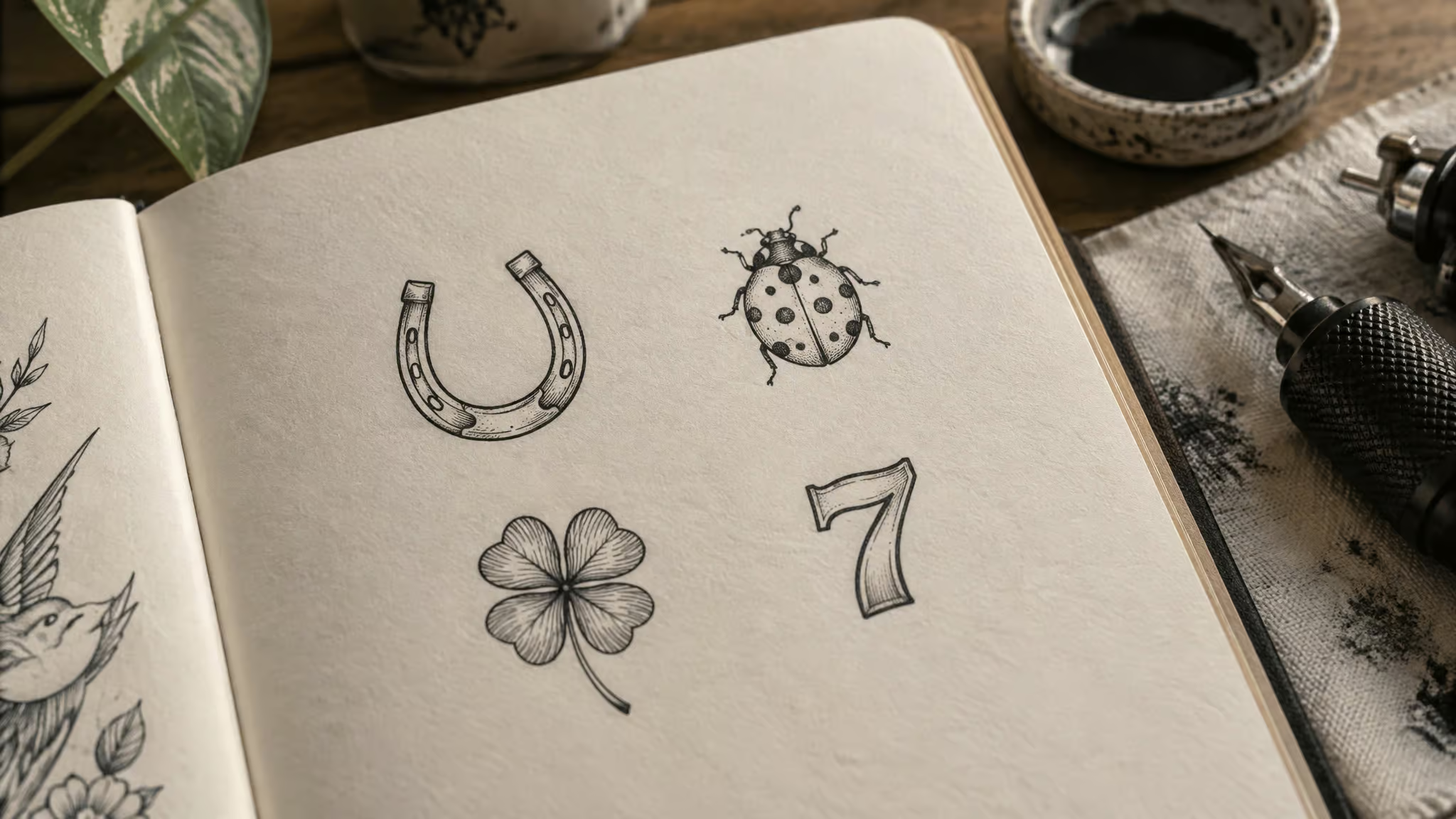
The first bucket is a specific list from a Vastu expert who posts as Tarot by Dhwani on Instagram, shared in a Times Now lifestyle article updated April 19, 2023. She named seven designs considered good for money and luck: Om, dream catcher, four-leaf clover, hamsa, Trishakti, moon phases, and Celtic knots. The second bucket is Western folk luck: clovers, horseshoes, ladybugs, the number 7. Both traditions show up in this article, labeled as they come.
One distinction worth making before anything else, because it’s what this whole article is about: a rose or a wolf tattoo carries meaning, but not a luck belief. Those are beautiful symbols about love or resilience. They aren’t talismans. (If you want the full range of designs beyond luck, the broader feminine tattoo ideas gallery covers that territory.)
Clover, horseshoe, and ladybug: Western folk luck
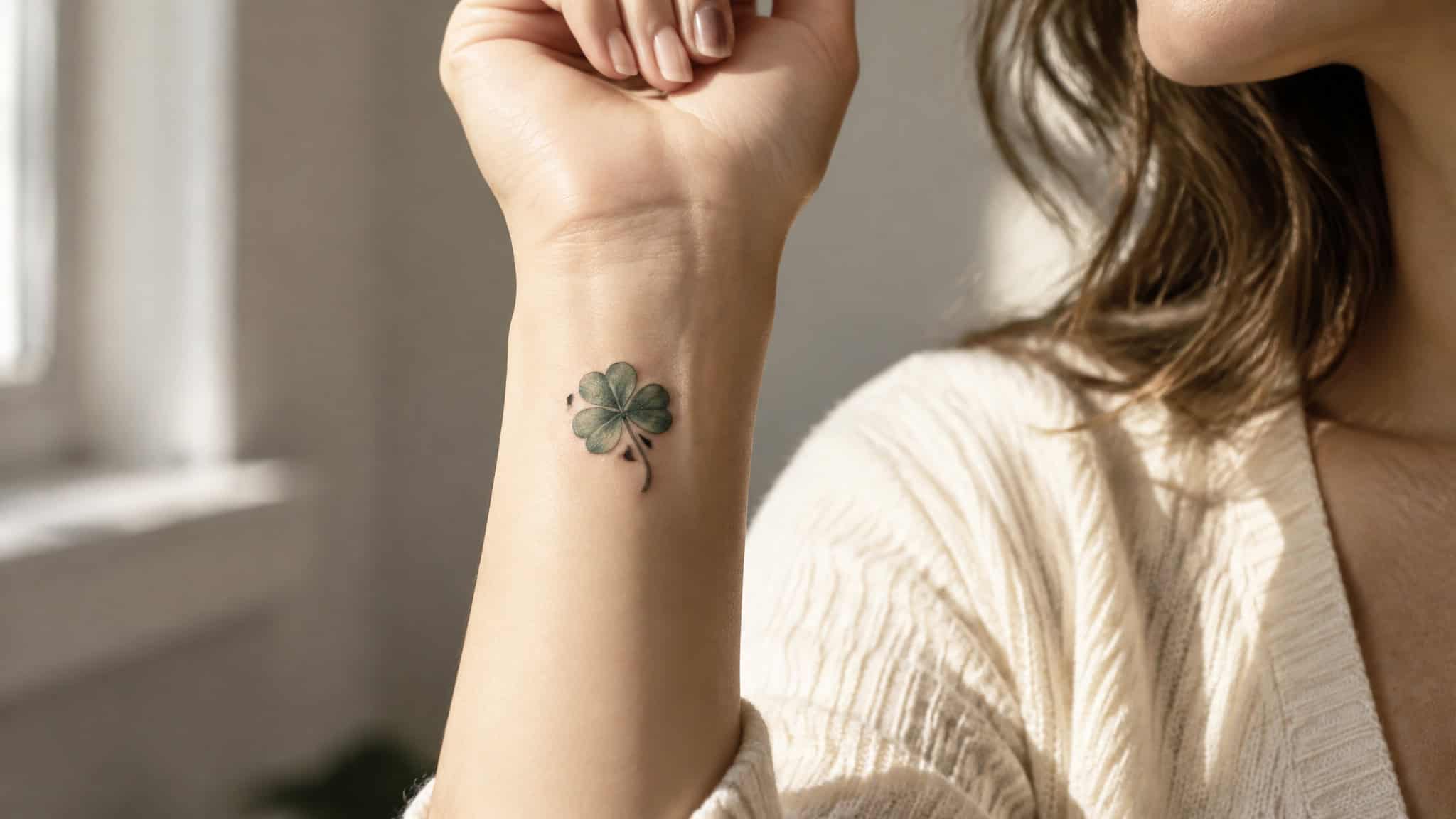
Start with the clover, because it’s the one everyone half-knows, and the half most people know is wrong. It’s not just “clover equals luck.” The four leaves each stand for something: faith, hope, love, and luck, in that order. Point at them like I’m doing right now.
One faith, one hope, one love, one luck. That’s the whole meaning, and it’s a much better answer when someone asks about your tattoo than “it’s lucky, I guess.”
Part of why the four-leaf clover reads as powerful good fortune is that finding one is considered rare. That scarcity is the belief’s engine. Some people read each leaf as a pivotal moment in their own life, which turns the tattoo into a little autobiography. Visually, clover tattoos often come in vibrant greens or intricate linework, and a single clover scales down cleanly to a wrist or even a finger. More on why that matters later, because it matters a lot.
The horseshoe is a genuine decision, not just a cute shape. Pointing up is said to hold luck inside the U. Pointing down lets it pour out. No tradition agrees on which is correct. Pick the orientation whose story you like, and know someone will have an opinion about it.
The ladybug is the simplest of the bunch: folk tradition treats a ladybug landing on you as lucky, and that’s the whole of it. No elaborate origin story needed, and honestly, none invented here.
Hamsa, evil eye, and the Italian horn: protection symbols
The hamsa, sometimes called khamsa, is the open hand you’ve seen on necklaces and charm bracelets everywhere. The classic protective image is an open right hand with an eye at its center, and the eye at the center is the point. It represents blessings, power, and strength, and it’s believed to ward off negative energies and bring good fortune. Some people wear it as a marker of a personal growth or healing journey, which is a quieter meaning than the amulet one but no less real. Designs can be customized with personal significance, so it’s a symbol that tolerates being made yours.
The evil eye is the protection symbol from Greek and Turkish culture, and you already recognize it: that blue-and-white eye bead. It and the hamsa are basically one family of protection symbols, the kind whose whole job is deflecting harm.
Then there’s the cornicello, the Italian horn, an Italian talisman that works like the evil eye. And it comes with the best story in this piece.
Sophia Crevelt, a journalism student, has her cornicello tattooed as a postage stamp, complete with a plane and the number 22. It commemorates her 2022 first trip to Italy with her mom. Her mother came to the US from Naples at 27 as a law student, before Crevelt’s brother was born in 1999. So the tattoo isn’t just a horn. It represents her mother, her tie to Naples culture, and meeting her Italian family for the first time.
The cornicello itself is ubiquitous in Naples. It’s sold on every street corner, worn on cars. Her cousin wears four, for extra good luck. And the detail that makes the whole point: strangers constantly mistake it for a chili pepper and tell her, “I love your chili tattoo.”
Sit with that for a second, because it’s the section’s real lesson. A symbol’s meaning is invisible to outsiders unless they know the tradition. Crevelt sees her mother and Naples and a first meeting with family. Everyone else sees produce. That’s how symbols work.
The hamsa spans Middle Eastern and North African traditions, so the honest framing is “traditions where the symbol carries meaning” rather than pretending there’s one definitive origin. If it carries meaning in a tradition you’re connected to, or you understand and respect the one it comes from, you’re approaching it the right way.
Om, Trishakti, and the dream catcher: Vastu-framed spiritual designs
These are the symbols most Western lucky-tattoo lists never explain properly, especially the second one.
Om symbolizes unity with the highest, combining spirituality and physicality. In Hindu culture it reflects the essence of the universe: creation, preservation, and destruction. It appears at the beginning and end of multiple Sanskrit prayers, which is a neat detail on its own. It also stands for unity, spiritual growth, mindfulness, and meditation practice, so it fits someone whose tattoo is about their inner life rather than their bank account.
Now Trishakti, because you probably haven’t heard of it and shouldn’t have to wait to find out what it is. Trishakti is a Tri-Energy symbol combining India’s three most auspicious signs: Swastik, Om, and Trishul. It’s said to purify the atmosphere and remove faults, which in everyday language makes it the fresh-start symbol on the list. About the swastik, one clear beat and no lecture: within this tradition it’s one of India’s most auspicious signs, a meaning that was inverted by its Western misreading. In the tattoo context, the auspicious traditional meaning is the one that counts.
The dream catcher represents protection from evil dreams, and designs can be adapted to illustrate different ideas. It’s on Tarot by Dhwani’s list directly. It comes from Native American tradition, so treat it as a living tradition rather than a pretty hoop. It’s a symbol people pick because they want protection while they sleep, and that meaning is worth understanding before it goes on your skin.
Maneki-neko, elephant, and the number 7: money luck
If what you want is luck and money, the maneki-neko is the most pointed symbol on this page. It’s the Japanese lucky cat, the one from restaurant counters, with a single paw lifted as if waving you inside. That raised paw is the entire point. It’s thought to attract good fortune, prosperity, and financial success, which is why it’s especially beloved among business owners. It’s also seen as a charm for general well-being, so it’s not only about money.
Here’s the detail that separates a prosperity symbol from a cute animal: a cat tattoo without the beckoning paw is just a cat tattoo. The paw is what carries the meaning. If the maneki-neko’s whole job is the beckoning, get the beckoning.
The elephant and the number 7 come from reader demand rather than the expert’s list, so they get folk-belief framing only. Folk traditions across cultures consider the elephant a luck symbol, and the number 7 is a long-standing lucky number across many traditions. Both are thought to carry good fortune. Neither comes with a detailed tradition-of-origin story, and I’m not going to invent one.
Moon phases and Celtic knots: designs where the structure is the meaning
Both of these carry meaning in their internal structure, which matters twice: once for what they mean, and once for how small you can tattoo them.
Moon phases carry a whole spread of associations: magic, purity, dreams, mystery, shadows, eternity. There’s no single correct meaning to pick from that list; it’s more like a friend describing options and letting you choose what resonates. The softer vibe is part of the appeal. It’s a mood.
Celtic knots are the layered one. They stand for nature’s three forces: water, fire, and earth. One unbroken line speaks to oneness of spirit, the no-beginning-no-end idea. The spirals represent growth.
And the gaps in the spirals symbolize stages of life: life, death, and rebirth. The gaps are the meaning. That’s the reading that goes deeper than the usual “eternity knot” one-liner, and it comes from Celtic tradition.
Plant the placement flag here, because it becomes a whole section soon: shrink a Celtic knot or a moon sequence too far and you keep the image while losing the meaning. The gaps close up. The phases blur into dots. More on that below.
Making it yours: how luck symbols get personalized
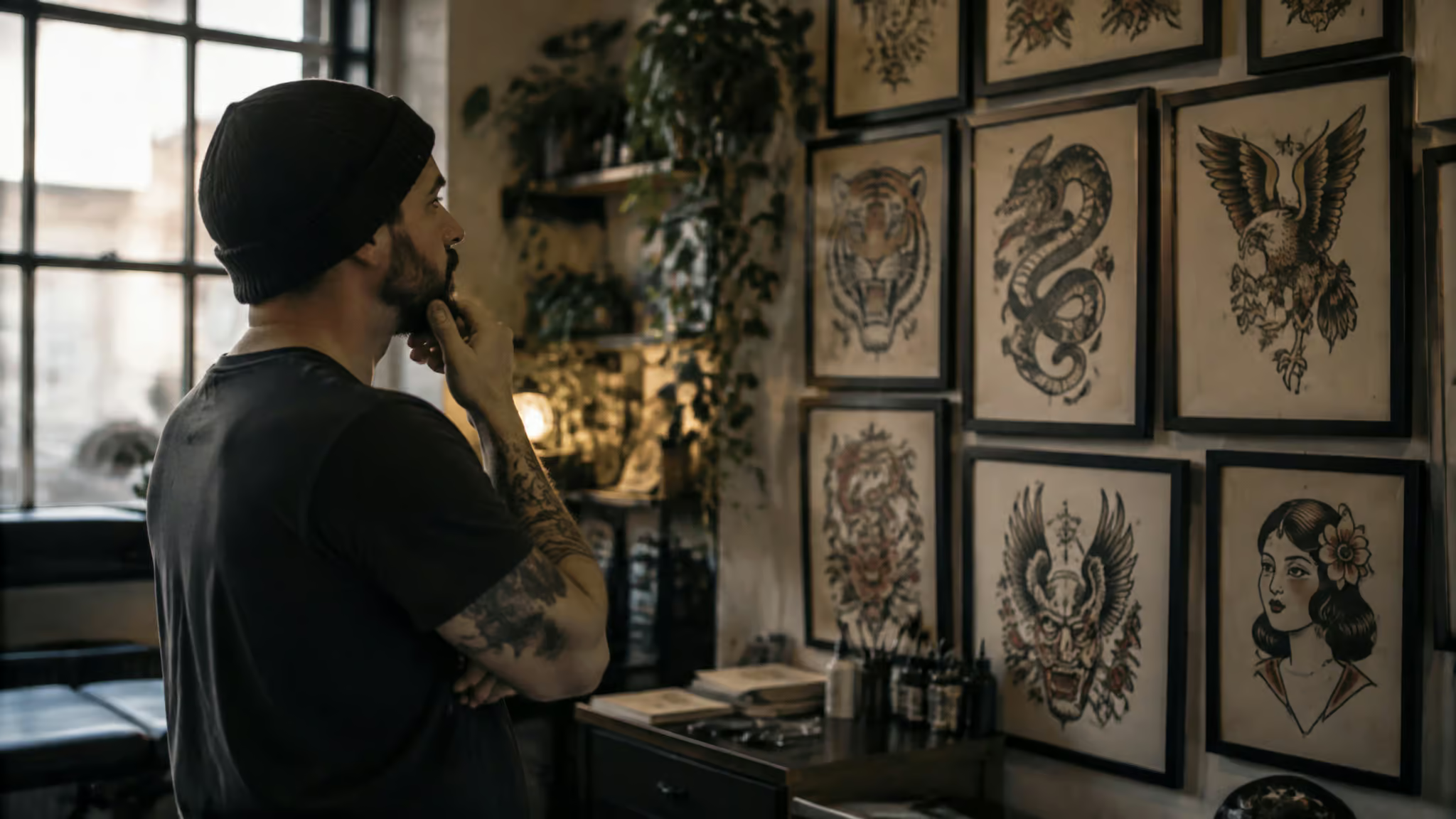
Here’s the pattern, in practice: wearers fold the luck meaning and the memory meaning into one piece. The tell is almost always a small secondary element, a number, a stamp-like frame, a paired flower, that outsiders read as decoration but the wearer knows is the point.
Crevelt’s cornicello-as-postage-stamp is the model case. The plane and the number 22 are the 2022 trip, her mother, Naples, the first meeting with her Italian family. The luck symbol is the vehicle and the memory is the cargo, and both fit on a postage stamp.
The second model is pairing. A hamsa combined with a lotus expresses protection and renewal together. The lotus represents purity, enlightenment, and rebirth. Its emergence from muddy waters speaks to resilience and healing. Yes, the lotus is probably the most common “meaningful” tattoo out there, and it’s common because the image actually works for people who’ve been through a hard season.
The third model is Allison Hawn, a tattoo art historian of Pict descent. Her family crest tattoo translates to “success nurtures hope.” She got a boar tattoo on finishing her Ph. D. in 2022, and she has her grandmother’s favorite teacup with a variation of a Wadsworth poem.
None of those are luck symbols in the clover sense. All of them are talismans in the way that actually matters: marks of identity, intention, and memory.
And then the exhale-inducing part, courtesy of Sasha Park: tattoo meanings can be post-hoc justifications. Sometimes you get the flash piece because you liked it, and the meaning shows up later. Meanings evolve with the wearer over time. A lotus you got at 25 because it was pretty might mean growth by 35.
Which means the stakes of choosing “wrong” are lower than they feel at the tattoo shop. The meaning isn’t frozen at the needle.
Small, wrist, and hand placements: the size tradeoff nobody mentions
The sources don’t cover placement, so this is practical pattern, not a rule from a named artist. But the pattern is real: small wrist and hand placements suit minimalist luck symbols because those symbols scale down cleanly. A single clover, a tiny evil eye, a simple infinity line. Reduce them and they’re still themselves.
Symbols whose meaning lives in internal structure are different. Miniaturize them and the detail disappears, and the detail is the meaning. A hamsa without its central eye is just a hand. A Celtic knot with the gaps closed up is just a tangle. A moon-phase sequence compressed into dots is just dots.
So the counterintuitive point, stated plainly: smaller isn’t always safer. Sometimes the small version keeps the picture and loses the exact symbolism you chose it for. Match the symbol’s structure to the size:
- Ask where the symbol’s meaning lives. In the overall shape, or in a specific detail?
- If it’s a detail, ask whether that detail survives at the size you’re picturing.
- If it doesn’t, either size up or pick a simpler symbol whose meaning does survive small.
That’s it. That’s the whole placement decision for luck tattoos, and it matters more than which wrist you pick.
You’re joining an 8,000-year-old habit
The oldest known tattooed mummies date to 3300 B.C. in Egypt; tattooing spans at least 8,000 years. Figurines of seemingly tattooed people plus possible tattooing tools go back tens of thousands of years, though the evidence there is suggestive, not certain. The mummies are the concrete part.
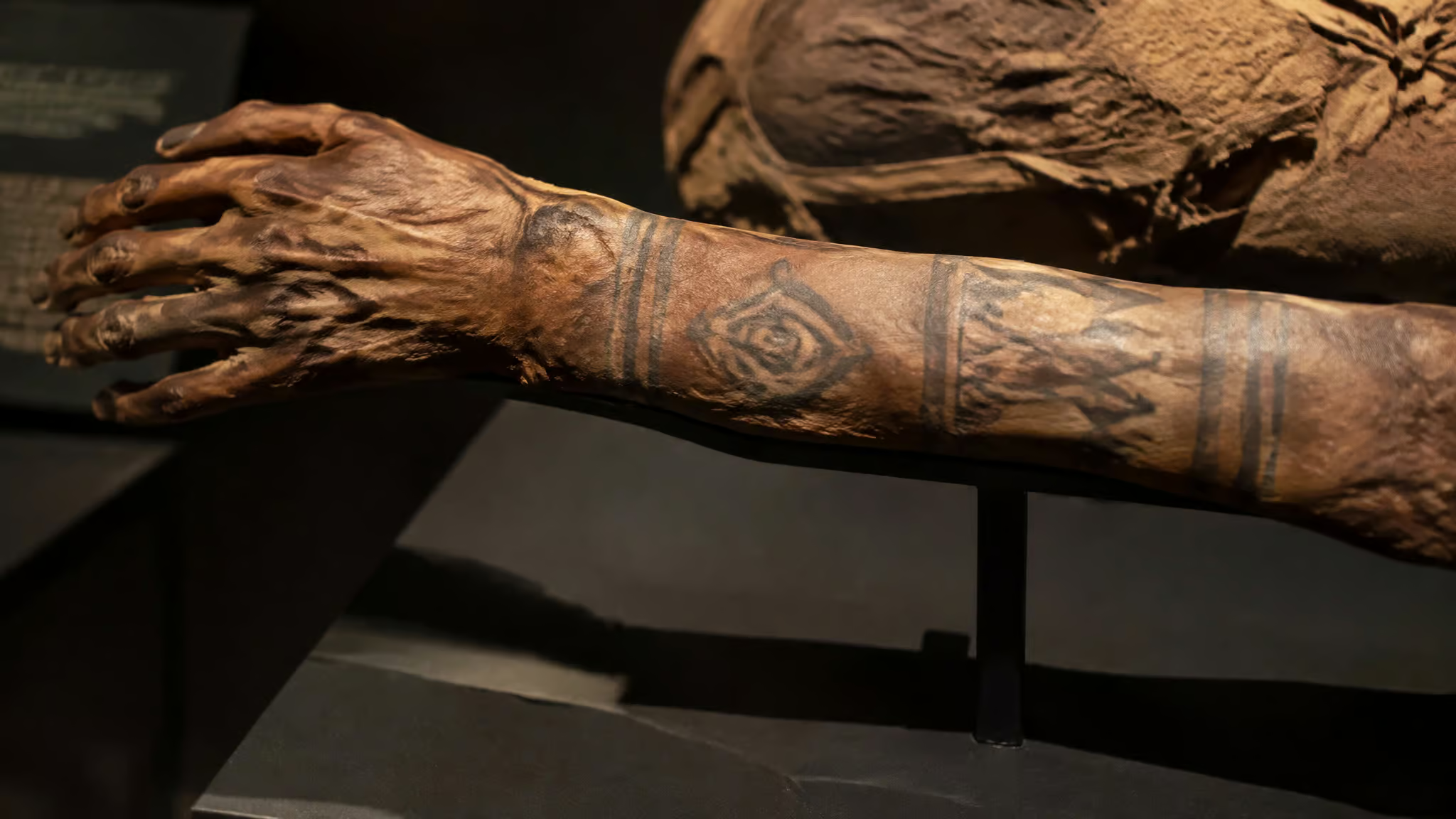
Ötzi the Alpine iceman, of comparable age, has charcoal tattoos running down his spine, across the back of one knee, and circling both ankles, possibly an early form of acupuncture. Possibly. It’s a great maybe. A Chinchorro culture mummy from pre-Incan Peru sports inked whiskers above his lip, which is such a specific, human choice that it deserves its own sentence. Amunet, a priestess from Egypt’s Middle Kingdom, carries tattoos thought to symbolize sexuality and fertility.
The word itself: “tattoo” comes from “tatao,” a Polynesian word used in Tahiti, adopted after Captain Cook landed there in 1769. Stories of what his crew found sparked a tattoo craze in Victorian English high society, a society that publicly disapproved of tattoos while privately loving them. Queen Victoria reputedly had a tattoo of a tiger fighting a python. Reputedly. But someone told that story about their queen for a reason.
Sailors marked their travels: an anchor meant you’d crossed the Atlantic, a turtle meant you’d gone south of the Equator. A naturalist aboard Cook’s ship observed that everyone there was marked according to their humor and life circumstances, which is to say people have always inked their own stories onto their own skin.
Eight thousand years of people marking themselves on purpose, and a talisman for luck is simply the newest version of a very old instinct. You’re not following a trend. You’re joining a habit.
Choosing respectfully: where each symbol comes from
| Symbol | Tradition it comes from | Core meaning |
|---|---|---|
| Four-leaf clover | Western folk luck | Faith, hope, love, and luck |
| Horseshoe | Western folk luck | Luck held in or poured out, depending on orientation |
| Evil eye | Greek and Turkish culture | Protection from harm |
| Cornicello | Italian, especially Naples | Spiritual protection, parallel to the evil eye |
| Maneki-neko | Japan | Thought to attract fortune, prosperity, and financial success |
| Om and Trishakti | Hindu and Vastu tradition | Unity of spiritual and physical; tri-energy purification |
| Dream catcher | Native American tradition | Protection from evil dreams |
| Celtic knots | Celtic tradition | Nature’s forces, oneness of spirit, growth, life stages |
| Moon phases | Celestial imagery used across many traditions | Magic, purity, dreams, mystery, eternity |
| Number 7 | Lucky across many cultures | Long-standing good fortune |
Two more symbols deserve an honest note rather than a table row. The ladybug and the elephant have luck associations that are broad folk beliefs without a single point of origin, so “folk traditions across cultures” is the most truthful tradition cell either one gets.
Then there’s the clearest example of a design that isn’t yours to borrow. The Māori of New Zealand celebrate heritage through intricate moko designs. Tā moko is a traditional Polynesian form with deep cultural and spiritual significance, practiced for centuries. Historically, an unfinished moko, from shying away from the excruciating chiseling, marked cowardice. That’s living heritage, not a design menu, and the contrast teaches the difference: symbols like the hamsa and the evil eye span many cultures and travel widely, while moko belongs where it belongs.
Which brings the whole thing back to the actual decision. The luck in these tattoos is belief and meaning, not mechanism. No clover has ever deposited money into an account. What a lucky tattoo does is carry a story: a tradition you understand, a memory you’ve folded in, an intention you wanted made permanent.
The real question was never “will this bring luck.” It’s what story am I willing to wear forever. Know the tradition before you wear it, and the answer to the second question tends to take care of itself.
This is general information, not professional advice. It won’t cover your specific skin, artist, or situation, so those conversations belong with an actual tattooer or a medical professional if anything about your health is in question.
Frequently Asked Questions
Which tattoos attract money?
The maneki-neko, the Japanese lucky cat with a single raised paw, is the most specific money-luck symbol — it’s thought to attract fortune, prosperity, and financial success, which is why business owners love it. The detail matters: a cat tattoo without the beckoning paw is just a cat tattoo. The number 7 and elephant also carry broad folk-luck associations.
What symbol brings good luck?
There’s no single universal one — it depends on the tradition. Western folk luck favors the four-leaf clover, whose four leaves stand for faith, hope, love, and luck in that order. Protection symbols like the hamsa and evil eye are believed to ward off negativity and bring good fortune, while the maneki-neko is the go-to for prosperity.
What symbol brings good luck across different cultures?
Different cultures have their own: the four-leaf clover in Western folk luck, the hamsa across Middle Eastern and North African traditions, the evil eye in Greek and Turkish culture, the cornicello in Naples, the maneki-neko in Japan, and Om and Trishakti in Hindu and Vastu tradition. The honest framing is knowing which tradition a symbol comes from before wearing it.
Is it disrespectful to get a hamsa or dream catcher tattoo if it’s not from your culture?
The hamsa spans Middle Eastern and North African traditions and travels widely, so the honest approach is understanding and respecting the tradition it comes from — or having a genuine connection to it. The dream catcher comes from Native American tradition and should be treated as a living tradition, not a pretty hoop. The contrast case is Tā moko: a Māori design that belongs where it belongs and isn’t a design menu.
Four-leaf clover tattoo vs hamsa tattoo: which is better for a first lucky tattoo?
It depends on size and meaning. A single clover scales down cleanly to a wrist or even a finger because its meaning lives in the overall shape. A hamsa’s meaning lives in the central eye — shrink it too far and you’re left with just a hand. If you want something small, the clover survives miniaturization better; if you want protection symbolism and can give it room, the hamsa works.