I try not to get frustrated when I lose at Solitaire. I tell myself it’s just a game, a way to unwind with a cup of coffee. But then it happens. I’ve made every move carefully, I haven’t rushed, and I still end up staring at a tableau with no legal moves left.
I recently had a game where I played what felt like a perfect game, only to lose. The next deal, I barely had to think. Cards just fell into place, and I won in a few minutes. Same player, same skill level, wildly different results.
That’s the moment the question hits you: Is this a game of skill, or am I just at the mercy of a random shuffle?
The honest answer? It’s both. It’s a blend of luck and skill, but it’s not a 50/50 split. Depending on the version you’re playing, the balance shifts.
Key Takeaways
About 80% of Solitaire games are winnable, but that doesn’t mean you’ll win them, a winnable deal only means a path exists, and you still have to find it.
The “Snowball strategy” (organizing tableau piles from smallest to largest) is a concrete skill that reveals hidden cards sooner and gives you more options.
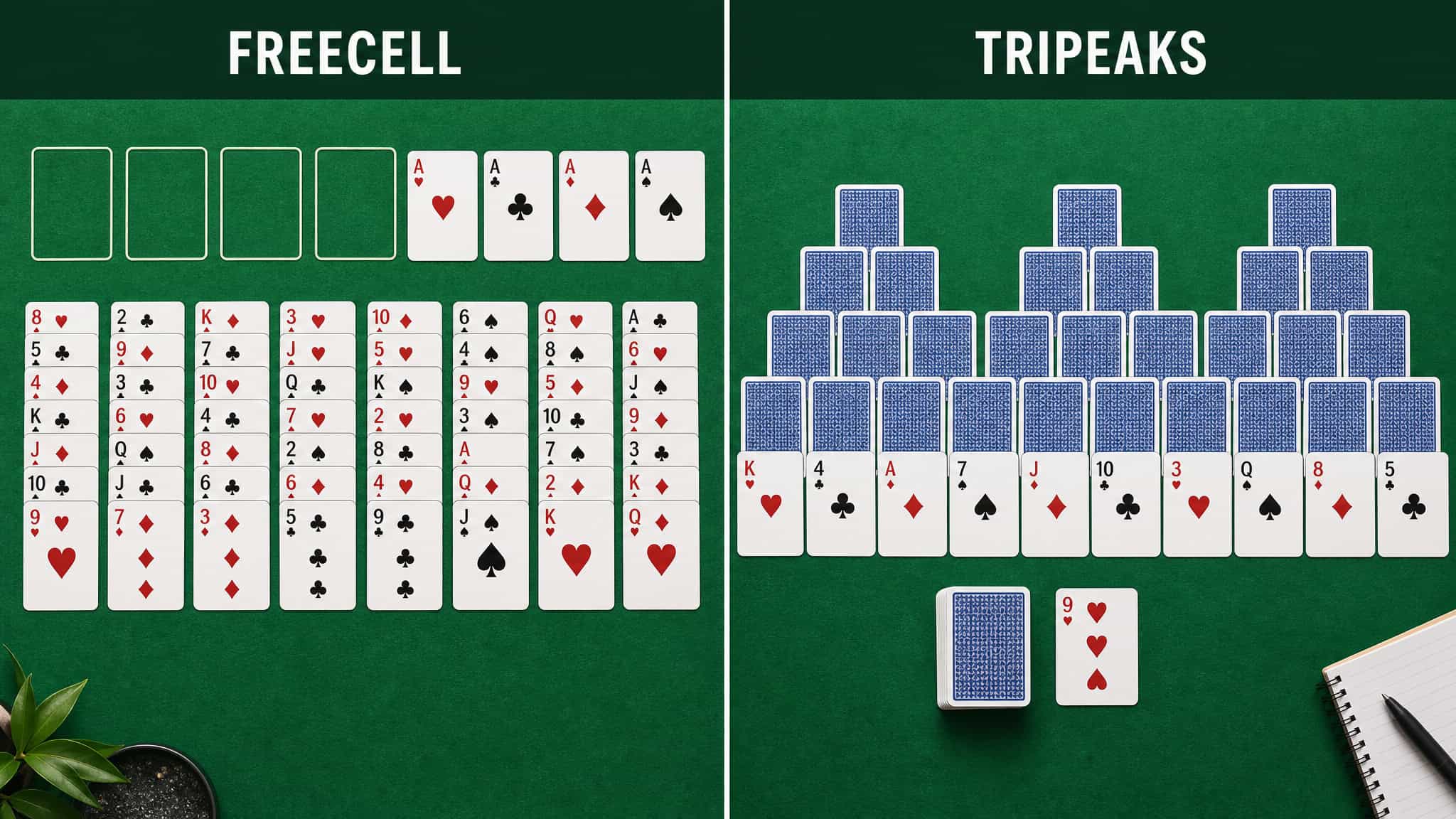
The luck-to-skill ratio isn’t fixed. FreeCell is near-pure skill because all cards are face-up, while TriPeaks and Pyramid are luck-heavy because the layout dominates.
Table of Contents
The Luck Factor: Unwinnable Deals and Hidden Cards
Let’s start with the part that makes you feel like the game is rigged against you.
Some deals simply cannot be won. It doesn’t matter if you’re playing at a world-champion level, the cards are buried, the sequences are blocked, and there’s no valid path to completion. It’s not your fault, and it’s not a skill issue. The deal was dead on arrival.
Here’s the scale of what you’re dealing with. Every Solitaire game starts with roughly 8×10⁶⁷ possible arrangements, that’s more than the number of atoms in the known universe. With that many permutations, some of them are going to be unwinnable. It’s inevitable.
In a standard Klondike setup, there are 21 hidden cards sitting face-down in the tableau piles. Those 21 cards are making decisions behind your back. You’re planning around them, but you can’t see them. Sometimes they cooperate, sometimes they don’t.
Estimates from Solitaire sites suggest that about 80% of games are actually winnable. That sounds encouraging, right? Well, it also means about 1 in 5 games aren’t winnable. No amount of skill can fix a deal that just doesn’t give you options.
And here’s the kicker: a winnable deal doesn’t guarantee a win. It only means a winning path exists. You still have to find it, and that’s where the skill comes in.
The huge scale of possible games means luck is built right into the experience. But those 21 hidden cards? What you do with what you can see matters just as much.
The Skill Factor: Where Your Decisions Actually Matter
Picture this: you and I get the exact same deal, same cards, same layout, same everything. We both sit down to play. I might finish, and you might get stuck. That’s not luck. That’s skill.
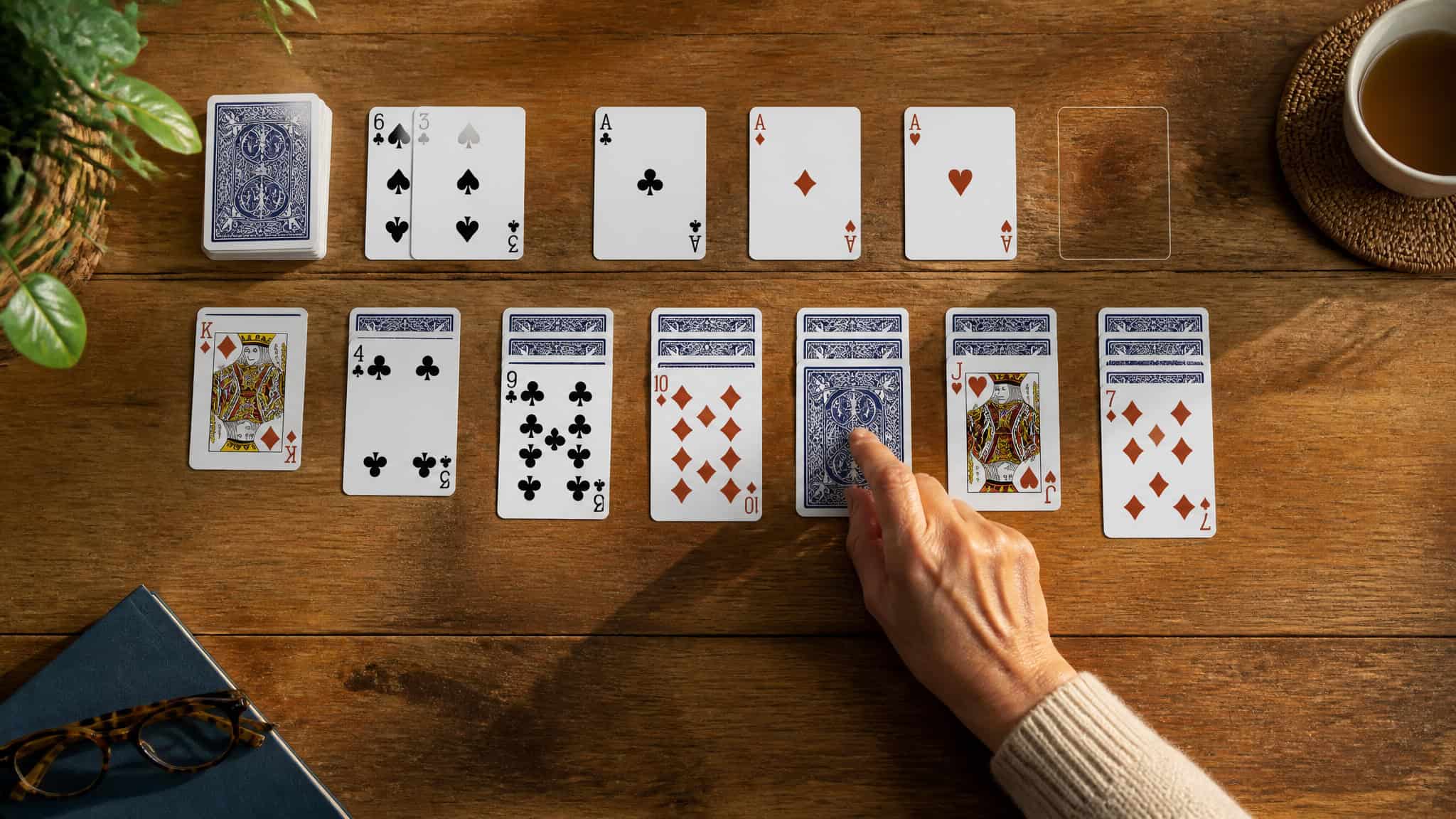
Picture this: you and I get the exact same deal, same cards, same layout, same everything. We both sit down to play. I might finish, and you might get stuck. That’s not luck. That’s skill.
Solitaire does require skill. It’s not a slot machine with cards. The skill shows up in your choices: which cards to move, when to reveal hidden cards, when to hold back, and when to clear a column. At its heart, that’s really what’s the point of solitaire, a quiet ritual of patience and focus that rewards small, deliberate decisions.
The core strategic priority is revealing hidden cards early. When you have two legal moves, choose the one that reveals a face-down card, a principle central to most solitaire rules for beginners. Remember, there are 21 hidden cards at the start, and forgetting to expose them early is a common disaster. It’s one of those things that seems obvious in hindsight but is surprisingly easy to overlook when you’re in the moment.
Good players also think two or three moves ahead. It’s chess with cards. Ask yourself: “What will happen if I play this card? Does it open anything, or does it just give me one more move before I hit a wall?”
Beyond that, prioritize Kings and Aces: Kings start new builds, and Aces clear foundations. Build foundations evenly to avoid soft-locking, and be cautious with stock draws in 3-card draw games.
One technique that separates experienced players from beginners is the Snowball strategy. Organize your tableau piles from smallest to largest. You burn through the smaller stacks quickly, which means you reveal hidden cards sooner, a practical how to win solitaire strategy for the efficiency-minded player. The more hidden cards you expose, the more options you have. It’s a snowball effect, the faster you clear the small stuff, the more the big stuff opens up.
Skill is what you do with the luck you’re given. The shuffle gives you the ingredients; your decisions are the recipe. You can’t control what cards you get, but you can control how you use them.
The Variant Spectrum: From FreeCell to TriPeaks
Here’s where the “is it luck or skill?” question gets interesting: it depends on which game you’re playing. The balance isn’t fixed. It shifts dramatically based on the variant.
- Klondike (the classic): Medium luck. This is the version most people mean when they say \”Solitaire.\” There are many face-down cards, and the stock order affects what you can access. It’s the most popular variant by far, for many players it’s the only one they call by that name. It sits right in the middle of the luck/skill spectrum.
- FreeCell: Near-pure skill. Here’s the big difference: all cards are face-up from the start. There are no hidden cards, so your decisions are based on logic and planning, not guesswork. You can see the entire board and plan your moves accordingly.
It’s the closest the genre comes to a pure skill game. (Even FreeCell has some luck in the initial deal, but it’s minimal.)
- Spider Solitaire: High skill. This one requires building descending sequences and managing empty columns. It’s often played with two decks. An empty column can completely change the game, it gives you space to reorganize long stacks.
The difficulty scales too: one-suit Spider is forgiving, while four-suit is demanding. The main challenge is sequence management.
- TriPeaks, Pyramid, Golf: Luck-heavy. These games are dominated by the card order and layout. The deal can limit your options before you even start. That said, smart timing and streak management still help.
TriPeaks is all about card order, but timing your moves matters. Pyramid’s layout can limit you, but pairing choices still make a difference. Golf is quick and depends on the deal, yet your tactical choices can extend how long you keep going.
- Yukon: Many cards are visible, but poor sequencing can block your options. Skill still matters here.
The general rule is simple: more visible cards means more skill matters. More hidden cards means more luck. It’s not a ranking of better or worse games, they’re just different challenge types.
Scoring Rules Change Everything (Vegas Scoring)
Here’s a rarely discussed angle that changes the whole calculation: scoring rules can transform the skill/luck balance because they change what “playing well” actually means.
Take Vegas scoring, for example. This scoring system penalizes each draw from the stock and each redeal. That changes everything.
I play with Vegas scoring, and I always end up at -$1000. Every single time. That’s not bad luck. That’s the scoring system punishing draws, and I keep making the same mistakes.
Vegas scoring adds a resource-management layer to the game. Minimizing draws becomes just as important as making moves. You’re not just trying to win, you’re trying to win efficiently. A move that wins the game but uses three extra draws might not be the right move under Vegas rules.
And here’s something else: undo features and auto-play, which are available in online versions, change the calculation too. They’re not cheating, they’re learning tools. Backtracking lets you experiment and see what went wrong. It’s like having a time machine for your mind: you can try a move, observe the outcome, then rewind and attempt another approach. The undo button is a legitimate way to learn.
The point is that scoring rules force you to play differently, and that changes the skills that matter. Under standard scoring, you might prioritize revealing cards. Under Vegas scoring, you might hold back on draws even if it means slower progress.
The Skills Carry Over (And How to Practice)
Here’s the good news: the skills you build in one variant transfer to others. Playing different versions teaches different skills.
- TriPeaks improves quick decision-making.
- FreeCell rewards planning and thinking ahead.
- Spider rewards sequencing and managing empty columns.
I play about four different versions myself. I alternate between them for variety, but also because each one exercises different skills. It keeps things fresh, and it makes me a better player overall.
Use the undo feature as a deliberate learning tool. When you make a move that leads to a dead end, undo it and figure out what you could have done differently. That’s not cheating, that’s practicing.
Patience is also a skill, and it’s one that new players often overlook. Rushing leads to roadblocks. New players often try to win as fast as possible, and they hit walls. A session might suddenly stop with no legal moves because you were too hasty. Staying calm and making deliberate choices helps you spot smart plays.
And here’s the most important reframe: losing isn’t failure, it’s data. Not finishing a deal says something about the cards, not about your worth as a player. You didn’t mess up necessarily; the cards just weren’t in your favor. That’s freedom from frustration.
The Verdict: A Blend, But Not a 50/50 One
So where does that leave us?
Many seasoned players generally agree on a rough split: about 70% skill, 30% luck. That’s an estimate, not a scientific measurement. But it captures something real. Skill decides how well you uncover cards, manage your choices, build sequences, and avoid blocking future moves. You can’t remove luck from the game, but you can increase how frequently you make the best possible choice.
But that 70/30 split is really an average, the actual ratio swings wildly depending on the variant, from FreeCell’s near-certainty to TriPeaks’ chaos.
There’s a comment I remember from a forum that I’ve never forgotten. Someone broke it down like this: Solitaire is approximately five-sevenths luck, three-fourteenths skill, and one-fourteenth magic. The “magic” was a playful reference to cheating. It’s silly, but it’s also kind of true. There’s always an element you can’t control.
Here’s the thing, though: you wouldn’t want it any other way. A 100% skill game would feel like a spreadsheet. The luck is part of the appeal. It brings surprise and challenge.
It gives you the highs of an easy win and the puzzle of a difficult deal. The luck creates challenges, and the skill makes winning satisfying.
When you lose a deal that was never winnable in the first place, that’s not on you. You can’t control the shuffle, but you can control how you play. And that’s where the satisfaction lives. It’s not about winning every game, it’s about playing the ones you can win as well as you possibly can.
Frequently Asked Questions
What is the trick to winning Solitaire?
The main trick is to prioritize revealing face-down cards early, especially from tableau piles with the most hidden cards. Also, use the undo feature to experiment and learn from mistakes, and practice different variants to build transferable skills.
Is Solitaire actually good for your brain?
Yes, Solitaire exercises skills like planning, sequencing, and quick decision-making, depending on the variant. FreeCell rewards foresight, Spider improves sequence management, and TriPeaks sharpens quick choices, so playing regularly can keep your mind agile.
What percentage of Solitaire is luck?
Many seasoned players estimate the balance at about 70% skill and 30% luck, though it’s not a scientific measurement. The exact ratio varies by variant: FreeCell is near-pure skill, while TriPeaks and Pyramid are luck-heavy.
How does Vegas scoring change Solitaire strategy?
Vegas scoring penalizes each draw from the stock and each redeal, so minimizing draws becomes as important as making moves. This adds a resource-management layer, forcing you to play more efficiently rather than just aiming to win.