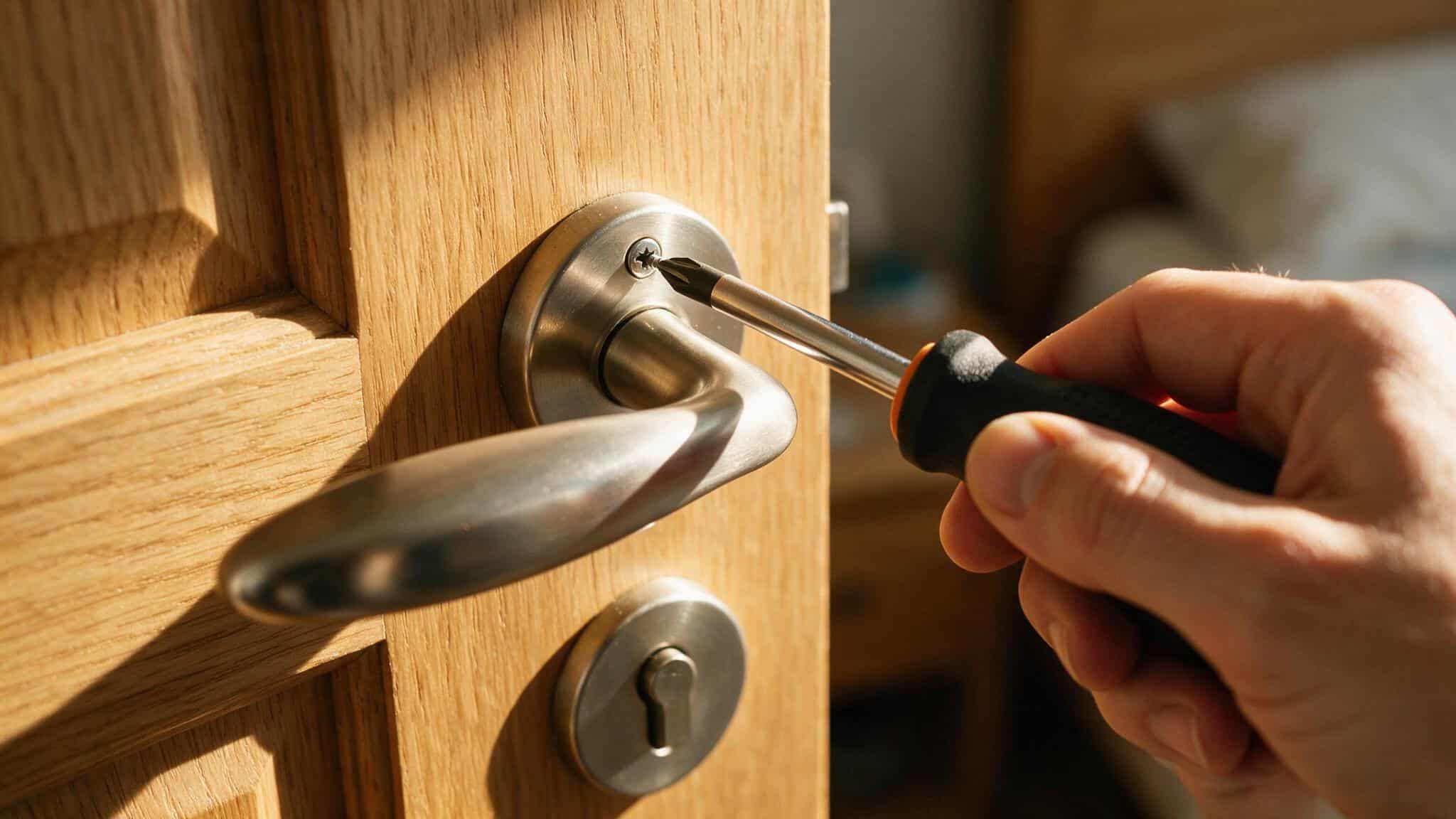
You’re staring at the broken door handle on your kid’s bedroom. The lever is wobbly, the latch is sticky, and the last thing you want is to get the drill out, patch holes, and repaint. Good news: you can swap that handle in 10 to 30 minutes with a screwdriver – no drilling, no filler, no swearing at a fresh hole that’s slightly off.
The trick is to buy a new handle that matches exactly where the old one sat. Same screw holes, same latch position. It’s a straightforward swap, and this guide walks you through measuring, choosing, and installing so you don’t end up with a handle that doesn’t fit.
Key Takeaways
Measure the centre-to-centre distance (PZ) between the two main screw holes – 92 mm is the most common UK standard, and your new handle must match it exactly.
The whole job takes 10 to 30 minutes with only a Phillips screwdriver; a loose handle may be fixed in under 2 minutes by just tightening the screws.
If your new handle has an extra mounting hole (like the ERA Protect Smart Universal Door Handle), you can remove the screw pillar to avoid drilling, but the backplate may sit with a small gap at the top.
Table of Contents
Why this is the easiest swap you’ll do
Most door-handle guides assume you’ll drill new holes. This how to install door handles assumes you won’t.
You need exactly one tool: a screwdriver. (Flat-head and Phillips both, ideally. But one screwdriver.) No drill, no filler, no repainting.
You’re not altering the door – you’re just swapping the handle for a new one that uses the exact same screw holes and latch position. That’s the whole premise.
A loose handle? Tighten the screws. Takes less than 2 minutes. If it’s still wobbly or the lock is jammed, then it’s time to replace, but the job stays small—how to install lever door handle with lock is exactly the step-by-step the parent who did this during a nap wrote.
Step 1: Measure your existing hole pattern (this is the most important step)
Do not buy a handle until you’ve taken three measurements.
Centre-to-centre distance (PZ)
This is the distance between the two main screw holes on the backplate or rose. 92 mm is the most common UK standard – for example, the ERA Protect handle uses a 92 mm PZ. Measure yours. If it’s 92 mm, you’re in luck – most replacement handles will fit. If it’s something else (e.g., 70 mm or 110 mm), you need a handle designed for that exact spacing.
Quick test: Measure between the two main screw holes before you leave the house. If it’s not 92 mm, your handle options narrow fast.
Backset
The distance from the edge of the door to the centre of the latch hole. Usually 44 mm or 57 mm. Measure it. A handle that’s the wrong backset won’t align with the strike plate.
Spindle size and screw hole pattern
The square rod that connects the handles is almost always 8 mm, but check. Also note how many screw holes are on your current backplate – two, three, or four – and their spacing. A new handle’s screw holes must match.
Pro tip: Write the measurements on your phone. You’ll need them when you’re in the shop.
Step
Frequently Asked Questions
Can you just replace door handles?
Yes, you can replace a door handle without drilling new holes or patching the door. As long as the new handle matches the existing screw hole spacing (centre-to-centre distance) and latch position, the swap takes only a screwdriver and about 10 to 30 minutes.
How to replace door handles with the same holes with a key?
If your new handle uses the same screw hole pattern and latch position as the old one, you simply unscrew the old handle, slide out the spindle, and install the new one in reverse order. A keyed handle will have a lock cylinder that fits into the same mortise or latch mechanism — just make sure the backset and spindle size match.
Are all door handle holes the same size?
No, they aren’t. The most common UK standard is a 92 mm centre-to-centre distance (PZ) between the two main screw holes, but you’ll also find 70 mm and 110 mm patterns. The latch hole position (backset) is usually 44 mm or 57 mm from the door edge, and the spindle is almost always 8 mm square. Always measure your existing setup before buying a replacement.
How to swap door handles as wrong way for door?
If you’ve bought a handle that doesn’t match your existing screw hole pattern or latch position, you can’t simply swap it without drilling new holes and filling old ones. The trick is to measure your current handle’s centre-to-centre distance and backset before buying — that way you avoid the ‘wrong way’ problem entirely.
What is the centre-to-centre distance (PZ) on a door handle?
The centre-to-centre distance, often called PZ, is the measurement between the two main screw holes on the backplate or rose of a door handle. It’s the single most important number for a no-drill swap — if your new handle doesn’t match this spacing, it won’t line up with the existing holes.
How do I measure the backset on a door handle?
Backset is the distance from the edge of the door to the centre of the latch hole. Measure it with a tape measure or ruler — common sizes are 44 mm and 57 mm. If your new handle has a different backset, the latch won’t align with the strike plate on the door frame.