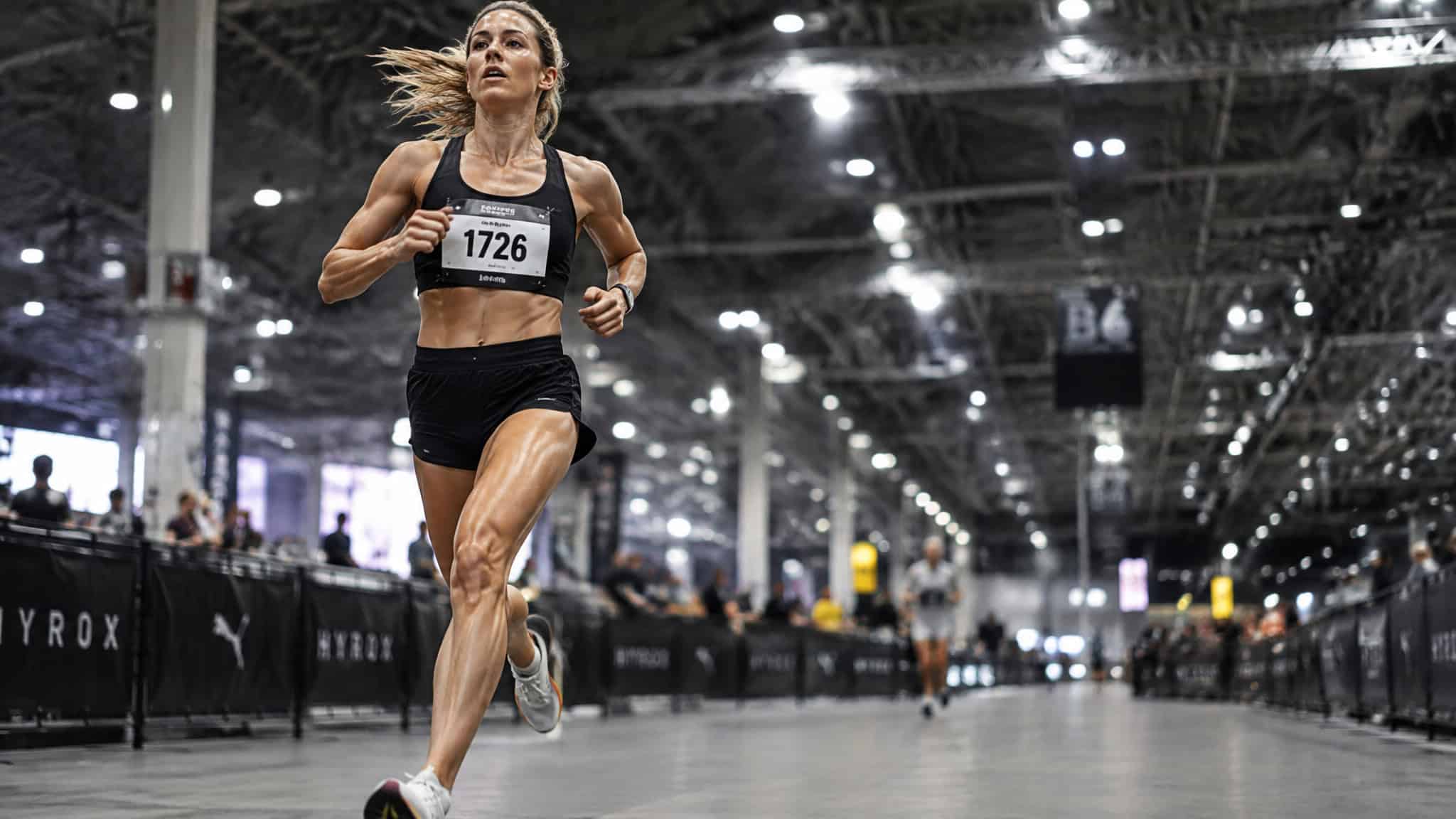
The confirmation email is sitting in your inbox right now, and for about ten minutes after you paid, you felt extremely capable. Then you googled what you actually signed up for, read the words “202kg sled,” and closed the tab. This is the article for when you reopen it. I’m not going to pretend it’s easy. I’m going to tell you exactly what happens out there, station by station, and what to do about it.
Key Takeaways
HYROX is eight 1km runs alternating with eight functional stations in a fixed order that never changes anywhere in the world; running plus the Roxzone transitions always totals 8.7km.
Open division weights include a sled push of 102kg (women) or 152kg (men) with the sled itself counted, and 100 wall balls at 4kg or 6kg. Open is the right first division.
Most first-timers train 8-12 weeks, and month one is genuinely simple: three easy Zone 2 runs plus two or three strength sessions a week. Running decides your finish time more than any station does.
Table of Contents
What a HYROX workout actually is
A HYROX workout, the thing you signed up for, is a race: eight 1km runs, each followed by one functional workout station, repeated in the same order every time. Run a kilometer, do a station, run again, eight times through. That’s the whole thing.

It happens indoors, in big exhibition halls, with music, commentary, and a genuinely loud crowd. Some events run outdoors, but picture a packed hall and you’ve got the vibe.
The sameness is the actual product. Because the format and weights are identical everywhere, your time in one city compares directly to your time in any other. That’s what makes the global leaderboards work, and it’s also quietly great news for you: your first race becomes a permanent, comparable baseline you can chase for years.
One number most explainers skip: running plus the Roxzone (the transition areas between runs and stations, more on those later) always totals 8.7km, not 8. The Roxzone counts toward your time.
There’s no time limit and no qualification to enter. Walking is allowed. Breaks at stations are allowed. The first race was in Hamburg in April 2018; roughly 175,000 people competed circa 2023, and over a million raced in the 2025/26 season.
The average finisher lands around 1.5 hours, about 1:27 for men and 1:36 for women. Elites finish in 55 to 75 minutes, which is basically a different sport. One heads-up that shapes everything below: running is the biggest single factor in your finish time, which sounds obvious until you watch beginners train only for the stations.
Oh, and the name stands for nothing. The “hybrid plus rockstar” story got debunked by co-founder Moritz Fürste, and the event was briefly called CUROX before a trademark dispute forced the change.
The eight stations, in order
Before the station-by-station: the first four are where first-timers lose the most time. Know your danger zones going in so nothing surprises you.
Station 1: SkiErg, 1000m
A SkiErg looks like a standing rowing machine that you pull down with two handles instead of sitting. Everyone does the same one; there are no division differences here, which is a nice little leveling. It hits your lats, shoulders, triceps, and core, so the backs of your arms and your sides will have opinions tomorrow. The classic rookie move is yanking the handles hard in the first 200m because you feel amazing.
You will not feel amazing at 600m. Settle in early.
Station 2: Sled push, 4 x 12.5m
Four short trips down and back, 50m total. Open pushes 102kg for women and 152kg for men; Pro is 152kg and 202kg. Those numbers include the sled itself. This works everything from your shoulders down, honestly: posterior chain, core, front of the thighs. The technique is one sentence: hips low, drive with your legs, don’t stop, because momentum is your friend and restarting is expensive.
Two things catch nearly everyone, and they’re worth naming as a pattern rather than a personal failing. Competition carpet is slower than any gym floor you’ve trained on, so the first push feels heavier than anything you rehearsed. That’s normal, not a sign you undertrained.
Station 3: Sled pull, 4 x 12.5m
Same four lengths, pulling instead. Open pulls 78kg for women and 103kg for men; Pro is 103kg and 153kg. You pull hand over hand down the lane. It’s brutal but simple, and beyond keeping the rope moving, there’s no big trick to it.
Station 4: Burpee broad jumps, 80m
No weight, just you and 80 meters of floor, same for every division. Drop, chest to the floor, jump forward as far as you like. Small steady jumps count exactly the same as big dramatic ones. The standard that trips people: your chest has to fully touch the floor on every rep, and judges are right there, so no sneaky half-reps.
Stay rhythmic, even if the rhythm is slow. Race time is made or broken right here.
Station 5: Row, 1000m
A 1000m row on a Concept2, the machine most gyms already have. No division differences. The universal rookie move is going too hard in the first 250m, because the rower lies to you; it feels easy right up until it very much doesn’t. Pick a pace you could hold for twice the distance and start there.
Station 6: Farmer’s carry, 200m
A kettlebell in each hand for 200m. Open carries 2 x 16kg for women and 2 x 24kg for men; Pro is 2 x 24kg and 2 x 32kg. Everyone gets this one instantly: you carry heavy things. It works your upper back and core, but mostly your grip, which you’ll discover the hard way. The clock keeps running when the bells drop, so plan your put-downs instead of taking “quick breaks” that quietly cost you a minute each.
Station 7: Sandbag lunges, 100m
A hundred meters of walking lunges with the sandbag. Open uses 10kg for women and 20kg for men; Pro is 20kg and 30kg. The rule that ends races: your knees must alternate. Skip the alternation, even once, and you’re disqualified.
Not a slow time. No time. And the sneaky part isn’t your legs. Grip on a sandbag fatigues faster than on a barbell or kettlebell, because the bag shifts and slumps with every step.
Station 8: 100 wall balls
Yes, one hundred. And yes, that’s the last thing you do before the finish line, which is why people remember it. The rep count is the one station where Open and Pro match. Open throws a 4kg ball (women) or 6kg (men) at a 9-foot or 10-foot target; Pro uses 6kg and 9kg.
In practice, you’re throwing a ball at a line high on the wall, over and over, on legs that just did everything above. Each miss costs 15 seconds, and tired arms make misses expensive, so aim matters late. Break it into sets you can actually manage and breathe at the bottom of the squat. Nobody hands out a medal for going unbroken.
HYROX vs CrossFit
No, and the difference is a design decision, not vibes. The surface similarity is real: both mix functional movements with hard conditioning, which is why HYROX is popular with CrossFit athletes, runners, triathletes, and OCR competitors. But a CrossFit workout changes every time; HYROX is the same race everywhere, every time, down to the weights. The stations were deliberately chosen to avoid overly technical movements, and box jumps were rejected partly for trip-and-fall risk, per Mintra Tilly.
So HYROX rewards repeatable capacity under fatigue, not movement virtuosity. You don’t need to learn party tricks. You need to be good at eight things while exhausted, and good at running. If you’re curious how this fits into the longer story of fitness crazes from aerobics to app-based training, HYROX is very much this decade’s entry.
Divisions, and what you’ll actually lift
Open is the entry division and the right call for your first race. The weights are real but not scary, and the division is challenging but doable for most fitness levels. Start here. There’s no shame in it, and plenty of people never leave.
Pro is the same race with heavier everything, for experienced athletes. You’ll know if that’s you.
Doubles is the drag-a-friend-in option. Both of you run the full 8km together, then split the stations you-go-I-go style, so one of you rests while the other works. Open Doubles uses the respective Open weights. Mixed Doubles uses Pro women’s weights, which surprises people, so now you know. There’s no Pro Mixed Doubles category, so don’t plan around one.
Relay is the group-chat option: four athletes, each doing two runs and two stations, at Open weights, with stations assigned by who’s good at what. Your friend who loves the rower gets the rower. Doubles and Relay are legitimate lower-barrier entry points, not lesser formats.
Elite 15 is the top tier, racing at Pro weights on clearer courses with easier overtaking, so don’t compare your time to theirs. From the 2026/27 season, Elite qualification is points-based. There’s also an Adaptive division for athletes with a range of impairments, with its own full rulebook.
Age groups run from 16-24 up to 85-89 in five-year bands for individuals and doubles, with podium awards for the top 3 in each. Relay splits under-40 and 40+. Youngstars races cover ages 8-15, and standard races open at 16. Worlds qualification comes through top placings in your age group and division, and the 2027 World Championships run June 10-13 in Hong Kong.
Here’s how the weights line up. Two assignments confuse everyone, so after the table: Open men lift the same loads as Pro women (the wall ball target height is the one difference), and Mixed Doubles uses Pro women’s weights.
| Station | Open women | Open men | Pro women | Pro men |
|---|---|---|---|---|
| Sled push (4 x 12.5m) | 102kg | 152kg | 152kg | 202kg |
| Sled pull (4 x 12.5m) | 78kg | 103kg | 103kg | 153kg |
| Farmer’s carry (200m) | 2 x 16kg | 2 x 24kg | 2 x 24kg | 2 x 32kg |
| Sandbag lunges (100m) | 10kg | 20kg | 20kg | 30kg |
| Wall balls (100 reps) | 4kg to a 9ft target | 6kg to a 10ft target | 6kg to a 9ft target | 9kg to a 10ft target |
Sled weights include the sled itself. All figures are for the 2026/27 season.
Your first training week
The prerequisite is modest: if you can run 3 miles comfortably, you can start. Most first-timers train 8-12 weeks, which fits real life better than you’d think.
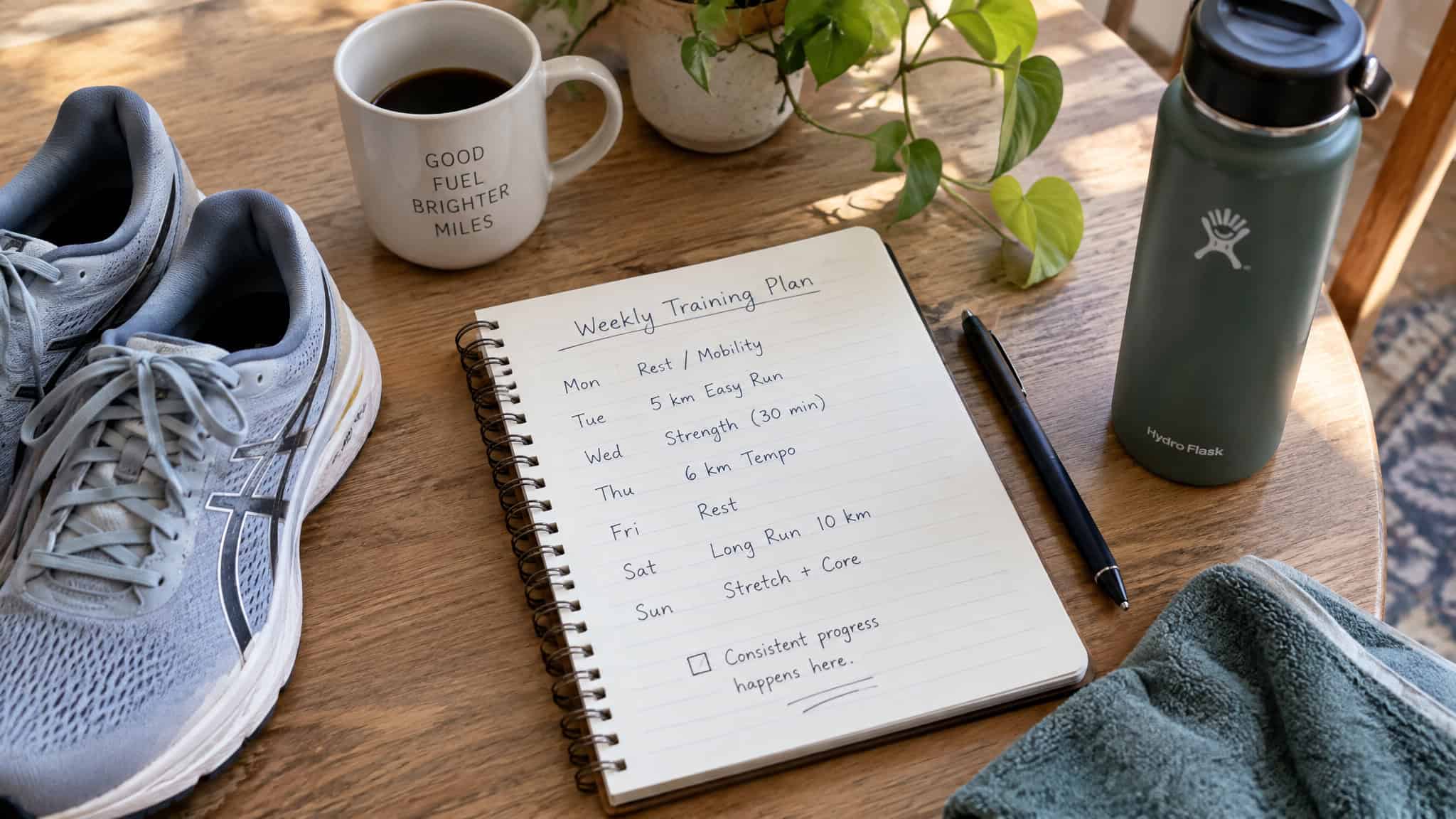
Month one, mapped onto a week, looks like this. It comes from an Official HYROX Training Club’s Phase 1, and it’s genuinely this plain:
- Monday: Zone 2 run. Zone 2 just means easy, conversational pace, the kind where you could chat the whole time. Build toward 30-45 minutes.
- Tuesday: Strength. Compound lifts plus the race patterns: sled pushes if you have a sled, walking lunges, farmer’s carries.
- Wednesday: Zone 2 run.
- Thursday: Recovery. Easy spin, a walk, mobility work, whatever leaves you better than it found you.
- Friday: Strength, same shape as Tuesday.
- Saturday: Your longest Zone 2 run.
- Sunday: Rest, or a second recovery session if you want one.
That’s three runs, two or three strength sessions, one or two recoveries. Flip the days to fit your life; the shapes matter more than the calendar. If you’re the person who chases whatever’s trending in workouts right now, fair warning: HYROX rewards the boring stuff.
No SkiErg at your gym? Rowing intervals and overhead pulling build the same energy systems. That’s the closest honest substitute, not a perfect replica, and I won’t pretend it guarantees race readiness. Lunges, wall balls, and carries are possible at most gyms or with minimal kit. For sleds, Rogue builds commercial-grade options for Stations 2 and 3, made to hold up on indoor venue surfaces. Sleds, the SkiErg, and a rower are ideal but not essential.
The plan references training five to six times a week, that’s three Zone 2 runs plus two or three strength sessions, with a recovery session or two on top. That’s a lot, and it’s okay if life makes it four. If you do manage five or six, the rest days are doing work too. Skip them and you’re sabotaging the program.
The 12-week plan
The build from an Official HYROX Training Club’s plan, in four phases:
- Weeks 1-4: Zone 2 runs three times a week, up to 30-45 minutes. Strength two to three times.
- Weeks 5-8: Add one interval session, 4-6 x 800m at race pace with 90 seconds of rest. Add weekly combo work: a 1km run straight into a station. Wall balls and burpee broad jumps enter the picture here.
- Weeks 9-11: Weekly mini-HYROX simulations of four or five stations with full 1km runs between. Pacing rehearsal. Some deliberately stacked hard days.
- Week 12: Taper. Cut volume 40-50%, keep a few short race-pace efforts, sleep 8+ hours, and change nothing about your nutrition. This is the week you’ll be tempted to panic-train. Don’t.
The combo work is the actual point of the whole plan. HYROX isn’t running fitness plus gym strength; it’s producing force immediately after hard running, and neither discipline develops that quality on its own. That’s why a generic run plan fails here, and so does a gym program.
One piece of kit worth knowing about: a STRIDE slat-belt treadmill uses dynamic braking for resistance, up to 400 lbs, which makes it a legitimate stand-in for sled work when you can’t get to one. And the slightly annoying truth, worth saying twice in one article: running is the biggest single factor in your finish time. Most of your race is spent running, so most of your prep should reflect that. Beginners over-index on sled and wall ball training because the stations look intimidating, while 8km of running under station fatigue quietly decides the race.
Practice running on tired legs (that’s the “compromised running” bit) closer to the event, and don’t feel obligated to simulate the full race in every session. Partial practice counts.
The rules that end races
The rulebook reads like fine print and functions like a performance document. A beginner who trains perfectly but doesn’t alternate lunges doesn’t get a slow time. They get no time.
- Sandbag lunges must alternate knees. Non-alternating lunges mean disqualification.
- Burpee broad jumps require full chest contact with the floor, every rep.
- Each missed wall ball target costs 15 seconds.
- A missed running lap costs 3 minutes. Count your laps; it’s the most avoidable mistake in the building.
- No headphones. Leave the podcast at home.
- Water and energy gels must be carried from the start. Spectators can’t hand you anything, so pack like your support crew can’t reach you, because they can’t.
- The farmer’s carry clock keeps running when the kettlebells drop, which turns drops into a planned tactic rather than free rest.
- Liquid chalk is permitted at all events and genuinely helps the sled pull grip.
Mechanics, briefly: you wear an ankle timing chip that records your total time plus splits for every run, Roxzone, and station, which is a weirdly fun breakdown to read afterward. You start in waves, so it’s not a mass sprint off a gun. Judges enforce movement standards and count reps. Someone is watching your burpees.
Gear: the shoe decision and the cheap wins
The single most useful gear decision a first-timer makes is the shoe, and the decision is grip versus energy return. Running shoes are built for forward motion on pavement, and on the sled push they slip. Picture the wheelspin: you’re leaning everything into 152kg and your soles are skating. Cross-trainers with rubber grip soles handle both the running and the stations.

One shoe, two jobs. People have learned this the hard way so you don’t have to.
What you’re actually shopping for: a 30-38mm heel stack (enough cushion for the running, not so much you wobble), 60%+ midsole energy return (the shoe gives some of your push back instead of eating it), and a grippy outsole that works on both road and sled carpet.
Named options, tradeoffs stated plainly:
- PUMA Deviate Nitro Elite 4 HYROX, $230. The only shoe purpose-built for HYROX from the ground up: a grippier, wider PUMAGRIP outsole, firmer NitroFoam Elite, and a wider base for stability.
- Reebok Nano X4. The comfort-under-training-volume pick, the shoe for the training weeks, not just race day. Tradeoff: less ground feel under heavy sled loading.
- Saucony Endorphin Pro 4. Carbon-plate propulsion for run-dominant athletes. Not designed for heavy lifting or repeated sled work. This shoe picks a side, and that’s fine.
Cheap wins: liquid chalk (legal at all events, helps the sled pull grip) and compression socks (less muscle vibration, less soreness the next day). Small money, real difference.
Race-day checklist, kept boring on purpose:
- Cross-trainers with grip soles
- Moisture-wicking shirt and comfortable shorts (no specific clothing requirements; many men compete topless)
- Lifting gloves or grip aids, legal in most divisions. Check your event before you buy, not at check-in.
- Foam roller or lacrosse ball for warm-up
- Pre-race meal and snack
- Water bottle you carry from the start, because nobody hands you one mid-race
If you want a bag built for the weird gear list, the Built For Athletes HYROX x BFA 35L sits between their 20L and 45L sizes, water-resistant with a wet compartment, and code BOXROX10 takes 10% off. That’s affiliate-adjacent content, so treat it as a pointer rather than a verdict. The 45L Pro Series exists for people traveling between races.
Home equipment, compactly: most HYROX training needs minimal kit. If you want the real machines, the Concept2 SkiErg is the official Station 1 equipment at every race, and no substitute replicates the technique demand. A rower earns its spot used at pre-fatigue, meaning row after something hard and practice rowing tired. Sleds cover the push and pull stations.
Kettlebells, medicine balls, and a sandbag round it out: your grip needs practice carrying, not just hanging, 100 wall balls is a skill when you’re tired, and the sandbag’s wobble is the training. A barbell can’t teach that.
Race day: fueling, pacing, and what normal looks like
Race-day nutrition is almost entirely about the hours before the start. Most athletes don’t fuel during the race itself, because a ~90-minute effort is short enough not to need it. The timeline:
- 3-4 hours before: a balanced carb-and-protein meal. Oatmeal with banana and peanut butter, or rice and chicken.
- 60-90 minutes before: a small carb snack. Banana, rice cake, sports drink. A top-up, not a meal.
- 15 minutes before: a few sips of water or sports drink. A few sips, not a gallon.
- Within 30-60 minutes after: carbs plus protein. Shake, sandwich, real meal. Your body did a thing.
The one rule everyone learns the hard way: nothing new on race day. New gels and race-day stomachs don’t mix.
Pacing: the first kilometer should feel easier than training pace. You will feel amazing at the start, and that feeling is lying to you. The first four stations, SkiErg through burpee broad jumps, are where first-timers lose the most time, and the tell of a blown race is a strong first split followed by progressively slower station times. The Roxzone counts too.
Transition time is part of your total, and the run-plus-Roxzone distance is always 8.7km, so practice the in-between bits. That’s where the minutes hide.
Logistics: show up early, walk the venue, find your starting block, check in, attach the timing chip, and warm up before your wave goes.
On expectations: the average finisher lands around 1.5 hours, about 1:27 for men and 1:36 for women from the 2024-25 season. Many first-timers take considerably longer, and finishing well above average is completely normal. Walking is allowed and there’s no official cutoff. Nobody pulls you off the course for being slow.
Things I’d tell a friend before their first one:
- Going out too hard on the first run.
- Running shoes on the sled push.
- Underestimating the wall balls. 100 sounds fine until you’re on rep 30 with jelly arms.
- Skipping Roxzone transition practice.
- Not training the SkiErg. No machine? Sub rowing intervals and overhead pulling.
- Ignoring recovery. More sessions isn’t always more progress.
And the honest part about pacing: there’s no hack for it. You hold back when everything in you wants to go, it feels boring, and it’s the whole race. Yeah, this part just sucks, and the people who accept that end up with the times they’re proud of.
Frequently Asked Questions
What order does HYROX go in?
The eight stations always run in the same order: SkiErg 1000m, sled push, sled pull, burpee broad jumps 80m, row 1000m, farmer’s carry 200m, sandbag lunges 100m, and 100 wall balls. Each station follows a 1km run, and the format never changes anywhere in the world. Running plus the Roxzone transitions totals 8.7km, not 8.
Is there a free HYROX training program available?
A solid first-timer structure is simple enough to follow without paying for anything: three easy Zone 2 runs, two or three strength sessions built around the race patterns (lunges, carries, sled pushes), and one or two recovery days per week. Most first-timers train 8-12 weeks this way, adding intervals and run-into-station combo work from week 5 onward.
What are the HYROX stations and weights?
In the Open division: sled push 102kg (women) or 152kg (men), sled pull 78kg or 103kg, farmer’s carry 2 x 16kg or 2 x 24kg kettlebells, sandbag lunges 10kg or 20kg, and 100 wall balls with a 4kg or 6kg ball. SkiErg, row, and burpee broad jumps have no weight differences. Sled weights include the sled itself.
What is HYROX training?
It’s preparing for a race of eight 1km runs alternating with eight functional stations, so training has to build both running fitness and the ability to produce force immediately after hard running. That combo quality is why a generic run plan fails and so does a gym program. Month one is genuinely simple: easy Zone 2 runs plus strength sessions, with running mattering more than any station.
What shoes should I wear for HYROX?
Cross-trainers with grippy rubber soles, not running shoes, which slip on the sled push. You’re shopping for a 30-38mm heel stack, 60%+ midsole energy return, and an outsole that works on both road and sled carpet. One shoe has to do two jobs: the running and the stations.