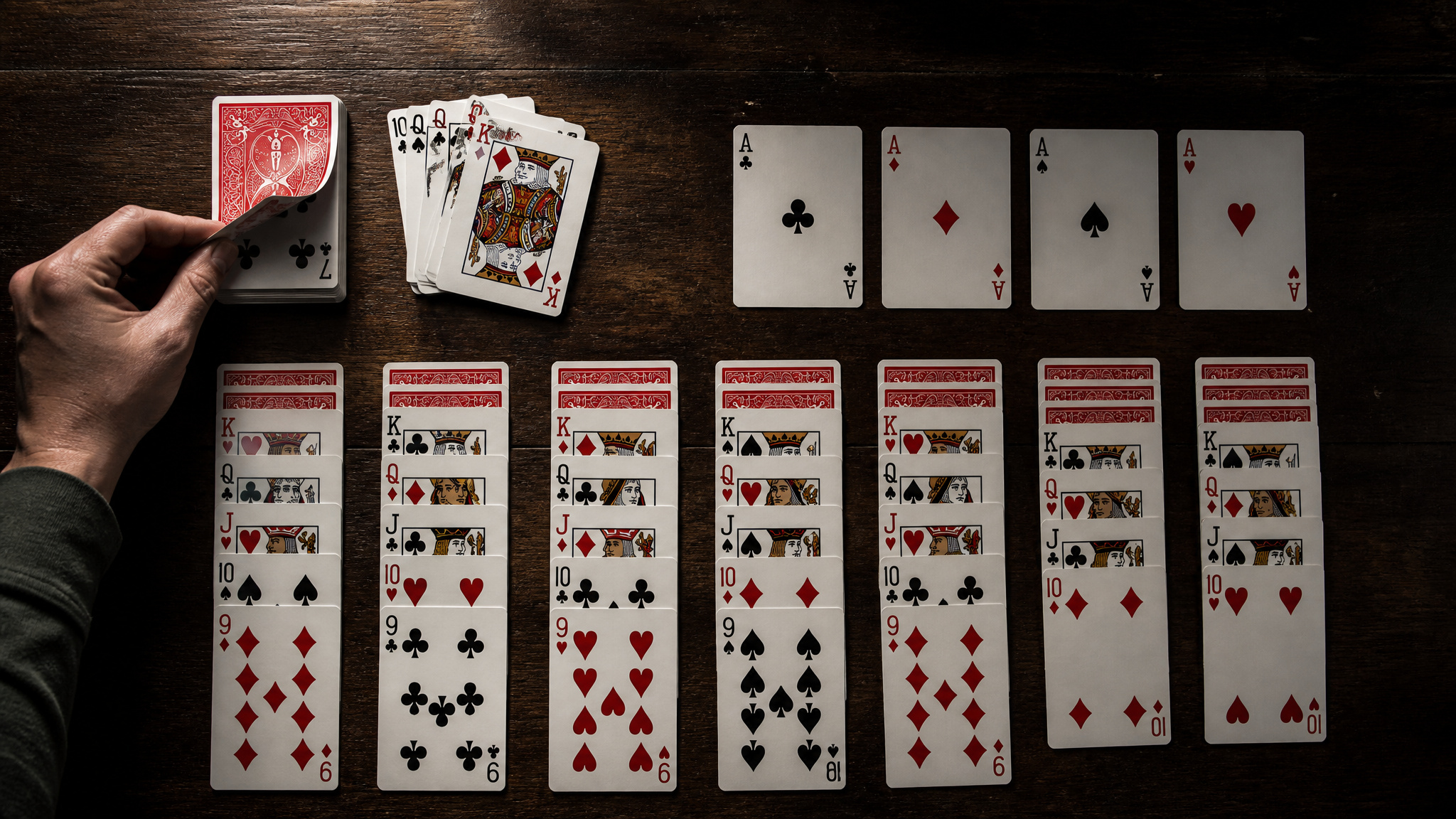
I’ve been playing Klondike solitaire for years, and I still remember the first time I switched from flipping one card to flipping three. I’d been coasting along in Draw 1, feeling pretty good about myself, winning maybe half my games. Then I tapped the Draw 3 option out of boredom, and suddenly I couldn’t buy a win. Cards I needed were buried under cards I couldn’t touch.
The whole game felt different, not just harder. It was a different kind of puzzle.
That’s the thing about the solitaire card flip 1 or 3 choice. It’s not a minor settings tweak. It’s the difference between a relaxing pastime and a genuine mental workout. One mode is forgiving, the other demands you think several moves ahead. Neither is better, but they’re absolutely not the same game.
Key Takeaways
Draw 1 flips a single card that’s immediately playable, making it the friendlier mode with estimated win rates of 30-50% for casual players and 50-70% for experienced ones.
Draw 3 flips three cards but only the top one is playable, which is why it’s the competitive standard and why win rates drop to 5-15% for casual players and 15-30% for experienced ones.
The strategic heart of Draw 3 is the multiples-of-three rule: play a multiple of three cards in a single pass and you’ll see the same cards again on the next deal.
Table of Contents
What Is Klondike Solitaire?
You know this game. Even if you’ve never called it Klondike, you’ve clicked through it on a Windows computer or tapped it on your phone. In the US and Canada, “solitaire” basically means Klondike. In the UK, it’s called Patience.
Elsewhere, it’s American Patience. Same game, different names.
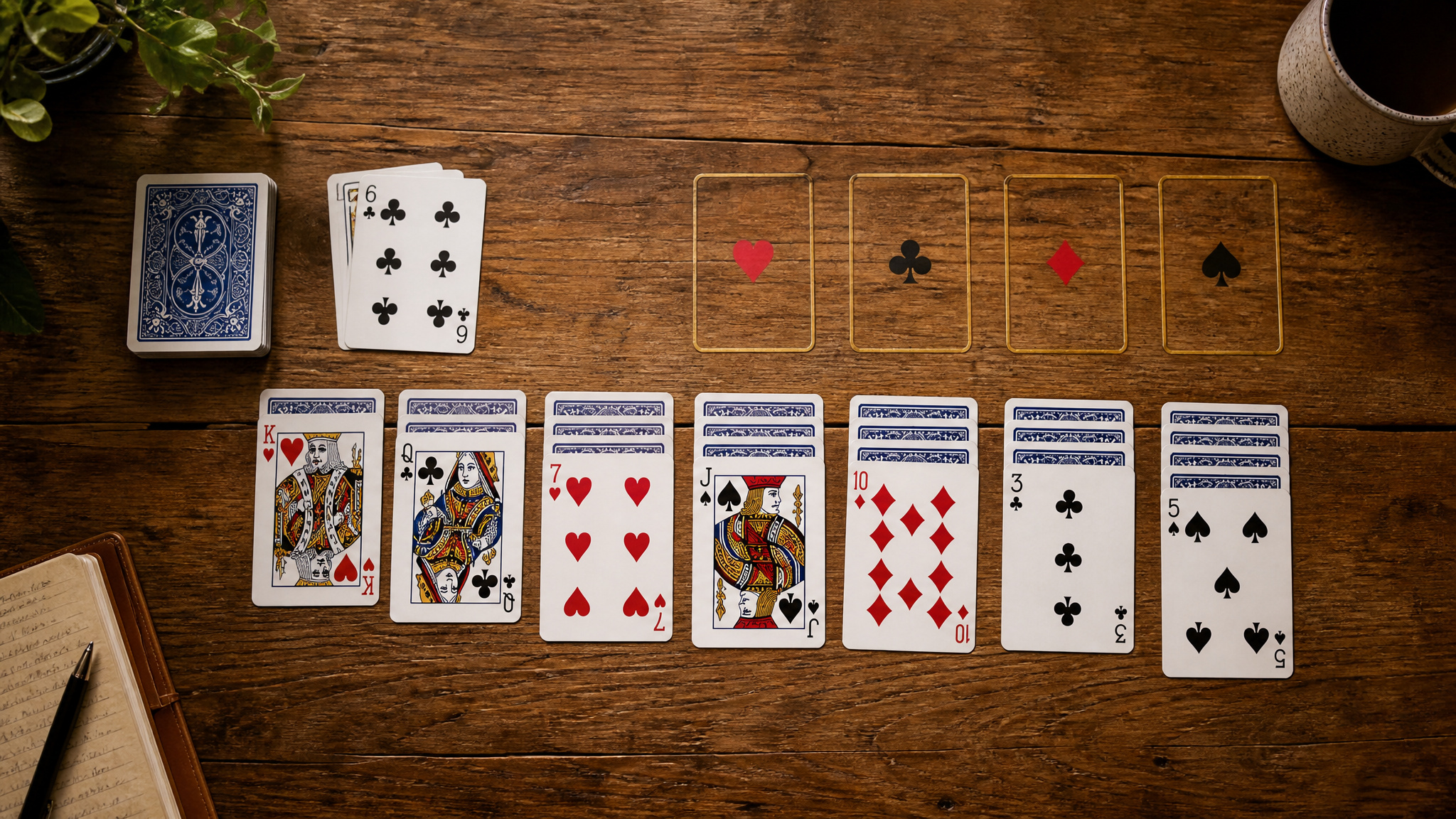
The setup is that familiar triangle shape. Seven piles, one card in the first, two in the second, all the way up to seven in the last. Only the top card of each pile is face up. The rest are a mystery until you uncover them. You’re playing with a standard 52-card deck, no jokers.
The goal is simple: build four foundation piles from Ace up to King, one suit at a time. In the tableau, you build down, alternating red and black. Empty tableau spots are for Kings, or a pile that starts with a King. The leftover cards go in the stock, face down in the upper left. You flip from there to the waste pile, and that’s where the whole draw 1 vs draw 3 solitaire question comes in.
The Core Mechanic: Draw 1 vs Draw 3
Here’s the entire difference, and it’s smaller than you’d think.
In Draw 1, you flip one card at a time, and each card you draw is playable right away if it fits the rules. Simple. You see a card, you decide what to do with it, and you move on. This is what most beginners and casual players use, and it’s the friendly version.
In Draw 3, you flip three cards at a time. But here’s the catch: only the top card of the waste pile is playable. The other two are just waiting their turn. If you flip a 7 of hearts, a 3 of clubs, and a King of spades, you can only play the King.
The 7 and the 3 might as well not exist until you clear the King off the top. This limits access to cards and cuts your margin for error way down, so every decision matters more.
That single rule changes everything. In Draw 3, if three or more cards remain in the stock, exactly three are dealt, keeping their order. If fewer than three remain, you just flip what’s there. When the stock runs out, you flip the waste back over and go again, as many times as you want in the unlimited-pass version. The game is lost when you can’t make any more meaningful moves.
Quick test: In Draw 3, if you see two useless cards hiding under a playable top card, ask yourself if moving that top card now is worth what it costs you later.
The Numbers Behind the Modes
The difficulty gap isn’t just a feeling. It’s math.
Casual players win Draw 1 about 30-50% of the time. Experienced players can hit 50-70%. Draw 3 is a different story entirely: 5-15% for casual players, 15-30% for experienced. That’s a massive drop, and it’s why leaderboards use Draw 3.
It separates the casual players from the serious ones. And these numbers are actually the best-case scenario, the real odds are even worse.
The numbers get even more interesting when you look at what computers can do. One algorithm won 52% of its games in turn one mode but only 18% in turn three. Another, using a fancy search technique called Monte Carlo tree search, solved only 35% of randomly generated games in turn three with unlimited passes. A skilled human player won 43% of games in one experiment. So if you’re losing a lot in Draw 3, you’re in good company.
Here’s the stat that really explains why Draw 3 is so much harder. In a version called Thoughtful Klondike, where you can see all the cards, the win rate jumps to about 82% with draw-three rules. That’s the whole game in one number. The difficulty isn’t just about the rules.
It’s about hidden information. You’re guessing what’s under those face-down cards, and in Draw 3, a wrong guess costs you far more.
Nobody actually knows the exact odds of winning Klondike with perfect play. Mathematician Persi Diaconis called it “one of the embarrassments of applied probability,” which is a fancy way of saying it’s really hard to figure out. Hoyle’s, the classic game rulebook, suggests about a 1 in 30 chance with a single pass. So don’t expect to win every time, though if you’re ready to level up, our spider solitaire guide introduces a gentler, more complex cousin of the game.
How Strategy Changes Between the Modes
The strategy shift between Draw 1 and Draw 3 is the real reason this choice matters. It’s not just about win rates. It’s about how you think.
Draw 1: Improvisation
In Draw 1, your main goal is to reveal those face-down tableau cards, that’s where the game opens up. You can be sloppier with your planning because mistakes are easier to fix, and you don’t need to memorize the stock order since cards come up fast enough. When you’re wondering what’s the point of solitaire, think of it as a quiet ritual of patience and mental clarity. And remember, you can be more aggressive with foundations since you have more options to recover. Draw 1 gives you more room to adapt and a better chance of winning, so it’s the go-to for steady results.
Draw 1 is about reacting. You see what comes, you play what you can, and you don’t overthink it.
Draw 3: Planning
Draw 3 is chess. You have to think ahead, and the first thing you need to do is memorize the order of the waste cards. That’s how you predict what’s coming next. Don’t just cycle through the stock without a plan, because each pass brings you closer to running out of redeals.
Sometimes it’s better to hold off on foundation moves, since they can unlock bigger plays in the tableau. Empty tableau columns are valuable, so don’t fill them without thinking.
The most important Draw 3 strategy is the multiples-of-three rule. If you go through the hand without moving any cards, the next pass presents the same sets of three cards. Play a multiple of three cards in a single pass, and the same cards come back around again.
Here’s a concrete example. Say cards 1 through 24 are dealt in groups of three. If you play cards 9, 8, and 12 on the first pass, they’ll come back on the second pass. Play only 9 and 12, and the next deal changes.
It’s a trap. Don’t play all three dealt cards at once unless you’re sure it’s the right move.
Common Draw 3 mistakes are easy to make. Cycling the stock without making progress. Auto-moving cards to the foundation when you need them in the tableau. Ignoring buried waste cards that might be the key to your next move.
Filling empty columns too early, panicking when cards get buried, we’ve all done it.
Which Mode Should You Choose?
So, solitaire card flip 1 or 3: which one is right for you?
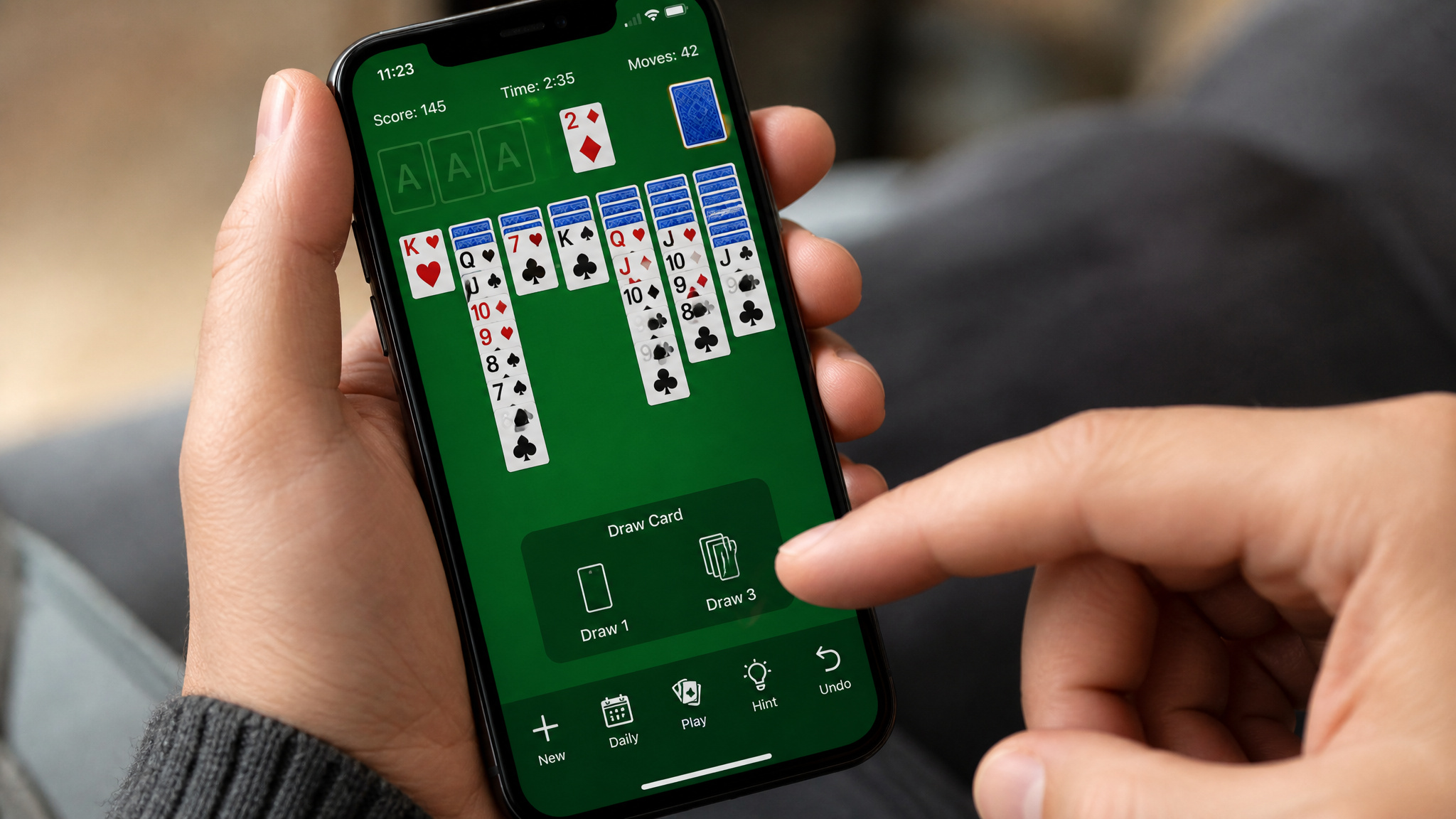
Start with Draw 1. No question. It’s the best way to learn the rules without getting frustrated. You’ll build your strategy, get a feel for the game, and actually win sometimes. Most solitaire apps let you switch between modes, so you can try both and see what clicks.
Draw 3 is for when you want a challenge. It’s the standard for competitive play because it separates skill from luck. Draw 1 leans more on luck, while Draw 3 rewards skill since fewer games are winnable. Moving from Draw 1 to Draw 3 requires a mental shift, from improvising to planning.
Here’s the reframe that helps when Draw 3 gets frustrating: many losses are just bad shuffles. Not your fault. That can be freeing. When you lose in Draw 1, you wonder what you did wrong. When you lose in Draw 3, sometimes the answer is just “bad deal.”
And when you win, it feels earned. You beat the shuffle, not just the game.
A reasonable progression is to practice in Draw 1 and compete in Draw 3. A good goal is to win 10 straight games in Draw 1, then test yourself in Draw 3. It’s a fun challenge, and it gives you a goal beyond just clicking through cards.
A Quick Note on History
The funny thing is, Draw 3 came first. The earliest known rules for Klondike are found in the 1907 edition of Hoyle’s Games, where it was called “Seven-Card Klondike.” By 1913, the Official Rules of Card Games renamed it simply Klondike, with a modification: the pack is run through one card at a time instead of three. The original Klondike was then called Canfield.
The naming gets confusing from there. Historically, Klondike was called Canfield in America. Today, Canfield is the American name for a different game called Demon in England. There’s a rumor that Richard Canfield invented the game, but he actually called his version Klondike. The name might come from the Canfield Casino in Saratoga Springs, New York, though nobody’s confirmed that.
Nobody knows where the name comes from. Some guess it’s from the Klondike Gold Rush, but there’s no proof.
Microsoft included Solitaire in Windows 3.0 in 1990, both as a fun distraction and a way to teach people how to use a mouse. By 1994, Microsoft reported that Solitaire was the most-used Windows application. That’s why so many of us know this game. There were earlier computer versions too, like Mark Reid’s Atari 8-bit version in 1981 and Michael A. Casteel’s Macintosh shareware in 1984.
Klondike even made it into Nintendo’s Clubhouse Games series. One notable variant is Joker Solitaire, created by Joli Quentin Kansil, which includes two jokers that act as limited wild cards.
The Bottom Line
Both modes have their place. Draw 1 is for relaxing, for learning, for those times when you want to win a game and feel good about it. Draw 3 is for when you want to think, to plan, to earn a win against a tough shuffle. There’s no wrong choice. Pick the one that gives you what you want from a game right now.
If you’re curious about why this game has such a hold on us, think about what solitaire actually does for your brain. It’s a quiet ritual, a moment of focus in a busy day. And if you ever want to level up to something even more challenging, Spider Solitaire is waiting for you. But if you’re in the mood to explore other solo card game classics, they’re just a flip away.
But for now, flip one or flip three. Just play.
Frequently Asked Questions
Do you flip 1 or 3 cards in solitaire?
It depends on the mode you choose. In Draw 1, you flip one card at a time from the stock, making it easier to see and play cards. In Draw 3, you flip three cards at once, but only the top card is playable, which adds difficulty and requires more planning.
What is the difference between 1 card and 3 card solitaire?
The main difference is the number of cards flipped from the stock and the difficulty. Draw 1 flips one card, giving you more access to cards and higher win rates (30-50% for casual players). Draw 3 flips three cards but only the top is playable, reducing win rates to 5-15% for casual players and requiring more strategic planning.
Which solitaire mode is easier to win?
Draw 1 is significantly easier to win. Casual players win about 30-50% of Draw 1 games, while experienced players can win 50-70%. In Draw 3, casual players win only 5-15% of games, and even experienced players win just 15-30%. So if you’re looking for a relaxing game, Draw 1 is the better choice.
Why is Draw 3 solitaire so hard?
Draw 3 is harder because you flip three cards at a time, but only the top card is playable, so you have less access to the cards you need. This increases the role of hidden information and planning. Win rates drop dramatically, and even skilled players win only 15-30% of games, compared to 50-70% in Draw 1.