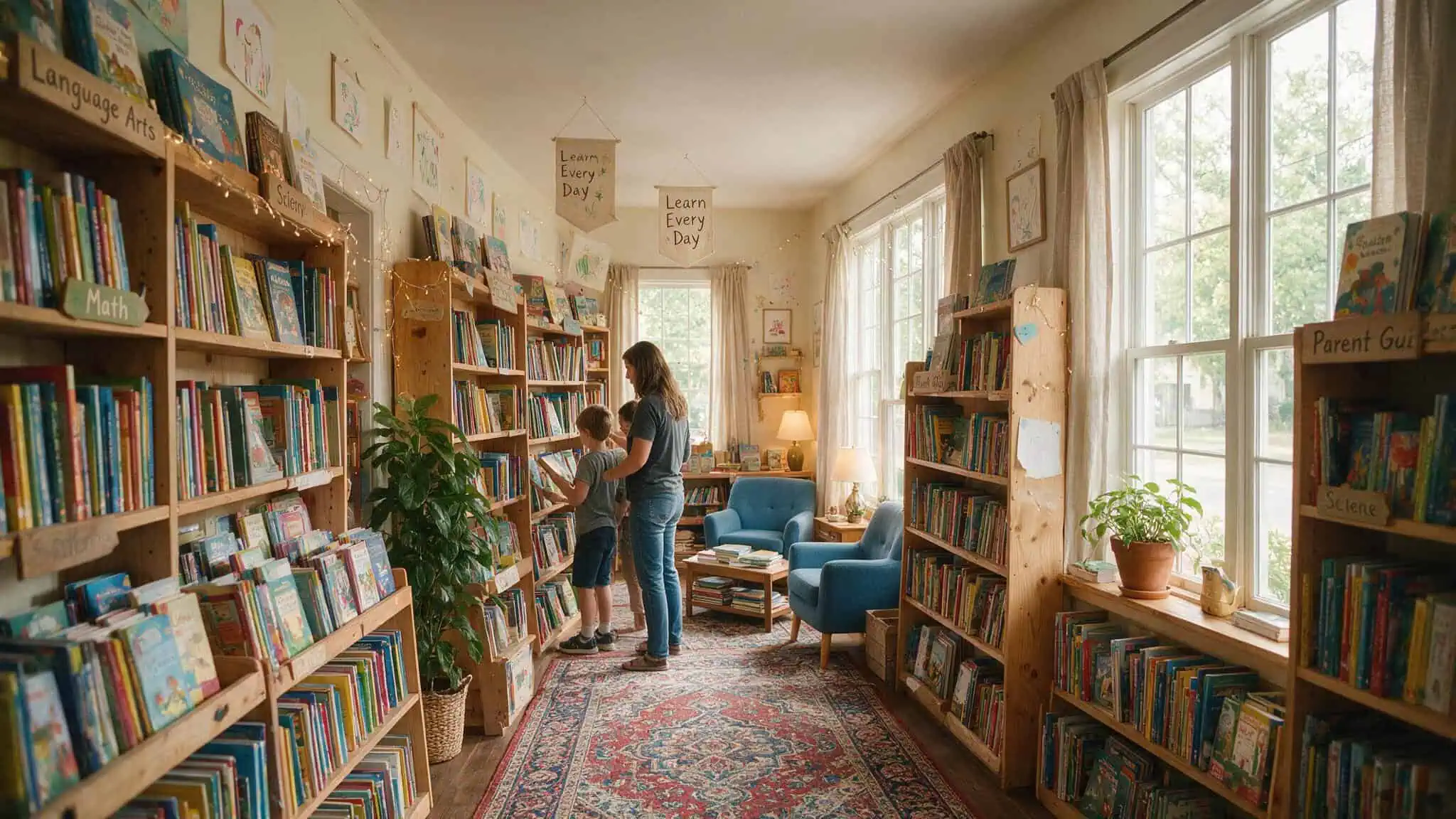
You know that feeling when you order a used math workbook online, and it shows up with half the pages already filled in — in pen?
I’ve been homeschooling for 15 years now, and I’ve bought curriculum from every corner of the internet. I’ve also tried unit studies, Charlotte Mason, Classical, traditional textbooks, and unschooling — sometimes all in the same year. And there’s no substitute for seeing something before you buy it.
That’s why finding a local homeschool store like The Homeschool Supply Co. is worth the effort — for the peace of mind that comes from knowing you’re not gambling your money on a product description.
Key Takeaways
The Homeschool Supply Co.. in Bothell, WA is the only place in western Washington where you can touch and feel new curriculum from multiple publishers before buying, and they guarantee all used curriculum is 100% usable — no written-in workbooks or missing pages.
The Lemon Tree Community, a nonprofit branch of The Homeschool Supply Co., offers classes, clubs, workshops, and events, turning a retail store into a community hub that reduces the need for separate co-ops and enrichment programs.
Florida and South Carolina have organized county-by-county directories of homeschool supply stores, including Teacher Tools in Plantation, ACE Educational in Davie, ROCK Solid in Jacksonville, BJU Press in Greenville, and The Learning Cycle in Lyman.
Table of Contents
Why a local bookstore beats scrolling online
I’m not saying online shopping is bad. I’ve bought plenty of curriculum from Homeschool Classifieds and Second Harvest Curriculum, and I’ll keep doing it. But when you buy used curriculum online, you’re trusting a stranger’s description. That “like new” workbook might have three chapters of scribbled answers. Those “all pages intact” flashcards could be missing half the deck.
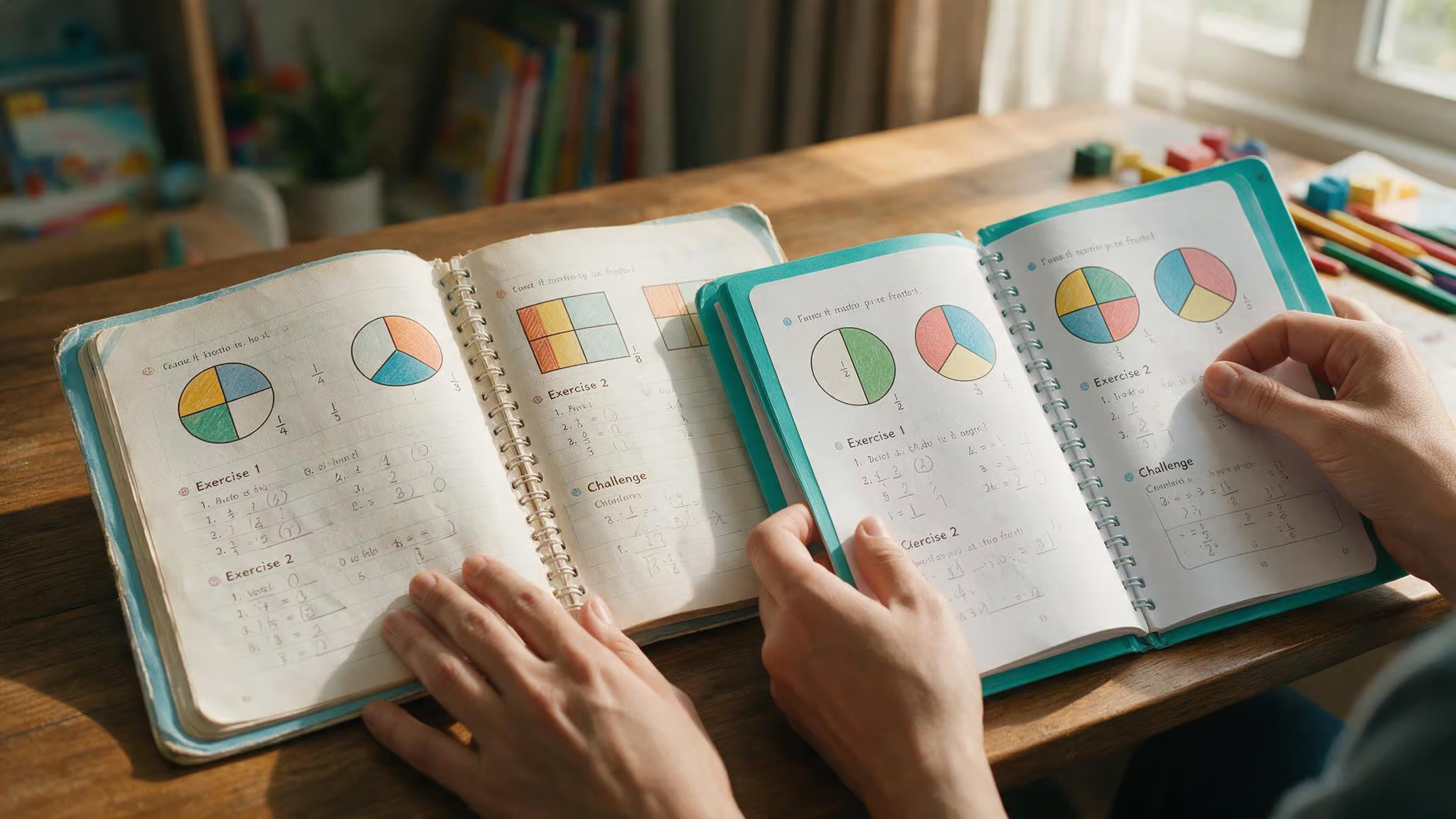
The Homeschool Supply Co. in Bothell, Washington, is the only place in western Washington where you can touch and feel new curriculum from a wide variety of popular publishers before you buy. Want to compare how two different math programs explain fractions? You can flip through both in five minutes.
Trying to decide between a Charlotte Mason-style history and a more traditional textbook? They’re both right there.
And with used curriculum, a store like The Homeschool Supply Co. has standards you can count on. They, for example, guarantee that every piece of used curriculum they sell is 100% usable — no workbooks with writing in them, no missing pages, all puzzle and game pieces present. That’s the benchmark to look for in any store.
Red flag: If a store can’t clearly state their used curriculum condition policy, inspect every single item yourself before you hand over cash.
If you’re an eclectic homeschooler like me — which means you combine multiple methods when one method isn’t working, being able to see a living-books language arts program next to a Classical history CD next to a traditional science textbook is huge.
The Homeschool Supply Co.: A blueprint for the ideal local store
The Homeschool Supply Co. in Bothell is a locally owned, women-owned, homeschool-mom-owned store, and it gives you a checklist for evaluating any store near you.
Store hours, location, and a welcoming space
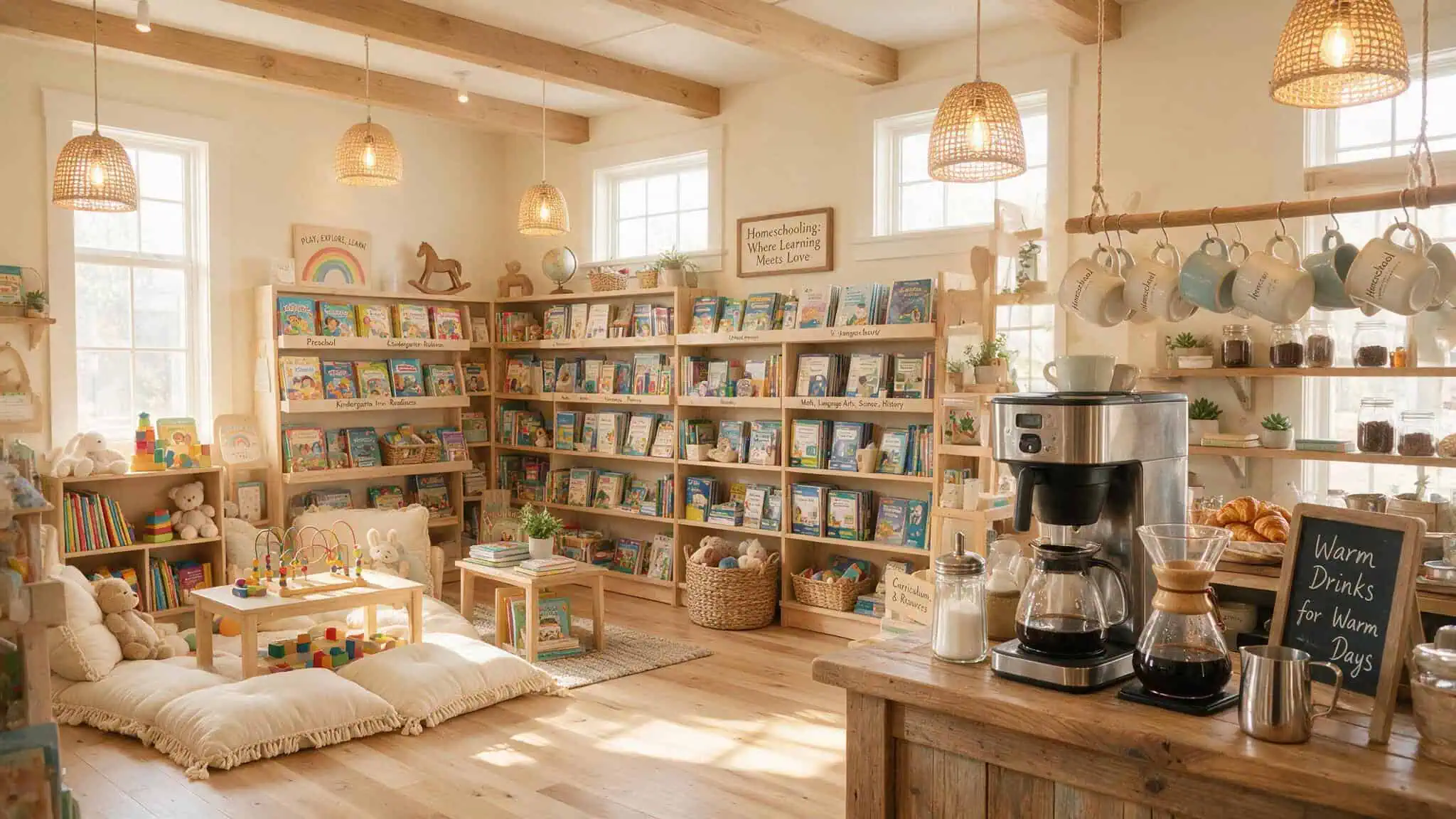
The store is open Monday through Thursday, 10am to 3pm, or by appointment. It’s located in downtown Bothell, Washington, which means you can make a morning of it.
They have a children’s play area and a coffee and tea bar. Being able to let your kids play while you take your time looking through materials is a game changer.
If you need something shipped, they offer same-day shipping if you order before 4pm PT Monday through Friday. That’s a backup when the store’s not open.
The 100% usability guarantee on used curriculum
All used curriculum sold by The Homeschool Supply Co. comes with a guarantee: workbooks are not written in, no pages are missing, and all pieces — puzzle pieces, game cards, flashcards, are present and accounted for.
When you’re shopping at any local store, ask: “What’s your used curriculum condition policy?” If they can’t give you a clear answer, be careful. If they say something like “we check everything but can’t guarantee it,” make sure you inspect every item before you buy.
For comparison, Second Harvest Curriculum offers used curriculum and allows sellers to make money, and Good and Acceptable allows users to create a free online storefront to sell items, but the condition checking is on you as the seller. A store that does the vetting for you is worth paying a little more for.
Play rooms, coffee bars, and mom-owned staffing
The Homeschool Supply Co. is locally owned, women-owned, and homeschool-mom-owned. That means the person helping you has probably been where you are — up at midnight researching phonics programs, wondering if you’re ruining your child’s education, trying to figure out how to teach long division without crying.
Staff who are also homeschooling parents can answer the questions that matter: “Will this work for a kid who hates writing?” or “Does this curriculum require a lot of prep time?” They’ve been through it. They’re not reading from a script.
The play room and coffee bar aren’t gimmicks — they’re the difference between a stressful errand and a pleasant morning.
More than a store: The community hub model
Some stores, like The Lemon Tree Community, answer the community question by being more than a place to buy stuff.
The Lemon Tree Community: Classes, clubs, events, and workshops
The Homeschool Supply Co. has a nonprofit branch called The Lemon Tree Community. It offers classes, clubs, educational opportunities, family events, workshops, and community connections. That means you can walk into the store to buy a science workbook and walk out with a registration form for a weekly chess club or a hands-on science workshop.
If a store near you has something similar — a nonprofit branch like The Lemon Tree Community, a community space, or even a regular events calendar, that’s a bonus. It means the store isn’t just selling curriculum. It’s building the kind of support network that makes homeschooling sustainable.
When you’re searching for a store, check their website or call ahead to ask if they host events or classes. Even if they don’t have a full community program, ask if they know of local groups. The best stores function as information hubs.
Finding a store in your area: State-by-state directories
Here’s a method that works, plus examples from Florida and South Carolina to show you what a directory looks like.
Florida: A county-by-county model
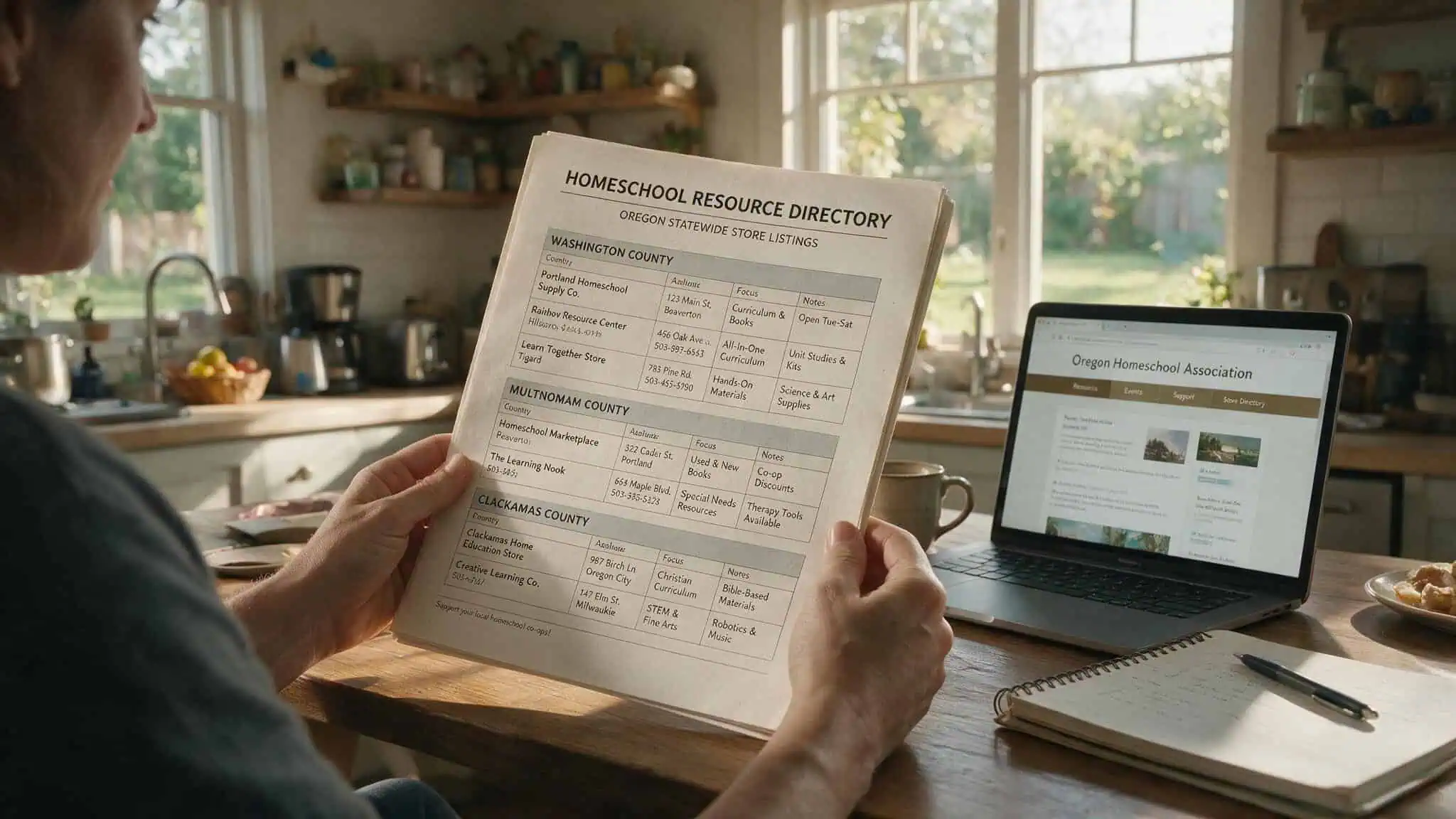
Florida has a county-by-county list of homeschool supply stores. Here’s what that looks like, with a note on what makes each one worth knowing about.
Teacher Tools — Locations in Plantation and Miami. These are dedicated homeschool stores, so they’ll have a focused selection.
ACE Educational — Superstore in Davie, plus another location in Margate. If you’re near Davie, the superstore is worth the trip for selection alone.
ROCK Solid — Located in Jacksonville. Good option for north Florida families.
Lakeshore Learning — Locations in Tampa and Fern Park. They’re a big chain, but worth checking for supplies and manipulatives.
Classroom Outfitters — Located in Miami. Another solid option for South Florida.
Get Smart — Located in Pinecrest. Small local shop that’s worth knowing about if you’re in the area.
Teachers’ Exchange — Located in Lakeland. Central Florida families take note.
If you’re in Florida, start here. If you’re not, use this as a model for your own search.
South Carolina Upstate guide
The Upstate of South Carolina has options including BJU Press store, The Learning Cycle, and ReCraft GVL.
BJU Press store — Located at 1430 Wade Hampton Boulevard, Suite 212, Greenville, SC. Phone: 864.770.1368. They carry products for K3 through 12th grade. If you use BJU curriculum, visiting the store at 1430 Wade Hampton Boulevard, Suite 212, Greenville, SC is a no-brainer. Call ahead to check hours, since it’s a publisher’s store and may have limited hours.
The Learning Cycle — Located at 557 Hammet Store Road, Lyman, SC. Phone: 864.968.0391. This is a consignment store for homeschool curriculum. That means stock changes frequently, so call ahead to 864.968.0391 to see what they have. You can also sell your old curriculum here, useful if you’ve got a pile of finished workbooks taking up space.
ReCraft GVL — Located in Greenville, SC. This is a creative reuse center, not a traditional homeschool store. They sell reused craft and school supplies, have a Makerspace, a donation station, and host special events and programs. If your kid loves hands-on projects, ReCraft GVL is worth checking out.
General strategies for other regions
If you don’t live in Florida or South Carolina, here’s how to find what’s near you.
First, check your state’s homeschooling organization website. Many maintain directories of local resources, including stores that sell gently used curricula on consignment, such as those recommended in a potpourri of must-reads.
Second, search “homeschool store” plus your county name. County-level searches tend to be more useful than city-level ones, since stores often serve a wider area.
Third, ask in local homeschool groups. Facebook groups, co-op email lists — someone has been to the store you’re looking for and can tell you whether it’s worth the drive.
Fourth, check library bulletin boards. Physical bulletin boards in children’s libraries are still one of the best places to find flyers for local homeschool stores and events.
Shopping for an eclectic curriculum: 15 products to look for
I’ve tried unit studies, Charlotte Mason, Classical, traditional textbooks, and unschooling. And here’s what I’ve learned: none of these methods harmed my children. You can switch methods when something isn’t working, and for a rich blend of curriculum, local resources, and real-mom tips, Homeschool Potpourri is a comprehensive guide to this eclectic approach.
My own homeschool uses an eclectic approach. My oldest son was unschooled for kindergarten and most of first grade, then switched to Charlotte Mason — he’s now above grade level in middle school. My oldest daughter has been a traditional textbook learner since age 4. Same parents, same house, completely different approaches that work for each kid.
Here’s a sample eclectic 4th grader’s curriculum that shows what mixing methods looks like in practice: Language Arts uses living books with a Reading Journal and Reading Guide Safari (Charlotte Mason), History uses Classical Conversations CD Cycle 1 (Classical), Science uses Apologia’s Flying Creatures with a Journal (a blend of traditional textbook and unit study), and Math uses Teaching Textbooks (Traditional model). For tips on organizing this kind of mix, including selling used curricula and exploring virtual programs, check out this collection of tips, tricks, and resources.
When you walk into a well-stocked homeschool store, here are 15 products to look for, but you can also save money by knowing where to find a homeschool consignment store near me.
The Historian’s Toolkit – Year 1
A secular, science-based deep history curriculum coming in August. It’s priced around $20.00 through $30.00 and comes in three parts: a read-aloud text with a Time Traveler’s Passport, a student workbook with teacher’s guide, and an audiobook read by Dr. Sherri Mehta. It covers 34 stops across 6 continents, from walking ancestors of 3 million years ago to eel farmers of Australia 6,600 years ago.
One Family, Many Stories
A journey through deep history before written records, also fully secular and grounded in real science and archaeology. It spans the same broad timeline — from 3 million years ago to about 6,600 years ago, with 34 stops across six continents. Comes in three parts: read-aloud text, hands-on student workbook, and audiobook.
The Critical Thinker’s Toolkit – Level 1
Designed for ages 6-10 and priced around $69-105, this program teaches kids to notice their own thinking (metacognition, if you want the fancy term). It has 11 sequential lessons with kinesthetic activities, picture books, real-world scenarios, and films. There are optional Writing Revolution exercises if you want to add writing practice.
The Writer’s Toolkit – Year 1
A full-year writing curriculum for grades 1-3, priced around $95-176. It follows the Hochman Method (The Writing Revolution), which is a very structured, skills-based approach. This is not a program focused on creative writing or a set of prompts — it’s explicit modeling, carefully sequenced instruction, and daily structured practice.
3rd Grade Complete Language Arts Bundle
Priced around $95-176, this includes Hearth & Story Complete 3rd Grade Language Arts. It’s a thematic series called “Talk of the Town” that covers scaffolded writing, critical thinking, grammar, and spelling.
Critical Thinking Through Film – Oz/Wicked
A mini-unit for middle school priced at $20. It uses three films presenting the same story from conflicting perspectives — The Wizard of Oz, Wicked, and the upcoming Wicked: For Good. Great for critical thinking. It’s included with The Critical Thinker’s Toolkit Level 2 but can be used standalone.
We Are Homeschoolers Journal
A guided journal for secular homeschoolers by Blair Lee, priced around $15-23. It’s a place to reflect on your homeschool journey — useful for those days when you need to remind yourself why you’re doing this.
Marine Science
An ecosystem-based journey through the ocean in 18 chapters, priced around $108-154. It includes text, hands-on labs, and more than 90 custom videos. Fully aligned to NGSS for middle school.
Beginner Molecular Literacy Packet PDF
A chemistry resource priced at $109.79. It’s a PDF packet that includes Files #1-4, an Activity Pack, Ionic Ooze Card Game, Atomic Bingo Game PDF, and M.C. Detective Agency: Files 1-4 Beginner Lesson Plans PDF. It’s built on lessons learned from 30 years of teaching chemistry.
Rock by Rock: Real-World Projects for K–8
A project-based learning program priced at $150. The thematic series is called “Warmest Welcome” and covers scaffolded writing, critical thinking, and language studies.
Microbiology
By Blair Lee, priced around $96-148. Endorsed by Andrew Hessel, Chairman of the Board and Co-Executive Director of Genome Project-Write — so it’s got serious science credentials.
Project-Based Learning: Creating a Modern Education
A book about project-based learning, priced around $30-45. Good if you want to understand the philosophy behind PBL before diving in.
The Science of Climate Change: A Hands-On Course
A text with 18 hands-on activities, priced at $20. Explains global warming and climate change through interactive learning.
Homeschool Planning Boot Camp
A 5-day program to plan your entire homeschool year. Sounds intense, but worth it for those of us who need structure.
Selling used curriculum: Turning workbooks into store credit
Here’s a tip I wish someone had told me years ago.
Pencil vs pen: The condition rule that saves a workbook
If your child writes in a workbook with pencil, you can erase it and sell it as gently used. If they wrote in pen, you’ve got to disclose that and price it accordingly — note the page count and offer a discount.
Stores like The Learning Cycle in Lyman, SC and Second Harvest Curriculum both buy used curriculum. Knowing the pencil-versus-pen rule means you can walk in with a stack of workbooks that are actually valuable, not a pile of writing samples.
When you’re selling, be honest about condition — a store that trusts you will give you a better price, and you’ll build a relationship that pays off next time.
Online fallback: When no local store exists
Not everyone has a local homeschool store. If you’re in a rural area or a state with fewer homeschooling families, online might be your only option. Here’s what to use and when.
Homeschool Classifieds
One of the largest sites for buying and selling new and used homeschool materials. It’s like Craigslist but just for curriculum. You can also find local groups, activities, and events here.
Paperback Swap
A trade club where you list books you’re done with and swap them with other members. 1,171,816 available books, so you’ll probably find what you need. It’s not a store — you’re trading, not buying, but it’s great for building a library on a budget.
Second Harvest Curriculum
Sells used curriculum and also lets you sell your old stuff. One stop for both buying and selling.
Good and Acceptable
Lets you set up a free online storefront to sell your items. No listing fees. If you have a lot of curriculum to sell, this is a good option.
Half Price Books
What you actually pay matters more than the sticker price — condition varies, so check carefully. They’re a well-known used book chain with locations everywhere.
Chegg
Mostly known for college textbooks, but they have a 21-day guarantee. If the book’s not right, you’ve got time to send it back. They also rent textbooks, which is handy if you only need something for a semester.
Goodwill Books
Free shipping on everything, and your purchase supports a good cause. No surprise fees at checkout.
Thrift Books
Over 160 million used books in stock. You’ll find what you’re looking for.
AbeBooks
Lets you search for books, curriculum, even fine art and collectibles from independent sellers around the world. Good for hard-to-find items.
What you’re giving up when you go online: No tactile inspection. No same-day availability. No opportunity to compare multiple methods in one trip. No staff who can answer your questions about whether a curriculum works for a reluctant writer or a kid who hates repetition.
What you gain: Massive selection, often lower prices, and the ability to access the whole country’s worth of used curriculum.
The case for visiting in person
The next time you type “homeschool store near me” into a search bar, you’ll know what to look for.
You’re looking for a place that lets you flip through workbooks before buying, guarantees the condition of used materials, and has staff who understand what it means to teach a kid who learns differently than his siblings. You’re looking for a store that might have a play room or a community space — somewhere that feels like a resource, not just a transaction.
And if you find one? Make the trip. Bring your list. Take your time. Let the kids play while you compare two history curricula side by side. Walk out knowing what you’re getting, with no shipping wait and no surprises.
That’s worth the drive.
Frequently Asked Questions
What’s the difference between buying used curriculum online vs. in person?
Buying in person lets you inspect every page for writing, missing pieces, and overall condition before you pay — no trusting a stranger’s ‘like new’ description. Online gives you massive selection and often lower prices, but you risk getting workbooks with scribbled answers or missing flashcards.
How do I find a homeschool store near me?
Start by checking your state’s homeschooling organization website for a directory of local stores, then search ‘homeschool store’ plus your county name for better results. Ask in local homeschool Facebook groups or check library bulletin boards — other parents will tell you which stores are worth the drive.
What should I look for in a good homeschool store?
A great store lets you flip through multiple publishers’ materials side by side, guarantees that used curriculum is 100% usable with no missing pages or written-in workbooks, and has staff who are homeschooling parents themselves. Bonus points for a play area or coffee bar so you can actually browse in peace.