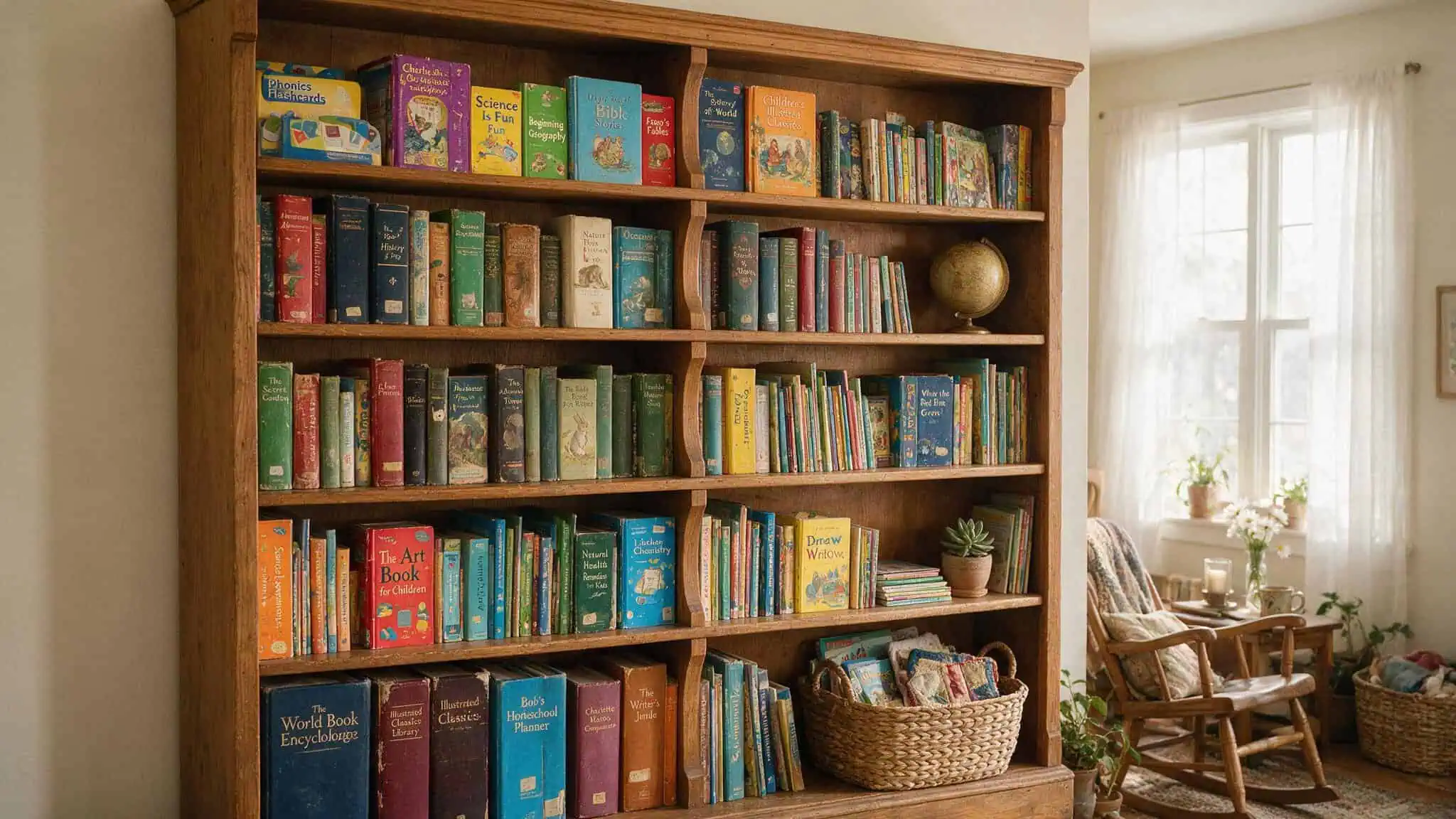
Saxon math on page one, Sonlight literature on page three, Apologia science somewhere in the middle. I wanted to mix them — pick the math spine that made sense to me, the history I wanted to read aloud, the science that wouldn’t put my kid to sleep. But every publisher wanted me to buy a full boxed set.
Homeschool Potpourri — a pre-owned curriculum store in Kirkland, Washington, does what its name suggests. It’s a physical and online shop that sells used educational materials, sorted by brand, subject, genre, and grade. The store serves the United States market, with a particular focus on King County.
Key Takeaways
Homeschool Potpourri categorizes its inventory four ways — Popular Curriculum (16 brands), Subject (21 categories), Book Genre (9 genres), and Shop by Grade (7 bands plus Teacher), making it easy to build a mixed-year curriculum.
The store offers $5 flat-rate shipping on any size order, which removes the cost penalty of buying from multiple categories in one cart.
MapQuest lists the store as “Closed” for all hours (likely a formatting error), but the store’s own website is active with product listings; always cross-check hours before visiting.
Table of Contents
The four-axis system: how the store solved the chaos
The first time I browsed Homeschool Potpourri’s website, I noticed something different. Most homeschool stores let you search by brand or subject, but this one organizes everything four ways: Popular Curriculum (who made it), Subject (what are we learning), Book Genre (what are we reading), and Shop by Grade (who is this for).
When I’m planning a year, I start with one child. I pick the subject that’s hardest to teach — say, math. Then I choose a brand that works for that kid (Saxon, because my kid needs spiral review). Then I check the grade band to make sure I’m looking at the right level.
Then I browse the genre section for a picture book or biography that ties into the history unit we’re doing. One kid, one subject, one brand, one grade, one genre. It’s a filter, not a free-for-all.
The fix: shop by child first, then by subject, then by brand. Don’t start with the curriculum names — start with the kid.
The 16 curriculum brands you’ll find (and what to check when buying used)
Homeschool Potpourri carries popular curriculum brands including Abeka, BJU, Sonlight, Christian Liberty Press, and Apologia, most available as pre-owned. Here’s a quick reference for the brands you’ll see and what to watch for when buying used:

Abeka — All-in-one Christian curriculum, most often resold. Check that all test booklets and answer keys are included.
All About Reading — Hands-on phonics with letter tiles and readers. Verify all pieces are present before buying.
Apologia — Creation-based science with textbook and notebooking. Works well for middle and high school. Make sure the notebooking journal isn’t written in.
BJU — Christian video-based instruction. If it’s a digital version, confirm the video access still works. BJU Press is a well-known name in pre-owned homeschool curriculum.
Classical Conversations — Classical model with memory work. The guides pair with timelines, maps, and read-alouds. Check the edition matches your cycle.
Horizons/Alpha Omega — Colorful spiral worktexts, strong for independent math. Consumable format means used copies vary in how much is written in.
IEW — Structured writing method. Buy with the teacher materials and DVDs, those are the expensive part. IEW is a popular pre-owned curriculum line for writing instruction.
Math-U-See — Manipulative-based mastery math. The integer block kit is the key piece; make sure it’s complete.
Memoria Press — Classical, Latin-centered, rigorous. Buying used offsets the cost of the long reading lists. Check that teacher guides are included.
MasterBooks — Open-and-go Christian texts, often family-style for multiple grades. Affordable new and widely resold.
Saxon — Incremental spiral math. Buy with the solutions manual. It works as a math spine you can build other subjects around.
Sonlight — Literature-based all-in-one. The core plus instructor guide is the heart. Make sure the read-alouds and books are the right edition, and search for homeschool potpourri near me to find local groups, co-ops, and events that embrace a mix of curricula, field trips, and social opportunities.
Story of the World — Narrative world history for elementary. Pairs with activity books. Grab the activity guide too.
The Good and the Beautiful — Family-style, aesthetically strong, low-cost. High demand used, snag it when you see it.
Moving Beyond The Page — Project-based, literature-driven units. For visual inspiration on eclectic learning spaces and real-life homeschool days, check Homeschool potpourri photos and included manipulatives, plus the right age range.
Christian Liberty Press — Affordable traditional Christian texts. Good filler for a weak subject.
subject categories: building a balanced year
The subject menu at Homeschool Potpourri is a checklist for a well-rounded mix, and you can shop The Tuttle Twins for fun resources that teach critical thinking, real-world economics, and important values. For organizing your curriculum, selling used materials, or exploring virtual programs, check out this collection of homeschool tips, tricks, and resources. Here’s the full list: All-In-One, Bible, Computer, Critical Thinking/Logic, Finances and Business, Foreign Language, Geography, Health, History/Social Studies, Language Arts, Literature and Fiction, Math, Music/Arts, Parenting/Homeschool Resources, Poetry, Reading, Reference Materials (Dictionaries & Thesauruses, Test/College Prep), Science, Speech & Debate, Spelling/Vocabulary, Games/Activities.
You can group them into three buckets for planning:
- Core academics: Reading, Math, Science, History/Social Studies, Language Arts, Spelling/Vocabulary, Geography, Health
- Enrichment and life skills: Bible, Computer, Critical Thinking/Logic, Finances and Business, Foreign Language, Music/Arts, Poetry, Speech & Debate, Games/Activities
- Reference and parent support: Reference Materials, All-In-One, Parenting/Homeschool Resources
A simple starter balance: one core subject, one enrichment, one reference or game item.
book genres: filling your home library
Genre browsing is how an eclectic library becomes more than textbooks. Before deciding if Homeschool Potpourri is right for your family, check out Homeschool potpourri reviews from real homeschooling moms—then the library separates books into: Biography, Christian Living, Early Readers, Fiction, Holiday, Kids Bible, Personal Growth, Picture Books, Rare Books.
Picture books and early readers for younger kids. Biography and fiction to deepen history or science units. Rare books for collectors or special finds. It’s a discovery layer on top of grade and subject — you can grab a picture book about the Civil War while you’re picking up a Saxon math text, and suddenly your history unit has a read-aloud.
Shop by grade: PreK through teacher resources
The grade bands are PreK-K, 1st through 3rd, 4th through 6th, 7th through 8th, 9th through 10th, 11th through 12th, and Teacher. Some practical tips for each:
- PreK-3rd: Check for missing pieces and writing in workbooks. Little kids use crayons, and that’s harder to erase.
- 4th-8th: Verify the edition matches your state standards or co-op scope. A few editions difference can mean a whole chapter on something you don’t need.
- 9th-12th: Confirm the solutions manual and test key are included. High school materials without answer keys are nearly useless for the parent.
- Teacher category: Worth browsing even if you’re not a teacher. Teacher guides have discussion questions, scheduling help, and often the answer keys you need.
How consignment works: recycle curriculum, recover costs
Homeschool Potpourri sells pre-owned materials on consignment. You bring in materials you no longer use, the store lists them, and you recover some of the cost — typically as cash or store credit. The product range includes new and consigned books, enrichment materials, dictionaries, reference materials, and games.
The failure pattern I see most often: holding onto unused curricula “just in case” for younger siblings. A consignment cycle forces a clean keep-or-sell decision. If you’re not going to use it, let it go. The money you get back funds the next semester’s mix.
Why $5 flat-rate shipping matters for eclectic orders
Homeschool Potpourri offers a flat $5 shipping rate regardless of order size. That’s a big deal for eclectic homeschoolers. When you’re mixing a Saxon math text, an Apologia science notebook, and a Sonlight read-aloud in one cart, per-item shipping from individual sellers adds up fast. $5 flat removes that penalty. You can order from three different categories in one transaction and pay the same shipping as a single item.
The Kirkland store and the local homeschool ecosystem
The physical store is at 12815 NE 124th St, Kirkland, WA 98034-8313, inside Totem Lake Business Park. It’s close to Billings Middle School (6 reviews), Chopin Academy of Music (15 reviews), Lighthouse Christian School (4 reviews), and Totem Preschool (3 reviews). Other nearby businesses include Sport Court, F3 Functional Fitness, Pink Blossom Events, Seatown Sweets, and a dance school.
Don’t trust the MapQuest hours: a cautionary tale
MapQuest lists the store’s hours as “Closed 10 am -5 pm” Monday through Friday and “Closed 10 am -3 pm” Saturday. That’s a formatting error — the store’s own website is active with product listings. The same MapQuest page shows “similar places” that are useless: a tattoo shop (Ink Illusions, Taylor G. rating 80), a label company (Creative Label Inc), and sidebar collections like “Best Breakfast Places in Portland, OR” (7 places) and “Best Brunch in Portland, OR” (9 places). None of that helps a shopper. The page also features collections like Free Things to Do in Seattle, WA (9 places) and Cheap Things to Do in Seattle, WA (9 places).

Data is provided by System1, and one review shows an 80. Taylor G. rating for Ink Illusions, though the scale is unclear.
Review counts on the page are inconsistent — 6 (Billings Middle School), 15 (Chopin Academy of Music), 4 (Lighthouse Christian School), 3 (Totem Preschool), 80 (Ink Illusions), with no clear scale. The data is partially provided by Infogroup, © 2026. The store is also listed on Yelp. The lesson: always cross-check hours with the store’s website or social media before driving.
Follow on Facebook, Instagram, and TikTok for new arrivals
The store links to Facebook, Instagram, and TikTok from its website. These channels announce new consignment items, popular curriculum drops, and store updates. High-demand items — The Good and the Beautiful, Abeka sets, Sonlight cores, sell quickly. Social media is first access. Turn on notifications if you’re hunting for a specific curriculum.
How to make a potpourri curriculum actually work
Blending curricula from different publishers can feel chaotic, but with a clear strategy, it becomes a tailored education that fits your child’s needs.
Blending Abeka, Sonlight, and Math-U-See in one year
Use Sonlight as the history and literature spine (it’s literature-based). Use Math-U-See or Saxon as the math spine. Use Abeka for phonics and spelling. Pace each subject independently — don’t force them to start and end on the same schedule.
One subject might take 30 weeks, another 36. That’s fine.
The Good and the Beautiful vs. MasterBooks for mixed grades
Both are family-style, open-and-go Christian options. TGATB is more scripted and visual; MasterBooks is more straightforward text. Key consideration: TGATB is aesthetically strong and low-cost, which means it’s high demand used. MasterBooks covers multiple grade levels and is widely resold and affordable new. Your choice depends on whether you want a scripted lesson plan or a read-and-discuss format.
Lessons parents learn about blending curricula
Start with one non-negotiable subject per child. Stagger new curricula — don’t debug three programs at once. Use consignment so switching is affordable. If something flops, you’re not stuck with a $200 set you’ll never use again.
Start with one category
Pick one child’s hardest subject. Buy that one used curriculum spine from Homeschool Potpourri. Add one enrichment item — a picture book, a game, a science kit. If it doesn’t work, you can sell it back and try something else.
Just verify the hours before you drive. MapQuest isn’t your friend on this one.
Frequently Asked Questions
How do I build a mixed curriculum without it being chaotic?
Start with one child’s hardest subject, pick a curriculum brand that works for that kid, then add one enrichment item like a picture book or game. Use the store’s four-axis system—Popular Curriculum, Subject, Book Genre, and Shop by Grade—to filter instead of browsing everything at once. Stagger new programs so you’re not debugging three at once.