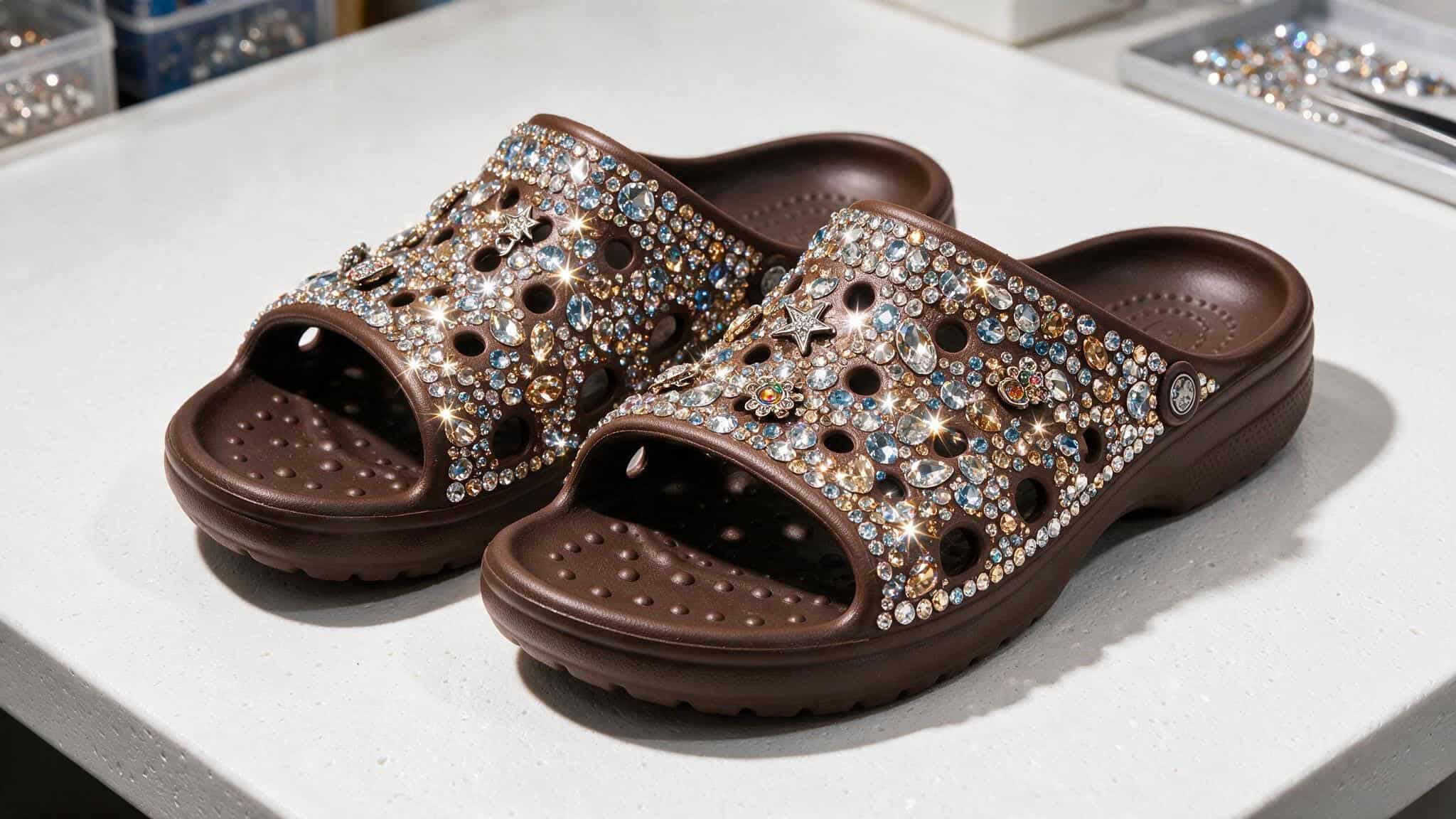
I still remember the first time I glued a rhinestone onto something and thought, “I could sell this.”
People are making money turning plain Crocs into sparkly masterpieces, jazzing up phone cases, and even bedazzling pet collars. Etsy is crowded. Success isn’t about just making pretty things — it’s about picking the right products, using the right glue, and pricing so you don’t accidentally work for free.
So I put together everything I wish someone had told me when I started: 20 specific products that sell, exactly which rhinestone brand to use for each, what glue won’t fail you, a simple pricing formula, and where to actually list your stuff. Let’s get into it.
Key Takeaways
Start with Luna rhinestones for prototyping and high-volume items like bedazzled sliders ($0.02 per stone, material cost ~$2 per pair, retail $15–20)
Use E6000+ glue for rubber footwear (Crocs, wellies, jelly shoes) because it’s flexible and waterproof; use Gem Tac for paper and plastic items like greeting cards and office supplies
Etsy charges $0.20 per listing for four months plus 5% commission, while Creative Market gives you 70% revenue share on digital patterns with no exclusivity lock-in
Table of Contents
What You Need to Start: Startup Costs and Essential Tools
You can get started for about $20 to $50 if you’re just testing the waters. A full setup with a decent stash of rhinestones, a few glue types, and proper tools will run you more like $100 to $200. But here’s the smart way to think about it: don’t blow your budget on expensive stones before you know what’s going to sell.
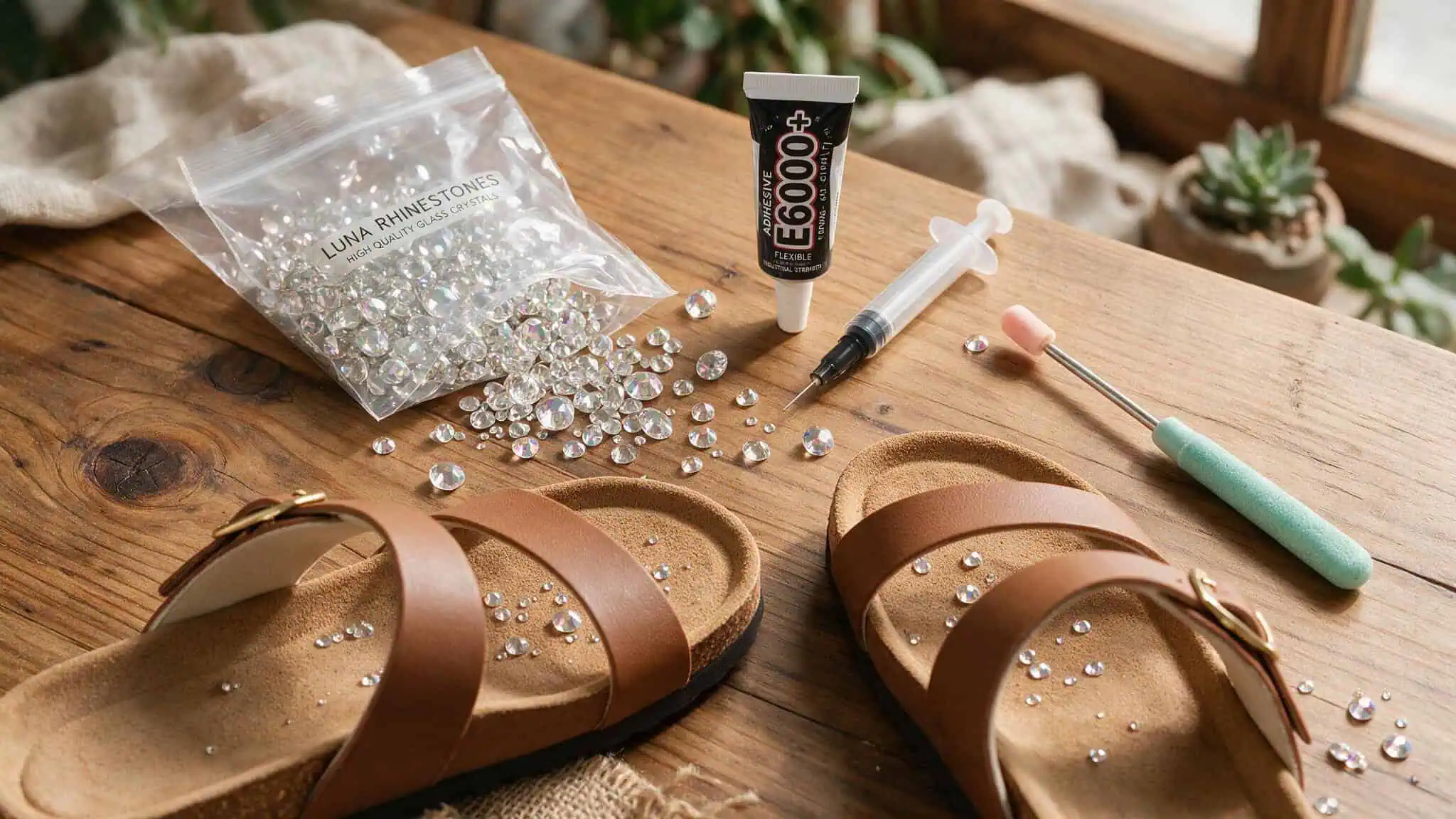
Rhinestone brand tiers — cost and quality positioning
One of the biggest mistakes I see new sellers make is buying the cheapest rhinestones they can find — or, on the flip side, going straight for Swarovski and wondering why they’re losing money. Here’s how I think about the four main options:
Swarovski is the Rolls Royce. Precision cut, sparkle, and that famous name. You’ll pay a premium, but for luxury custom orders — think bridal pieces or high-end gifts, customers expect it. I only reach for Swarovski after I’ve already sold a few of whatever I’m making and someone’s asking for the “fancy” version.
Preciosa is almost as good as Swarovski, slightly cheaper, and has a fantastic color range. If you’re making something that needs to look premium but you want to keep your margins healthy, this is your sweet spot.
Zodiac is our go-to for most everyday projects. It’s a balance of quality and price that works. Zodiac Light Pink AB is a particular favorite for office items and gifts — it catches the light without being obnoxious.
Luna is your budget hero. These stones cost about $0.02 each, making them perfect for prototyping, testing a new product idea, or high-volume items where you can’t afford Swarovski per piece. The sparkle is decent, and for things like novelty phone cases or kids’ items, nobody’s going to inspect the cut quality.
The smartest strategy? Start with Luna to validate a product idea. Once you’ve got sales and know what customers actually want, upgrade to Zodiac or Preciosa for the regular line, and offer Swarovski as a premium option.
Bottom line: Start with Luna to test demand, then upgrade stones once you’ve proven the product sells.
Glue types and when to use each
Nine times out of ten, fallen-off rhinestones are the wrong glue. Here’s what to use:
E6000+ is your heavy lifter. It’s flexible and waterproof, which means it’s perfect for rubber, silicone, and any surface that’s going to bend or get wet. Crocs, sliders, jelly shoes, wellies — if it’s a shoe that’s actually going to be worn outside, this is the glue. It’s also a bit thick, so you’ll want a syringe applicator to place it precisely.
Gem Tac is for everything else. Paper, plastic, metal, glass — it dries clear and holds well on flat surfaces. Greeting cards, office supplies, makeup items, phone cases that don’t flex much. It’s thinner than E6000+, so it spreads nicely and doesn’t leave globs.
Applicator tools and optional supplies
You don’t need a lot of fancy gear, but a couple of things make a difference:
- Syringe applicators let you put the glue exactly where you want it, exactly the size you need. No messy blobs, no wasted glue, no glue-fingerprints on your finished product.
- Pick-up tool — trust me, your fingers will thank you. Trying to place tiny rhinestones with your hands is frustrating, especially when you’re doing a full honeycomb pattern. A wax-tipped pick-up tool makes it faster.
- Dressmakers chalk is useful if you’re doing fabric or logo tops — you can sketch your design, place the stones, and the chalk washes off.
- Rhinestone sheets are a game-changer for cylindrical items like lipstick tubes or brush handles. Cut and stick.
Glue Guide: Matching Adhesive to Surface
Here’s the whole thing:
If the surface is flexible, rubbery, or going to get wet — Crocs, wellies, jelly shoes, sliders, use E6000+. It’s the only glue that’s flexible enough to move with the material and waterproof enough to survive rain, puddles, and the occasional trip through the car wash.
If the surface is paper, plastic, glass, or metal — greeting cards, notebooks, pen holders, phone cases, perfume bottles, office supplies, use Gem Tac. It’s not waterproof the way E6000+ is, but it holds beautifully on rigid surfaces and dries crystal clear.
One glue for everything is a beginner mistake. Two glues make you look like a pro.
Application Methods: Speed vs. Quality for Different Order Volumes
How you apply the stones matters as much as what you’re applying them to. The method you choose depends on how many items you’re making and how much you want to charge, as well as your choice of bedazzling ideas rhinestones for the specific project.
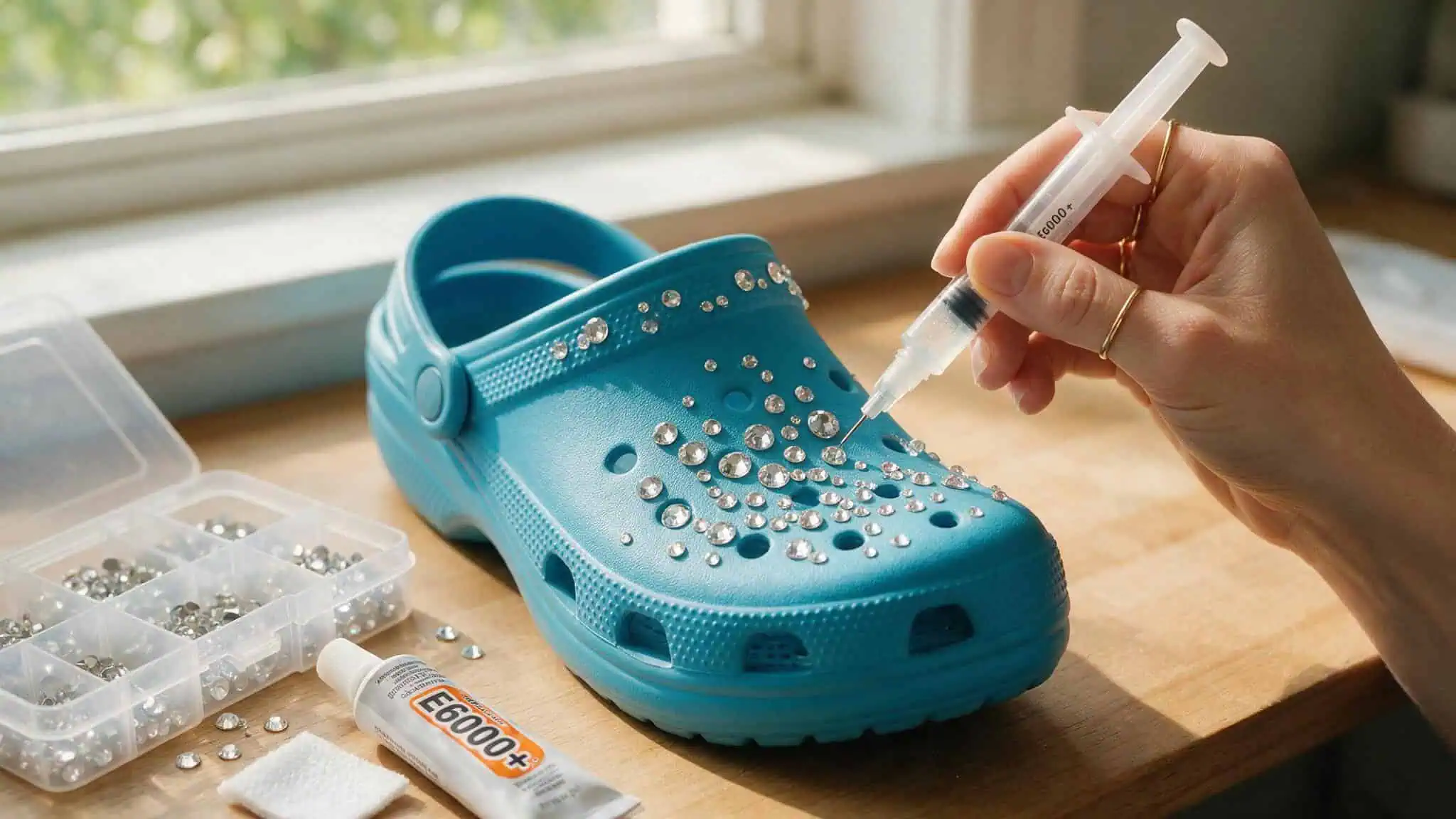
Honeycomb method is full coverage — you’re covering the entire surface with flatback crystals, usually in a pattern. It’s time-intensive (1 to 3 hours for a handbag), but the perceived value is through the roof. I use this for premium handbags and custom orders where the customer is paying $50 to $80.
Scatter Effect is partial coverage. You’re placing stones here and there, maybe in a gradient or random pattern. It’s faster (15 to 30 minutes) and uses fewer stones, so your material cost stays low. Perfect for novelty items, budget-friendly gifts, or when you’re testing a new product idea.
Rhinestone transfers are your secret weapon for bulk orders. You send your design to a transfer company, they make a pre-arranged sheet, and you apply it in seconds with heat or pressure. This is how you go from making 5 items a week to 50. The setup cost is higher, but the per-unit time drops.
Rhinestone sheets are cut-and-stick. Great for cylindrical items like lipstick tubes, brush handles, or straws. No glue, no mess, just peel and place—though for larger projects, you might want to consider what to look for in a bedazzling kit.
Crystal buttons are sew-on, no glue required. They’re popular for bridal gowns, coats, and jackets. If you’re doing fabric items, this adds sparkle without worrying about glue compatibility.
Bedazzled Products That Sell (with Profit Tips)
Here’s the list. Each one includes the glue, the technique, the recommended rhinestone brand, and a profit tip that’ll help you make money.
Sliders / Crocs
E6000+, flatbacks and pearls in a rockery effect (clustering them together). Use Luna stones to keep costs low. Material cost is about $2 per pair, labor is 20 minutes, and you can retail at $15 to $20. These are my top recommendation for beginners.
Greeting cards
Gem Tac, small rhinestones placed sparingly. Material cost is almost nothing — a few cents per card. Sell them as sets of 3 to 5 for $12 to $18. Low risk, high margin.
Sunglasses
Zoe, a member of the Crystal Parade team, bedazzled a pair of Harry Styles sunglasses for a concert and got lots of comments. Fan merchandise sells fast. Use Preciosa for quality, charge $25 to $35. Concert season is your window.
Pet collars and accessories
Rhinestones on leads, food bowls, coats. Make sure stones are secure — choking hazard is real. Growing market, low competition. Use Zodiac for a mid-range look, charge $10 to $20 for a collar.
Drinks bottles
Full rhinestone cover. You can turn a bottle into a lamp base. Unique gift item, higher perceived value. Use Luna to prototype, Preciosa for the final product. Charge $25 to $40.
Champagne flutes
Bespoke bridal and anniversary gifts. Gem Tac, small flatbacks. Use Swarovski or Preciosa — the bride’s crowd will notice. Charge $30 to $50 per pair.
Phone cases
Swarovski or Preciosa for a luxury feel. High-margin item — materials are cheap relative to perceived value. Use scatter effect for speed, honeycomb for premium. Retail $25 to $45.
Water bottles
Ombre is still trending, clear diamante works well. Fitness crowd is a ready market. Use Luna for budget, Preciosa for quality. Charge $20 to $30.
Jelly shoes
3D crystals from a vintage range, E6000+. Nostalgia sells — jelly shoes are back. Set the gems into the gaps. Use Luna, charge $15 to $25.
Makeup items (lipstick tubes, brush handles)
Rhinestone sheet, cut and stick. Easy to produce, quick to sell. Use Luna, charge $10 to $15.
Rhinestone transfers
Sell the transfers themselves as a product. Someone else can apply them to their own items. Use Zodiac, charge $5 to $15 per transfer sheet.
Crystal buttons
Sew-on, no glue. Popular for bridal gowns, and coats and jackets. Bridal market has higher price tolerance. Use Swarovski, charge $3 to $10 per button.
Logo tops
Dressmakers chalk to sketch the logo, then glue on stones. Custom orders command premium. Use Preciosa, charge $25 to $40.
Wellies (rain boots)
E6000+, waterproof. Festival season is your window — prep in spring. Use Luna, charge $20 to $35.
Handbag
Honeycomb method, flatback crystals. Material cost $10 to $15, retail at $50 to $80. This is a statement piece.
Novelty items (keychains, small figurines)
Match colors, full or partial coverage. Fun, giftable, low competition. Use Luna, charge $10 to $15.
Office items (staplers, calculators, pen holders)
Gem Tac, Zodiac Light Pink AB. Unique desk decor niche, little competition. Charge $15 to $25.
Perfume bottles
Pearls and cabochons from a vintage range. Heirloom feel, high perceived value. Use Preciosa, charge $25 to $40.
Novelty phone (like a toy phone or retro handset)
Luna with Gem Tac, scatter effect as budget option. Kitsch items have a dedicated collector market. Charge $15 to $20.
Crystal keychains
Small, fast to make, cheap materials. Use any leftover stones. Charge $8 to $12.
Pricing Strategy: How to Actually Make a Profit
Here’s the formula that keeps you in the black:
(Materials + Labor + Platform Fees) × 2 to 4 = Retail Price
Let’s walk through an example using bedazzled sliders:
- Materials: Luna stones (about $0.02 each, you’ll use maybe 100 for a pair = $2), plus a sliver of E6000+ (say $0.25 amortized). Total materials: $2.25.
- Labor: Scatter effect takes about 20 minutes. Even at minimum wage, that’s $3.33. But your time is worth more than that — I’d value it at $5 for 20 minutes.
- Platform fees: Etsy charges $0.20 to list the item (for four months or until sold) plus 5% commission on the sale. If you’re selling at $15, fees are about $0.95. Add that to your cost.
- Total cost: $2.25 materials + $5 labor + $0.95 fees = $8.20.
- Retail price: $15 to $20 gives you a 1.8x to 2.4x markup. That’s healthy.
The math changes if you use Swarovski vs. Luna, or honeycomb vs. scatter. But the formula stays the same. Do not skip this step.
Cost check: If your retail price doesn’t cover materials, labor at $15/hour, and platform fees with at least 2x markup, your pricing is too low.
Where to Sell: Marketplace Comparison
Not all platforms are created equal for bedazzled items. Here’s how I break it down:
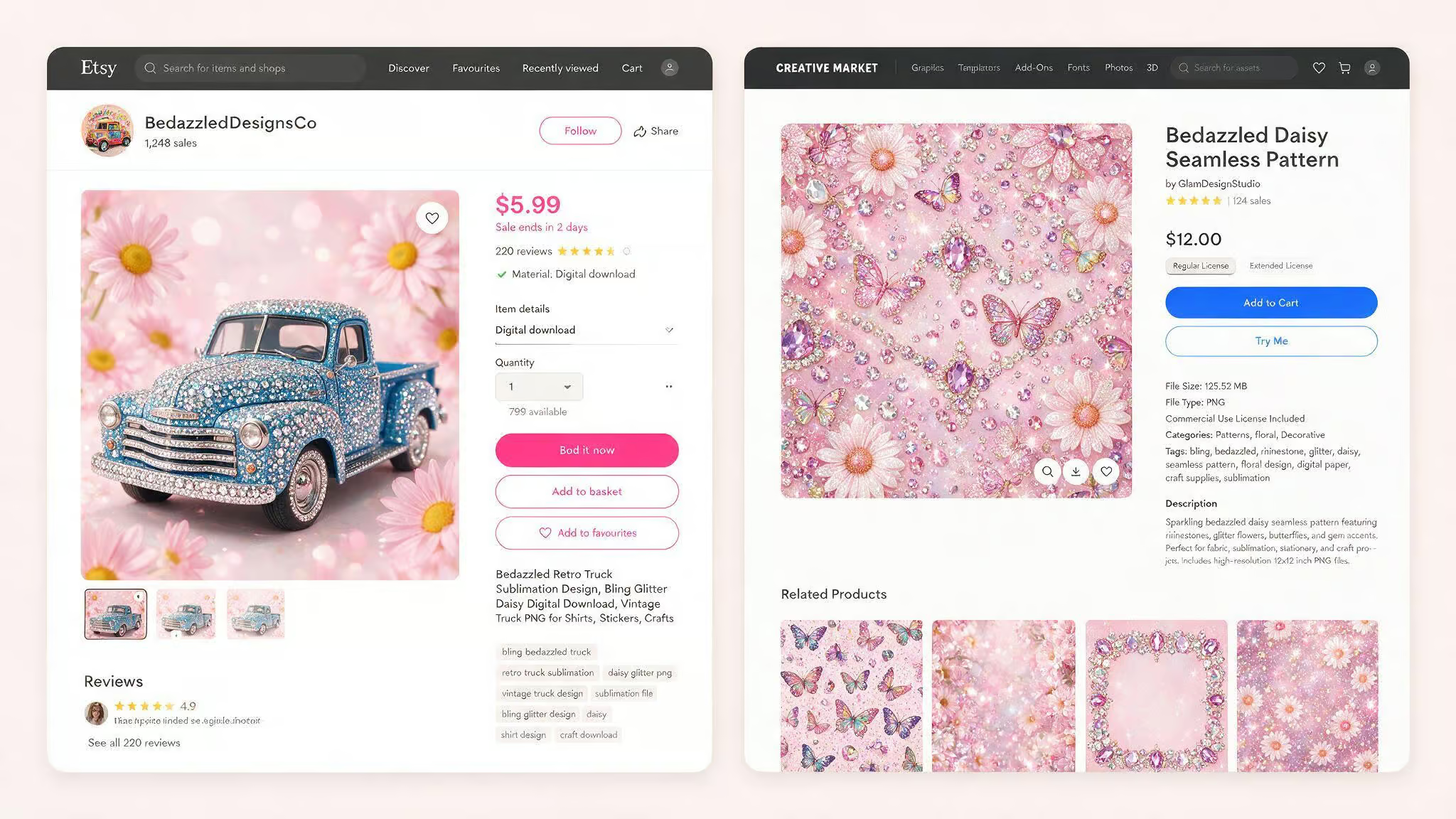
Etsy is the obvious choice. $0.20 listing fee for four months, plus 5% commission. Large audience (2.68 million visits per month for design items), but the competition is stiff. You need good photos, good keywords, and a niche. Best for finished physical items.
Creative Market is what I use for digital patterns. 70% revenue share — you keep 70 cents of every dollar. No exclusivity lock-in, so you can also sell on other platforms. Over 4 million assets on the site, and visitors spend about 8 minutes browsing. Great for selling bedazzled design patterns (someone else can apply them).
Zazzle takes 5% commission. It’s print-on-demand, so you upload your design and they handle production and shipping. No inventory, no upfront cost. Good for designs you don’t want to physically produce — like a pattern that gets printed on a mug or a shirt.
Society6 is free to join, or $12.99/month for an upgraded account. Also print-on-demand.
Prodigi is a Fine Art Trade Guild printer. You set your own prices, they handle production. They claim 100% accurate color reproduction, which matters if you’re selling art prints of your bedazzled designs.
INPRNT is a curated gallery. Artists vote on submissions before they go live. It’s harder to get into, but that also means less competition.
Your own website avoids fees and the risk of plagiarism (which can be rampant on Etsy). But you’re responsible for driving traffic. Worth it once you have a following.
The decision tree: physical items → Etsy or local markets. Digital patterns → Creative Market (better margins). Print-on-demand → Zazzle or Society6. And the counterintuitive angle is that digital patterns can be more profitable per hour than physical items — you make it once, sell it forever.
Finding Your Profitable Niche
The “sell everything to everyone” trap is real. You end up with a shop that looks like a craft fair exploded, and nobody knows what you’re known for. Pick one niche and own it.
Here are some niches that work:
- Fan merchandise: The Harry Styles sunglasses example from Zoe is a real thing. A single fandom item can generate huge engagement. Think concert gear, holiday gifts.
- Pet accessories: Collars, leads, bowls. Growing market, low competition. Make sure stones are secure.
- Festival gear: Wellies, sliders, handbags. Seasonal but high volume. Prep in spring. Google Trends data shows searches for ‘bedazzled Crocs’ spike 300% in April as festival season approaches.
- Bridal and formal: Crystal buttons, champagne flutes, perfume bottles. Higher price tolerance.
- Office and cubicle: Staplers, calculators, pen holders. Unique desk decor, little competition.
- Kids: Jelly shoes, school crafts. Price-sensitive but high volume.
Test demand with 5 to 10 items in your chosen niche before going all-in. If they sell, scale up. If they don’t, try a different niche.
Common Beginner Pitfalls and How to Avoid Them
Here are a few traps to watch for:
- Wrong glue for the surface. That leads to stones falling off, returns, and negative reviews. Always match the adhesive to the material.
- Buying cheap stones without foil backing. They’ll look dull and fall off faster. Invest in stones with good foil backing — it’s worth the extra few cents.
- Underpricing because you forgot fees and labor. You’re not selling materials — you’re selling time and skill. Do the math before you list.
- Over-investing in Swarovski before testing demand. Start with Luna, validate the product, then upgrade.
- Neglecting photos and packaging. Your bedazzled item might be gorgeous, but if the photo is blurry and the packaging is a Ziploc bag, nobody will pay premium.
Scaling from Hobby to Business
Here’s the path to scale:
- Start with scatter effect and rhinestone sheets for low volume. Make 5 to 10 items, test the market.
- Graduate to rhinestone transfers for batch production. You can apply a design in seconds instead of hours.
- Offer custom design services. People will pay you to create a one-of-a-kind piece for a special occasion.
- Sell digital bedazzled patterns on Creative Market. Passive income — you make the pattern once, and it sells while you sleep.
- Use print-on-demand (Zazzle, Society6) to expand without inventory. No risk, no storage.
The fastest path? Sell finished items AND license designs as patterns. Two revenue streams from the same creative work.
Your First Profitable Bedazzled Product
Pick one item from the list — bedazzled sliders, and make five pairs. Buy one pack of Luna stones, a tube of E6000+, and a pair of cheap sliders from a craft store. Material cost: about $2 per pair. Labor: 20 minutes. Retail: $15 to $20.
Make them. List them on Etsy or Facebook Marketplace. See what happens.
People Also Ask
What crafts are most profitable to sell?
Bedazzled items with a high perceived value and low material cost are the most profitable — think greeting card sets ($12–$18 for a few cents in materials) or crystal keychains ($8–$12 using leftover stones). The real money comes from digital patterns sold on platforms like Creative Market, where you keep 70% revenue and make the design once.
What can I make and sell with beads?
You can make and sell bedazzled sliders, pet collars, novelty phone cases, crystal buttons for bridal wear, and rhinestone transfer sheets that customers apply themselves. The smartest approach is to start with scatter-effect items using budget stones to test demand, then upgrade to premium stones for higher-priced custom orders.
What glue should I use for bedazzling Crocs so the rhinestones don’t fall off?
Use E6000+ — it’s flexible and waterproof, which is exactly what rubber and silicone surfaces need. Gem Tac works great for rigid surfaces like paper and plastic, but it won’t hold up on Crocs or rain boots that bend and get wet.
How much money can you make bedazzling items to sell?
Profit depends on your pricing formula: (materials + labor + platform fees) × 2 to 4 equals your retail price. A pair of bedazzled sliders costs about $2.25 in materials and $5 in labor, so selling at $15–$20 gives a healthy 1.8x to 2.4x markup. The real profit scales when you move to digital patterns or rhinestone transfers that take seconds to apply instead of hours.
Is Etsy or Creative Market better for selling bedazzled items?
Etsy is best for selling finished physical items — it charges $0.20 per listing plus 5% commission and has a huge audience, but competition is fierce. Creative Market is better for digital bedazzled patterns because you keep 70% of every sale with no exclusivity lock-in, meaning you can sell the same patterns elsewhere too.