
A side table is a small table placed beside seating so the things you’re actually using, your tea, your book, the remote, your phone, sit within arm’s reach. That’s the whole job, whether you’re shopping for side tables in Perth or anywhere else with a couch and a Tuesday night. Everything else about choosing one flows from how well it does that job in your room.
Key Takeaways
A side table’s height should sit roughly level with your sofa or chair’s arm, so you can grab a drink without leaning or stretching.
The three names (side table, end table, nightstand) describe where the table usually sits, not official categories, so you can shop across all of them.
Shape is a circulation decision: round edges for walkways people cross constantly, rectangular for the narrow gap beside the couch.
Storage drawers are worth paying for only if you’ll actually use them to corral remotes and glasses.
Table of Contents
The small pieces run the room
Here’s something I didn’t figure out until years into homeownership: the lounge suite gets all the attention, but it isn’t what makes a living room work. The small stuff is. Where the drink lands, where the book sits, whether the lamp is close enough to read by, whether anyone hip-checks a corner on the way to the kitchen. Those details decide how the room actually functions on a Tuesday night.
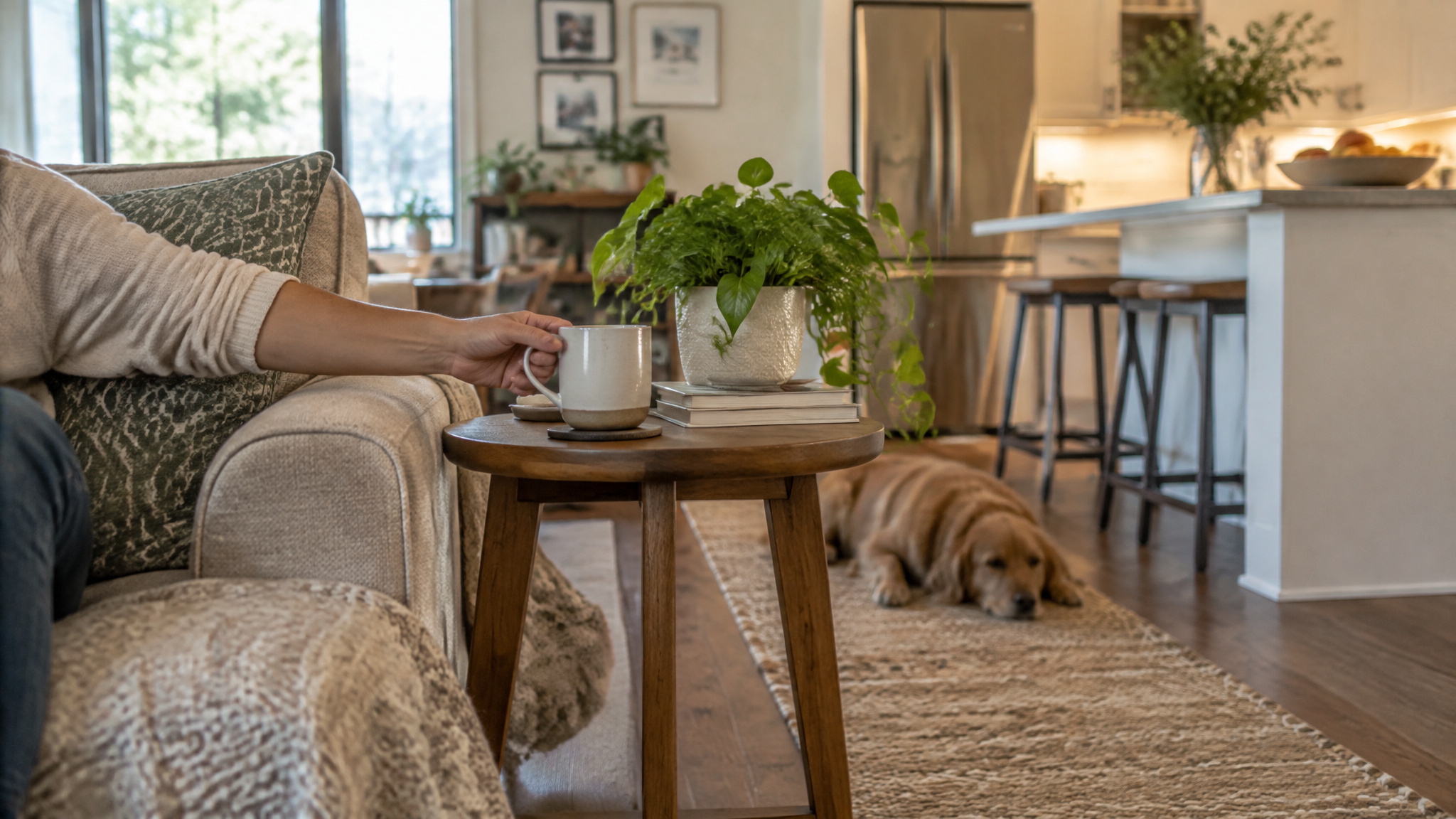
I had a moment of clarity about this one evening. Everyone was home, everyone home, and I realized I’d been balancing my mug on the couch arm for the third night in a row, which is a system that works beautifully until it doesn’t. The remote had migrated somewhere between the cushions and the floor, a location we treat as a lost-and-found bin. And the corner between the couch and the bookshelf had become a place where nothing happened, ever.
Not a disaster. Just a room that wasn’t quite doing its job.
That’s the thing about side tables. They’re not decoration with a pulse. They’re the difference between a room that looks finished and a room that works, and the second one matters more. Choosing one is less about matching your decor and more about auditing how your household actually moves: who sits where, what they’re holding, and where things currently go to get lost. Once you look at it that way, the wall of nearly identical small tables online starts sorting itself into a much shorter list.
Side table vs. end table vs. nightstand: the labels are conventions, not laws
A side table is a small surface next to where you sit. An end table is, in everyday usage, the same idea flanking the arms of a sofa. A nightstand is the bedside version, usually a bit taller with storage built in. Nobody enforces these definitions.
There’s no furniture standards board sending violation notices. The names just describe what typically sits where and at what height, which is useful to know, because it means you can shop across all three labels instead of being fenced in by a heading. If the perfect table for your couch is listed as a nightstand, buy the nightstand.
A few adjacent formats are worth knowing by role, not by category: nesting tables tuck together and pull apart when you need extra surfaces, C-tables slide over the arm of a chair or couch so the surface hovers over your lap, and accent or drum tables are round, often solid, and mostly there to hold a lamp or fill a spot.
| Table | Typically beside a sofa? | Usually arm height or lower? | Often has storage? |
|---|---|---|---|
| Side table | Yes | Yes (roughly arm height) | Partial (some models) |
| End table | Yes (flanking the arms) | Yes | Partial (some models) |
| Nightstand | No (bedside by convention) | Partial (often slightly taller) | Yes (drawer or shelf, usually) |
Trust function over labeling. The table that works is the table that works.
Height and placement: the two things that actually matter
Get the height right and everything about the table gets easier. The rule of thumb is friendly, not fussy: aim for the tabletop sitting roughly level with the arm of your sofa or chair. That’s the height where your hand naturally rests, which means you can grab your drink or your book without the awkward lean, the mid-relax stretch, or the full sit-up that defeats the purpose of relaxing in the first place. A table considerably higher or lower than arm height is less convenient to use, because your drink and book sit out of easy reach, full stop. A pretty table at the wrong height still fails.
Quick test: Sit in your usual spot and let your arm relax — the tabletop should land about where your hand does.
The second thing is walking room. Before you fall in love with a table, measure the spot beside the couch, and then leave enough space for people to actually move through the room without bumping into corners or blocking the path. You know the room I mean: everything technically fits, the layout looks fine in photos, and yet every trip past the couch involves some kind of negotiation with a table leg. That’s the failure mode. A table that blocks you fails at its one job, no matter how good it looks.
Material and finish: complement, don’t clone
Material choice is equal parts looks and maintenance load, meaning how much wiping-up you’re signing up for. Take them one at a time.
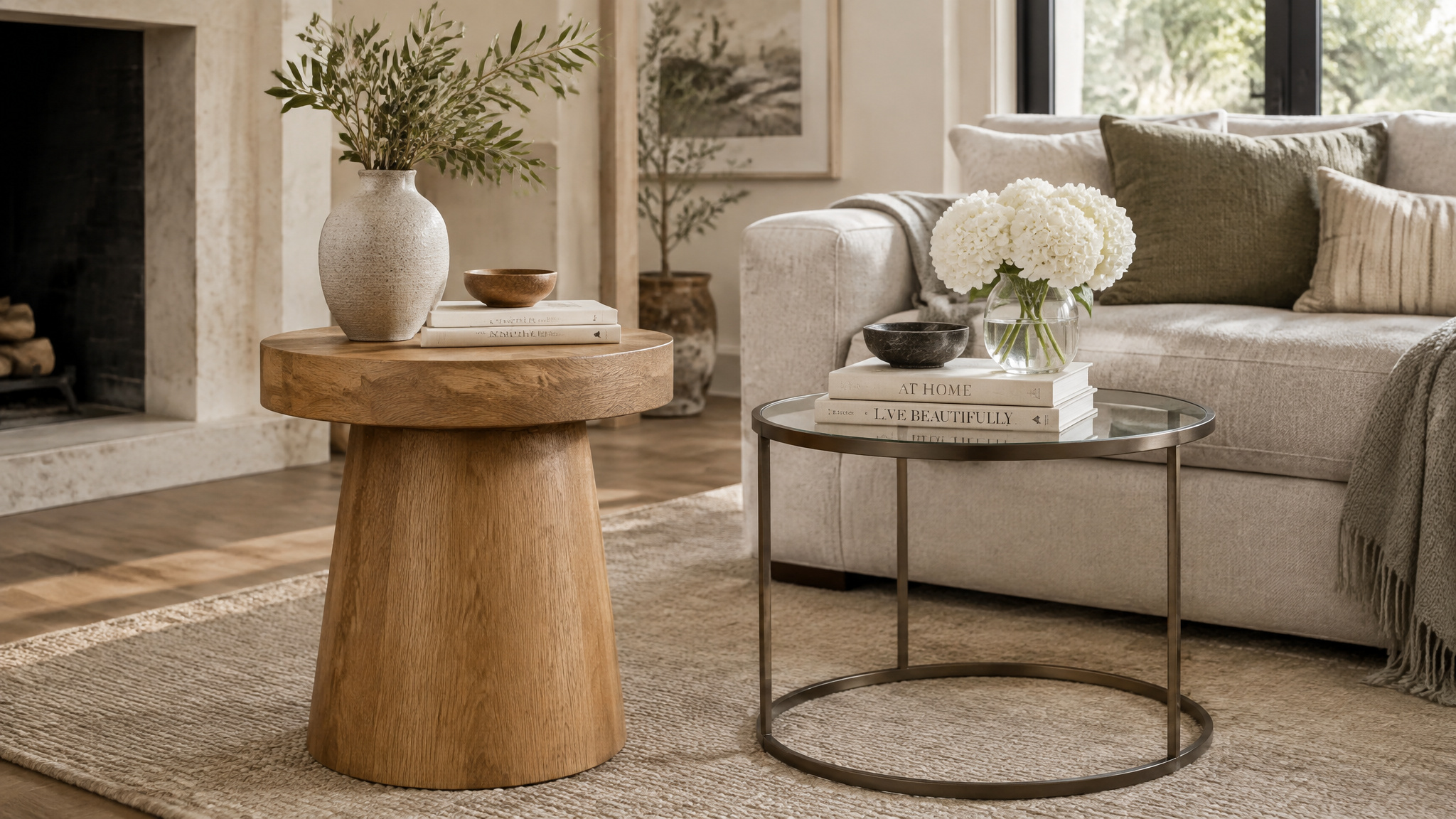
Timber reads relaxed and warm. It’s forgiving in a family room, it doesn’t announce every fingerprint, and it tends to play nicely with the other big pieces already in the room. Metal and glass read more contemporary, sharper-edged visually and, in glass’s case, honestly, practically too: glass shows everything. Every smudge, every ring, every crumb. If that sounds like a chore you’ll resent by week two, believe yourself.
Then there are engineered materials, which is the catch-all term for board-based surfaces, the kind made from pressed wood products with a finish on top. In plain English: they’re the budget-friendly, often good-looking middle ground, and they clean up easily, though they’re less forgiving of standing water and rough treatment than solid timber.
The guiding principle either way: complement the room without over-matching it. Look at what’s already there, your furniture, your floor, your colors, and pick a finish that plays nicely with the big pieces. Learning how to place furniture in a living room helps, too, since arrangement and finish choices work together. You don’t need a matching set. A room where everything matches perfectly starts to feel like a showroom, and nobody relaxes in a showroom.
Is storage worth it?
Yes, if your household has the specific problem storage solves, and you’ll know instantly whether yours does.
The case for it: storage versions, with a drawer, a shelf, or a small cupboard, give remotes, glasses, magazines, and charging cables one findable home instead of letting them scatter across cushions and migrate around the room. In a house with small hands constantly relocating things, that’s not a nice-to-have. It’s the difference between “where’s the remote” being a thirty-second question and a fifteen-minute archaeological dig. Open shelves suit books or a basket of odds and ends if you’d rather see what’s there than hide it. And there’s a double win: the stuff is findable, and the seating area looks less chaotic, not magazine-photo tidy, but real-life tidy.
The honest counterweight: storage features add real cost beyond the sticker price, in money and sometimes in bulk, since drawers take up room inside the table. So treat it like any feature upgrade: pay for it only if you’ll actually use it. If your remotes already live in a basket and you like it that way, a clean simple top might serve you better. You know your habits better than any product listing does.
Shape is a circulation decision, not just a style one
This is the part most shopping guides skip, and it’s the part that explains why some tables never work no matter where you put them.
Round tables belong in walkways and high-traffic paths. If people pass beside your couch constantly, on the way to the kitchen, the hallway, wherever the kids are, a round table means nothing sharp at shin height. No corners to catch a hip on, no edges to bruise anyone. That’s not a styling preference; it’s a daily-comfort decision.
Rectangular tables belong in tight gaps. That narrow slot between the couch and the wall, or beside the armchair where a curve would waste usable surface, is rectangular territory. A rectangle fills the gap edge to edge, so you get the most top for the space you have.
Match the shape to where the table lives, not to what looked good in the photo. If your current table has corners in a spot everyone walks through, that’s probably why it never felt right, and no amount of rearranging the room will fix a shape problem.
When a side table isn’t the right tool
Some spots want something else, and that’s fine. Nesting tables pull out when company comes and tuck away when they leave. A C-table slides over a chair arm for laptop-and-snack situations. An ottoman or a simple stool can hold a tray where a table would crowd the room,.
A word on trends
If you’re wondering whether one look is “in” right now, the honest answer is that the question answers itself through the same material logic above. Relaxed timbers lean toward the warmer, softer end of what people are drawn to for family rooms; metal and glass lean toward the crisper, more contemporary end. Neither goes out of usefulness, because both are tied to how a room gets used, not to a calendar. Pick the finish that works with the room you already have and you’ll never have to chase it.
The close
Measure your traffic patterns before your Pinterest board gets a vote. Check the height against your couch arm. Be honest about whether you’ll use that drawer. And forgive the current imperfect arrangement, every living room has one, and most of them are one small table away from working better.
Because that’s the real goal here. Not a room that photographs well. A room that works on ordinary Tuesday nights, when the tea needs somewhere to land and the book needs somewhere to sit and nobody wants to get up for either. The right side table is a small purchase that pays out every single evening. That’s a better deal than most of what’s in the room.
Frequently Asked Questions
Are side tables with storage worth it for keeping remotes and chargers organised?
Yes, if your household actually has the problem storage solves. A drawer or shelf gives remotes, glasses, and charging cables one findable home and makes the seating area feel genuinely tidier. But storage adds cost and bulk, so if your remotes already live in a basket and you like it that way, a clean simple top may serve you better.
What material should a side table be made of — timber, metal, or glass?
Timber reads warm and relaxed, forgives fingerprints, and plays nicely with other big pieces, which makes it the low-maintenance family-room pick. Metal and glass read more contemporary, but glass shows every smudge, ring, and crumb — a chore you’ll resent by week two if that bothers you. Engineered board-based surfaces are the budget-friendly middle ground: good-looking and easy to clean, but less forgiving of standing water and rough treatment.
How much space should I leave around a side table so it doesn’t block walkways?
Measure the spot beside the couch before you buy, and make sure people can still move through the room without bumping corners or negotiating table legs. The exact clearance depends on your layout, but the test is simple: if every trip past the couch involves sidestepping the table, it’s blocking the path and failing at its one job.
Which side tables work best in a small living room?
In small rooms, shape and footprint matter more than style: a rectangular table fills a narrow gap beside the couch efficiently, while nesting tables give you extra surfaces when company comes and tuck away when they leave. A C-table can slide over a chair arm, and an ottoman or stool with a tray works where a full table would crowd the room. Budget-friendly options exist in every one of these formats.
How can a side table make my living room more functional?
It gives your drink, book, remote, and phone a landing spot within arm’s reach, which is the difference between a room that looks finished and a room that actually works. The right table in the right spot also cuts down on things migrating into couch cushions and around the room. Get the height level with the sofa arm and the shape matched to the traffic path, and it pays out every single evening.