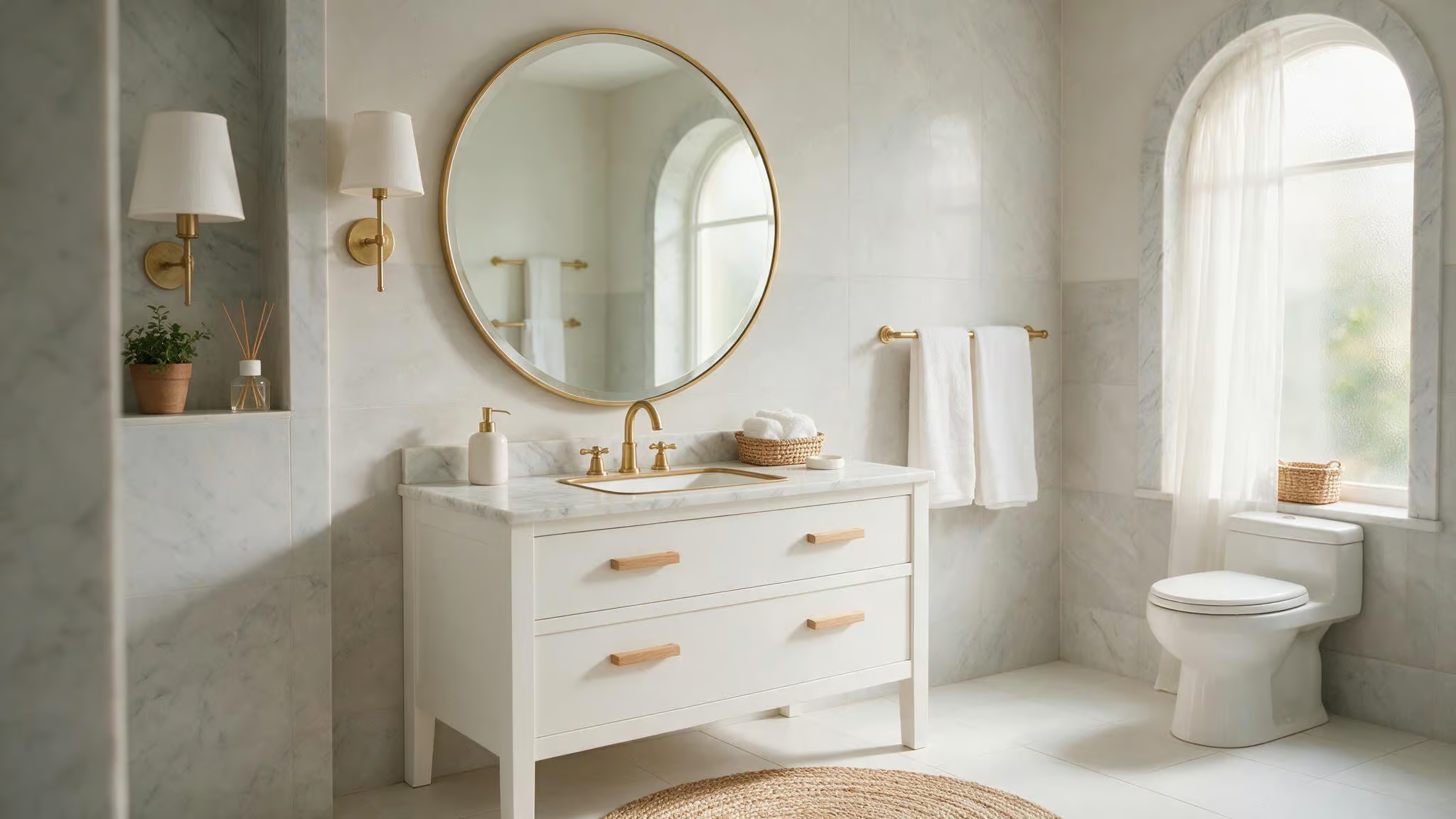
The short answer is yes — for a specific kind of remodel.
The 2026 national average bathroom remodel cost is $16,500. So $10k sits below average, but that doesn’t mean it’s impossible. It just means you’re in the right tier — the budget refresh tier, which runs $5,000 to $10,000. You’re at the upper end of that range, which is a good place to be.
Key Takeaways
With $10,000, you’re at the upper end of the budget refresh tier ($5,000–$10,000), not the mid-range tier ($16,000–$28,000) — so you can get a cosmetic-to-light update with new vanity, toilet, fixtures, flooring, paint, and lighting, as long as you keep the same layout and plumbing.
A $10,000 cosmetic refresh typically recoups $7,000–$8,000 at resale (70–80% ROI), which is actually better than luxury renovations that return only 45–55%.
The biggest cost lever is keeping your existing layout: moving plumbing runs $500–$1,500 per fixture, and relocating a shower valve just 3 feet costs $600–$900 — so avoiding layout changes can save you $3,000–$10,000.
Table of Contents
What $10,000 Actually Buys — A Line-Item Breakdown
Let’s picture a standard 5×8 bathroom — that’s 40 square feet, the size you’d find in most houses built in the last 50 years. For that space, a budget remodel runs $3,200–$4,800. A mid-range one runs $7,200–$11,200. Notice that $10k puts you at the upper end of that mid-range range for a 5×8. That means you can get slightly better finishes than the bare-bones option, as long as you don’t go wild.
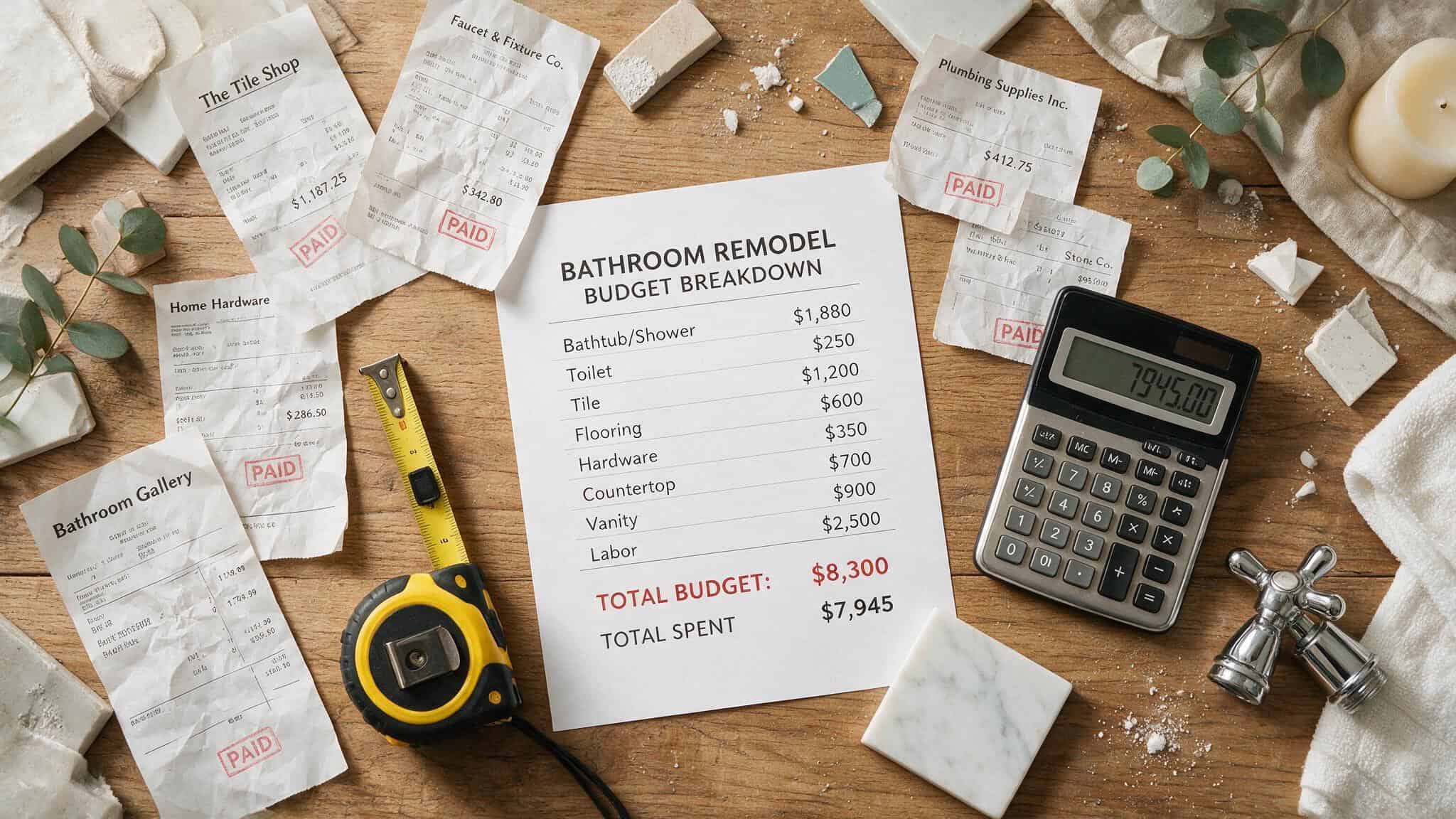
Here’s how the money shakes out.
Vanity, Toilet, and Fixtures
The vanity is probably the biggest single purchase you’ll make. A four-foot double vanity runs $525 to $2,940, and installation adds another $105 to $630.
The toilet is simpler. You can get a standard toilet for $105 to $630, plus $105 to $630 for installation. Or you can drop $1,500 to $5,000 on a smart toilet. People spend a third of their entire budget on a toilet that heats the seat and plays music.
Vanity lights run $32 to $630 — but that doesn’t include installation or a mirror, so budget for those separately.
Flooring and Shower
Here’s where you make the biggest tradeoff in the whole project. You can choose floor tile ($525 to $3,673) or vinyl plank ($160 to $840). The difference is about $700 to $2,800.
The shower decision is the single biggest lever in your budget. A prefab shower unit, installed, runs $800 to $2,500. A custom tile shower runs $3,500 to $15,000 installed. That’s a huge gap.
If you’re trying to stay at $10k, a prefab shower is your friend. There’s a smart middle ground too: a custom shower with a prefabricated base can be less expensive than a labor-intensive tile shower, as interior designer Leah Tuttleman puts it.
The Budget-Timeline Link — Why $10k Takes Longer
A $10,000 budget usually means you’re doing some or all of the work yourself. And that changes the timeline dramatically.
A professional project typically takes 2 to 4 weeks. A DIY project often stretches to 6 to 10 weeks. That’s two to three months of living with a construction zone. The labor shortage adds another 1 to 2 weeks on top of pro projects, so even if you hire someone, it’s not fast.
The apparent savings look like 40–50%, but once you account for everything, the true savings shrink to 20–30%. Here’s where the money goes:
- DIY permits: $200–$1,200
- Tool rental for a 2–3 week project: $500–$1,500
- DIYers waste 15–20% more material than pros
- Potential do-over costs if you mess up: $500–$2,000
So you can save money. But it’s not the huge windfall it seems like. And it takes longer.
Where Your $10,000 Goes — The Expensive Parts
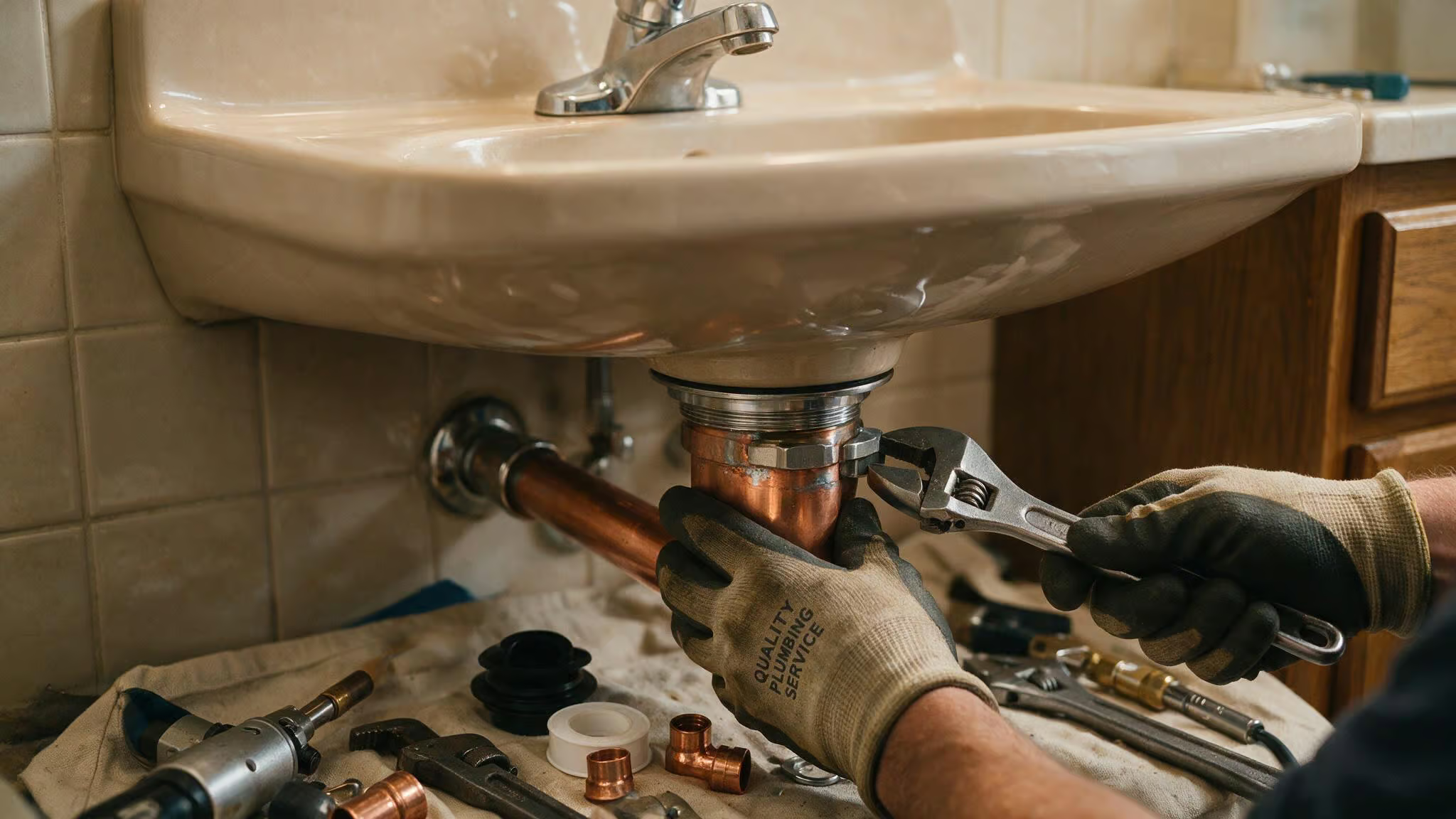
Plumbing labor is your biggest line item. Licensed plumbers charge $85 to $175 per hour, up 8–10% from last year. A full plumbing job for a bathroom runs $3,000 to $8,000. That’s almost your entire $10k budget right there if you’re moving things around.
Tile installation labor is the second biggest. Tile installers charge $12 to $22 per square foot, up from $10 to $18 in 2024. That adds up to $2,500 to $6,000 for a bathroom. If you’re tiling the shower and the floor, you’re looking at real money.
Electrical labor is smaller but still significant: $800 to $2,500, with electricians charging $60 to $145 per hour, up 6–8%.
General contractor fees add 15–20% of the total project cost. If you’re hiring a GC, that’s $1,500 to $2,000 on a $10k project.
The biggest cost lever is keeping your existing layout. Doing that saves you $3,000 to $10,000 — that’s the single biggest thing you can do to stay under $10k.
Hidden Costs That Will Blow Your Budget
I’ve seen people decide to “just move the toilet a little” without realizing that single decision can eat 5–15% of their entire $10k budget—which makes the question of can a bathroom be remodeled in a week depend entirely on avoiding such scope creep.
Moving plumbing costs $500 to $1,500 per fixture. Relocating a shower valve just 3 feet? That’s $600 to $900. Moving a toilet to a new wall? $1,000 to $1,500. On a $10k budget, that’s a big deal.
Permits run $200 to $1,200. You might not think about them, but they’re required for most renovations.
Code compliance — new 2026 requirements for ventilation and waterproofing, adds $500 to $1,500.
High-rise condo fees are a whole separate world. HOA approval fees: $200 to $1,000. Building access fees: $50 to $200 per day, which adds $1,000 to $3,000 to your total. And if you’re in NYC, costs are 25–40% higher than suburban projects.
Demolition itself costs $390 to $2,100, plus a dumpster rental at $160 to $630 per day. You could also donate reusable items to Habitat for Humanity — saves you disposal fees and helps someone else.
Is $10,000 a Smart Investment?
A $10,000 cosmetic refresh recoups $7,000 to $8,000 at resale — that’s 70–80% ROI. Mid-range remodels deliver 65–80% ROI. Luxury renovations that cost $40,000 or more? They return only 45–55% ROI.
The sweet spot for pre-sale remodels is $15,000 to $25,000. So $10k is below that, but still worthwhile. A $25k remodel adds about $16k to $20k to your home’s value — you don’t get all of it back, but you get most of it.
And keep a single-room remodel within 20–30% of your home’s value. If your house is worth $200,000, a $10k bathroom remodel is right in the sweet spot, but before you dive in, how long does a bathroom remodel take? A realistic timeline depends on the scope, size, and potential delays.
Smart Tradeoffs to Stretch Your $10,000
The shower decision is the biggest one. A prefab shower costs $800 to $2,500 installed and lasts 10–15 years. A custom tile shower costs $3,500 to $15,000 installed and lasts 20–30+ years. Over 20 years, the prefab costs about $3,500 total, while the custom tile runs $5,000 to $6,500. So the custom option is actually cheaper per year — but only if you’re staying in the house long enough to benefit.
Flooring: Vinyl plank ($160–$840) vs. floor tile ($525–$3,673). Interior designer Satsha Lopez-Jaimes suggests opting for cost-effective flooring like vinyl or laminate that mimics hardwood or stone — they’re durable and water-resistant.
Toilet: Standard ($105–$630) vs. smart ($1,500–$5,000). A standard toilet with water-saving features is a better use of your $10k. Smart toilets use just 1.28 gallons per flush (GPF), compared to older models that use 3.5–7 GPF, so they save water over time. Construction expert Quinn Babcock recommends replacing an older toilet with a newer, water-saving model — it’s one of the easiest upgrades.
Water-saving fixtures: WaterSense showerheads save 2,700 gallons per person per year, with a payback period of 6 months to 2 years. High-efficiency toilets save 16,000–20,000 gallons per year, with a payback of 2–5 years.
Tile on the walls: Designer Artem Kropovinsky suggests choosing basic white or light-colored subway tiles — they’re typically less expensive and look great. Make a statement with eye-catching floor tile instead.
Regrouting: Contractor Matt DiBara points out that regrouting and resealing tiles can be cost-effective instead of replacing them.
Financing and Grants That Can Help
If $10k isn’t quite enough, there are ways to supplement it.
Personal loans: Fastest approval (24–72 hours), but rates range from 7% to 24% APR. Convenient but expensive.
HELOCs: Better rates (6–9% APR), but take 2–6 weeks to approve.
Contractor financing (like GreenSky or Synchrony): Promotional 0% APR for 12–24 months, approval in 5–15 minutes.
Utility rebates: Many utility companies offer $50 to $150 for water-efficient fixtures. Check with yours.
Grants for accessibility modifications: If you need ADA modifications, there are specific programs. California’s CalHFA offers up to $10,000 for accessibility modifications. Florida’s SHIP program provides grants up to $7,500 for elderly homeowners. VA HISA grants provide up to $6,800 for service-connected disability modifications. Canada’s HATC offers a 15% non-refundable credit on up to CAD $20,000.
Medical expense deduction: The IRS lets you deduct medical expenses that exceed 7.5% of your adjusted gross income — so ADA modifications might qualify.
Market Reality Check
2026 costs are 4–6% higher than 2025. Material costs are stabilizing (2–3% increases), but labor is still climbing.
Material trends:
- Porcelain tile: stable pricing — safe bet
- Fixtures: up 2–3%
- Vanities and cabinets: up 3–4%
- Copper plumbing: up 2–4%
- Natural stone: volatile, 3–6% fluctuations
- Brass and bronze: up 3–5%
Tariffs are hitting hard: There’s a 50% tariff on imported bathroom vanities and cabinets, a universal 10% tariff on all global imports, and 24–46% duties on specific Asian materials. That’s driving up costs for anything made overseas.
Location matters a lot. If you’re in a high-cost area like New York City or California, $10k may only cover a half-bath refresh. A half-bathroom remodel runs $5,390 to $8,385 this year. In Canada, remodels cost 15–25% more than in the US, with GST/HST adding 5–15% and labor running 20–30% higher.
The labor shortage extends timelines by 1–2 weeks. If you’re hiring, expect to wait.
Five Mistakes That Will Blow Your $10,000 Budget
1. Over-allocating to a custom tile shower. A custom tile shower can consume 35–100%+ of a $10k budget. If you’re not careful, you’ll have a beautiful shower and nothing else. The prefab or prefab-base compromise is your friend.
2. Ignoring plumbing move costs when changing layout. Moving a toilet to a new wall costs $1,000–$1,500. Moving a shower valve 3 feet costs $600–$900.
That’s real money. Keep the layout.
3. Assuming DIY saves 40–50% without accounting for the extras. Tool rental ($500–$1,500), permits ($200–$1,200), and do-over costs ($500–$2,000) eat into that. True savings are 20–30%.
4. Choosing volatile materials like natural stone without a contingency budget. Natural stone prices fluctuate 3–6%. If you want it, budget for the high end.
5. Not checking for utility rebates. That $50–$150 rebate on a water-efficient fixture might not seem like much, but it adds up.
So — is $10,000 enough for a bathroom remodel in 2026? Yes, if you keep the same layout, make smart choices on the shower and flooring, and are realistic about whether you’re doing the work yourself or hiring out. You’ll end up with a bathroom that feels fresh and modern, even if it’s not a full gut job.
Frequently Asked Questions
What does a $10,000 bathroom remodel look like?
Think new vanity, toilet, faucets, lighting, paint, and flooring — but with a prefab shower instead of custom tile, and vinyl plank instead of floor tile. You’re getting a fresh, modern look without moving any plumbing or walls.
What is a realistic budget for a bathroom remodel?
The national average is $16,500, but budgets range from $5,000–$10,000 for a budget refresh up to $40,000+ for a luxury renovation. A $10,000 budget puts you at the upper end of the budget refresh tier, which is a sweet spot for a cosmetic update with decent finishes.
What is the most expensive part of a bathroom remodel?
Plumbing labor is the biggest line item at $3,000–$8,000 for a full job, followed by tile installation at $2,500–$6,000. The single biggest cost lever is keeping your existing layout — moving plumbing can cost $3,000–$10,000 extra.
How much does it cost to move plumbing in a bathroom remodel?
Moving plumbing runs $500–$1,500 per fixture. Relocating a shower valve just 3 feet costs $600–$900, and moving a toilet to a new wall runs $1,000–$1,500. On a $10k budget, those costs can eat 5–15% of your total.
How long does a $10,000 bathroom remodel take?
A professional project takes 2–4 weeks, but a DIY project often stretches to 6–10 weeks. The labor shortage adds another 1–2 weeks on top of pro projects, so expect delays even if you hire someone.