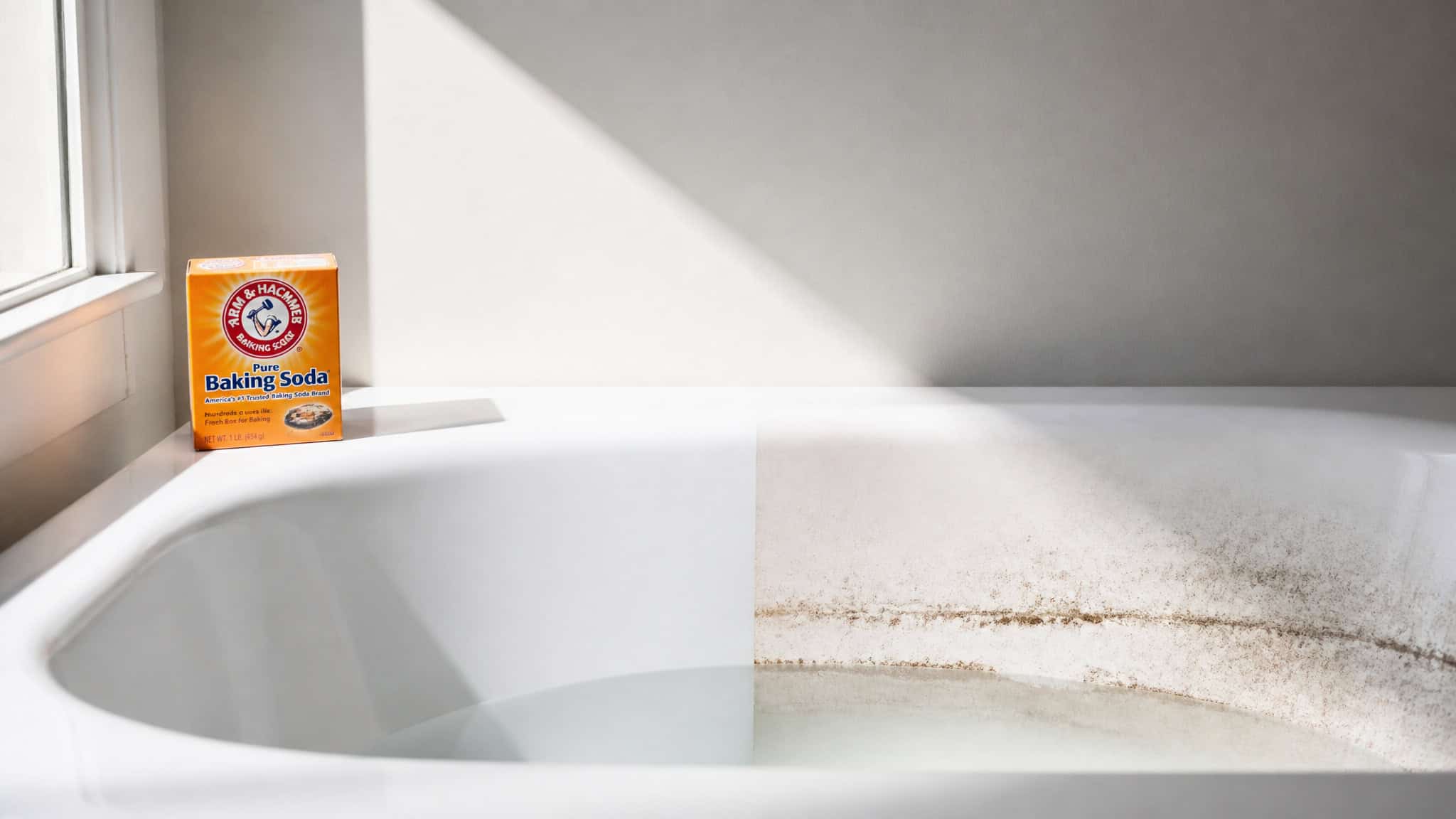
There’s a specific kind of Saturday, nobody’s bleeding, nobody’s asking for snacks, nobody’s crying, when you look at the bathtub and realize the ring around it has become a personal project. You’ve been meaning to handle it. And the cheapest ally you’ve got is probably sitting in the back of your pantry right now: baking soda.
It’s the old standby for a reason. But there’s a right way to use it, a wrong way, and one particular internet “hack” I’m begging you to stop believing. I’ve made every mistake you’re about to make, so let me save you the trip.
Key Takeaways
Baking soda (pH 8-9) is a mild abrasive that safely scours soap scum and everyday grime off fiberglass, porcelain, acrylic, ceramic, cast iron, cultured marble, and copper, but skip it on stone resin, where it leaves a film and damages the finish.
The viral baking soda + vinegar fizz doesn’t clean anything: mixing them neutralizes both into water, carbon dioxide, and sodium acetate, basically salt water. Use soda to scrub and vinegar for hard-water stains, separately.
Ashley Kidder of Dashing Maids recommends wiping down after each use and cleaning weekly (every 3-5 days if the tub gets daily use), yet an Apartment Guide survey found 38% of Americans clean their bathtub less than once a month.
Table of Contents
What is the best bathtub cleaner, actually?
Honest answer: it depends on your tub and your stain. Baking soda is the clear winner on cost and safety. There’s a reason it’s the favorite, it’s affordable, effective, and safe for most tubs.
Baking soda is alkaline (pH 8-9) and mildly abrasive. It doesn’t dissolve stains the way acids do; it scours them off. That’s why it’s perfect for soap scum, which is basically leftover soap mixed with hard-water minerals. It even reacts with grease to form a soap-like substance, which is how it lifts everyday grime you can’t see.
Safe on: fiberglass, porcelain, acrylic, ceramic, cast iron, cultured marble, copper.
Skip it on: stone resin, it leaves a film and damages the finish. And go easy on wood; light touch, no steel wool.
One catch: acrylic and fiberglass scratch easily, so use a soft sponge and light strokes. Let the soda paste sit a few minutes and do the heavy lifting, elbow grease is how you end up with a scratched-up tub. If you’re not sure what your tub is made of or want the full material-by-material rundown, the complete guide to cleaning every type of bathtub has you covered.
The actual method, step by step
No scrubbing like you’re trying to earn a badge. Here’s the routine I use.
- Clear it out. Take the bottles, the kids’ floating toys, that one rubber duck. Wipe down anything you removed and set it aside so cleaner doesn’t rain on your shampoo.
- Rinse the tub with warm water. You want everything damp, not standing.
- Sprinkle baking soda in an even coat, heaviest where the grime is.
- Add just enough warm water to make a paste. Paste clings. Soup runs down the drain and takes your soda with it.
- Let it sit. 2-3 minutes for everyday grime, 15-30 for the stubborn ring. Don’t let it dry, or you’ll be rinsing for a week.
- Scrub in circles, top to bottom. Walls first, then the basin, then the outside, so the dirty water drips down and you don’t re-dirty what you just cleaned.
- Rinse thoroughly. Twice, honestly. Soda leaves a chalky film if you rush it.
- Dry with a microfiber cloth. This is the step that keeps the ring from coming back.
Tools: a soft sponge, an old toothbrush for the edges, a microfiber cloth for drying. And since we’re talking about back-saving tricksSouthern Living swears by a dedicated toilet brush (a fresh one, never the bathroom one, ever) with a long handle for scrubbing the basin without wrecking your knees. Warm tradition, and your knees will thank you. Just reserve that brush for sturdy tubs, soft acrylic still prefers the sponge.
Field note: Paste sits, then scrubs. Let the soda do the work and your sponge just guides it.
For yellow stains, that classic aged-tub yellow, sprinkle baking soda, then spray with 3% hydrogen peroxide until it’s a damp paste. Let it sit 20-30 minutes, scrub gently, rinse. It works on the yellow that porcelain gets over the years.
Matching the cleaner to the stain
Baking soda is a grease-and-grime machine, but it’s not a miracle worker. Different stains need different pH.
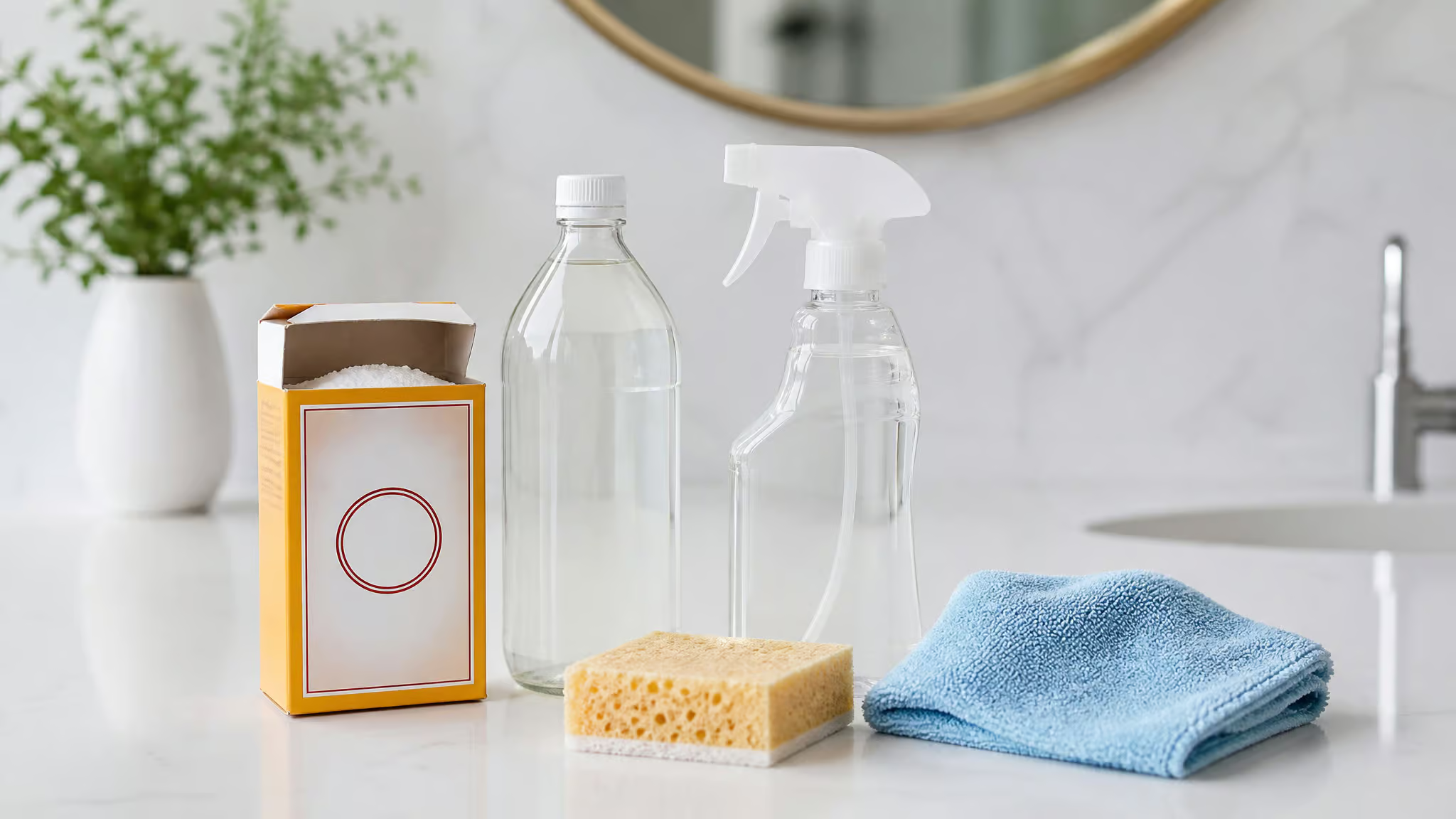
Soap scum and everyday grime: baking soda paste. If it’s really caked on, add a squirt of dish soap, the soap cuts the grease, the soda handles the grinding. Let the paste sit 15-20 minutes first.
Hard-water spots and limescale (those white crusty rings): that’s alkaline scale, so you need an acid, not an abrasive. Vinegar is the move. Mix equal parts white vinegar and warm water in a spray bottle, spray the spots, let it sit 15-30 minutes, then scrub gently and rinse. Vinegar has a pH around 2.4, which is exactly what scale needs.
Just dilute it on porcelain, cast iron, cultured marble, and copper, straight vinegar can hurt those over time. Fiberglass and acrylic handle it fine. Vinegar is safe on fiberglass and acrylic.
Rust stains: soda won’t touch rust. You need oxalic acidBar Keepers Friend (pH 1.5-2.5) is the standard. Make a paste, gentle scrub, rinse. And if you’re getting repeat rust, check whether your tub has metal parts or your water’s high in iron, otherwise you’ll be chasing it every month.
Yellow mineral stains: that’s where citric acid (pH 3-6) helps, or the hydrogen peroxide method above if it’s organic staining.
Quick rule: grease says alkaline, scale says acid, rust says acid-plus. Match the pH and the stain loses.
The myth: baking soda + vinegar
I have to be honest with you. You’ve seen the videos. Sprinkle soda, spray vinegar, watch it fizz, feel productive. It does nothing.
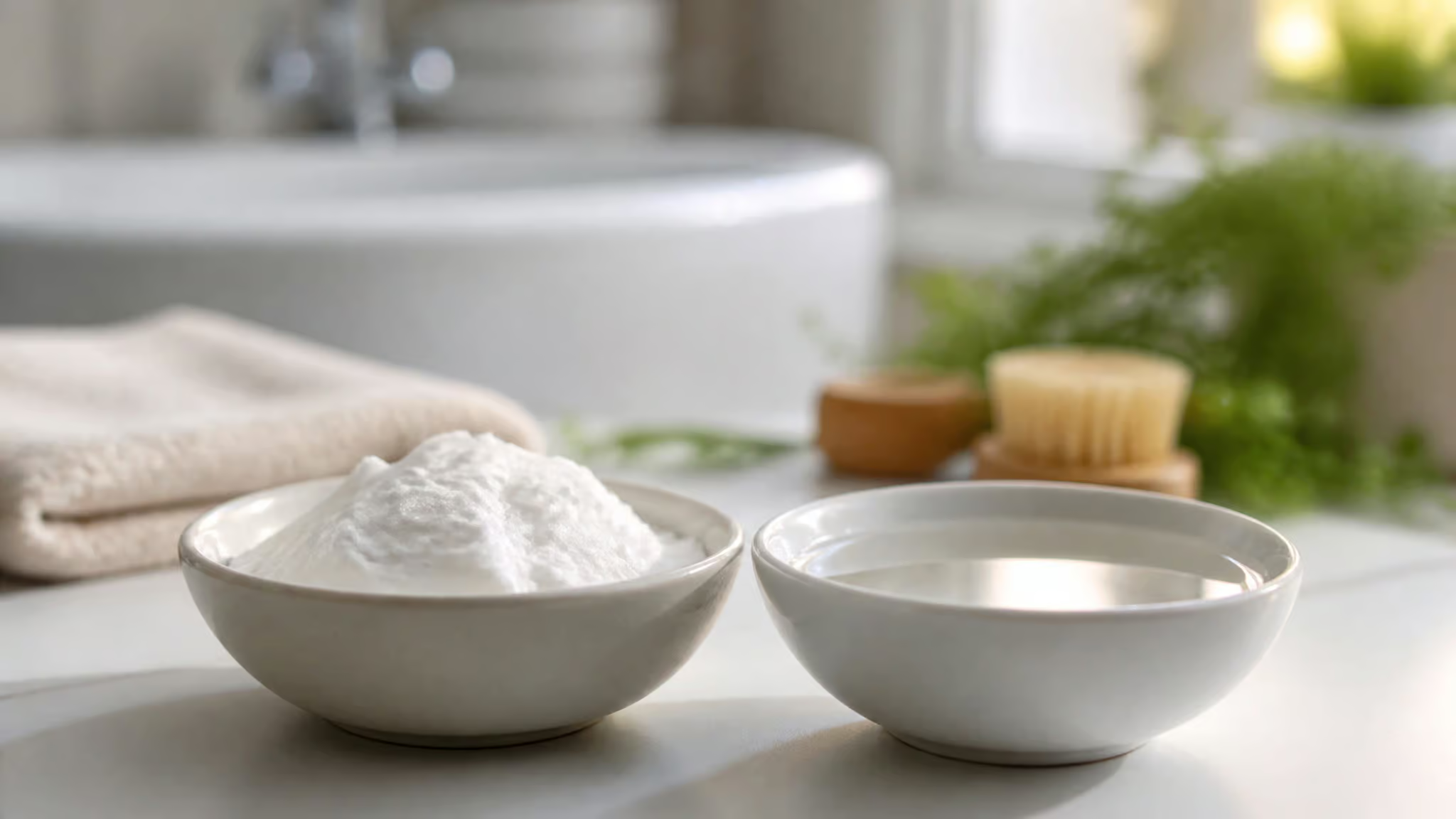
Here’s the chemistry: baking soda is a base (pH 8-9). Vinegar is an acid (pH 2.4). And when you combine them in roughly equal amounts, they cancel each other out, bang, you’re right back at neutral. The reaction produces water, carbon dioxide (that’s the fizz you’re filming), and sodium acetate. Which is basically salt water.
You’ve made salty fizzy water and scrubbed your tub with it. Congrats, you’ve wasted perfectly good soda.
The ironic part: that fizzy reaction does have one legitimate job, the drain. Drop half a cup of soda down, follow with half a cup of vinegar, and let it bubble for a few minutes. The agitation actually dislodges gunk. Then flush with hot water.
That’s the one place the fizz earns its keep. On stains, they cancel each other out, use soda to scrub, vinegar for hard-water spots, and never together on the tub itself.
Baking soda vs. vinegar vs. bleach: the honest hierarchy
Everything is pH. Higher pH (alkaline) cuts grease. Lower pH (acid) dissolves scale. Bleach is… bleach.
Baking soda (pH 8-9): the everyday workhorse. Cheap, safe, mild. Won’t disinfect, won’t touch rust, but it’s the tub equivalent of “let’s just clean up a little.”
Vinegar (pH 2.4): your hard-water, limescale, mildew-adjacent friend. Totally safe to have around kids, the smell fades fast.
Simple Green (pH 8.5-9.5) and Krud Kutter (pH 12.5-13.5): heavy-duty alkaline degreasers when the soda needs backup. Krud Kutter is strong stuff, the higher you go on the pH scale, the more corrosive it gets, so take care.
Bleach (pH 12): the nuclear option, and I mean that. It disinfects and whitens white porcelain, but it’s toxic, the fumes can hurt your eyes, your lungs, your stomach. It eats the coating on acrylic and enamel tubs, turns colored porcelain blotchy, and leaves red streaks if your tub has iron in it. Safe on fiberglass, ceramic, and stone resin.
Cultured marble, diluted only. And never, ever mix it with other cleaners, especially anything containing ammonia, that produces toxic gas. Comet and Ajax are bleach-based but less potent, if you need that in your life. Use bleach as a last resort, ventilate like crazy, and rinse twice.
Red flag: Mixing bleach with ammonia makes toxic gas. Never together, ever.
Safety when you’re using the strong stuff
Baking soda and vinegar are the friendly ones, kids can be in the room, no big deal. Bleach deserves respect. Mixing it with ammonia creates toxic gas, and it can damage your drains over time. If you’re using it:
- Clear the area, bottles, toys, anything that could get splashed.
- Gear up, gloves, glasses (or goggles), long sleeves.
- Open a window, turn on the fan.
- Dilute it, about half a cup (roughly 118 ml) to a gallon of water.
- Never mix with anything. Especially other cleaners. Especially ammonia. Toxic gas, serious burns, hospital trip. Not worth it.
- Rinse the tub thoroughly when you’re done, twice, honestly.
- Keep it emergency-only, not part of your weekly routine.
The parts everyone forgets
Showerhead: if yours unscrews, take it off and soak it in a bowl, about 3 cups of white vinegar with a cup of baking soda added. A minimum of an hour, overnight if it’s really crusted. The fizz agitates the mineral gunk out of the holes. If it won’t unscrew, fill a plastic bag with the mix, rubber-band it over the head, and let it soak overnight.
Drain: half a cup of soda down, half a cup of vinegar after, let it bubble a few minutes, then flush with a pitcher of hot water. This is the one place you want them together, the agitation clears the gunk. Do it monthly and you’ll see fewer slow-drains.
Jets (whirlpool tubs): fill the tub with hot water until the jets are covered. Add 2 tablespoons of dishwashing liquid plus a cup of vinegar. Run the jets for 15 minutes. Drain, refill with plain hot water, run 10 more minutes, rinse. Bleach in the jet lines is an emergency-only move, it can mess with the system.
Grout: make a paste from baking soda and a little lemon juice (the acid helps where soap scum meets scale). Spread it along the grout lines, let it sit 10-15 minutes, then go at it with an old toothbrush and rinse.
Caulk: if it’s just mild mildew, a damp toothbrush dipped in vinegar does the job. But if the caulk is gray, cracked, or peeling, no cleaner will save it, cut it out and put fresh in. Dead caulk is a replacement problem, not a cleaning problem.
How often, and the laziest method that actually works
Here’s the number that matters: Ashley Kidder, founder of Dashing Maids, says clean your tub weekly, or every 3-5 days if it gets daily use. Which, given that an Apartment Guide survey found 38% of Americans clean their bathtub less than once a month, means most of us are behind.
Daily, the move is simple: wipe down after each use, keep a spray bottle of vinegar-water mix near the tub, one quick swipe when you’re done. Ten seconds. If you’ve got tile walls, squeegee them and run the fan. That’s the whole secret for tub-shower combos full instructions for those here.
And here’s the professional secret for the weeks when you don’t have a Saturday in you. Kidder calls it the lazy method, and it’s brilliant: fill the tub with warm water, squirt in a good amount of dish soap, and let it sit overnight. Drain it in the morning and do a quick rinse. The soak loosens the grime so you don’t have to scrub on your knees. That’s it.
That’s the hack. For the five-minute version of the daily routine, this one’s worth keeping handy.
Bottom line: The overnight soak with dish soap loosens grime so you skip the knee work entirely.
And don’t kid yourself about what you’re cleaning. A neglected tub isn’t just ugly, it’s a playground for soap scum, mildew, hard-water deposits, and bacteria. Staph and E. coli can absolutely set up shop in a dirty tub, and that slippery film is body oils, sweat, and dead skin. Neglect also accelerates wear, rust, stains, breakdown of finishes. The tub that gets wiped down lasts longer than the one that gets a heroic battle every three months.
The short version
The tub is always going to need a cleaning at some point. That’s just tubs. What makes it painless:
- Daily: wipe down after each use, vinegar-water spray.
- Weekly: soda paste, soft sponge, let it sit, rinse. Two minutes of actual work.
- Match the cleaner to the stain: grease = soda (add dish soap if it’s bad); scale = vinegar; rust = Bar Keepers Friend; yellow = soda + hydrogen peroxide.
- Never: soda-and-vinegar on stains (they cancel out), soda on stone resin, vinegar on stone resin, bleach on acrylic or enamel, and absolutely never mix bleach with anything.
- Monthly: drain (soda + vinegar + hot water), soak the showerhead, run the jets if you have them, check the caulk.
And when you genuinely don’t have it in you, the overnight soak. Fill it, soap it, walk away. Future-you gets a clean tub without the knee work.
The ring will come back. That’s Saturdays. But now you’ve got the cheap fix, the honest chemistry, and the lazy method in your back pocket. The tub’s not going to win this one.
Frequently Asked Questions
What should you not clean with baking soda?
Skip baking soda on stone resin surfaces, as it can leave a film and damage the finish. Also avoid it on wood if you’re scrubbing hard, since it’s abrasive. For rust stains, baking soda won’t do anything—you need an acid like Bar Keepers Friend instead.
Why does baking soda and vinegar not clean bathtub stains?
Baking soda is a base (pH 8-9) and vinegar is an acid (pH 2.4). When mixed in roughly equal amounts, they neutralize each other, producing water, carbon dioxide (the fizz), and sodium acetate—basically salt water. So you’re scrubbing with salty fizzy water, which does nothing for stains. Use them separately: soda to scrub, vinegar for hard-water spots.
What’s the difference between baking soda, vinegar, and bleach for tub cleaning?
Baking soda (pH 8-9) is a mild abrasive that cuts grease and is safe for daily use. Vinegar (pH 2.4) is an acid that dissolves hard-water scale and limescale. Bleach (pH 12) is a strong disinfectant and whitener but is toxic, can damage acrylic and enamel, and should be a last resort. Match the cleaner to the stain: grease = soda, scale = vinegar, rust = acid like Bar Keepers Friend.
How often should you clean your bathtub?
Experts recommend cleaning your tub weekly, or every 3-5 days if it gets daily use. A quick wipe-down after each use with a vinegar-water spray helps prevent buildup. If you’re short on time, the ‘lazy method’ is to fill the tub with warm water and dish soap, let it soak overnight, then drain and rinse in the morning.
Can I use bleach to clean my bathtub?
Bleach can be used on fiberglass, ceramic, and stone resin, but it’s a last resort. It’s toxic, can irritate your eyes and lungs, and will eat the coating on acrylic and enamel tubs, turn colored porcelain blotchy, and leave red streaks if your tub has iron. Always dilute it (about half a cup per gallon of water), ventilate well, and never mix it with other cleaners, especially ammonia—that creates toxic gas.