
Somewhere on your phone there’s a folder with 400 screenshots of tattoos. A moth. A fine-line bouquet. Someone’s rib script in a font you will never find again.
You keep saving and nothing gets chosen, because the problem was never a shortage of pictures. People have been tattooing each other since ancient Egypt, so the “should I” part of this is settled history. The live question is which design, where, how big, and by whom, and no gallery answers that. What answers it is a method you run yourself: timing filters before any image gets considered, a 30-day design test, a placement rule, an artist standard, and an honest accounting of what regret actually costs to undo.This is how a woman who’s done collecting screenshots finally picks her tattoo.
Key Takeaways
A 2024 cross-sectional study associated upper-extremity tattoos with regret in 72.3% of respondents and removal interest in 56.9%, and the same dataset ranked face tattoos as the highest-regret placement at 44.1%.
People who regretted a tattoo got their first one at a mean age of 19.3, versus 22.7 among those who didn’t regret, and decisions made within 24 hours show the highest regret rates of all.
Judge artists on healed work rather than fresh photos, and check the stencil for spelling, placement, orientation, size, spacing, and symmetry before any needle touches skin.
Table of Contents
Start with the decision, not the design: four filters before any image
Timing and motivation decide whether you regret a tattoo long before any design does, which is why the four filters below come before a single picture. Run them first and they’ll quietly eliminate half the images in your saved folder. These filters are decision aids practitioners use and recommend, not doctor-prescribed rules.They’re the distilled judgment of people who watch these decisions play out for a living, which is exactly the kind worth having.
- Life stage. Does this fit who you’re becoming, not just who you are this month? Everyone is mid-change in some way, so ask it warmly rather than as a test you can fail. A design that suits the version of you a few years out is a much safer bet than one that flatters this exact moment.
- Career visibility. Look at what stays exposed at work. Hands, fingers, neck, and face are genuinely hard to cover, and that’s a fact about stakes, not a verdict on anyone’s choices. Plenty of people choose visible placements with open eyes; the filter just asks you to be one of them.
- Relationship permanence. Names, matching symbols, and dates deserve extra caution, said with empathy rather than doom. Relationships change and the tattoo doesn’t. You’ll get better substitutes for these in a bit.
- Motivation stability. Does the reason survive reflection, or does it trace back to a breakup, a big night out, or a trend you noticed last week? If any answer feels forced, pause. That pause is free.
The research backs the patience.Peer-reviewed research found that people who regretted a tattoo got their first one at a mean age of 19.3 years, versus 22.7 among those who didn’t regret. A few years of waiting shows up in the data, and waiting is what lets taste, work plans, and priorities settle. Decisions made within 24 hours show the highest regret rates of any timing, and survey data has associated regret with younger adults and tattoos gotten before 25.
None of that means 22-year-olds shouldn’t get tattoos.It means the calendar is already doing some of the deciding.
One green flag worth naming now: a reputable artist will discuss visibility and scale with you rather than hurrying you toward a deposit. If a consult feels like a checkout line, that tells you something too.
Test the design before you commit: the 30-day rule and three durability tests
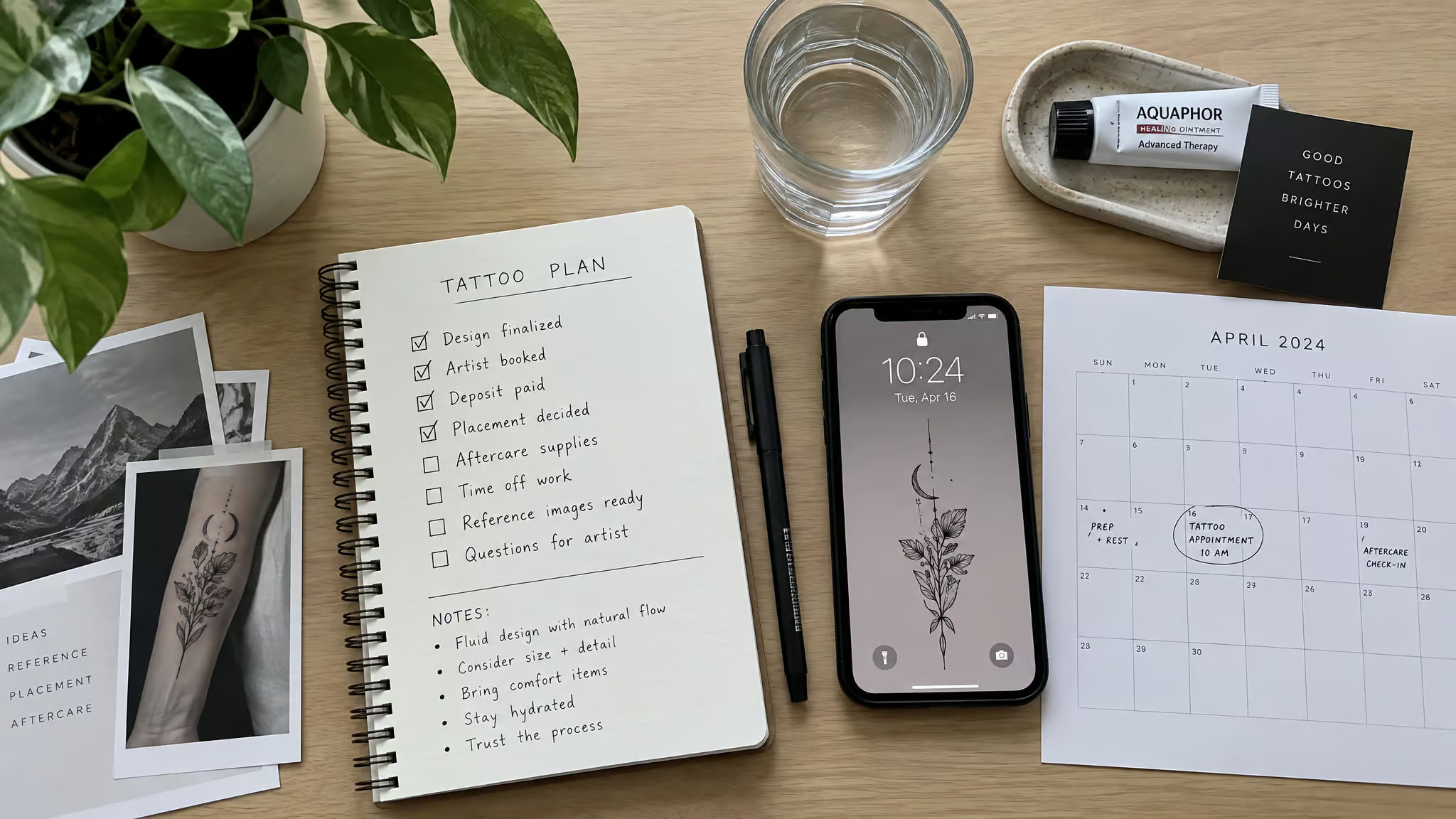
The design earns its spot by surviving daily visibility and three durability questions, and the 30-day rule is how you run that test before any money moves.It’s dead simple, free, and it works, which is more than you can say for most decision advice.
- Save the design and set the digital rendering as your phone lock screen, or tape a printed copy to the bathroom mirror.
- Look at it every day for 30 days. Not hunting for flaws, just noticing how you feel when it’s there.
- Big pieces, meaning a half sleeve, full sleeve, or back piece, get extra weeks on top of the 30.
Scale the patience to the commitment. - At day 30, check in honestly. If you still want it, it’s probably real. If you feel relieved to stop looking, that’s an answer too.
These timelines scale with size and commitment level; they’re not universal rules, so adjust for what you’re actually planning.
Then run the three durability tests, which take about five minutes total:
- The ten-year test: will the image still read clearly if the edges soften?
- The wardrobe test: does the placement actually work with the clothes you wear, including work clothes?
- The resize test: could the design scale up without losing whatever makes it itself?
Design testing comes first, and artist research is a separate stage covered later. The two waiting periods run at different decision points, not in competition with each other.
Choose a design that ages well: what ink actually does over ten years
How a tattoo ages is predictable, and three things decide it: ink migration, line spread, and pigment stability. Ink migration is ink slowly drifting under the skin over the years until crisp lines go muddy.Old military-era tattoos are the clearest example: dense little designs that have blurred into shapes nobody can read anymore. The ink did that, slowly, under skin that never stopped moving. Tiny lines and dense detail are the first casualties.
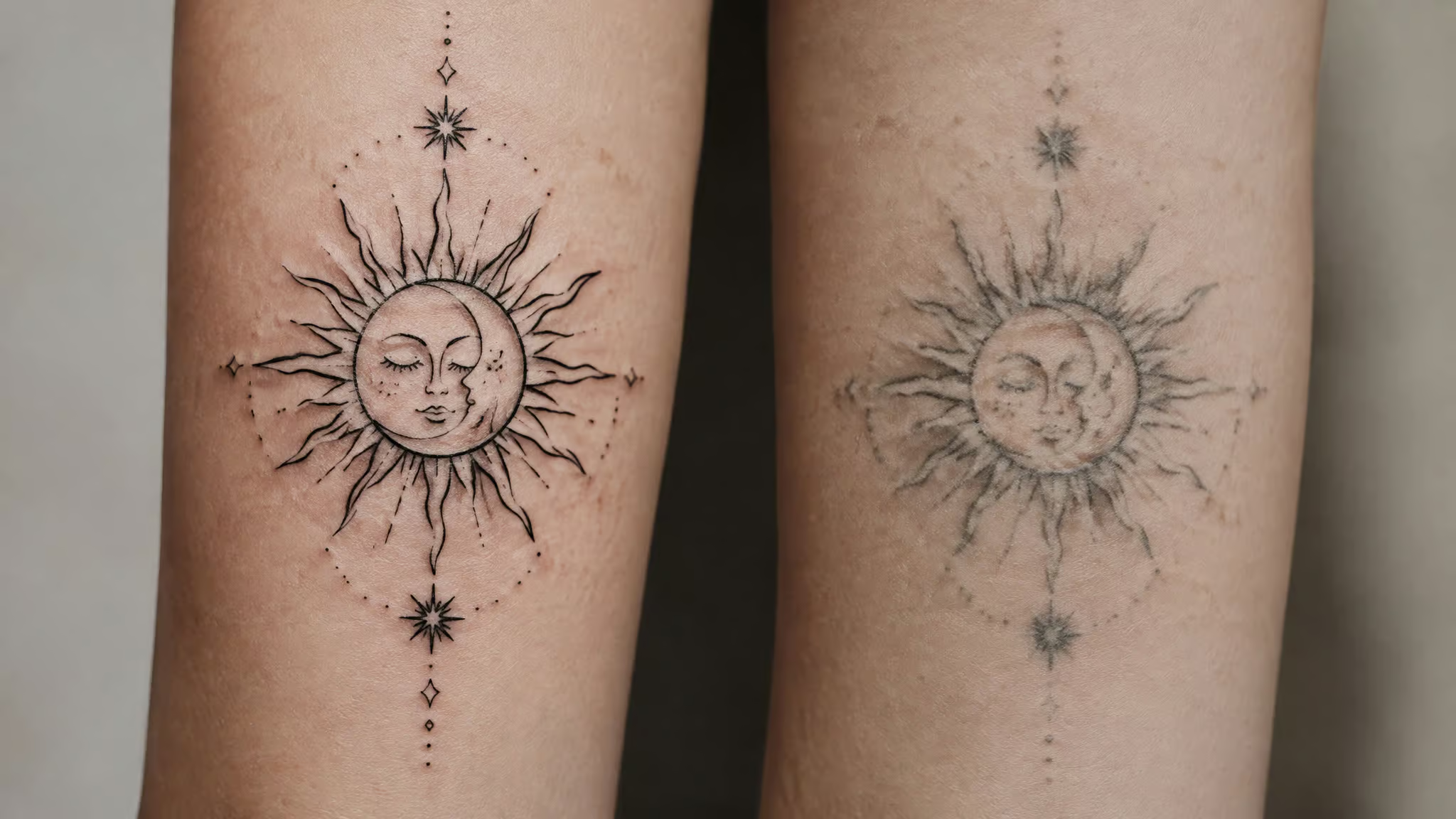
That’s why sizing matters more than most reference images suggest. Plan roughly 20% more canvas than the image calls for, because skin swells and healed lines spread.Treat that as a practitioner’s rule of thumb rather than a lab figure, but it’s a weirdly useful one. When you’re matching a design to a specific spot, the 1/3 rule for tattoo sizing is worth a quick read before your consultation too.
Style longevity, compared honestly:
- Traditional is the gold standard. Bold outlines and saturated color hold up because the heavy line work frames the design as pigment settles.
- Realism can lose fine detail as skin changes, and it wants sun protection and upkeep.
That’s a trade-off, not a dealbreaker. - Fine line blurs and fades more, so it needs touch-ups more often. If you love fine line, go in with open eyes, not talked out of it.
On color: black and gray ink are the most stable pigments, which is why black and grey work tends to age gracefully. Light yellows and pastels fade fastest.
Some design categories are more technically demanding than others. Symbols and icons are the safest bet: an anchor, a flower, an animal, a tool, a personal emblem, as long as the line weight suits them.Great news for first-timers. Text and lettering need caution, because script gets hard to read at small sizes, especially on fingers and high-friction spots.
Portraits and realism need room: features only separate on a larger, high-contrast canvas, which is why small portraits so often go wrong. Abstract and geometric work lives or dies on the artist’s control, since repeated shapes and symmetry expose every wobble.Pick a specialist, not someone with one geometric piece buried in an unrelated portfolio.
Trend-proofing comes down to speed, not taste. Trends turn over in months; tattoos last for decades. That gap is the risk, not the trend itself.The practical test: has this idea meant something to you for years, not days?
Art that endures comes from your own history, not whatever the wider world is chasing, so keep the design rooted in something personal and request custom work rather than a copy of a screenshot. Fine-line, micro, minimalist, botanical, and cybersigilism designs were prominent in 2025 trend coverage, and subtle isn’t the same as durable for every skin type or placement. If you want the current landscape, the tattoo trends for 2026 breakdown covers which looks age well and which risk dating quickly.
Artists describe the same pattern over and over: someone saves a fine-line micro design from social media, books within days, and a few years later the compressed detail has blurred. The tell was there from the start. The design looked crisp in the portfolio photo because it was shot at fresh-ink scale.
Placement: the highest-leverage regret decision
Placement is a regret multiplier: a good idea in the wrong spot still goes wrong, because where a tattoo sits controls how often you see it, whether you can cover it, how much friction it takes, and how long it stays readable.The research ties placement to regret directly. A 2024 cross-sectional study associated upper-extremity tattoos with regret in 72.3% of respondents and with removal in 56.9%. The same dataset summarized face tattoos as the highest-regret placement at 44.1%, with head, neck, hands, wrists, and fingers also high-risk. Those are two different measures from one dataset, one ties regret to a body region and the other ranks placements, and the face number makes its own point without any commentary from me.
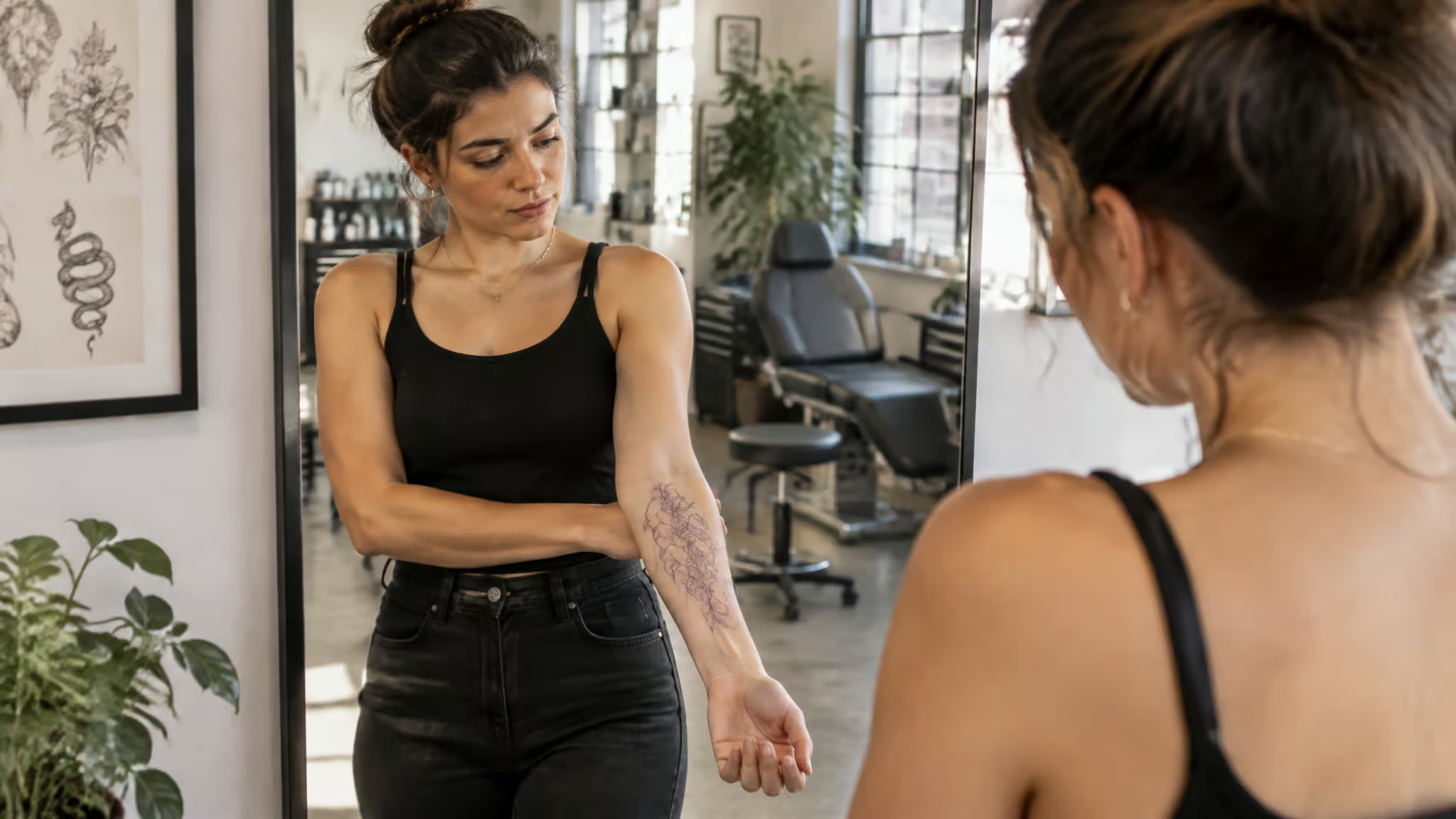
High-friction, sun-exposed, and high-movement zones fade or blur faster: hands, feet, forearms, ribs, elbows, knees. Sun exposure fades tattoos faster, especially color work, so a high-sun placement carries a sunscreen commitment for life once it heals. Nobody mentions that part at the shop.
Then run your actual life against the placement: work visibility, clothing friction, bags and straps, gym or yoga, swimming, and how easy the spot is to keep clean while healing.The practical rule, as friendly guidance rather than a directive: pick the placement that hides most easily while still feeling right to you. Both halves matter. Check the stencil while standing, seated, and moving, using a mirror to see it as others will.
For women specifically, career visibility is a real filter, because hands, neck, and face limit concealment in professional settings, and heavily visible placements also limit future cover-up options. The research has no gender breakdown, so what follows is the general data applied to contexts women actually navigate, not a statistic specific to women. Fit the design to your body as it is: how visible the spot is, how much it hurts, and how your body might change, because weight shifts and muscle growth happen to tattoos too.
The inner forearm and upper arm hit the sweet spot: visible when you want it, coverable when you don’t.And a good design flows with your muscles and bone structure rather than cutting across them, the way a vine follows a trellis instead of ignoring it.
| Zone | Coverable at work | Pain runs high | Healing friction | Fades or blurs faster |
|---|---|---|---|---|
| Inner forearm | Yes (with sleeves) | No | Partial (bag straps, sun) | Partial (sun) |
| Upper arm | Yes | No | No | No |
| Ribs | Yes | Yes | Partial (waistbands) | Partial (movement) |
| Hand or fingers | No | Yes | Yes (constant use) | Yes |
| Neck | No | Yes | Partial (collars, hair) | Partial (sun) |
| Face | No | Yes | Yes (washing, weather) | Yes |
These are general patterns. Your clothes, climate, and job change the math, which is exactly why the stencil-in-the-mirror step exists.
Now the counterintuitive part most guides paper over. “Start small and hideable” is a hedging mistake, not safety.Tiny hidden tattoos age poorly, because ink migration turns micro-detail into mud, and they obstruct future large work: artists building sleeves, back pieces, chest pieces, or rib panels have to work around or cover them. Artists have a comparison for it: a bumper sticker slapped on a Mercedes.
What actually protects you is a spot you can cover, at a size that holds up over the years. If you want it, go all in.
Meaning without regret: names, dates, text, and what to do instead
Names, dates, and relationship tattoos are a top regret category because life changes faster than ink, but the same meaning can almost always be carried with less risk, and meaning doesn’t have to be solemn. We all know someone with an ex’s name across their chest and a relationship that ended shortly after. That story gets told about other people for a reason.
The alternatives ladder, same meaning with less risk:
- A symbol representing the person: a flower, a constellation, an animal, an object.
- A shared memory: a place, a set of coordinates, an object that matters to you both.
- An abstract design that holds its meaning even when circumstances shift.
If a name or date is still what you want, no judgment, just loop the artist in on font size and placement.Tiny script blurs over time, and heavily visible placements limit your future cover-up options. Those are the two things you wish someone had told you, so now someone has.
Text tattoos get a verification protocol, and it’s boring on purpose. Type it out and proofread it character by character, more than once.Then ask a fluent speaker to verify the wording is exactly right. Never rely on auto-translation, and know that even a technically correct foreign translation can read as awkward or slangy to native speakers. The canonical failures, used gently: the Chinese character believed to mean “strength” that actually translated to something closer to “gullible tourist,” and the misspelled “No Ragrets” that adorns a surprising number of forearms.
And here’s your permission slip: tattoos don’t need a deep spiritual backstory. Decorative, funny, or simply personal is completely fine, the goal is choosing it on purpose, not making it solemn. Even an extreme piece, a full Sistine Chapel across someone’s back, works when it’s genuinely chosen.
Where meaning does help is durability: designs connected to your journey, milestones, or values are less likely to be regretted, and broad, enduring symbols hold up better than ultra-specific references to a moment or an outgrown version of yourself. If you want a starting point for symbols, there’s a whole gallery of feminine tattoo ideas, but browse it after the filters, not before.
Vetting the artist: healed work, style match, and the walk-away signals
The artist matters more than the design, and the standard is healed work, not fresh photos. Fresh tattoos always look crisp in photos. Healed work is what reveals line quality, saturation, and how the piece actually settles into skin, so look for clean, consistent lines, smooth shading, readable details, actual healed photos, and a genuine style match with what you want. Just ask to see healed tattoos.Fresh work flatters everyone.
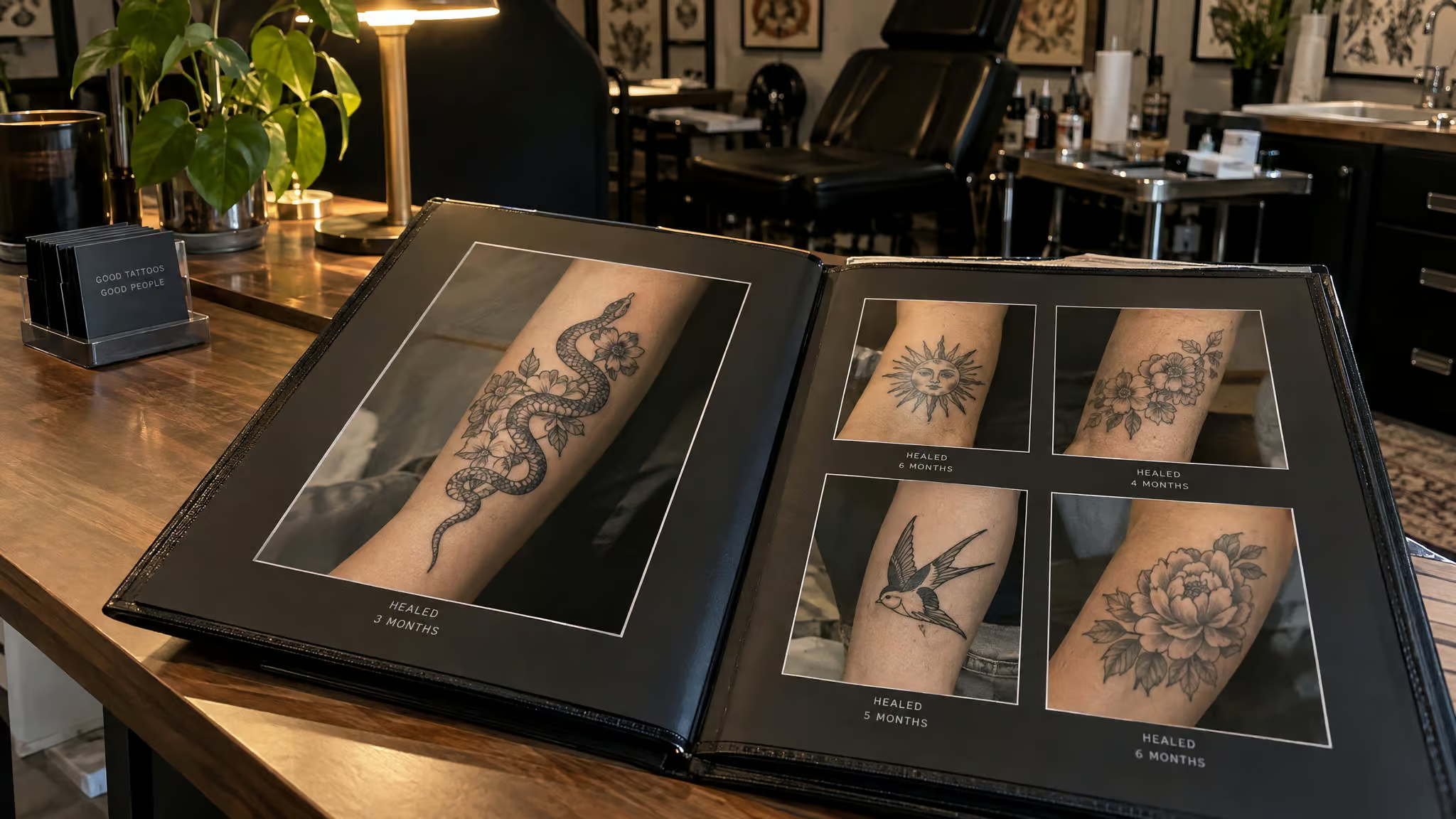
Specialization matters. Fine line, realism, traditional, and black and grey are different skill sets, the way you wouldn’t ask your dentist to do your haircut. A single geometric piece sitting in a portfolio of unrelated styles is a red flag; specialized artists produce more consistent work, and “jack of all trades, master of none” gets dismissed for a reason.Check reviews, reputation, time in business, and the number of reviews.
Nobody recommends “my guy, he’s pretty mediocre.” You want technical skill and someone who actually collaborates on custom work, so it’s worth doing the search right. Some studios make browsing easier: Club Tattoo, with locations in Arizona, Las Vegas, and New Jersey, offers interactive touchscreens where you can look through thousands of designs and preview placements.A handy tool, wherever it’s offered.
Research portfolios for at least 3 to 6 months before booking. Yes, months. It doubles as a pause that lets your taste settle, and it runs alongside the design test from earlier rather than replacing it.If you still love an artist’s work a few months in, that’s information.
In the consultation, six question categories, as a cheat sheet rather than an interrogation script: style fit, placement judgment, healing expectations, studio safety, schedule, and booking terms. Two questions worth asking almost word for word: “How often do you take on this style, and is there a colleague here better suited to it?” and “Does this spot have the room and stability this level of detail needs?” Asking how the design will look in five to ten years is a respected question, not an awkward one.
Walk-away signals: vague answers, pressure to book immediately, refusal to show healed work, an untidy station.And the big one: an artist who signs off on every idea without weighing in on scale or placement isn’t being agreeable. They’ve stopped paying attention. A studio that says yes to everything isn’t automatically helpful, and the best artist may tell you your idea needs work, so treat pushback as a good sign.
The vibe check matters for the outcome too.You’ll sit side by side for hours, and being treated like a burden before the tattooing starts is a warning. During the design process, defer to the artist’s expertise over friends’ opinions. You wouldn’t bring friends to a mechanic to decide on car work.
On price: cheap, fast work shows up later as blown-out lines, which is ink spreading under the skin, plus patchy shading, weak saturation, and designs that don’t fit the body.Cheap tattoos often become expensive corrections, so price should never be the main reason for choosing a studio. The cautionary example, used lightly: the envisioned majestic eagle that healed into a rather confused chicken.
The consultation pattern to watch for, because it comes up constantly: someone new to tattoos walks in, the artist raves over every idea and quotes a quick turnaround, and the client takes the enthusiasm for good service. What’s missing is the part where the artist questions the size, the spot, or whether the style actually suits you.
Studio safety and the stencil check: the cheapest regret insurance in the process
The stencil check is non-negotiable: six attributes, minutes to verify, years to live with an error. Studio hygiene is just as observable. Professional studios treat fresh, single-use needles and throwaway supplies as the baseline, and you can check a lot just by walking in: a clean station, barriers, general tidiness. No expertise required, just eyes. Red flags: feeling rushed, a messy shop, or being discouraged from asking about sterilization.
Asking is normal. It’s your skin, and trust your gut if something feels off.
It helps to know where the stencil check sits in the custom design process, which runs in stages: consultation, artist direction, design build, stencil and placement, execution. The check comes second to last, which means there’s still time to change things when you get there.On flash versus custom, honestly compared: flash suits people who’ve connected with an artist’s style and want a straightforward design, and that’s a legitimate choice. Custom suits personal concepts, specific placements, and designs shaped to your body. Regret often follows when flash is grabbed for speed and later lacks personal meaning.
The stencil check itself is simple: verify spelling, placement, orientation, size, spacing, and symmetry before any needle touches skin.Adjustments take minutes. Errors take years.
Session prep starts two days out so nobody wings it: good sleep, steady hydration, no alcohol, no blood-thinning medication unless a doctor directed it, a real meal before arrival, and clothing that exposes the placement. On pain, plainly: bony, thin-skinned spots like ribs, spine, inner biceps, hands, and feet sting sharper than fleshier zones, and how long you’re on the table matters as much as where.Yeah, this part just hurts, and no trick gets you around it. Numbing cream can change how skin behaves, interfere with the artist’s process, or wear off mid-session, so ask the artist before using any.
What regret actually costs: the remedy ladder and the removal math
Undoing a tattoo is measured in sessions, not dollars, and the top rung of the fix-it ladder costs a year and a half. The ladder, smallest first: small issues get a touch-up, design problems get a rework, bigger mistakes need a cover-up, and laser removal is the last resort, slow, costly, and unpleasant in equal measure.
The removal math, so “think it through” stops being a platitude: laser removal takes 6 to 12 sessions spread over 12 to 18 months, and it works better on darker inks than lighter colors. It carries real risks, including scarring, skin discoloration, and incomplete removal, per guidance from the American Academy of Dermatology and Mayo Clinic, and nobody can promise you a particular result. Cover-ups typically come out noticeably bigger and darker than the original, and fixing regret means weighing ink density, scar tissue, and placement to land on a realistic design for that area. Be wary of quick fixes offered by artists who didn’t do the original work.
Before any removal decision, wait at least six months. Initial regret often diminishes with time and perspective, and acceptance or reframing is a legitimate outcome alongside removal and cover-ups, not a consolation prize. Some context that reassures rather than alarms: roughly 22% of tattooed people report some regret, which means 78% don’t, and thinking it through is a big part of that gap.
Tattoo shock and the first weeks: what’s normal, what’s not, and how to heal the thing
Fresh tattoos look darker and bolder than they will healed, so day-three panic is usually tattoo shock, not regret. A new tattoo can look darker, bolder, sharper, redder, swollen, or simply more intense than the final result, and most people need a few weeks before the fully settled, healed result becomes visible.Early doubt is normal even when the tattoo is well done. Your brain is adjusting to a permanent change to your body, and it notices. That’s also one more argument against impulsive choices, since a considered decision gives you less to second-guess.
The pattern practitioners see constantly: the new tattoo looks bolder than expected, doubt sets in immediately, and the person starts researching removal clinics the same week.In practice, most of that early panic fades once healing reveals the settled result. Real regret is different. It persists after healing and traces to something specific: the design, the placement, the size, or the execution. Panic fades.
Poor decisions don’t.So wait until the tattoo heals before making any serious decision about rework, cover-up, or removal. If you’re reading this the same week you got tattooed, possibly after searching some version of tattoo regret immediately after at 2 a.m., this paragraph is the reassurance.
Then comes the healing window, which is where good tattoos get ruined by what you do afterward, not by the artist’s skill. Healing runs in three phases: days 1 to 3, days 4 to 14, and days 15 to 21.Your artist’s written aftercare instructions override any general guidance, because wrap type, ink saturation, and placement all change the routine. Their sheet first, general advice second.
The classic mistakes, one at a time. Over-washing and under-washing both irritate, so it’s a Goldilocks problem nobody warns you about.Heavy ointment layers trap bacteria; less is more. Picking and scratching pull ink out, and everyone’s been tempted, so consider this the understanding voice saying don’t.
Pools, hot tubs, lakes, and rivers are off-limits while it heals, the summer-plan sacrifice nobody enjoys. UV exposure fades a healing tattoo fast. Tight clothing and heavy workouts irritate healing skin, which is a real inconvenience if you have a routine, and it’s still worth the break.Keep it clean and moisturized with fragrance-free products, and once it’s healed, long-term sun protection is the single most important anti-fading step you can take.
On infection, calm context: estimates put overall infection risk at roughly 0.5% to 6%, and one study found about 3% of newly tattooed U.S. adults developed a skin infection while about 4% had at least one short-term complication. The highest-risk window is the first 2 to 3 weeks, which is exactly when people get careless. Worth naming gently, because you now won’t be one of them.Contact your artist or a doctor if you notice worsening pain, spreading redness, hot skin, pus, red streaks, or fever. Those signs deserve their own clear space, so here it is, unburied.
The final pre-booking checklist
The entire decision compresses into eight steps, in this order.
- Confirm timing. Run the four filters; if any answer feels forced, pause.
- Check visibility. Career, clothes, concealability.
- Test the design. Thirty days on your lock screen or mirror, plus the three durability tests.
- Choose the canvas. Placement and scale that age well, with roughly 20% more room than the reference suggests.
- Review healed work. Three to six months of watching portfolios before you book.
- Book the consultation. Six question categories, and pushback on your idea is a good sign.
- Understand the terms. Deposits are normal when they clearly reserve your time and spell out cancellation terms; that clarity protects both sides. Vagueness or pressure is a walk-away signal.
- Prepare the recovery plan. Two days of prep, three weeks of aftercare, artist’s sheet first.
The order matters because each step protects the next: timing confirmed first, then an aging-friendly design, then placement, then the artist, then the booking. Do them in that sequence and you land on the right side of the 22%, which is the whole point of running the decision yourself instead of letting a screenshot folder run it for you.
Frequently Asked Questions
How to decide which tattoo is right for you?
Run the decision before the design: timing filters first (life stage, career visibility, relationship permanence, motivation stability), then a 30-day design test, then placement and artist vetting. The order matters because timing and motivation predict regret long before any image does. If any filter answer feels forced, pause — the pause is free.
What is the 1/3 rule tattoo?
It’s a sizing guideline worth reading before your consultation, used to match a design to a specific spot so the tattoo fits the body’s natural proportions. It pairs with the broader sizing rule of thumb: plan roughly 20% more canvas than the reference image calls for, because skin swells and healed lines spread. Tiny, cramped designs are the first casualties of ink migration.
What are the top 10 tattoos to avoid?
The highest-risk categories cluster around speed and specificity: names, dates, and matching relationship tattoos; tiny hidden micro designs that blur into mud; small portraits, which need room for features to separate; fine-line script on fingers and high-friction spots; and trend-driven pieces grabbed within days of seeing them. Face, hand, neck, and finger placements also carry the highest regret rates in the research. The common thread is anything chosen fast, sized small, or tied to a moment rather than your own history.
How do you vet a tattoo artist before booking a consultation?
Judge healed work, not fresh photos — fresh ink flatters everyone, while healed work reveals line quality, saturation, and how the piece settles into skin. Look for a genuine style specialist rather than one strong piece in an unrelated portfolio, check reviews and time in business, and research for 3 to 6 months. Walk away from vague answers, pressure to book immediately, refusal to show healed work, or an artist who agrees with every idea without weighing in on scale or placement.