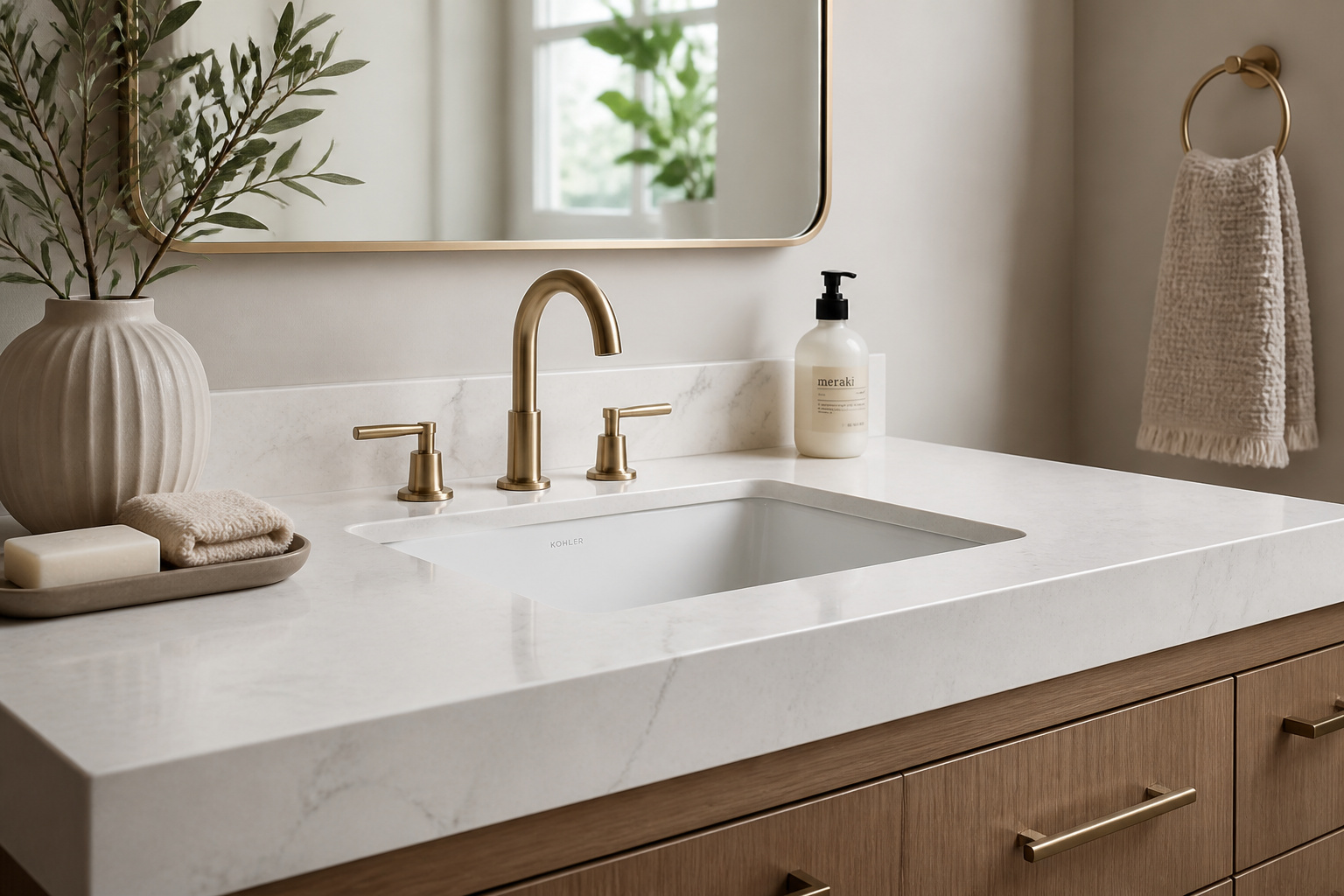
You’re standing in the aisle of a big-box store, or maybe you’ve got fourteen browser tabs open, staring at countertop samples. Some are shiny. Some are matte. One looks like marble but costs half as much — for example, quartz can mimic marble at $60–$120 CAD/sq ft versus marble’s $70–$200 CAD/sq ft.
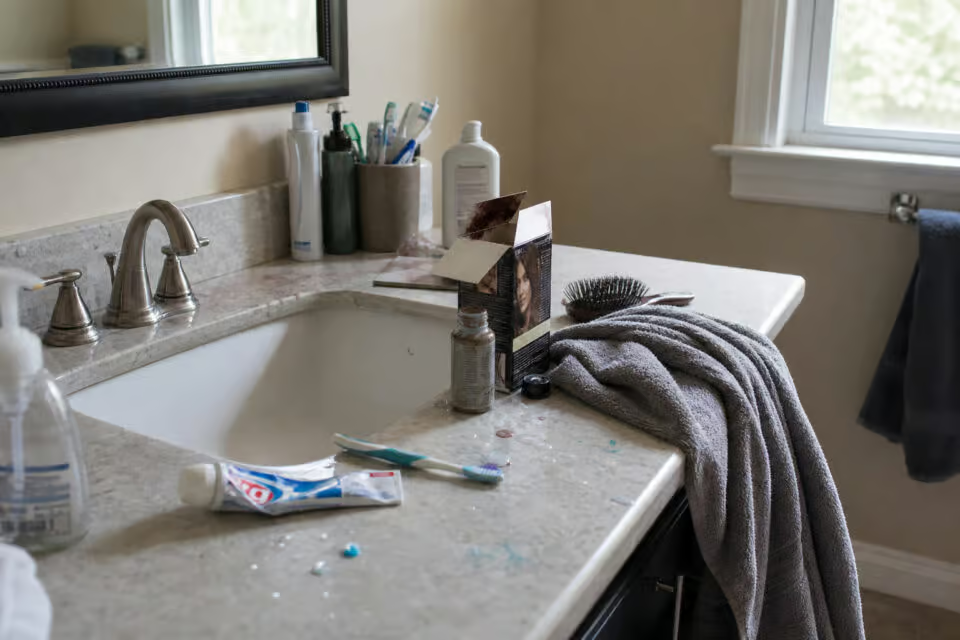
You’re trying to remember — does granite need sealing? Does quartz? Your kids’ bathroom needs something that can handle toothpaste splatters and the occasional hair-dye disaster, quartz resists staining from toothpaste, hair dye, and cosmetics. You need someone to walk you through it without the sales pitch.
Here’s how to work through it without losing your mind. We’ll go step by step, starting with how your bathroom is used — assess bathroom needs and usage, consider moisture exposure, frequency of use, and household members, then match a material to your actual willingness to maintain it. Not your Pinterest board — your life.
Key Takeaways
Start by figuring out who uses the bathroom and how often — marble belongs in a powder room, not a family bath that sees daily splashes and spills
Quartz is the low-maintenance workhorse: 90-95% natural quartz aggregate, non-porous, doesn’t need sealing, and sits at a Mohs hardness of 7 (very hard to scratch)
Your vanity style decides what material can go on top: floating vanities need lightweight tops like solid surface or compact porcelain, while freestanding vanities can handle heavy stone
Table of Contents
Step 1: Know your bathroom’s needs before you shop
Before you even look at materials, stop and think about who’s using this bathroom and how. I know — it sounds obvious, but it’s the step most guides skip, and it’s the one that’ll save you from buying something gorgeous that you’ll hate maintaining in six months.
Ask yourself three honest questions:
- How many people use this bathroom daily? A busy family bath shared by three kids sees more splash, steam, and chaos than a master ensuite used by two careful adults — a high-humidity environment like a bathroom requires moisture-resistant materials.
- Does anyone use harsh chemicals in here? Hair dye, bleach, strong bathroom cleaners — some materials will shrug them off, others will etch or stain.
- Are you actually going to reseal a countertop twice a year? Be honest. If sealing sounds like a chore you’ll forget by week three, that’ll steer you toward materials that don’t need it.
Here’s the rule: high-traffic family bathrooms need moisture-resistant, low-maintenance materials — quartz, with its non-porous surface and Mohs hardness around 7, is a strong candidate. Guest powder rooms can handle prettier, fussier options. Marble suits powder rooms, ensuite master baths used by careful adults, or light-use areas — it’s gorgeous, but it’s soft (Mohs hardness 3–4) and high-maintenance. The material that works best for your bathroom depends entirely on your answers here.
Quick test: If you can’t remember the last time you sealed a grout line or won’t commit to a twice-yearly sealant reminder, pick a non-porous material like quartz or solid surface.
Step 2: Choose your material — the full comparison
This is the big one. Let’s walk through each option with honest tradeoffs, not marketing fluff.
Natural stone: Granite and marble
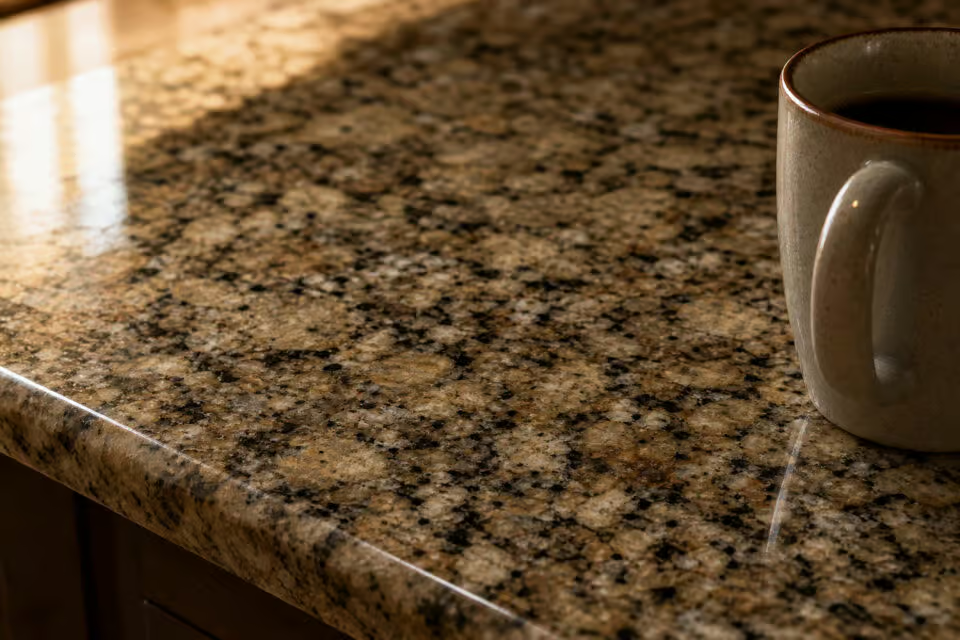
Granite is the classic natural stone choice. Every slab is one-of-a-kind because it’s a plutonic igneous rock with dynamic veining and mineral inclusions. It’s hard — Mohs hardness 6–7 — and its low coefficient of thermal expansion resists cracking from temperature fluctuations, so a hot curling iron won’t crack it. You can get it polished (shiny), honed (matte), or leathered (textured), and each finish looks and feels different.
The catch: granite is porous. You’ll need to seal it 1–2 times per year to keep stains out. That’s not a huge deal — it’s a ten-minute job, but it’s a recurring chore. Use pH-neutral cleaners on it; acidic stuff like vinegar or lemon juice can dull the sealant.
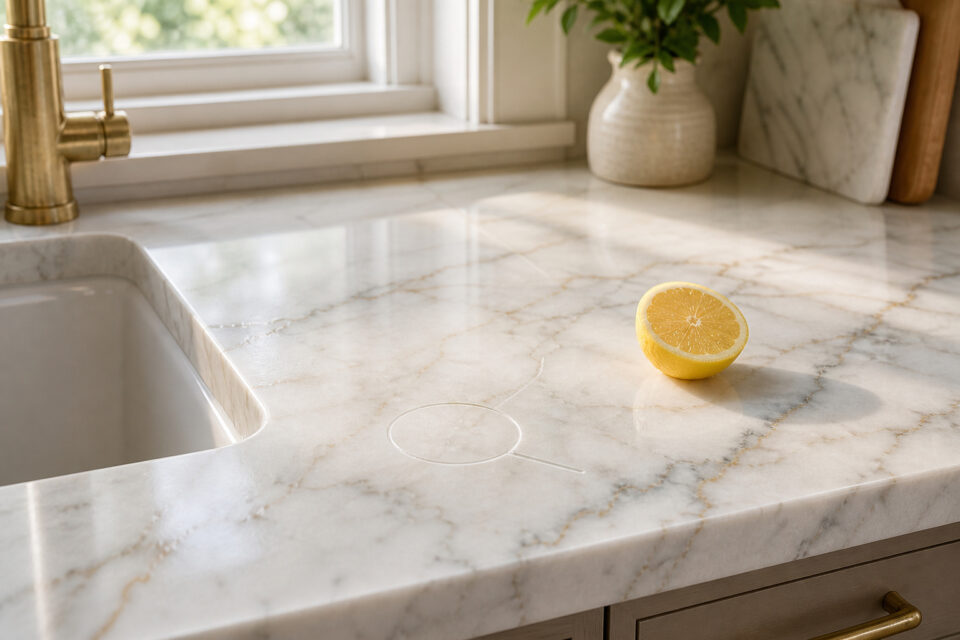
Marble is the beauty queen, but she’s high-maintenance. It’s a metamorphic rock composed of recrystallized calcite or dolomite, which makes it soft — Mohs hardness 3–4. It scratches and etches easily. Acids like vinegar, lemon juice, and certain soaps will etch the surface.
Even toothpaste can leave a mark. You’ll need to seal it every six months to annually, and you have to be careful about what touches it. Carrara marble has delicate veining; Calacatta has bold veining. Both are classic and their light-reflective quality enhances small bathrooms. Save marble for a light-use powder room or a master bath where adults are careful. Not the kids’ bathroom.
Engineered quartz: The low-maintenance workhorse
If you want something tough and maintenance-free, quartz is a top contender. It’s composed of 90–95% natural quartz aggregates bound with polymer resins and pigments. So it’s natural but not a solid slab of rock. That high quartz content gives it a Mohs hardness around 7 with the low maintenance of an engineered surface.
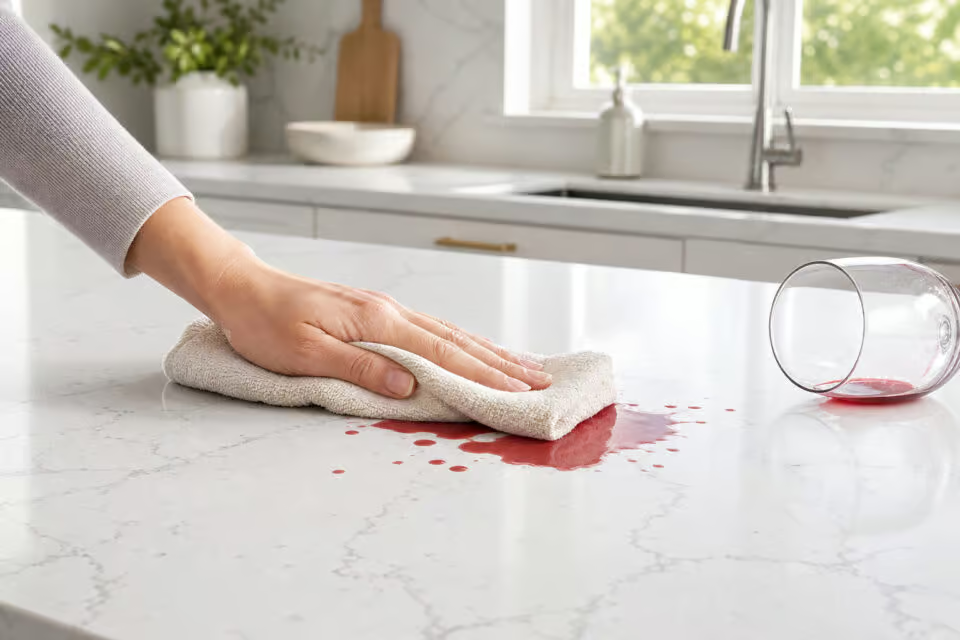
The selling point: no sealing needed. Ever. Just wipe it down. Toothpaste, hair dye, makeup — quartz shrugs it off.
Its dense molecular structure inhibits mold and bacteria, which is great for a damp room. It is also UV-stable, resists yellowing and fading, so if your bathroom gets good light, quartz stays looking new.
One thing to know: quartz can be damaged by harsh chemicals like paint thinners or strong solvents. Avoid trichlorethane or methylene chloride — they’ll ruin the surface. Stick to mild cleaners. For most stains, a non-abrasive cleaner works fine. Stubborn ones can be tackled with a no-scratch Scotch-Brite pad.
Budget and modern alternatives
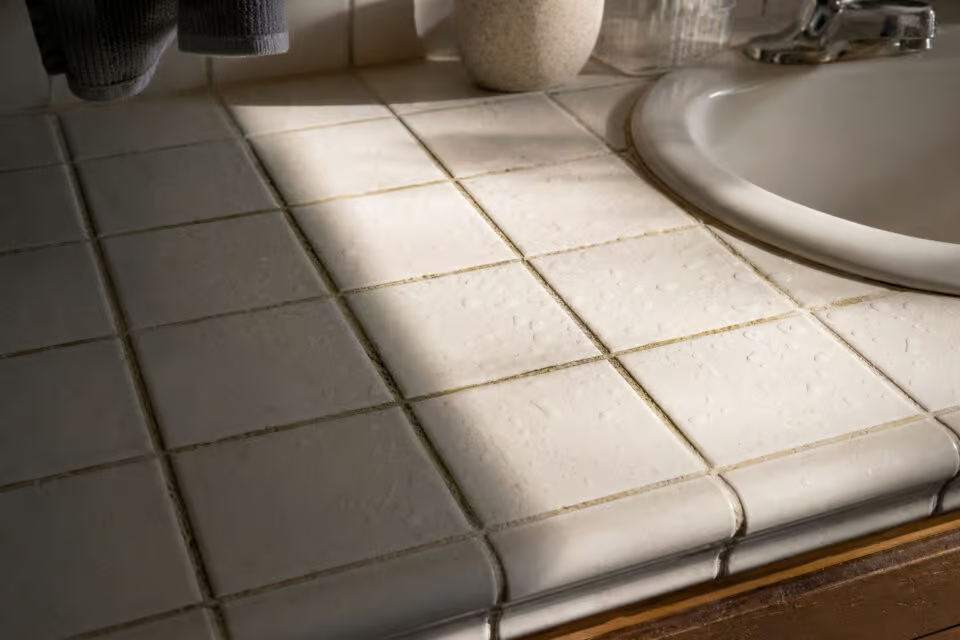
Ceramic tile is the budget-friendly option. The tiles themselves are moisture-resistant, but the grout between them is the weak spot. Grout absorbs moisture and can get moldy. It needs regular cleaning and sealing — that’s extra work. If you’re okay with that maintenance, it’s a cheap way to get a custom look.
Solid surface (like Corian) is a man-made material that’s seamless and repairable. It’s made from acrylic or polyester resins with mineral fillers — non-porous and uniform. You can get integrated sinks molded right into the countertop, seamless design, so no seams to collect gunk. Minor scratches can be sanded out; repairable in place.
If your kid goes at it with a toy, it’s fixable. It offers color and texture flexibility; can include custom inlays and LED backlighting. Pretty customizable.
Laminate is the cheapest option, but it’s not great in a wet environment. The seams are vulnerable to moisture — if water gets in, the particleboard underneath swells and falls apart. Should be replaced when damaged. I’d think twice before putting laminate in a bathroom that sees daily use.
Concrete countertops are custom-cast and have a unique, industrial look. They’re made from high-performance cement blends with polymers to make them stronger and less prone to cracking. You can cast them with integrated sinks, backsplashes, or decorative inlays. But concrete is inherently porous — requires advanced sealers (penetrating or topical) to keep moisture and stains out.
According to Elsa Home & Beauty, specialists in custom marble vanity tops, marble offers an alternative with timeless elegance and durability. Can be rendered rustic or refined with pigments, acid staining, or trowel finishing.
Recycled glass countertops are eco-friendly and come in vibrant colors. Post-consumer or industrial glass is crushed and bound in resin or cement. Non-porous, resistant to most stains, so they handle bathroom spills well. Comes in many colors and transparency levels. Very eye-catching.
Porcelain slabs are a newer option — super durable and thin. They’re sintered at extreme temperatures, which makes them incredibly hard and non-porous. UV-stable, scratch-resistant, chemical-resistant, and they handle heat well. Basically bulletproof. Thin profile and high flexural strength; suitable for sleek modern designs.
Step 3: Consider style and color
Once you’ve narrowed down materials, it’s time to think about how it’ll look in your actual bathroom.
White bathroom countertops make a small space feel larger. White reflects light, so a small bathroom feels more open and airy. And white does not mean plain; options like 1111 Vivid White, 5151 Empira White, 5111 Statuario Nuovo add texture. These add subtle texture or veining without the maintenance of real marble.
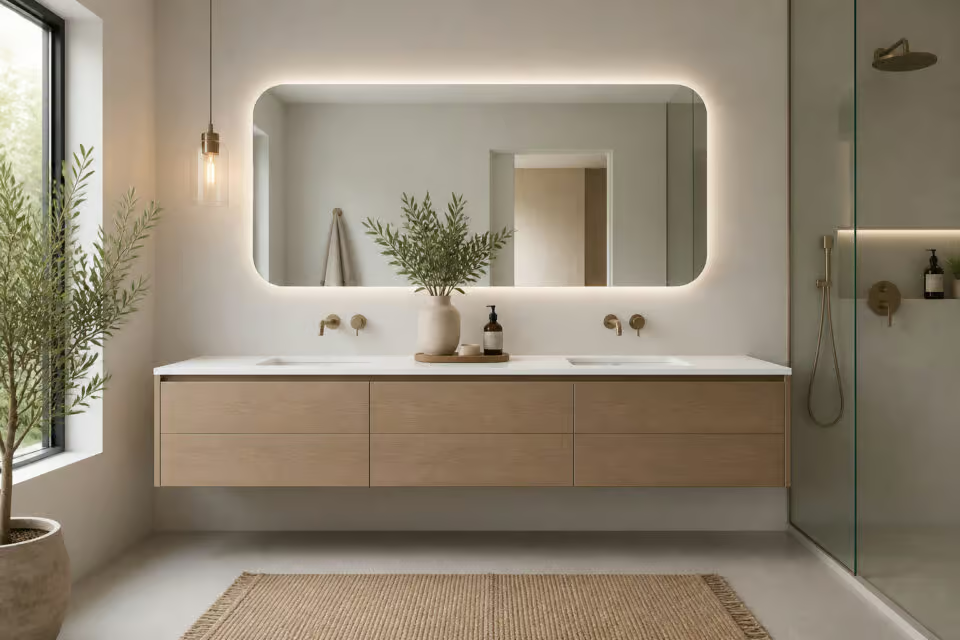
If you’re wondering how to match a countertop to your cabinets, here’s the simple version: white quartz pairs with almost anything. Pair it with warm wood cabinets — like the Royce vanity in Chestnut or the Abigail in Light Natural Oak — for a nice contrast. Or go with darker cabinets for a clean, modern look. That marble-look quartz (Empira White, Statuario Nuovo) gives you the style without the maintenance headache.
One more detail that makes a difference: the edge profile. It’s a small detail that can change the whole look of your vanity without changing the material. Caesarstone offers edge profiles: double radius, bevel, double bullnose, miter edge, bevel square, ogee bullnose, ogee square step, triple egg, triple bullnose. Customizing edge profile is a cost-effective way to transform room’s feel.
Step 4: Decide on sink mounting — undermount vs. integral
Here’s a common confusion: most people think undermount sinks are “seamless,” but the seam between the sink and countertop is still a moisture trap. That seam collects toothpaste gunk and needs regular cleaning.
Undermount sink creates sleek, modern look; Caesarstone surfaces engineered to tight tolerances to prevent leaks, but you should also consider the scale of the sink in relation to the size of the overall space.
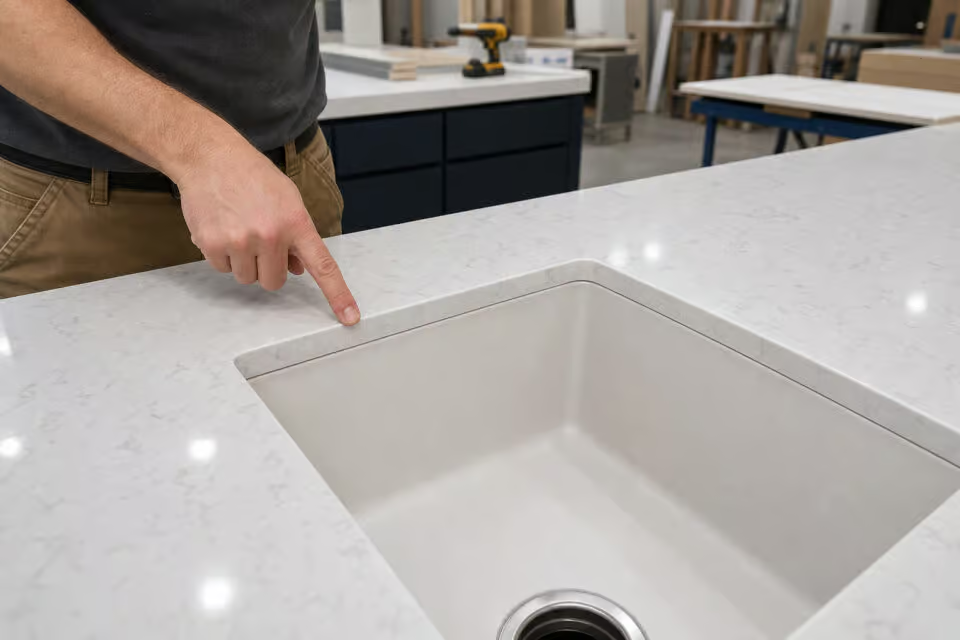
But if you want truly seamless, look at an integral (integrated) sink. The sink and countertop are one molded piece — integral (integrated) sink is truly seamless; no undermount portion, no seam; sink is one with countertop. No seam at all. Nothing to collect grime.
And here’s the detail most people don’t know: quartz can be molded for integral sinks. That’s an option if you want a sleek, easy-to-clean surface.
Step 5: Set your budget — cost per square foot for every material
Let’s talk real numbers. A standard bathroom vanity is about 10-15 square feet. Use that size to ballpark your total cost: multiply the per-square-foot price by 10-15.
Here are typical installed costs in CAD per square foot (from approved specifics):
- Laminate: $15–$30
- Ceramic tile: $20–$50
- Solid surface: $45–$80
- Quartz: $60–$120
- Granite: $55–$130
- Marble: $70–$200
So for a standard vanity, here’s what you’re looking at installed for the countertop alone:
- Laminate: $150–$450 (but remember the moisture risk)
- Solid surface: $450–$1,200
- Quartz: $600–$1,800
- Granite: $550–$1,950
- Marble: $700–$3,000
A few things to notice: laminate is cheapest but fails in moisture. Solid surface is the best value for performance — it’s non-porous, repairable, and reasonably priced. Marble is the most expensive and most demanding. Entry-level quartz can sometimes be found below $60 per square foot, so it’s worth shopping around.
Cost check: For a typical 10–15 sq ft vanity, quartz runs $600–$1,800 installed — similar to mid-grade granite but with zero sealing costs over its lifetime.
Step 6: Finalize installation style — freestanding vs. floating
This is a structural constraint most guides miss. Your material choice must follow your vanity style, not the other way around.
Freestanding vanities sit on the floor. They can handle heavy stone or concrete tops easily, and plumbing is straightforward. Simpler installation.
Floating vanities are wall-mounted with concealed brackets, which makes the room feel bigger. But here’s the catch: walls must be reinforced for heavy tops, especially if you’re using stone or concrete. Don’t skip this step or you could end up with a cracked countertop.
The practical rule: lightweight materials (solid surface, compact porcelain) recommended for floating vanities. If you want a heavy stone or concrete top, choose a freestanding vanity. This is the kind of practical, install-focused advice that DIYers search for.
Putting it all together: Your vanity top decision checklist
Let’s see how this works with real examples. Edward Martin carries vanities that show the framework in action — not as endorsements, but as illustrations of a complete decision.
The Royce 72″ Double Vanity in Chestnut with a 3 cm White Zeus Quartz Top shows how a quartz top pairs with a warm wood base. This is a common size for a shared bathroom. The quartz brings durability and a seamless finish, and the white top contrasts nicely with the darker cabinetry.
The Abigail 60″ Single Vanity in Light Natural Oak with a 3 cm White Zeus Quartz Top is a lighter, airier look. The 60-inch size is good for a master bath or larger powder room. The white quartz brightens up the natural oak — versatile design.
The Paxton 72″ Double Vanity in Pebble Oak with a 3 cm White Zeus Quartz Top gives a calm, spa-inspired feel. Freestanding vanity with quartz and pebble oak — clean and relaxing.
Each of these examples shows how the choices fit together: material, style, sink, installation. Quartz is a common thread because it works in many situations — durable, low-maintenance, and it matches almost any cabinet color.
Your turn. Start with Step 1 — who uses this bathroom and how?, and work through in order. By the time you get to installation style, you’ll know exactly what material makes sense for your family. You can actually make this decision.
Frequently Asked Questions
What type of bathroom vanity top is best?
The best vanity top depends on who uses the bathroom and how much maintenance you’re willing to do. For high-traffic family bathrooms, quartz is the top choice because it’s non-porous, scratch-resistant, and never needs sealing. For a low-use powder room, marble or granite can work if you’re okay with sealing them once or twice a year.
What are the latest trends in bathroom vanity tops?
Porcelain slabs are a newer trend because they’re ultra-thin, incredibly durable, and non-porous — basically bulletproof for bathrooms. Quartz that mimics marble is also huge right now, giving you the high-end look without the etching and staining headaches of real stone.
Can you just replace the top of a bathroom vanity?
Yes, you can replace just the countertop, but you need to check your vanity style first. Freestanding vanities can handle swapping in a heavy stone top like granite or quartz, while floating vanities need lightweight materials like solid surface or compact porcelain to avoid putting too much stress on the wall mounts.
Does quartz need to be sealed?
No, quartz never needs sealing. It’s made of 90-95% natural quartz aggregate bound with polymer resins, which makes it non-porous and resistant to stains from toothpaste, hair dye, and makeup. Just wipe it down with mild cleaner and you’re done.
What’s the difference between an undermount sink and an integral sink?
An undermount sink is mounted below the countertop, but there’s still a seam where gunk can collect. An integral sink is molded as one piece with the countertop — no seam at all, so nothing traps moisture or grime. Quartz can be molded for integral sinks, making it the easiest to clean.
How much does a bathroom vanity top cost installed?
For a standard 10-15 square foot vanity, installed costs range from $150-$450 for laminate to $700-$3,000 for marble. Quartz runs $600-$1,800 installed, which is similar to mid-grade granite but with zero future costs for sealing or maintenance.