
When a doctor tells you an infusion can happen in your living room instead of a hospital, the relief lasts about ten seconds before the questions start stacking up. You immediately wonder who’s walking through your front door, whether it’s safe to run an IV next to the couch, and whether your insurance will pay for any of it.
I remember bracing for a full hospital-style ordeal the first time my husband needed home infusion therapy to replenish his fluids. Between figuring out the four core pieces of a home setup, coordinating the care team, and sorting through the payor-by-payor coverage rules up through a proposed April 2027 Medicare expansion, the logistics can sound intimidating.
Key Takeaways
Medicare fee-for-service is the coverage outlier: Traditional Medicare (Parts A, B, and D) is the only major US health plan without comprehensive home infusion coverage, leaving many beneficiaries paying out of pocket for supplies, equipment, and nursing unless they carry Medicare Advantage or qualify under narrow Part B pump rules.
Accreditation is the real quality filter: Seven independent bodies, including The Joint Commission, ACHC, and URAC, credential home infusion pharmacies, and most commercial insurers require that credential before paying a dime.
The proposed April 2027 expansion is narrower than it sounds: A July 2026 federal proposal would add Medicare Part B coverage for certain supervision-dependent drugs starting April 1, 2027, but only if the therapy is dosed at least once a month and an RN or higher-level clinician is physically in the home.
Table of contents
Table of Contents
What is home infusion therapy?
Home infusion therapy is the intravenous or subcutaneous (under the skin) administration of drugs or biologicals to a patient in their own home. Every setup bundles four core components: the medication itself (such as antivirals or immune globulin), medical equipment (like an infusion pump), supplies (such as tubing and catheters), and nursing services. NHIA defines it as giving medication through a needle or catheter outside a hospital or medical facility, supported by specially trained pharmacists, nurses, and other professionals. Moving treatment out of a hospital or skilled nursing facility and into a familiar room helps patients cut down on time away from work, school, and normal daily routines while paying far less than an inpatient stay costs.
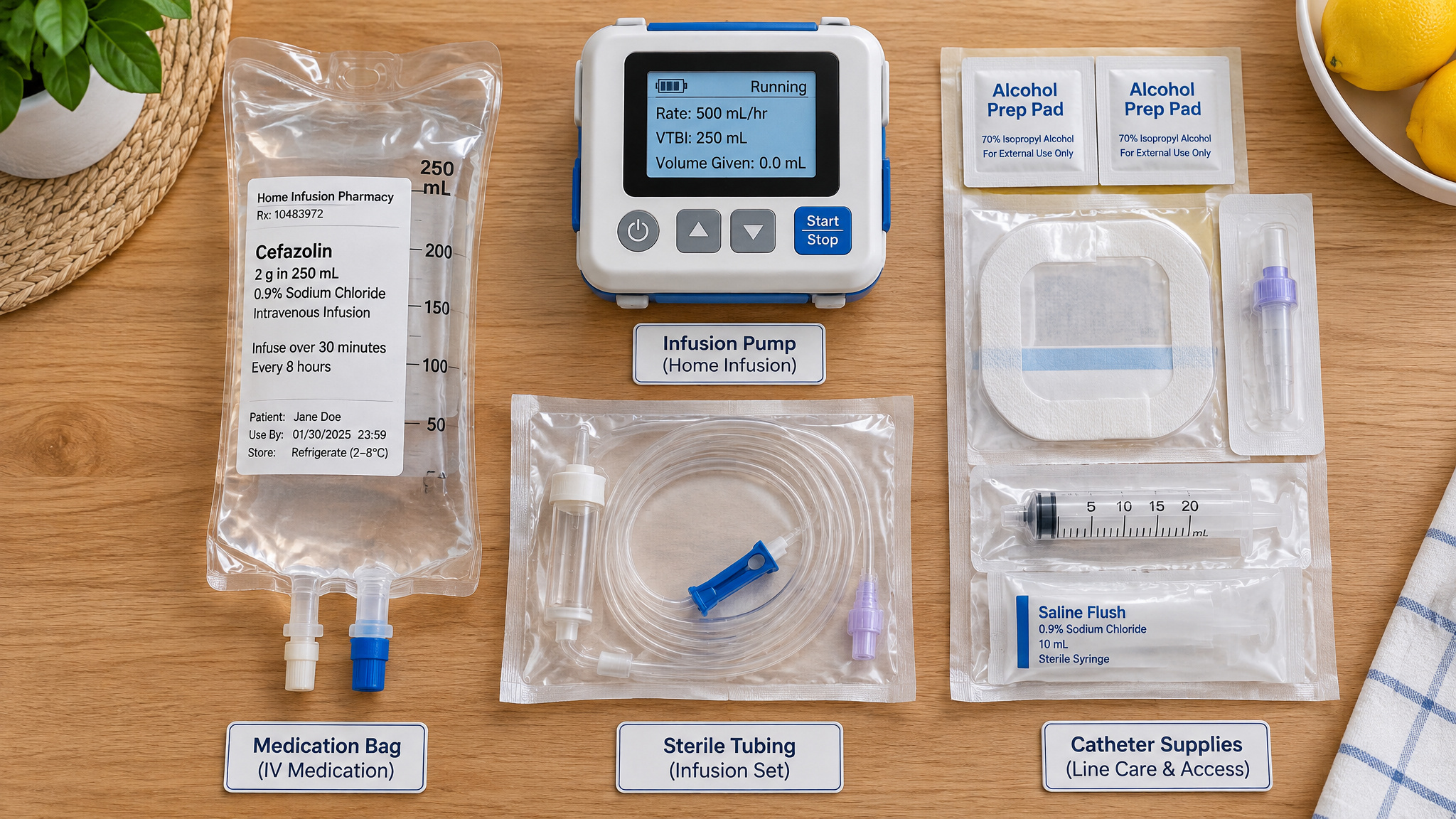
While most people picture an IV drip in a vein when they hear “infusion,” the term also covers medications injected right under the skin. As outcome and quality-of-life data have grown, home infusion has become a safe, effective alternative to inpatient admission for a wide range of short-term and long-term therapies.
Navigating coverage is confusing partly because three different definitions exist side by side:
- The National Home Infusion Association (NHIA) defines home infusion broadly as administering medication through a needle or catheter in any setting outside a hospital or medical facility, backed by specially trained pharmacists and nurses.
- The Centers for Medicare & Medicaid Services (CMS) defines it operationally for home care around those four bundled pieces: drug, equipment, supplies, and nursing.
- The Medicare statute (Social Security Act § 1861(iii)(2)) defines it much more narrowly, tying professional services, training, and remote monitoring specifically to drugs delivered through a durable medical equipment (DME) pump, which is reusable medical gear.
That statutory pump requirement is the root cause of almost every Medicare coverage fight. If a drug doesn’t require a DME pump, traditional Medicare’s home infusion benefit doesn’t kick in.
Conditions and medications treated at home
Home infusion therapy most commonly treats serious infections that require intravenous antibiotics, chiefly cellulitis, sepsis, and osteomyelitis. Doctors also prescribe it for urinary tract infections, pneumonia, sinusitis, and stubborn infections that didn’t respond to oral antibiotics, because delivering the drug straight into the bloodstream or under the skin gets higher concentrations where they need to go without keeping a patient in a hospital bed.

Conditions that require infusion
Beyond severe infections, home infusion covers several chronic and acute medical needs:
- Cancer and cancer-related pain
- Dehydration requiring fluid replacement
- Gastrointestinal (GI) diseases or disorders that prevent the gut from absorbing nutrients normally
- Immune and autoimmune conditions, including Crohn’s disease, rheumatoid arthritis, and multiple sclerosis
Medications and dosing frequency
Common home infusion drug categories include antibiotics, antifungals, antivirals, chemotherapy, hydration fluids, pain management medications, and parenteral nutrition (IV feeding). Specialty medications for chronic and rare diseases are also frequently given at home, including blood factors, corticosteroids, erythropoietin, infliximab, inotropic heart medications, growth hormones, immunoglobulin, and natalizumab.
Dosing schedules vary widely: some therapies run every day, while others happen once every few weeks or months. That schedule, rather than the diagnosis itself, dictates your home equipment setup, how much hands-on training you need, and whether a pump shows up at your door.
The home infusion care team: who does what
Every home infusion starts with a prescription order from the physician overseeing your care, followed by a visiting nurse who comes to your house. That nurse, employed either directly by the infusion pharmacy or through an affiliated nursing agency, handles the hands-on education and clinical checkups:
- Trains you or a family caregiver to administer the medication yourself.
- Explains potential side effects and the goals of the therapy.
- Checks the infusion site periodically and changes dressings.
- Teaches you the warning signs of infection, how to troubleshoot equipment, and how to reach the team if something looks off.
Behind the scenes, the infusion pharmacy’s clinical team, made up of pharmacists, nurses, and support staff, verifies insurance, builds the therapy plan, mixes and delivers sterile medications, schedules nursing visits, monitors lab results and your response to treatment, provides 24/7 phone support, and updates your doctor. Six parties have to stay in sync for it all to work: you, your physician, the hospital discharge planner (if you’re leaving a facility), your health plan, the home infusion pharmacy, and, when applicable, a home health agency.
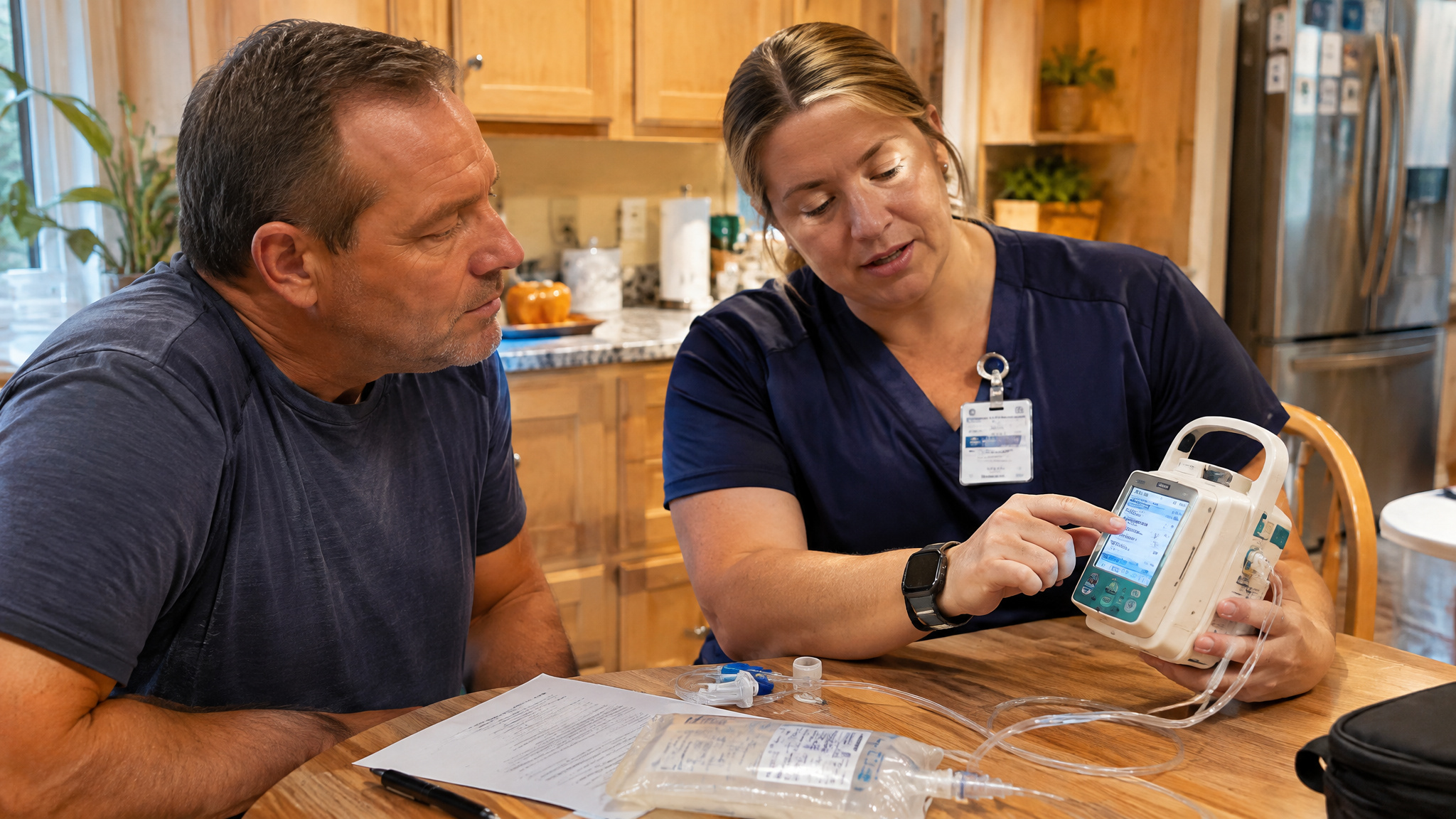
The practical tradeoff is straightforward: home administration only works if someone in the household can learn and handle the routine steps between nurse visits.
How home infusion stays safe and when a pump is used
Home infusion therapy is a safe and effective alternative to hospital care when providers follow documented sterile and monitoring practices. Pharmacies compound medications in a sterile environment, store them to maintain stability, and calibrate every regimen so the right dose goes in on the right schedule. Clinicians select the catheter (vascular access device) type and placement based on how long therapy will last and the drug’s pH, osmolarity, and osmolality (how concentrated the drug is), and lines are flushed with the proper solution between doses.

Safety practices from compounding to monitoring
Before your first dose arrives, a reputable pharmacy conducts a comprehensive upfront assessment covering your medical history, physical and mental status, lab work, cognition, family support, and all concurrent prescription and over-the-counter drugs. From there, safety relies on adherence to national sterile-compounding standards and state and federal rules, ongoing checks for adverse reactions, therapeutic effectiveness, drug interactions, and drug-catheter incompatibilities, employee competence validation, and root-cause reviews whenever a serious safety event occurs.
Because you or a caregiver are running the day-to-day steps at home, you can vet a pharmacy with three direct questions:
- How do you match the catheter type and placement to my drug’s pH and concentration?
- How do you monitor for drug interactions and drug-catheter incompatibilities?
- Do you conduct formal root-cause evaluations if an adverse event happens?
When an infusion pump is actually needed
Infusion pumps aren’t automatic for every home therapy. Under NHIA’s practice standard, pumps are generally reserved for continuous or extended infusions, such as parenteral nutrition, inotropic heart medications, and opioids for pain, or for drugs given three or more times a day, like certain antibiotics. Simpler needle-and-catheter setups handle intermittent therapies that run on a less frequent schedule.
What a home infusion session actually looks like
Most first-timers expect a home infusion to feel like a mini hospital ward taking over their living room, when in reality it usually feels like a surprisingly calm, routine visit. When my husband needed home infusion therapy once to replenish his fluids after heavy drinking, I braced for a complicated medical production. The one thing I wish I’d known beforehand was how convenient it turned out to be: no driving to a facility, no sitting in a waiting room, and the whole process handled in familiar surroundings.
For ongoing chronic treatments, that convenience compounds over time. In a Penn Medicine video featuring Penn Home Infusion Therapy nurse Rebecca Walton Martinez, RN, BSN, administering Remicade at home under a doctor’s order, patient Carla describes how she used to drive to a hospital or an in-hospital infusion center where appointments dragged on and she rarely saw the same nurse twice. At home, using a hands-free setup (one recorded session showed 1 hour and 51 minutes remaining, with her next visit about a month away), Carla says having the same nurse who knows her health and her veins makes her feel like family.
In the same video, patient Craig, a self-described nervous type, notes that having the nurse come into his comfort zone eases his anxiety, a preference that grew even stronger during COVID-era reluctance to go out to crowded clinics. That everyday nurse continuity is something rotating hospital and clinic schedules rarely match.
One important boundary applies to hydration: while NHIA lists dehydration as a condition treated with infusion and hydration as an infusion therapy, deciding whether home IV fluids are appropriate instead of a trip to the emergency room is always a medical call for the prescribing physician.

Home infusion vs. an ambulatory infusion suite
Choosing where to get infused isn’t strictly a binary choice between your couch and a hospital bed. Alternate-site care includes both the home and ambulatory infusion suites, which are clinic-style centers designed to shorten or replace hospital and nursing home stays while providers coordinate your care across settings, even if you’re traveling.

| Care Setting | Best Suited For | Clinical Oversight & Training | Insurance & Cost Considerations |
|---|---|---|---|
| Home Infusion | Established chronic therapies (like Remicade) and stable regimens | Visiting nurse continuity; patient or caregiver trained for routine steps | Often lower overall cost; coverage rules vary sharply by Medicare vs. commercial plans |
| Ambulatory Infusion Suite | New-therapy starts, blood draws, catheter care, and controlled-setting drugs | Extra upfront monitoring and hands-on self-administration training | Commercial insurers view suites as cost-competitive; site-specific coverage rules may steer patients here |
Before any therapy starts at home, the provider runs a thorough assessment of both the patient and the home environment to confirm that home care is clinically appropriate and safe. Available clinical guidelines don’t publish a universal checklist of automatic exclusions beyond that upfront assessment.
Who provides home infusion therapy and how to vet them
A home infusion therapy provider is a state-licensed, independently accredited pharmacy specializing in medically necessary infusions at home or in alternate sites, ranging from local independent pharmacies to health-system-affiliated centers and large regional or national companies. Families searching for home infusion services often bump into hospital-affiliated infusion centers first and discover independent or national pharmacies later, though actual suitability always turns on that upfront patient and home assessment rather than a quick phone screen.
Accreditation is technically voluntary, yet it functions like a mandatory backdoor license because most commercial insurers require it for payment and NHIA requires it for provider membership. Seven independent bodies accredit home infusion pharmacies: The Joint Commission, Accreditation Commission for Health Care (ACHC), Community Health Accreditation Program (CHAP), Healthcare Quality Association on Accreditation (HQAA), National Association of Boards of Pharmacy (NABP), The Compliance Team, and URAC. When vetting a pharmacy, ask one direct question: which of those seven accrediting bodies holds their current credential?
How commercial insurance pays for home infusion
Most commercial health plans cover home infusion as a medical-benefit service, paying under a per diem (per-day) system for clinical services, supplies, and equipment, with separate payments for the drugs and the nursing visits. NHIA’s National Definition of Per Diem spells out exactly what that daily rate covers so plans and pharmacies stay aligned.
Because billing splits into three buckets (the per diem rate, the drug, and the nursing visits), your charges can look fragmented on an explanation of benefits. Fortunately, you don’t have to guess at the math after treatment starts:
- Before delivering any medication, the infusion pharmacy contacts your insurer to verify your medical and pharmacy benefits.
- The provider calculates your expected financial responsibility across the per diem rate, drug cost, and nursing visits under your plan’s deductibles and coinsurance.
- The team walks you through your coverage and estimated out-of-pocket costs upfront, before you commit to the first visit.
While home infusion is generally much less costly than inpatient hospital care, specific dollar figures aren’t public because out-of-pocket costs depend on your plan’s negotiated per diem rate, the price of the drug, nursing charges, and your individual cost-sharing rules.
Medicare and home infusion: the coverage gap
Medicare fee-for-service (Parts A, B, and D) is the only major US health plan without comprehensive home infusion coverage. While commercial plans, Medicaid, TRICARE, and the Federal Employees Health Benefits Program (FEHBP) all reimburse home infusion (though Medicaid has coverage gaps in a few states), traditional Medicare leaves most beneficiaries exposed to steep out-of-pocket bills.
| Payor / Plan Type | Drugs Covered | Supplies, Equipment & Nursing Covered | Key Limits & Qualifiers |
|---|---|---|---|
| Commercial Health Plans | Yes (medical benefit) | Yes (per diem + separate nursing payment) | Nearly all plans cover home infusion after upfront verification |
| Medicare Fee-for-Service (Parts A, B, D) | Partial (Part D drugs or ~40 Part B pump drugs) | Partial (Part B pump-only; otherwise out of pocket) | No comprehensive benefit; patients typically pay out of pocket for supplies and nursing on Part D drugs |
| Medicare Advantage (Part C) | Yes (varies by plan) | Yes (varies by plan) | Many plans cover home infusion due to lower costs and high satisfaction |
| Medicaid, TRICARE & FEHBP | Yes | Yes | Reimbursed across programs, though Medicaid has gaps in a few states |
Under traditional Medicare, Part D prescription drug plans may pay for the infusion medication itself, but beneficiaries typically pay out of pocket for supplies, equipment, and pharmacy or nursing services. Medicare Part B’s durable medical equipment, prosthetics, orthotics, and supplies (DMEPOS) benefit covers only a narrow slice of infused drugs: intravenous immunoglobulin (IVIG, an antibody therapy) for primary immunodeficiency diseases (inherited disorders that weaken the immune system), parenteral nutrition for permanent GI impairment, and roughly 40 drugs deemed to require an infusion pump.
Congress tried to patch this in Section 5012 of the 21st Century Cures Act, enacted December 13, 2016, which amended Social Security Act §§ 1861(s)(2) and 1861(iii) to create a dedicated Medicare home infusion therapy benefit starting January 1, 2021. That benefit covers professional services (including nursing), training, education, and remote monitoring through a qualified supplier, but only for drugs given IV or subcutaneously through a DME pump. Most other home IV therapies, such as standard IV antibiotics, hydration, and routine catheter care, still fall outside traditional Medicare coverage.
Because about half of the Medicare-age population is enrolled in Medicare Advantage (Part C), your actual coverage often hinges on which card sits in your wallet. Many Medicare Advantage plans cover home infusion because it lowers overall medical costs and earns high patient satisfaction.
What changes in 2027: the proposed Medicare expansion
On July 6, 2026, CMS published the Calendar Year 2027 Home Health Prospective Payment System (HH PPS) proposed rule in the Federal Register, with public comments closing at 5:00 pm EDT on August 31, 2026. As Roy Tolentino, writing for McDermott Will & Schulte at mcdermottlaw.com, explains in his analysis of the rule, this remains a proposed rule rather than finalized law, and its headline expansion is much narrower than many patients expect.
The proposed DME expansion and its conditions
Implementing § 6222(a) of the Consolidated Appropriations Act, 2026, the proposal would expand Medicare Part B DME coverage effective April 1, 2027 for certain external infusion pumps, associated home infusion drugs, and related supplies. Previously, those therapies failed Medicare’s “appropriate for use in the home” test (42 CFR § 414.202) solely because they required professional assistance.
To qualify under the proposal, several strict conditions must be met:
- The drug’s FDA-approved prescribing information must require administration by or under the supervision of a healthcare professional.
- Permitted professionals are limited to physicians, nurse practitioners, physician assistants, clinical nurse specialists, and state-licensed registered nurses; licensed practical nurses (LPNs) and licensed vocational nurses (LVNs) are explicitly excluded due to patient-safety and serious adverse-event concerns.
- The qualified professional must be physically present in the home to administer or directly supervise the infusion.
- Care must run through a qualified home infusion therapy supplier under 42 CFR § 486.505.
- Under the statutory frequency bar (Social Security Act § 1861(n)(3)), labeling must indicate at least 12 administrations a year, which CMS proposes reading as at least once per month, while declining to add drugs under a separate infusion-rate criterion.
If your therapy doesn’t require a clinician physically standing in your home, or if it runs less often than monthly, this proposal won’t change your coverage. For providers, suppliers, and drug manufacturers, however, it could open new reimbursement for supervision-dependent therapies alongside heavier staffing and compliance demands.
New oversight and transparency requirements
The proposed rule also tightens DMEPOS oversight and paperwork rules:
- Accreditation reporting: Accrediting organizations would have to report status changes (terminations, revocations, withdrawals, or amendments) within five calendar days instead of three business days, report suspected fraud, waste, or abuse within three calendar days, and disclose and resolve conflicts of interest under 42 CFR § 424.58.
- Identical replacements: Face-to-face encounter rules (42 CFR § 410.38) would no longer apply to identical replacement items under the same Healthcare Common Procedure Coding System (HCPCS) code when gear is lost, stolen, irreparably damaged, or past its reasonable useful lifetime under 42 CFR § 414.210(f), though a new medical-necessity order is still required.
- Country-of-origin reporting: Competitive bidding contract suppliers would report the country of origin for lead items on Form C using US Customs and Border Protection markings (19 CFR Part 134) or customs and tariff records, with that data published in the Medicare supplier directory.
The palliative care clarification
Finally, CMS used the proposal to make its strongest statement yet on community-based palliative care, clarifying that palliative care can be delivered through existing Medicare home health services without creating a separate benefit. Patients must be homebound and need skilled care under 42 CFR §§ 409.32 and 409.42, with services ordered in the plan of care, without needing a terminal diagnosis, hospice election, or a decision to stop curative treatment. Covered interventions under 42 CFR § 418.3 include advanced symptom assessment and management, medication management, patient education, observation of complex conditions, medical social services for advance care planning, and therapy services, aligning with the Patient-Driven Groupings Model (PDGM), with illustrative examples planned for Medicare Benefit Policy Manual Chapter 7 after the rule is finalized alongside existing provider resources such as CMS’s overview of home infusion therapy services.
Finding a home infusion provider near you
Home infusion therapy providers can be found through two authoritative directories that verify credentials before you ever pick up the phone:
- Search the CMS Directory of Home Infusion Therapy Suppliers: CMS maintains a searchable online directory organized by locality and updated every two weeks so you can confirm which suppliers are qualified to bill Medicare in your area.
- Check the NHIA Provider Directory: NHIA hosts an interactive map of roughly 900 home infusion providers predominantly across the United States, letting you filter for accredited pharmacies nearby.
NHIA estimated in 2020 that it is a $19 billion industry with more than 900 providers serving 3.2 million patients a year, and the COVID-19 pandemic accelerated that growth by pushing non-acute care out of hospitals and raising awareness among both patients and physicians. An unnamed writer at specialtypharmacycontinuum.com notes that shifting drug life cycles and ongoing moves toward alternate care sites continue to shape how infusion pharmacies grow and partner, making market entry point selection a central strategic decision across the industry.

To track how the federal benefit is actually being used, CMS published two monitoring reports in February 2026: one examining home infusion therapy (HIT) visit utilization, user characteristics, and supplier organizations, and another tracking Home IVIG services for beneficiaries with primary immunodeficiency diagnoses. Anyone with specific payment-policy questions can consult the CMS FAQ or email HIT_IVIGpolicy@cms.hhs.gov. NHIA also publishes educational resources through Infusion Journal, NHIA University, NHIA Community, its Annual Conference, and its Foundation & Research arm, though NHIA notes its site materials are general information rather than legal advice and directs readers back to primary CMS, FDA, and Medicare contractor sources.
Before you schedule your first delivery, make sure the pharmacy you pick from either directory holds active accreditation from one of the seven recognized bodies and verifies your exact benefits upfront.
Frequently Asked Questions
What are the duties of a home infusion pharmacist?
Behind the scenes, the infusion pharmacy’s clinical team—including pharmacists—verifies your insurance, builds your therapy plan, and compounds and delivers sterile medications. Once treatment starts, they track your lab results and response to the drug, update your prescribing doctor, and back you up with 24/7 phone support.
What is a therapy infusion?
Infusion therapy is the delivery of drugs or biologicals either intravenously into a vein or subcutaneously right under the skin, rather than taking a pill by mouth. When done at home, the setup bundles four pieces together: the medication, supplies like tubing and catheters, any necessary equipment such as a pump, and nursing care.
What type of provider does home infusion?
State-licensed, independently accredited specialty pharmacies run the show, ranging from local independent shops to hospital-affiliated centers and large national companies. For in-home visits, they send a nurse employed either by the pharmacy itself or a partner nursing agency, while coordinating behind the scenes with your doctor, health plan, and any discharge planner.
Will insurance cover infusions?
Most major US health plans—including commercial insurers, Medicare Advantage, TRICARE, FEHBP, and Medicaid (with gaps in a few states)—cover home infusion after verifying your benefits upfront. Traditional Medicare (Parts A, B, and D) is the glaring exception, leaving most beneficiaries to pay out of pocket for supplies, equipment, and nursing unless their drug meets narrow Part B pump rules.
What is home infusion therapy and how does it work at home?
It lets you receive IV or under-the-skin medications in your living room instead of a hospital bed by bundling the drug, supplies, equipment, and nursing support into one coordinated plan. A visiting nurse handles site checks, dressing changes, and hands-on training so you or a caregiver can manage routine doses between visits. I expected a full hospital production the first time my husband needed fluids at home, and it turned out to be way calmer and simpler than hauling into a clinic.
What conditions and drugs are treated with home infusion therapy?
Doctors frequently order it for stubborn or serious infections—including cellulitis, sepsis, osteomyelitis, pneumonia, sinusitis, and urinary tract infections—using IV antibiotics, antifungals, or antivirals. It also treats dehydration, cancer and cancer-related pain, gastrointestinal disorders requiring parenteral nutrition, and chronic autoimmune or rare conditions with specialty drugs like infliximab, immunoglobulin, blood factors, and natalizumab.
Does Medicare cover IV infusion at home?
Traditional Medicare fee-for-service only offers partial coverage: Part D may pay for the drug itself, while Part B only covers nursing, supplies, and monitoring for therapies delivered through a durable medical equipment (DME) pump—primarily immunoglobulin for primary immunodeficiency, parenteral nutrition for permanent gastrointestinal impairment, and roughly 40 pump-dependent drugs. A July 2026 federal proposal would expand Part B starting April 1, 2027, for certain supervision-dependent pump drugs dosed at least monthly with a registered nurse or higher-level clinician physically present, though it isn’t finalized yet. If you carry a Medicare Advantage (Part C) plan instead, you’re much more likely to have broader coverage.
Are IV fluids at home covered by insurance?
Commercial plans, Medicaid, TRICARE, FEHBP, and many Medicare Advantage plans generally cover medically necessary home infusions, provided your prescribing doctor determines home hydration is safe instead of an emergency room visit. Under traditional Medicare, however, standard IV hydration typically falls outside the Part B home infusion benefit because it doesn’t require a covered DME pump, leaving you on the hook for nursing and supplies.
How much does home infusion therapy cost out of pocket?
Exact dollar figures aren’t one-size-fits-all because your share depends on your insurer’s negotiated daily (per diem) rate, the medication price, nursing visit charges, and your specific deductible or coinsurance. Even so, getting infused at home generally costs far less than an inpatient hospital stay. Before shipping your first dose, the pharmacy will verify your benefits and walk you through your estimated out-of-pocket total.
Does Medicaid cover IV therapy at home?
Yes—unlike traditional Medicare, Medicaid reimburses home infusion therapy, covering both the medications and the required supplies, equipment, and nursing care. Because Medicaid rules vary by state and coverage gaps still exist in a few states, the pharmacy will confirm your exact state benefits before treatment begins.
How do I find a reputable home infusion pharmacy near me?
Start with two vetted tools: the CMS Directory of Home Infusion Therapy Suppliers, which updates every two weeks by locality, and the NHIA Provider Directory, which maps roughly 900 providers nationwide. From there, verify that the pharmacy holds active accreditation from one of the seven recognized bodies—such as The Joint Commission, ACHC, or URAC—and ask how they match catheters to drug concentration, monitor for drug-catheter incompatibilities, and review adverse events.
What does a home infusion pharmacist or nurse actually do during treatment?
Your visiting nurse takes care of the hands-on work in your home, checking the infusion site, changing dressings, troubleshooting gear, and teaching you or a caregiver how to administer doses safely and spot infection warning signs. Meanwhile, the pharmacy’s clinical team compounds your sterile medications, tracks your lab work and side effects, updates your doctor, and staffs a 24/7 support line.