So you’ve got enough saved up to buy a house without a mortgage. But buying with cash isn’t about showing up with a briefcase full of twenties. It’s about skipping the lender, moving faster, and — if you play it right, saving a pile of money. But there are tradeoffs you need to see before you jump.
Almost a third of U.S. homes (32.6%) were bought with cash in 2024. That’s down from 35.1% in 2023, but it’s still a common move. And sellers love it — a Zillow survey found that 40% of financed offers fall through. Cash removes that risk.
There’s also a UC San Diego study showing cash buyers pay about 10% less on average. Not a guarantee, but an advantage you can lean on.
Bottom line: Cash buyers pay roughly 10% less and eliminate the 40% failure rate of financed offers.
Key Takeaways
About one in three homes were bought with cash in 2024, and sellers often prefer cash offers because 40% of financed deals fall through.
Cash buyers pay roughly 10% less on average, and on a $400,000 home with a 6% mortgage you’d save about $370,000 in interest.
You still need to do inspections, appraisals, and title work — no lender oversight means all the risk lands on you if you skip them.
Table of Contents
Step 1: Where the cash actually comes from (and how to prove you’ve got it)
Cash can come from savings, the sale of your last house, business profits, a family gift, an inheritance, or even borrowing against investments. But it has to be liquid — money you can actually write a check with or wire.
Here’s the trap: your 401(k) or IRA does not count. Rocket Mortgage is clear on that. Sellers want to see accessible money, not retirement accounts you’d get penalized for touching. So if your cash is tied up in stocks or a 401(k), you’ll need to move it to a bank account first.
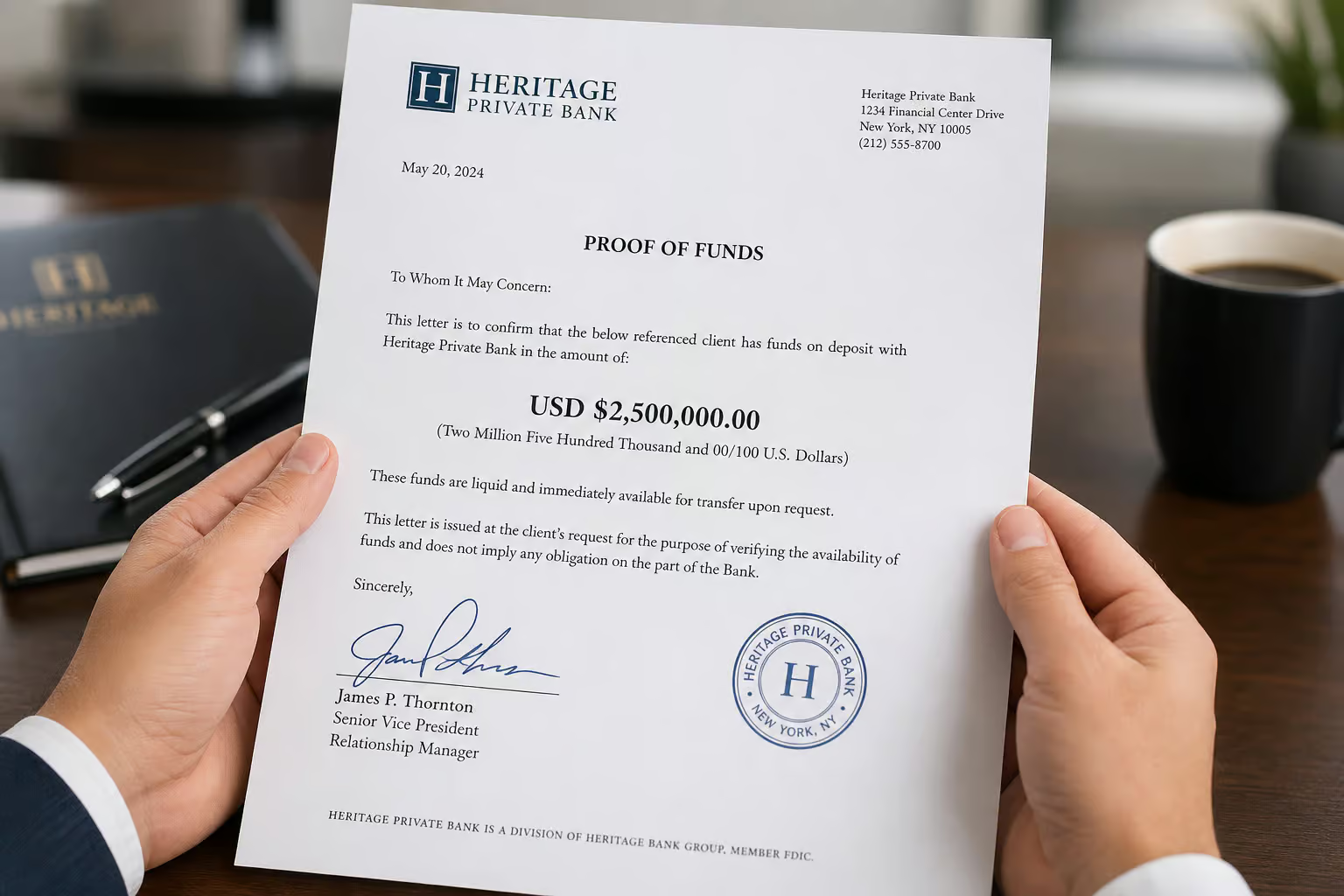
The document you need is a proof-of-funds letter from your bank. It’s more official than a bank statement — signed, sometimes notarized, and it says “yes, this buyer has the money.” You include it with your offer. Sherry Ludecker, a Tennessee agent, put it bluntly: Cash is a concept, not a physical object. You need to prove it.
Step 2: Making your offer — which contingencies to keep and which to waive
The big advantage of paying cash: you can waive the mortgage contingency. That means the seller doesn’t have to worry about your financing falling through. That alone makes your offer stronger than most financed offers, even if your number is lower.

But waiving other contingencies is a different story. In April 2026, 19% of buyers skipped the inspection contingency and 16% skipped the appraisal contingency, according to the Realtors Confidence Index. So most buyers still keep those protections — and for good reason.
Here’s a middle ground: you can do an inspection “for informational purposes only.” You still get to walk away if you find something awful, but you won’t ask the seller to fix anything. Agents recommend this as a way to stay competitive without giving up all your safety.
And then there’s the appraisal. Christine Marchesiello, a New York agent, says “the appraisal can throw the entire transaction” — but that’s when there’s a mortgage involved. As a cash buyer, you can waive the appraisal contingency to make your offer even more attractive. But you risk overpaying if you skip it.
You’ll also put down earnest money — typically 1% to 3% of the price — as a deposit demonstrating your commitment. It goes toward the purchase if the deal closes, but you could lose it if you back out without a valid contingency. Your agent can help you figure out the right amount.
Red flag: Waiving the appraisal contingency saves time but risks overpaying if the market shifts.
Step 3: Due diligence — no lender means you’re the only safety net
Without a loan, all that responsibility falls on you. When you get a mortgage, the lender shares the oversight — they demand an appraisal, require insurance, and make you check the title. Skip something and you own the problem.
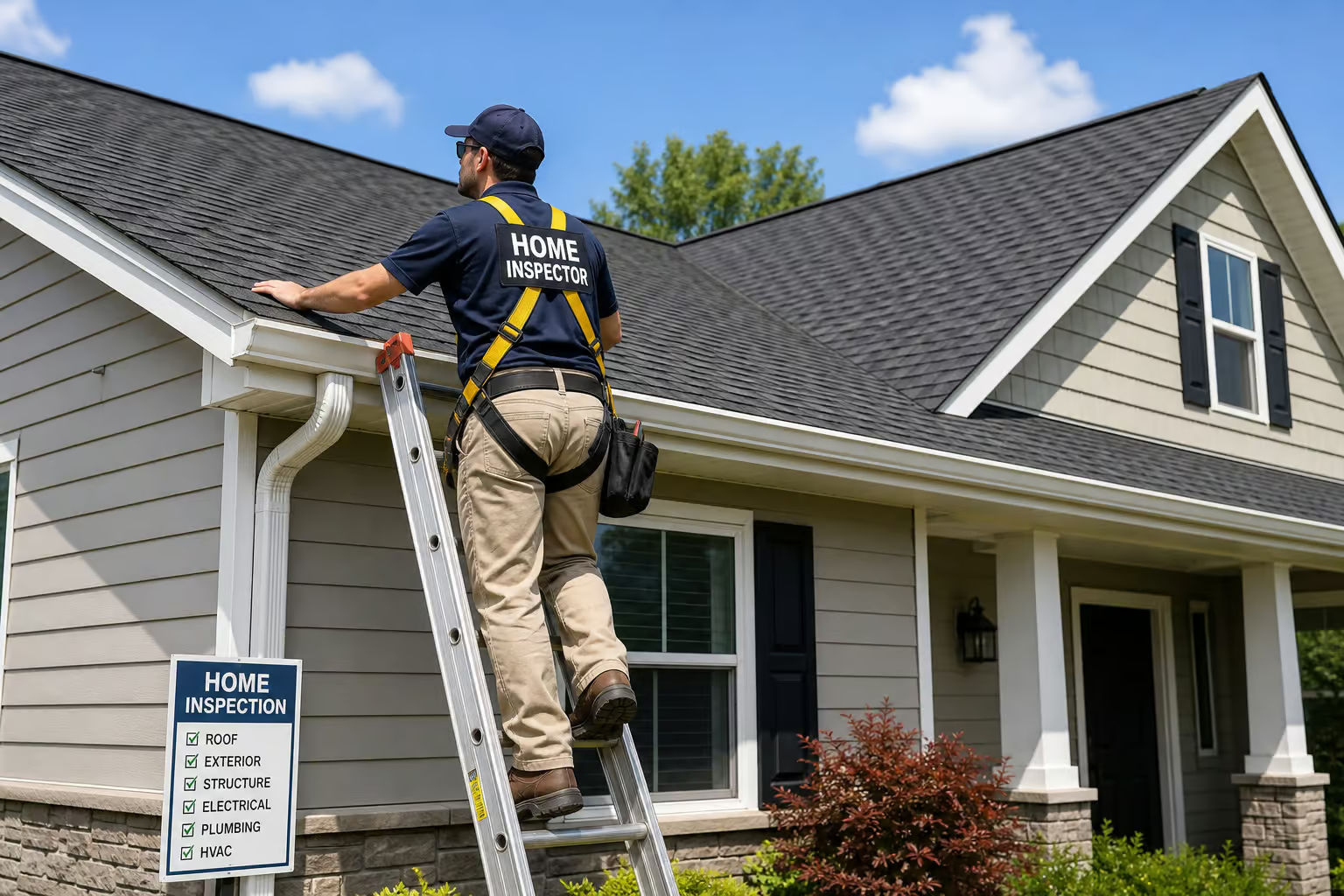
Home inspection: You don’t legally need one. But skipping it is like buying a used car without looking under the hood. A professional inspection can find damage, safety hazards, and repairs a walkthrough won’t reveal. Don’t skip it.
Appraisal: Not required when paying cash. But it’s a sanity check — it tells you the house is worth what you’re offering. If the appraisal comes in low, you can renegotiate or walk away. Without one, you might overpay and struggle to sell later if the market cools, so consider the pros and cons of buying a house in cash before proceeding.

Title search and title insurance: Title research checks for liens or claims against the property. Liens have to be cleared before you can buy. Title insurance protects you if something was missed — it’s a one-time fee and peace of mind.
Land survey: Advisable for large or irregular lots, to know your exact property boundaries, floodplain status, and easements.
Homeowners insurance: Not required by law for cash buyers. But if the house burns down, you’re out everything. Get it.
Step 4: Closing the deal — faster, but not free
Cash closings typically wrap up in one to three weeks, compared to 30 to 45 days for a mortgage.

On closing day, you pay via wire transfer or a cashier’s check. No physical cash. If you are considering paying that way, you might wonder whether is it suspicious to buy a house with cash; however, the escrow company handles everything and sends you a detailed breakdown a few days before.
You still have closing costs, even without a mortgage. You’ll pay for:
- Title insurance
- Escrow or settlement fees
- Pre-paid property taxes
- Recording fees
- Home inspection fees
What you avoid: mortgage origination fees, underwriting charges, and discount points. Those are lender-specific costs that simply disappear.
Your earnest money deposit gets subtracted from the total, so you bring the remaining balance on closing day.
So… is paying cash actually worth it?
Let’s look at the numbers. On a $400,000 home with 20% down at 6% over 30 years, you’d save $370,682 in mortgage interest and avoid $1,919 in monthly principal and interest payments, which highlights the advantages of buying a home with cash. That’s real money.

Plus that 10% average discount from the UC San Diego study. On a $400,000 house, that’s $40,000 off the price.
But there are tradeoffs:
- Liquidity: That cash is now in a house. You can’t easily get it back for emergencies, car repairs, or summer camp.
- Mortgage interest deduction: You lose it. (Property taxes are still deductible, but talk to a tax pro — this isn’t tax advice.)
- Opportunity cost: Could that $400,000 generate higher returns in the stock market or a business? Depends on your timeline and risk tolerance.
If paying cash would completely drain your savings, don’t do it. You need an emergency fund.
One escape hatch: you can refinance later. Rocket Mortgage explicitly says cash buyers can do a cash-out refinance to access equity. But that means paying interest and fees at that point — it’s not a free ATM.
The hybrid approach — a middle path nobody tells you about
Most articles frame it as all-cash or full mortgage. But there’s a middle ground: put 50% down and finance the rest. You get:
- A stronger offer than most financed buyers (big down payment = less risk for the seller)
- Lower monthly payment than a standard mortgage
- Less total interest
- Some price negotiation leverage
- The mortgage interest deduction on the portion you finance
- Half your cash still available for emergencies, investments, or other goals
This isn’t for everyone. If you want zero monthly payment and no lender involvement at all, go all-cash. But if you’re worried about draining your savings, the hybrid approach is worth considering.

HomeLight’s “Buy Before You Sell” program lets you unlock equity from your current home to make a cash offer without draining your savings.
Quick answers to common questions
Can you buy with bad credit? Yes — no mortgage lender credit check required for cash buyers.
Does cash affect taxes? You lose the mortgage interest deduction. Property taxes are still deductible. Talk to a tax professional for your situation.
Can you buy without a realtor? Technically yes, but multiple sources recommend against it. An agent handles negotiations, paperwork, and market knowledge. Your cash position is leverage — an agent helps you use it.
Is it suspicious to buy with cash? No, but large wire transfers can trigger anti-money-laundering checks. Keep clear documentation of where your funds came from.
What about the 3-3-3 rule? That’s for financed buyers (3 months savings, 3% down, 3x income). Doesn’t apply to cash buyers.
Buying with cash is simpler, faster, and can save you money — but only if you don’t wipe out your safety net to do it. Do the due diligence, talk to an agent, and consider the hybrid option if it fits.
People Also Ask
What are the disadvantages of buying a house with cash?
The main trade-offs are losing liquidity (your cash is now tied up in the house), missing out on the mortgage interest tax deduction, and the opportunity cost of not investing that money elsewhere. If paying cash wipes out your emergency fund, it’s probably not worth it.
How much less can you offer when paying cash for a house?
On average, cash buyers pay about 10% less than financed buyers, according to a UC San Diego study. That’s not a guarantee, but sellers often accept a lower cash offer because it eliminates the 40% failure rate of financed deals.
Do you get a tax break for buying a house with cash?
You lose the mortgage interest deduction since there’s no mortgage. Property taxes are still deductible, but that’s true whether you pay cash or finance. Talk to a tax professional about your specific situation.
How do you prove you have cash to buy a house?
You need a proof-of-funds letter from your bank — a signed document that confirms you have the cash available. Retirement accounts like a 401(k) or IRA don’t count because they’re not liquid.
Is the hybrid approach of putting 50% down better than buying all-cash?
It can be if you’re worried about draining your savings. You get a stronger offer than most financed buyers, lower monthly payments, some negotiation leverage, and still keep half your cash for emergencies or investments. Plus you can keep the mortgage interest deduction on the portion you finance.

Great article! This is one of the clearest explanations I’ve seen on buying a house with cash. I especially appreciated the balanced view — many people focus only on the benefits, but the points about liquidity, opportunity cost, and not skipping inspections are extremely important. The “hybrid approach” section was also very insightful because it gives buyers another option besides choosing between all-cash and a full mortgage. Overall, a practical and well-researched guide for anyone considering a cash purchase.