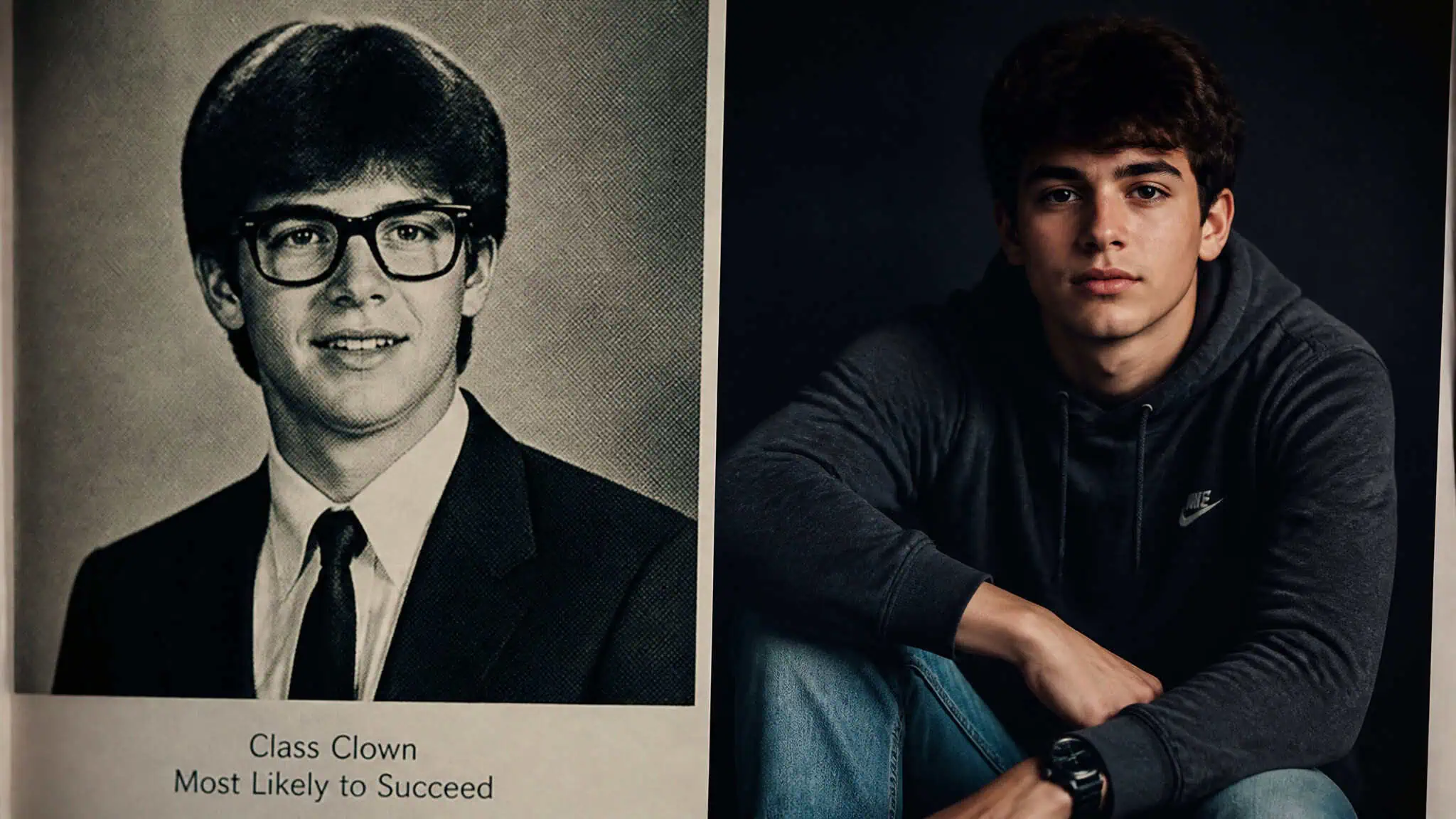
You know the moment. You’re flipping through an old yearbook or catching a rerun of some teen movie from the ’80s, and you stop dead on a face. The hair, the blazer, the confident smirk. There’s no way that kid is seventeen.
He’s got a mortgage and a retirement plan, surely. But the caption says he was a junior.
Then you look up at your own kid scrolling on the couch, or you mentally picture the kids at the local high school, and the contrast hits you like a wall. They look like babies, right? They all look like they’re about twelve. It’s one of the most common, universally shared observations on the internet: why do high schoolers look so young these days? Does everyone from the past just look ancient, or are we actually aging differently?
It turns out, the answer is yes to both. This question got a huge boost when educator Michael Stevens, known for his Vsauce YouTube channel, tackled it in a video that went on to rack up over 14 million views. In it, he explained that the reason for this weird discrepancy is a heady mix of psychology and hard science. Your eyes aren’t lying to you, and neither is your memory. It’s a combination of a subconscious trick called “retrospective aging,” and some very real, measurable changes in how our bodies are living through time.
Key Takeaways
It’s partially a trick of the eye: Retrospective aging means we subconsciously associate vintage clothes and hairstyles with older people, so our brains add years to old photos of teens.
We’re biologically younger than previous generations: A 2018 Yale and USC study found that biological age has decreased across all age groups over a 20-year span, even calculating a 60-year-old now roughly looks 56.
Lifestyle choices did the heavy lifting: Dramatic drops in smoking rates, better sun protection, and improved living conditions have literally changed how we age on a cellular level.
Table of Contents
Why your dad’s glasses are a disguise
So let’s dive into the first, and weirdly comforting, reason why those old photos look so wrong. It’s not that those kids were secretly crypto-babysitters; it’s your brain playing a trick on you.
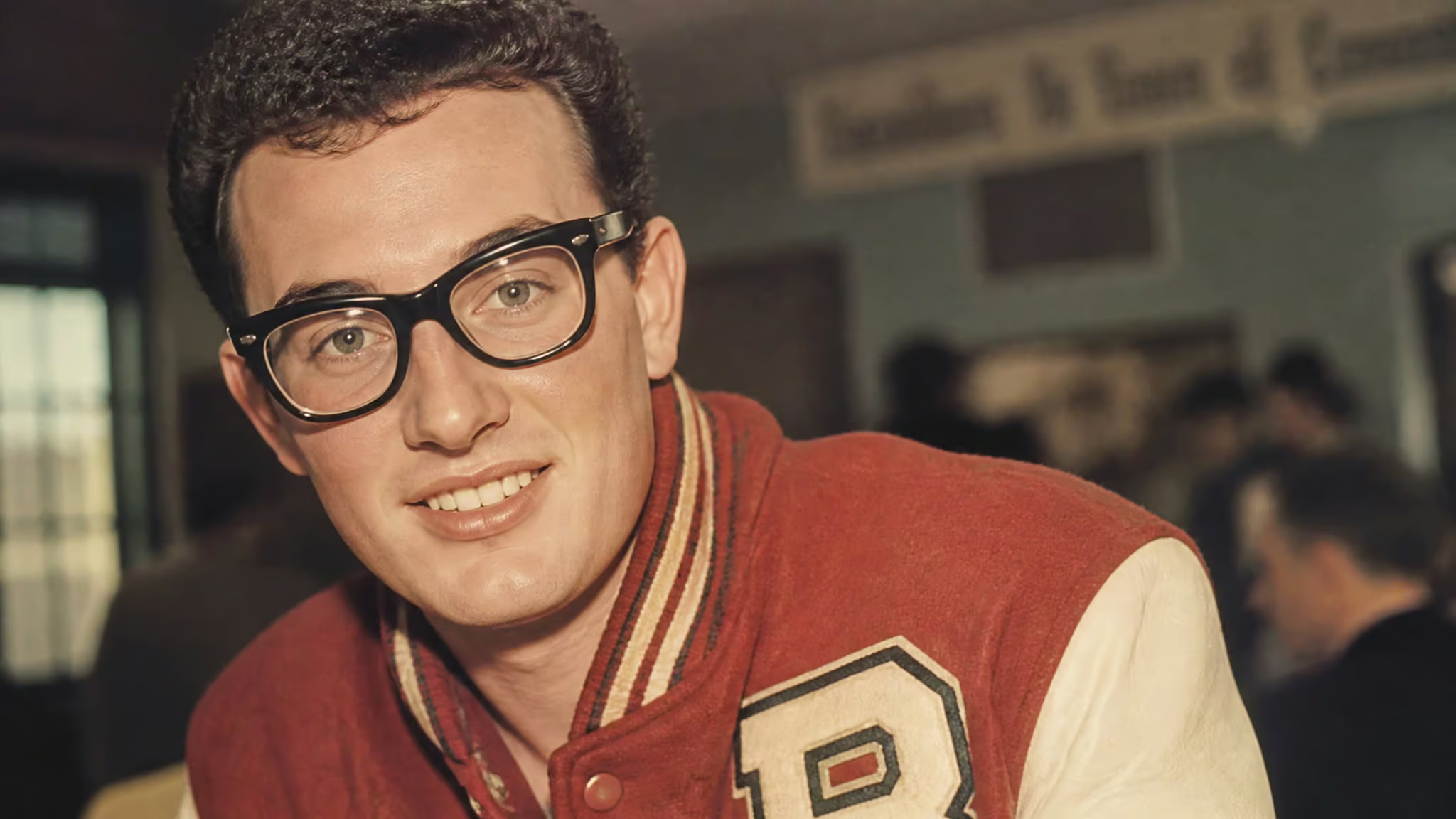
Think about the Buddy Holly glasses. Thick, black, and round, they’re a fashion statement. When they first came around in the 1950s, they weren’t aggressive, they were a subversive, fashionable choice for teenagers. But the generation that was wearing them?
They kept wearing them. They grew up, got older, and their style stayed completely frozen. Now, when you see a yearbook photo of a kid wearing those same glasses, your brain starts clocking it. I see Buddy Holly specs, and I see that haircut at my grandfather’s pharmacy, your pattern recognition screams, “this must be someone’s grandpa.” And just like that, you add fifteen years to the face in the photo.
This is retrospective aging. We project “old” onto these clothes because the people who wore them were actively aging with them.
This is also why people like Dale Irby are such fascinating time capsules. Irby is a Texan who accidentally wore the same sweater and vest in his school pictures for 40 years, starting in 1973. You can look at those early photos and laugh because he looks like a dad figure, even when he’s a high schooler. The clothing just… ages him in our minds.
It’s the exact same effect with everything else. A hairdresser named Gwenda Harmon once pointed out to Dazed Digital that the 1980s coif, those big perms and textured bangs, made young women look like they aged a decade in a day. It’s also that film cameras added a texture that reads as “old” to things, regardless of the biological face underneath.
The science says you’re (literally) younger
Okay, so we know the fashion is doing some heavy lifting, but that doesn’t explain the whole story. You’re not just logically fooled, it turns out that our bodies are genuinely younger than those stalwarts were.
There’s a difference between a ring’s age (your calendar age) and your biological age (the age your body acts like it is, based on measurements like blood pressure, sitting TV, lung capacity, and specific markers in your blood).
In 2018, researchers at Yale University and the University of Southern California (Los Angeles) published a study that dug right into this. They compared Americans measured between 1988 and 1994 with Americans measured between 2007 and 2010. They looked at cholesterol, blood pressure, lung function, and molecules in the blood. What they found was fairly stunning: for both men and women, in every single age group they looked at, biological age had decreased relative to actual age.
It held across the board, but the effect was a bit different depending on where you looked. A have a 60-year-old in the later group, on average, had the biological body of someone who was 56. Someone of 40 was closer to 37.5, and even a 20-year-old was looking slightly younger, closer to 19. These are the “ageless” numbers that get bandied around, and they hold up, though why do high schoolers look younger now reddit threads offer crowdsourced yearbook comparisons that suggest the trend may be even more visible in the hallways than in the lab.
The gender differences are interesting, though. For younger adults, men came in the biggest pole position. Men in their 20 and 30s had dropped their biological age by about 15 months, whereas women in the same bracket had “only” gained a few months. But when you look older, the scales tip: women in their 60s and 70s were about three years and eight months younger biologically, while men that same age had lost over four years.
A huge reason for the closing gender gap likely comes down to smoking, but we’ll get to that in a second. The most important, and arguably the most humbling, is that the scientists entirely admitted they couldn’t trace all of the changes. They guessed it’s had a mix of better early childhood health, in-womb conditions, and fewer infectious diseases, but the “why” is still a gray area.
The anti-aging in sickness: smoking, sun, and smog
So, what is dragging those biological clocks backward? Well, it’s not a magic pill. It’s a dizzying amount of boring, everyday improvements in our living situation.
The big one is, unmistakably, smoking. Doctors have a whole name for the effect of smoking on your face: “cigarette skin.” Not exactly a fake tan name, but it’s the look of gray-ish, dry, rough-looking buildup. Nicotine and the smoke reduce blood flow to the skin, literally starving it of oxygen and damaging the collagen that keeps it firm.
It triggers oxidative stress, and all that squinting from irritated eyes does you no favors either. In 1965, about half of all Americans and Canadians smoked. Today, that number has dropped to about 1 in 7 Americans and 1 in 10 Canadians. That’s a massive reduction in a hazardous skin-sabotage, just pulsing through the general population’s face, and it’s not negligible.
Sun follows closely behind. UV rays are the biggest single enemy. It’s a major cause of photo-aging, that leathery, aged look. We all burn more sunscreen now, which has become a stealthy anti-aging weapon that did give us a kind of spur.
Then there’s air pollution, the literal smog that’s outside my window. We are things like ozone and “particulate matter” trigger a chain of release that inflames skin cells, though that’s harder to control. And these forces are all cumulative. We shudder to think what the diet and skincare of a Victorian chimney sweep took. Those sweeps, the grubby had tons of labor, looked around twenty years older than they were.
And this isn’t just skin deep, either. Poor dental care and orthodontics do more than just create a straight smile; they keep the lower part of the face supported, keeping that structure from giving in to the old age.
The “Tweakments” and the Toddler Aesthetic
Holding the clock at bay is now a huge part of public culture, which complicates our answer. In previous generations, if you wanted to look younger, the only real chances were heavy makeup or a drawer cream. Now, youth has been made into a consumerized habit, and the pressure to maintain it often explains why teens in the 2000s appeared more mature.

For Millennials and Gen Z specifically, it’s not just about the products. Less invasive, cheaper procedures like Botox and fillers are becoming normalized “tweakments” at broader age ranges, alongside things like teeth whitening and other, er, subtler tricks like buccal fat removal or texture creams. When you see someone that looks incongruously smooth for their age, it isn’t just genetics; it’s increasingly likely that there are serums and injections doing the legwork you can’t see. Yet the perception cuts both ways why do teenagers look older now is a question that surfaces when early puberty and social media polish blur the lines between youth and maturity.
But that’s just the physical meddling. There’s also the big cultural shift in fashion cycles. Where the teens of the 80s were styled to look like mini-adults, dressing up and aspiring to an adulthood, the Millennial and Gen Z aesthetic is pretty clear: take a trip back to childhood. You see it everywhere: cartoon-printer T-shirts, bright colors, textures, cute accessories with cats.
They are playing it safe and youthful, your looks almost purposely toddler-soft, in defiance of the whole “grown up” signifier that generations before wore like a suit. So even though fashion is a misleader, some of it is a little bit of a “lie” that is also working in real time to make the average demographic look younger, which is exactly why do teens look younger nowadays when you compare decades of yearbook photos and track how digital filters have shifted our baseline for what a young face should be.
The Weird Match Between Names and Ago
If the fashion and flush were starting to tangle, now we get into the strange that just goes to show you that the final spread: This stuff is at the very fringe of psychology. But there are theories, the Dorian Gray effect, and the name-matching effect, that suggests that our perception of age is deeply influenced by our social scripts. The theory holds that names carry preconceptions, and those expectations can shape how we perceive a person’s features. Relatedly, the “name-matching effect” notes that people whose faces match whatever a name connotes tend to be better-liked and be easier to connect.
It’s not a settled science at all, but it’s a useful reminder. The “trajectory” of a person’s age is not just biologically what’s on your face, it’s culturally colored by the labels they have. In politics, that pulls us right into the trap.
The Millionaire trap of the viral photo
We can’t beat the feeling of “everyone looks older” without groaning at the internet. The algorithm isn’t designed to show you a representative sample of human faces. It’s designed to show you things that make people “duck” or “.”
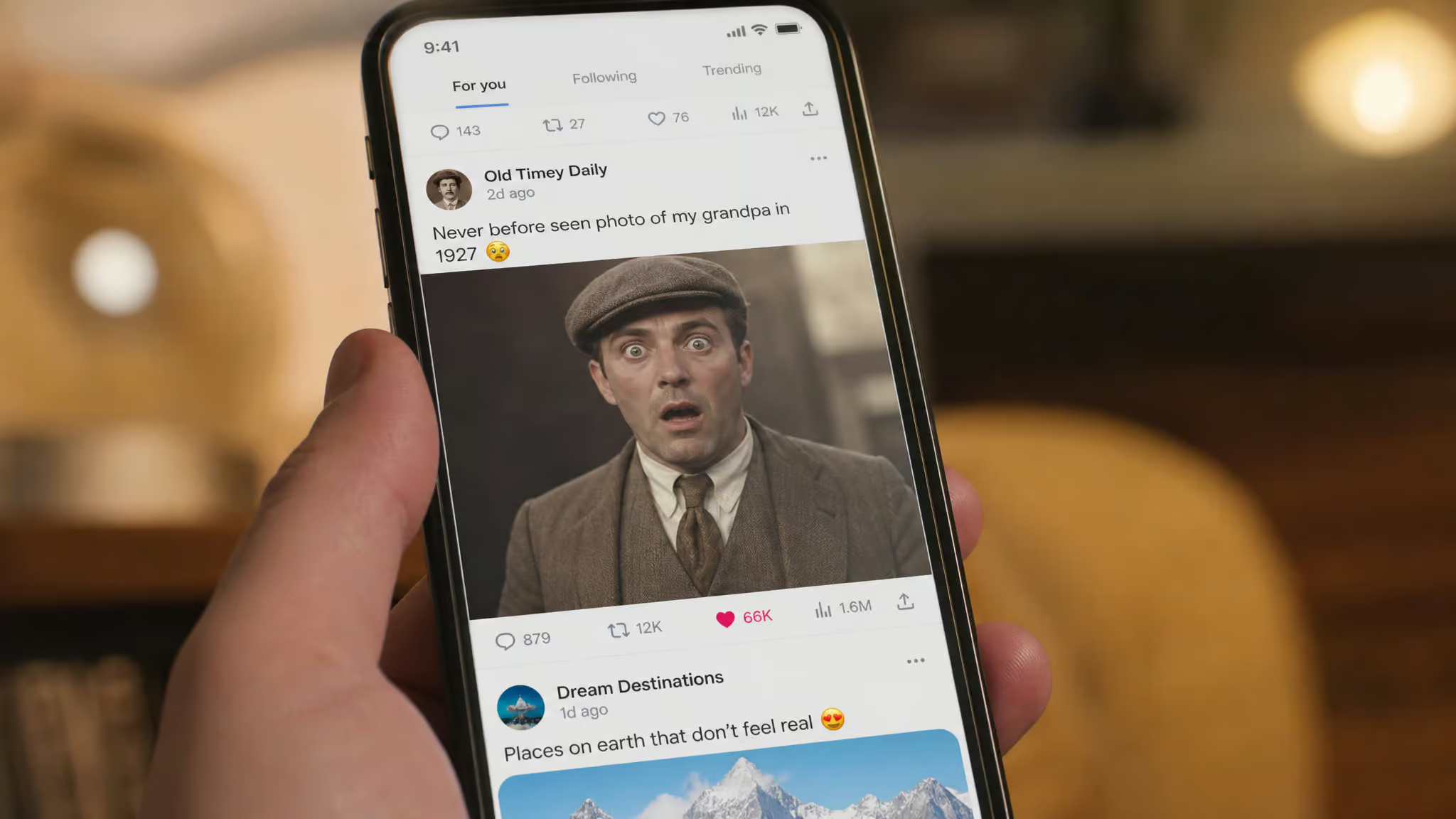
The photometer of a balding 25-year-old resemblance to a former President? The 45-year-old dad in the 70s garb who looks miserably old? This browser laced it right into your feed. Those are not examples of the average.
Those are examples of dramatic outliers. It’s the same reason why Sonny from Grease looks like a 50-year-old: that’s director John Travolta, style and slick. He was a product of that audience, but he’s an extreme, iconic exaggeration made to be memorable.
When you scroll past the 40-year-old who looks 20 or the teen who looks 15 in a way that’s completely impossible, you’re the spectator in the relationship. But it’s a selection bias, not a science. It only works because the internet sees a beautiful one-in-a-billion genetic lottery and goes viral. Once you have actual data, for risk is that we look at our own Facebook memories from college and think “Oh, we actually look… like kids.”
Then, it’s confusing. Because the average is full of childless faces.
The mystery of what we don’t know yet
It’s only fair to be a little prism. The biggest thing to say is: don’t buy any company that claims to have a biological age test ready for the clinic. They aren’t ready for a face.
The testing is strange, as it got many different systems you get radically different results. One blood test clocks you by measuring DNA changes in white blood cells, and another looks at the plaque proteins in urine. They could take you as far apart as a decade. The number you see printed on a fancy giant your dead is, for now, a scientific hypothesis, not a fixed number.
And the same scientific efficiency applies to the miracle of antioxidants. We do believe a “high oxidizing stress” has a role in damaging skin cells, but reactive oxygen contains stuff are not evil thing you have to make a prayer about doing. A bad lot is also important for your body’s normal function. The elaborate “tweakment” pill as a beauty gospel is currently a prayer, not a true fact. The truth isn’t that “stress” brings age, it’s nature: consistent external wear and tear is doing it, and that’s not a favorite game unless you’re in a nitrogen, either.
Where the lens ends
So, is it all in our heads? Is it real?
Yes. The answer isn’t an “or”; it’s an “and stubborn.
Part of this is because what you’re looking at is graph. Your sense that someone is “old” is precariously at the mercy of a hairstyle, a jacket, a posture he’s dressed in. The movie backwards working in that, twenty years from now and your kids might think your high school coulotte looks like you were preparing for a middle management panel.
The other part is real and captured in a hospital. Because across the last few decades, the diet, the medicine, and the general daily grime has slowed the clock of the clock. Quit smoking more, wear sunscreen, and getting your teeth fixed, this is the “anti-aging” that’s actually done work, and it’s not a privileged $400 fee. It’s available.
And what’s left for us is the nuance. It’s a bit of a weird thought, to be seen through the filter that kind of reveals what your younger self was, with beater of your hair or a ironed-in style. But it’s okay, rather than trying to be relentlessly, it doesn’t make us look older and you’re craving, it also lets us be a little gentler to ourselves and each other when we realize how much a skin is shaped by a decade. We don’t have to look any particular way to be our genuine chronological age.
Frequently Asked Questions
Why do teens look so much younger now than in old photos?
It’s a mix of perception and biology. Your brain projects “old” onto past styles like thick glasses and permed hair, a trick called retrospective aging. But people are also genuinely younger biologically now, thanks to lower smoking rates, better sun protection, and improved living conditions.
What is the biological age vs. chronological age difference?
Chronological age is how many years you’ve been alive, while biological age is how old your body acts based on markers like blood pressure, lung capacity, and cellular health. A 2018 Yale and USC study found that across all age groups, people’s biological age has dropped, so a 60-year-old today often has the body of a 56-year-old.
How does smoking affect how old you look?
Smoking accelerates aging by reducing blood flow to the skin, starving it of oxygen, and damaging collagen. This causes what doctors call “cigarette skin” — dry, rough, and prematurely wrinkled. Since smoking rates have dropped dramatically since the 1960s, that’s a major reason people look younger now.
Which generation is the youngest looking?
Current teens and young adults generally look younger than previous generations did at the same age. This isn’t just perception—a 2018 Yale and USC study found biological age has decreased across all age groups, meaning people are aging slower than they did decades ago.
How does fashion make people look older in old photos?
Fashion triggers retrospective aging: your brain associates certain styles—like Buddy Holly glasses or 1980s permed hair—with older people because those styles were popular decades ago. The people who wore them then grew older while keeping that look, so your pattern recognition automatically adds years to anyone wearing them in old photos.
What is the difference between chronological age and biological age?
Chronological age is simply how many years you’ve been alive—the number on your birthday cake. Biological age is how old your body acts based on markers like cholesterol, blood pressure, lung capacity, and cellular wear-and-tear. A 60-year-old can have a biological age of 56 if their lifestyle and health are better than average, which is exactly what recent studies have found.
Does smoking really make you look older?
Yes, and it’s not subtle. Smoking reduces blood flow to the skin, starving it of oxygen and damaging collagen, which leads to a condition doctors literally call “cigarette skin.” It also triggers oxidative stress and makes you squint, which adds wrinkles. This is a big reason why the dramatic drop in smoking rates over the past few decades has made entire generations look younger.
Can sunscreen and skin care actually reverse biological aging?
They don’t reverse aging, but they slow it down significantly. Sun exposure is the single biggest external cause of skin aging, and sunscreen prevents the damage that leads to wrinkles and leathery texture. Along with other everyday improvements like better living conditions and fewer infections, these habits have measurably reduced biological age across whole populations—meaning a 60-year-old today often looks and functions like a 56-year-old from 20 years ago.