
My parents aren’t getting any younger, and at some point in the last few months the vague worry turned into research. What I found fast: touring a memory care facility is a sales performance. The person walking you through the building has a script, the community is at its best behavior, and you’re supposed to make a six-figure decision, roughly $104,025 to $116,800 a year nationally, on the strength of that.
So I went looking for a way to think about it, and the best thing I found is a ten-question checklist from Pam Ostrowski, author of It’s Not That Simple, writing in Alzheimer’s TODAY Vol. 17 No. 1, published by the Alzheimer’s Foundation of America. This piece is that framework plus the stuff around it: how to time the search, how to tour past the performance, what documents to demand, and how the money math works before a crisis makes the decision for you.
Key Takeaways
Memory care runs roughly $104,025 to $116,800 per year nationally, most families pay out of pocket, and Medicare never covers room and board or custodial care.
Book one scheduled tour plus one or two unannounced visits at different times of day, including mealtimes, because the unannounced visit shows the real staffing picture.
The most revealing tour question is “How will you know my loved one?”, staff should use life history and routines to individualize care instead of running everyone through the same schedule.
Table of Contents
When is memory care needed? The signals and the care continuum
There’s no magic disease-stage number where memory care kicks in. It becomes the right setting when living at home turns unsafe or unhealthy, for your parent or for whoever’s doing the caregiving. That support can happen at home or in a dedicated community like memory care Yakima. Harvard Health frames the hard triggers as wandering or uncontrolled incontinence, either of which demands around-the-clock supervision that most families can’t staff.
| Exact model | Decisive documented advantage |
|---|---|
| Who’s running the place? | Who’s running the place?: Families typically tour with the marketing and sales director; Talk with the executive director about family engagement, issue resolution, staff training |
| How big or small? | How big or small?: Consider number of resident rooms, room size, private vs. companion rooms, number of dining rooms, indoor and outdoor activity spaces |
| What type of medical care is available? | What type of medical care is available?: Most memory care communities have at least one registered nurse or licensed nurse practitioner on the floor 24/7 (verify per community); |
| How do staff interact with residents? | How do staff interact with residents?: All staff should be trained in dementia care; Common caregiver ratio is one caregiver to five or six residents; Some facilities assign the |
| What’s to eat? | What’s to eat?: Evaluate meal setting and cleanliness; Meet the registered dietician about nutrition needs; Ask about meal alternatives; most communities offer a sandwich or |
| What types of stimulation are available? | What types of stimulation are available?: Facilities should accommodate both higher- and lower-functioning residents; Ask how they ensure activity participation; Ask how much time |
| Are companion rooms available? | Are companion rooms available?: Companion rooms are a good option when private rooms are unavailable or budget is a concern; Executive director matches resident profiles and |
| Are they regulated? | Are they regulated?: Regulation varies by state, not by community, typically overseen by the state’s Department of Health; Search the state Department of Health website for a list |
The other signals are less dramatic but as real. Care needs exceed what the family can handle. The caregiver’s own health starts slipping. The relationship collapses under the weight of the caregiver role, where your mother is now your patient and you’re now her nurse instead of her son. If any of those describe your house, the clock is already running.
It’s easier to picture if you see the whole continuum, because “memory care” is one stop on a longer line:
- Retirement housing fits the early stage, someone still mostly independent who wants limited supervision and social activities.
- Assisted living is the bridge, help with daily tasks, but not necessarily dementia-specific care.
- Memory care, or Special Care Units (SCUs), serves mid-to-late stages. These are usually cluster settings on a floor or unit of a larger building, and they may or may not be locked.
- Nursing homes handle the highest medical need, with around-the-clock care and long-term medical treatment.
One more option worth knowing: continuing care retirement communities (CCRCs) put multiple levels of care in one community, so a person can move between them without leaving the place. That matters more than it sounds, because every move is disruptive.
The reframe that made this click for me: timing isn’t a stage, it’s a set of failure signals. When home stops working, that’s the trigger, not a diagnosis milestone on a chart.
Memory care vs. assisted living: what “dementia-capable” actually means
The difference isn’t the label on the door. It’s whether the community actively closes support gaps, and here’s the uncomfortable part: not all assisted living is dementia-capable. Assisted living is regulated only at the state level, and definitions vary by state, so the same phrase covers very different operations.
The Alzheimer’s Association gives two concrete examples of what “not enough support” looks like:
- A community that offers activities but doesn’t actively encourage anyone to participate. The calendar looks full; nobody actually shows up.
- A community that sets up a weekly pill box but won’t give daily medication reminders. For someone with dementia, that’s a gap with real consequences.
Those two examples are the test. When you tour, ask what the community does, not just what it offers.
Who’s running the place? Leadership beyond the tour guide
Here’s something I didn’t know: the person giving you the tour is almost never the person running the place. Families typically tour with the marketing and sales director, which means you’re hearing the tour script, not the culture. The executive director is the one who sets it.
Engage the executive director directly on five things: how families are involved in care, how problems get resolved, staff training and certifications, COVID policies, and resident security. Then talk to the nursing staff and the medical director too. If the top person can’t answer basic questions without a sales pitch, that tells you something on its own.
How big or small should the community be?
The things worth noting on a tour: number of resident rooms, room size, private versus companion rooms, number of dining rooms, and indoor and outdoor activity space. Write down what you see. Two communities with identical brochures can feel different at scale.
What type of medical care is available?
Most memory care communities keep at least one registered nurse or licensed nurse practitioner on the floor 24/7, but that’s a benchmark to verify, not a universal. Ask directly, and speak with the nursing staff and the medical director about how they engage with families. Questions worth asking:
- Is a registered nurse on site at all times, or is coverage thinner than that?
- How do nursing staff and the medical director communicate with family members?
- Who coordinates physician visits, and how often do providers come on site?
How do staff interact with residents? Ratios, training, and behavior management
The numbers are checkable: a common caregiver ratio is one caregiver per five or six residents, and all staff should be trained in dementia care, not just the caregiving team. Some facilities assign the same caregiver every day, which helps residents feel oriented; that practice varies, so ask.
But the ratio math isn’t the decisive question. This is:
- How do caregivers manage distress, anger, and aggression?
- Are you comfortable with the answer?
That second question is the real one. A facility can hit every staffing benchmark and still handle a frightened, combative resident in a way you’d never accept for your own parent. Listen to the answer, then trust your gut on it.
How will you know my loved one? The individualized-care test
Of everything I’ve read, this is the most revealing tour question, and it isn’t about amenities or ratios. Ask the staff: how will you get to know my loved one? The framing comes from Senior Star Elmore Place. Executive Director Annette Martinez and Memory Care Director Emily Baker explained it in a KWQC segment that aired September 17, 2026. Staff should use life history, routines, interests, and preferences to individualize care, not run everyone through the same schedule.

The proof is observable on the tour itself. Do associates know residents by name? Does daily life feel natural, or staged? The companion question to carry with you: can I see my loved one being at home here?
Individualized care looks small from the outside. Five quiet minutes on a task someone actually enjoys. Folding towels. Helping tidy a dining space. Those moments are the product you’re buying, more than any amenity on the brochure.
What’s to eat?
Meet the registered dietician and ask about nutrition needs. Most communities offer a sandwich or similar alongside hot meals as an alternative. Ask about special dietary needs like low sodium or diabetic menus, mealtime flexibility, and distractions like a noisy TV in the dining room.
What types of stimulation are available?
A good facility accommodates both higher- and lower-functioning residents. Ask how they ensure participation, and how much time residents spend in their rooms. Typical programming covers gardening, crafts, cognitive games, exercise, music, and reminiscence therapy. Ostrowski’s own take, clearly her opinion: no TV in resident rooms, so residents have to leave the room to find stimulation. I’m inclined to agree with the logic.
Are companion rooms available? The private-room assumption, tested
A companion room can be a good option, when the budget is tight, when private rooms aren’t available, and sometimes because it’s better for the resident. That last one surprised me.
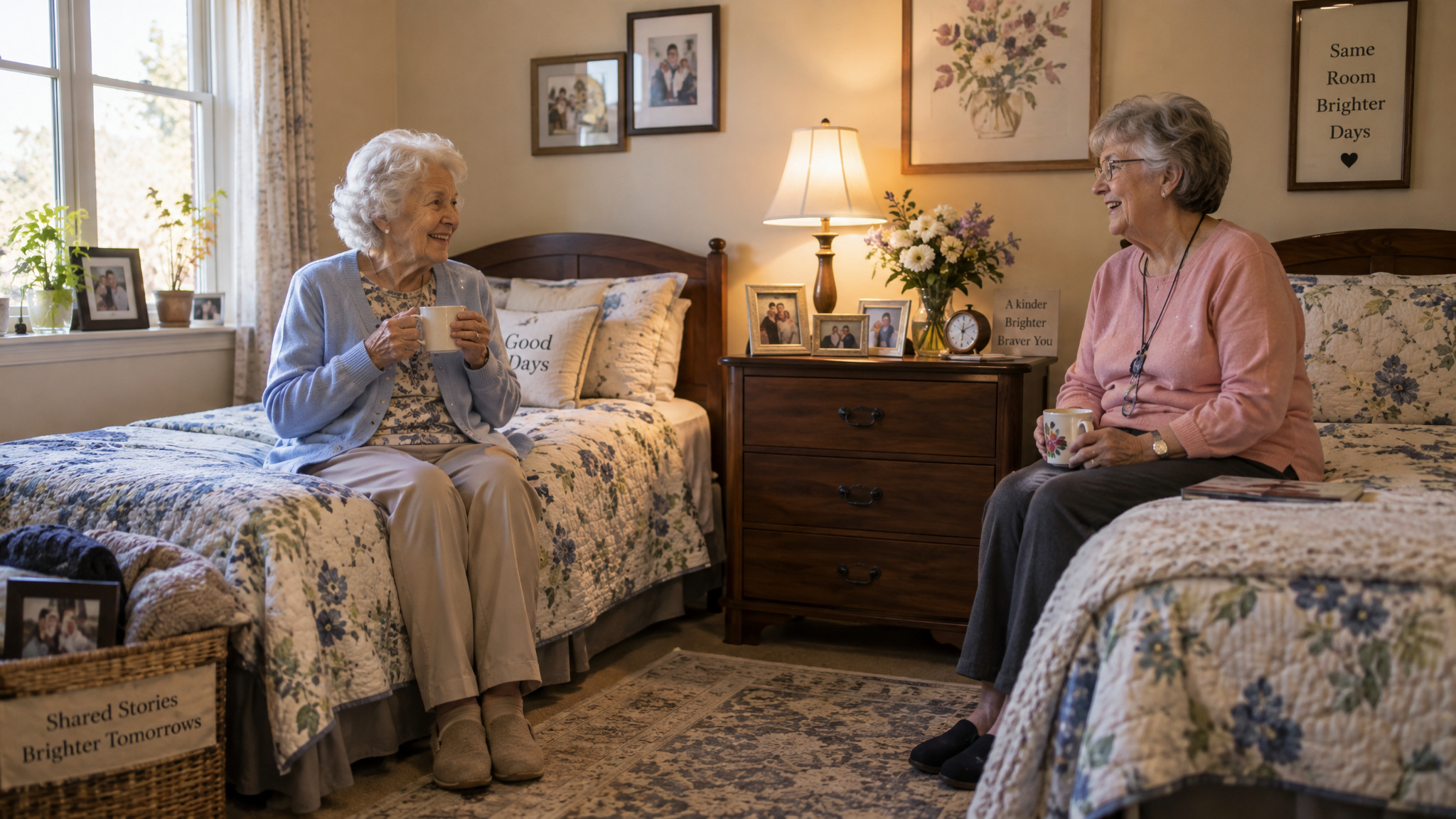
The mechanics: executive directors match resident profiles and observe compatibility, so a shared room isn’t a random bunking assignment. And Ostrowski’s own published account is worth hearing. Her mother’s private room always felt empty, and after switching to a companion room, both women seemed happier. That’s not every family’s outcome, it’s a tradeoff each family weighs, but the private-room default deserves to be questioned.
One question almost no checklist covers: can your loved one stay in the same room as the condition progresses? Room changes are disorienting for someone with dementia, and “aging in place” within the community is a real differentiator between facilities, especially when comparing assisted living options, as this retirement guide to choosing a place for your parents points out.
How do you tour a memory care facility? Multiple visits, unannounced
Book one scheduled appointment, then make one or two unannounced visits at different times of day, including mealtimes. Sample the food while you’re there. Talk with staff, residents, and their families, the families especially, since they’re living the place you’re only evaluating.
The scheduled tour is a performance. The unannounced mealtime visit is where the real staffing picture shows up. Families commonly describe the same pattern at places that look great on tour: call lights going unanswered, residents parked in front of a TV with nobody encouraging them to do anything.
Quick test: Show up unannounced at mealtime. Call lights answered, residents engaged, no odors — that’s the real staffing picture.
While you’re walking around, check the wellbeing indicators: are residents groomed, involved in activity, is the fall rate discussed openly, are there unpleasant odors, and do residents whose primary diagnosis is psychiatric illness share the dementia unit?
Are they regulated? How to verify with documents, not brochures
Yes, memory care is regulated, but by state, not by community, typically through the state’s Department of Health. And there’s no uniform legal definition of “memory care,” which is why the label means different things in different states. Nursing homes are state-licensed and federally regulated; assisted living is state-regulated only.
Three documents turn this into due diligence:
- Search your state Department of Health website for the list of regulated facilities and request the latest survey or inspection report.
- In some states, request the Special Care Unit Disclosure form, which lists fees and specialized services. Many families don’t know this form exists, and it doesn’t exist everywhere.
- For nursing homes, check medicare.gov/NursingHomeCompare and compare the facility against the national average.
Brochures are marketing. These are records.
Is there a waiting list? Why the search starts before the crisis
Waiting lists are common at the best communities, which is why the search should start when symptoms first appear, before a crisis forces your hand. The mechanics are friendlier than most people expect: you can join a list and pass if you’re not ready yet. But ask what happens when you pass, because some communities attach consequences to it.
The usual logic says touring early is premature. It’s the opposite. Getting on a list now is buying optionality, you decide later, on your timeline, instead of accepting whatever has an opening in a bad week.
How much does memory care cost, and how should families fund it?
Nationally, memory care runs roughly $104,025 to $116,800 per year for a semi-private versus private room, based on nursing-home averages, and most families pay out of pocket. Long-term care insurance, Medicaid, and veterans’ benefits can cover some or all of it, and plenty of families end up selling a home to fund care. Costs vary widely by state and facility, and prices may vary, the averages and case figures here come from their cited sources, not a fresh check.

What it costs. A worked example from a financial case published June 11, 2026: Karen and David’s preferred facility charges about $95,000 a year, one facility’s price, mid-range nationally for a private dementia-unit room, not a national average. That covers housing, meals, 24-hour supervision, medication management, and the locked environment. It excludes physician visits, hospitalizations, and separately billed supplies.
Their income is $85,000 a year, leaving a $10,000 annual gap. Lifetime cost for an 82-year-old could run $600,000 to $800,000 or more, and generating $95,000 a year at a 4% withdrawal rate takes roughly $2.4 million in assets. Annual increases of 3% to 5% are common, so the gap widens over time.
What Medicare and Medicaid actually cover. Medicare never covers room and board or custodial care, only medical services like physical therapy, doctor visits, certain medications, and assistive equipment such as shower seats and bedside commodes. Most families have to correct that assumption the hard way. Medicaid does pay for long-term care, but only once the patient spends down to roughly $2,000 in countable assets, only at participating communities, and there’s a five-year look-back on transfers: gifts, property transfers, and certain trust funding can trigger penalty periods. And note, eligibility depends on the patient’s assets, not the adult child’s.
A funding sequence. Fund from the patient’s own balance sheet first: Social Security, pension, savings, long-term care insurance, home equity. Many people sell homes to pay for memory care. The sequencing from the case: admit while qualifying for the private-pay tier, fund the first 18 to 36 months from the patient’s resources, engage an elder law attorney within the look-back window, and cap any family supplement at the annual gap, $10,000 a year here, rather than committing your own retirement. Subsidizing a parent from your retirement doesn’t help them qualify for Medicaid, and it can break two retirements instead of one.
Cost check: Cap any family supplement at the annual gap. Subsidizing a parent from your retirement can break two retirements instead of one.
Two comparisons worth having in your head. Around-the-clock home aide care at roughly $30 an hour runs over $250,000 a year, and the typical arrangement, eight hours of paid care plus family overnights, lasts about six months before it breaks down. For advanced dementia, the facility is often the cheaper option, not the luxury one. And ask the contract question almost nobody asks: what happens if a private-pay resident runs out of money? For anything state-specific, talk to an elder law attorney; this article isn’t legal advice.
Where to get help: local referrals and the restored family role
Everything above applies locally, and three referral channels do the legwork for you. Local senior living placement agencies, findable through the National Placement and Referral Alliance at npralliance.org, know the local options better than any national directory. The Alzheimer’s Foundation of America’s Helpline is at 866-232-8484 or alzfdn.org. And the Alzheimer’s Association and AARP Community Resource Finder at alz.org/CRF is a database of dementia and aging resources.
Here’s the part nobody says out loud, so I will. The family partnership works because you provide the background, the life history, the routines, while the care team communicates evolving needs back to you. That collaboration is what prevents caregiver burnout. Most family members feel guilt for not keeping a loved one at home; knowing the person is receiving better care eases it, and relatives get to go back to being spouse, child, or loved one instead of full-time caregiver.
That’s not a consolation prize. For advanced dementia, it’s usually the better outcome for everyone involved, including the person you’re doing all this for.
Frequently Asked Questions
What are the three golden rules of dementia care?
The core rules that come through in expert checklists are: individualize the care around the person’s life history, routines, and preferences rather than running everyone on the same schedule; make sure the setting actively closes support gaps instead of just offering services nobody uses; and treat safety triggers like wandering or uncontrolled incontinence as signals that around-the-clock supervision is needed. Staff should know residents by name, and daily life should feel natural, not staged.
How long does the average person live in a memory care facility?
Lifetime cost estimates for someone entering around age 82 run $600,000 to $800,000 or more, which implies a stay measured in years rather than months. The exact duration varies enormously by individual, so treat any average as a planning input, not a prediction. What matters more for planning is that annual cost increases of 3% to 5% are common, so the funding gap widens over time.
What are some important questions to ask when looking at a memory care facility?
The single most revealing question is ‘How will you know my loved one?’ — staff should use life history, routines, interests, and preferences to individualize care. Also ask whether a registered nurse is on site at all times, how caregivers manage distress and aggression, whether the same caregiver is assigned daily, what happens if a private-pay resident runs out of money, and whether your loved one can stay in the same room as the condition progresses. Engage the executive director directly, not just the sales director giving the tour.
What is the difference between memory care and assisted living?
The difference isn’t the label — it’s whether the community actively closes support gaps for people with dementia. Assisted living is regulated only at the state level and definitions vary, so not all assisted living is dementia-capable. Two telltale gaps: a calendar full of activities nobody is encouraged to attend, and a weekly pill box set up but no daily medication reminders. Memory care (Special Care Units) serves mid-to-late stages, usually as a cluster setting on a floor or unit of a larger building, sometimes locked.