Most parents have a pile of mail on the kitchen counter they cannot face. When you are navigating chaotic school mornings, negotiating screen time, and trying to keep your head above water, ignoring a letter from the government feels like a necessary survival mechanism. I know firsthand that leaving tax letters unopened usually stems from sheer burnout and executive dysfunction, not some grand plan to cheat the system. But burying your head in the sand creates a financial trap, leading to compounding penalties and potential asset seizure.
We avoid the mail because we think the government is manually hunting us down, and if we stay quiet, they will skip over us. Tax enforcement operates as a predictable algorithm. The system follows rigid mathematical rules, and knowing the specific IRS Automated Collection System (ACS) triggers allows you to hit pause before it enacts bank levies or wage garnishment.
Key Takeaways
Unpaid tax debt accrues daily interest and compounding penalties that can legally inflate your original balance by an additional 25%.
The government circumvents the traditional court process to seize your paycheck or bank account directly once your debt exceeds standard automated collection thresholds.
Establishing contact to set up a payment plan actively drops your ongoing failure-to-pay penalty rate from 1% down to a more manageable 0.25% per month.
Table of Contents
What Happens if You Ignore Back Taxes: the Silent Escalation of IRS Enforcement
Ignoring your back taxes guarantees the Internal Revenue Service (IRS) will eventually seize your assets, but you actually have the power to manually pause the machine before that happens.
You might think an agent is sitting at a desk investigating your missing payments; in reality, the IRS uses the Automated Collection System (ACS) to process most accounts. The IRS relies on highly predictable algorithms to send notices and queue up property seizures. Their initial silence after tax season is a sign of procedural queueing, not forgiveness.
The most effective way to protect your personal assets is recognizing that communication is a shield. Break the psychological paralysis by acting on the debt before compounded penalties legally inflate your base liability by an additional 25%. Acknowledging the problem doesn’t invite scrutiny. It disables the automated collection system.
“Communication is a shield; acknowledging the problem disables the automated collection system before it moves to seize your assets.”
IRS Notice Sequence and the Automated Collection System
IRS letters provide a statutory notification timeline dictating when the agency reaches the final notice stage prior to bank levies or wage garnishment.
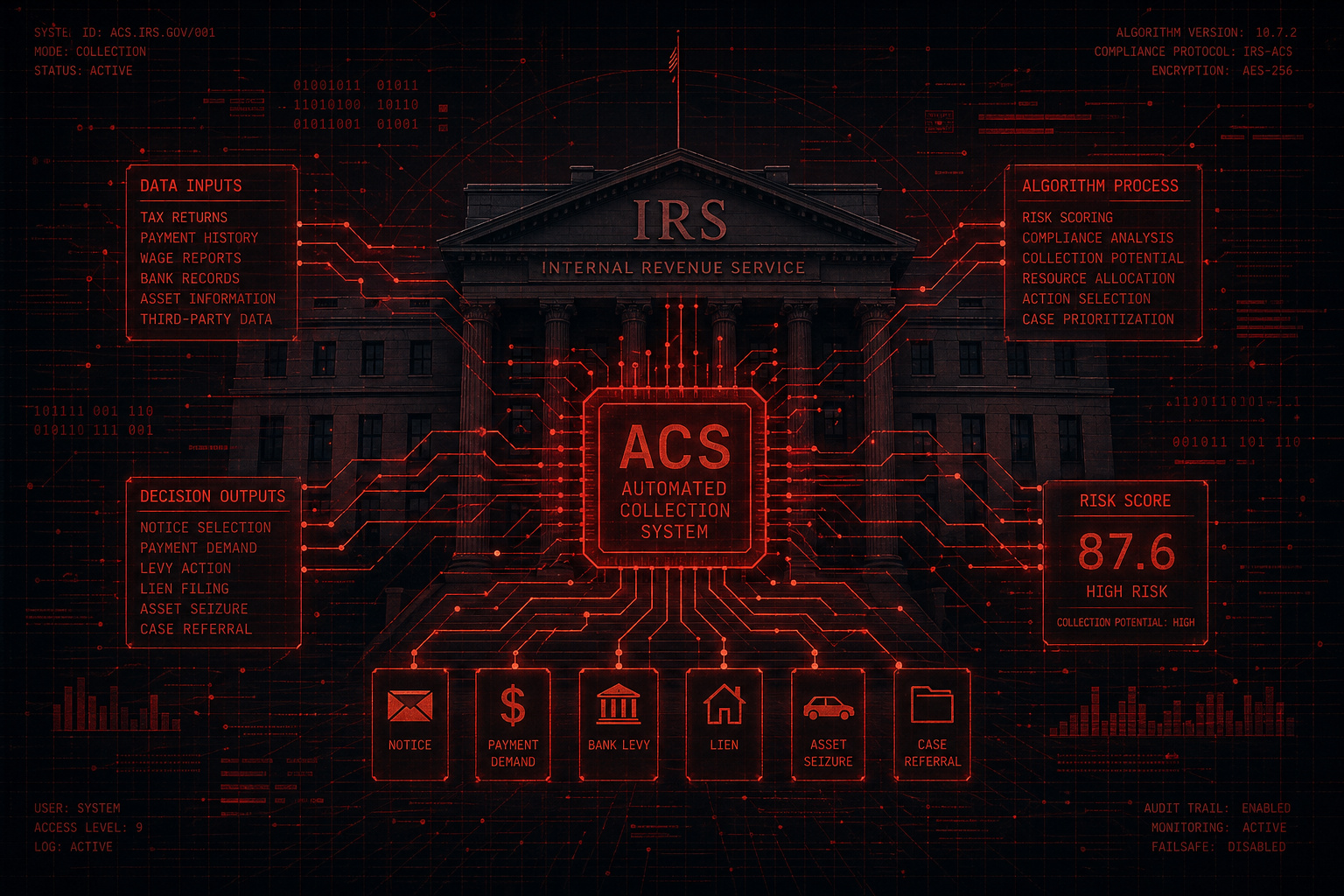
The agency must follow a statutory notification sequence before they can touch your bank accounts and undermine long-term wealth protection for children. Read the specific alphanumeric code on the top corner of your IRS correspondence to determine exactly how much time remains before actual asset seizure is authorized. Early letters like the CP14 are balance due notices, but subsequent letters escalate to urgent final warnings like the LT11.
Failure to respond to the IRS Tax Notice Series progresses your account to the IRS Automated Collection System (ACS). When you ignore the IRS Tax Notice Series, your file transitions away from physical mail warnings and drops into the IRS Automated Collection System (ACS). Once the countdown expires, this digital environment operates silently in the background, executing bank levies and wage garnishments with zero procedural roadblocks standing between the government and your money.
The Mathematical Trap of Unfiled and Unpaid Taxes
Dodging tax season because you cannot afford the bill triggers a penalty rate ten times higher than filing your return and failing to pay.
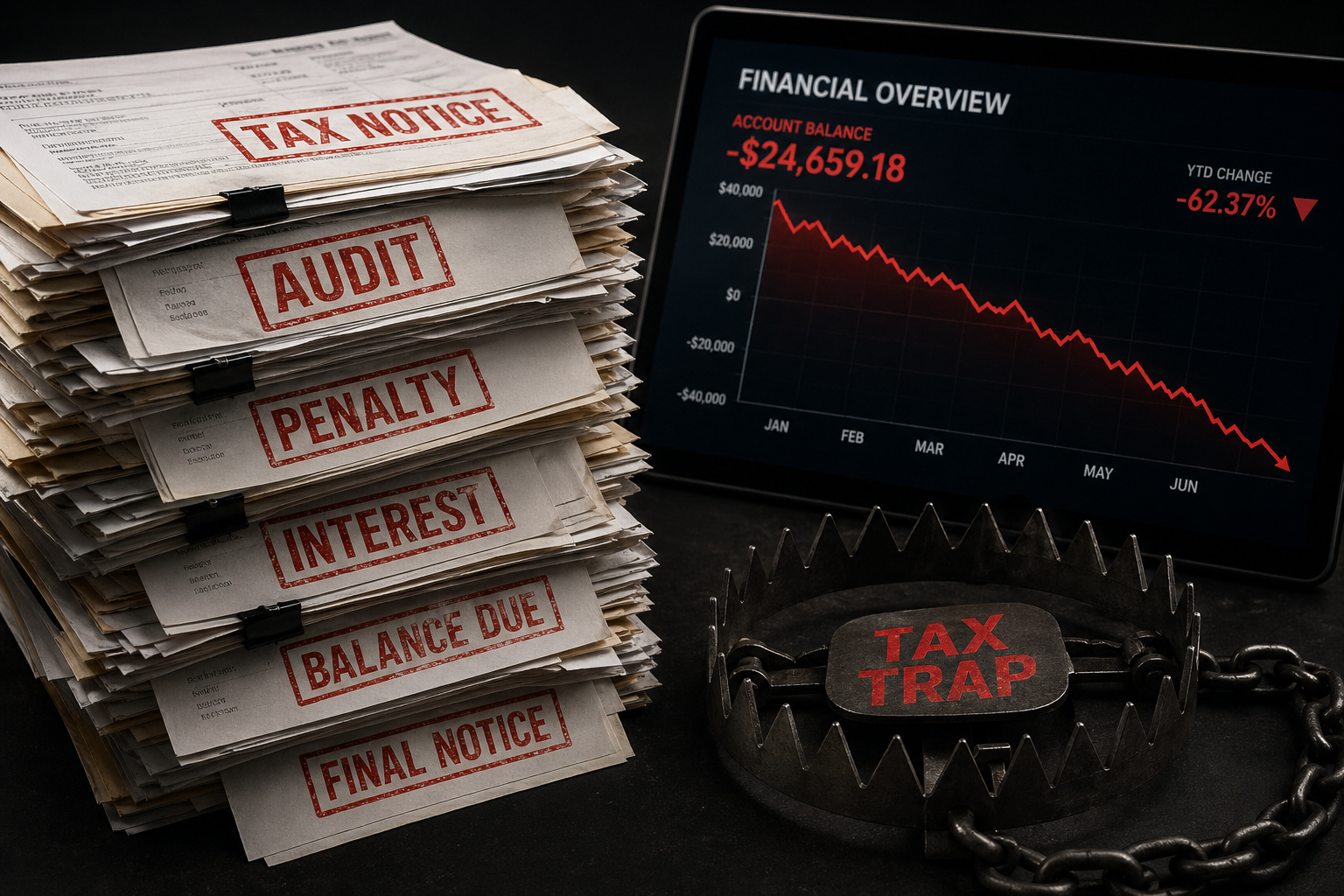
There is a misconception that if you lack the funds to pay your taxes, you should skip filing until you have the cash or an installment agreement in place. The penalty for failing to file a return sits at a brutal 5% per month. In contrast, the standard penalty for failing to pay is only 0.5% per month.
Always file your tax returns on time even if it is mathematically impossible for you to pay the balance. Unfiled taxes act as a predatory retroactive loan, stacking a baseline 5% annual interest rate alongside monthly tax payment penalties that overwhelm the original debt. Even if you secure a loan or a prepaid card issued by a partner bank like Pathward to try and slowly fix the balance later, the compounding nature of the Annual Percentage Rate guarantees the debt outpaces your payments. The system also sets up an automatic interception trap.
It seizes any future Tax Refund you are owed and applies it directly to the rapidly compounding balance. Filing an unfunded return is mathematically superior to hiding entirely.
IRS Enforcement Tools: Liens, Levies, and Passports
The IRS bypasses courts to initiate wage garnishment, file tax liens, and trigger passport revocation via the State Department.

Unlike private credit lenders or standard debt-collection agencies, the IRS circumvents normal legal friction. They do not need to secure a court judgment to authorize bank levies or wage garnishment. Monitor comprehensive tax liability totals across multiple years to prevent the balance from crossing the statutory $51,000 threshold that subjects you to passport revocation.
Tax Liens and Public Credit Damage
When your debt crosses the $10,000 mark, the government legally attaches its claim to your physical property and assets.
They do this by filing a Notice of Federal Tax Lien, which creates a highly visible public record broadcasting your debt to traditional lenders. This instantly halts your ability to sell your house or refinance your mortgage.

Direct Levies on Wages and Banking
The IRS seizes income via wage garnishment or withdraws funds from a checking account via bank levies.
They utilize different tools depending on your employment structure. The IRS enforces a wage garnishment to pull an exact percentage straight from a W-2 employee’s paycheck before it ever hits their bank, whereas they deploy an accounts receivable levy against 1099 independent contractors to intercept outstanding invoices directly from their clients. To make matters worse, aggressive state tax agencies run a parallel track. They often initiate immediate sweeps of your bank accounts and suspend your driver’s license far faster than the federal government moves.
Passport Revocation for Serious Delinquency
Owing a balance exceeding the $51,000 statutory threshold legally forces the State Department to restrict international travel.
If your accumulated balance over time meets a specific statutory limit—currently over $51,000—the IRS formally notifies the State Department. Being classified as seriously delinquent under section 7345 of the Internal Revenue Code triggers a passport restriction. The government will outright deny any new passport application, and they have the authority to revoke the physical identification passport you currently hold.
Tax Evasion Myths and the 10-year Statute of Limitations
Being broke and unable to pay your taxes is different from hiding money.
Taxpayers often wait in terror thinking the police will show up at their door over an unpaid bill. In reality, having no money to satisfy your debt is classified as a civil liability, whereas actively concealing assets, committing fraud, or willfully refusing to file triggers criminal prosecution. Poverty alone never leads to jail time. The boundary lies strictly in intent and deception, not the ultimate dollar amount you owe.
The IRS generally has a 10-year statute of limitations to collect back taxes. Verify the specific “date of assessment” on older tax debts rather than looking confusingly at the original filing year to accurately calculate when the 10-year collection clock officially expires. The 10-year statute of limitations defines the exact legal window the IRS has to force collection, though actions like filing for bankruptcy can pause that timer. While a Tax Audit might uncover old errors, declaring personal bankruptcy remains a highly flawed strategy for recent tax debts, as federal obligations are rarely discharged.
Halting Collections Through Formal Resolution Programs
Establishing an Installment Agreement via the IRS phone queue disables the Automated Collection System (ACS) and halts wage garnishment or bank levies.
The safest place to hide from enforcement is backward—it is in their own phone queue. Formally initialize contact to enter a recognized payment plan to instantaneously drop the monthly penalty accrual rate from 0.5% (or 1%) down to 0.25%, stopping direct asset levies in their tracks. Entering an official Installment Agreement cuts your ongoing failure-to-pay penalty in half while proving to the system that you are cooperating.
You do not even have to speak to the government yourself. The relief of shifting this burden to Enrolled Agents is measurable. Taxpayers can hire independent Enrolled Agents or tap into specialized Resolution Programs. Tax preparation platforms and firms, such as H&R Block or TurboTax, handle negotiation strategy securely. Standalone relief firms like TaxRise exist specifically to evaluate your unique tax situation and negotiate partial settlements. If you cannot afford living expenses, filing an Offer in Compromise allows you to settle back taxes for a lower amount based on a demonstrated inability to pay.
What happens if I never pay back taxes?
If you never pay, the IRS will eventually bypass the court system to seize your assets directly. This includes garnishing your wages, levying your bank accounts, and filing public tax liens that can prevent you from selling property or refinancing your home.
At what point will the IRS come after you?
The IRS operates on a predictable algorithm that transitions your account to the Automated Collection System (ACS) once you fail to respond to a series of urgent notices. Once your account enters this digital queue, the system automatically executes enforcement actions like bank levies without human intervention.
How does filing a tax return late impact my penalties?
Failing to file is significantly more expensive than filing and failing to pay because the failure-to-file penalty is 5% per month, compared to just 0.5% for failure to pay. You should always file your return on time—even if you have zero funds to pay—to avoid these aggressive compounding penalties.
Is it worth trying to hide from the IRS to avoid paying?
Hiding is a losing strategy because the IRS uses automated triggers to track your debt, and silence only confirms your account should move to the collections phase. Proactively reaching out to set up an installment agreement is better, as it cuts your failure-to-pay penalty rate in half to 0.25% per month.
What is the difference between a tax lien and a tax levy?
A tax lien is a public claim on your property that alerts lenders to your debt and complicates your ability to sell assets. A tax levy is the actual enforcement action that allows the government to forcibly remove money from your paycheck or bank account.
Can I lose my passport if I have unpaid back taxes?
Yes, if your total tax debt exceeds the statutory threshold of $51,000, the IRS is legally required to notify the State Department. This triggers a classification of ‘seriously delinquent,’ which results in the denial of a new passport application or the potential revocation of your existing passport.
How much does a payment plan reduce my IRS penalties?
Entering into an official installment agreement through the IRS drops your failure-to-pay penalty rate from 0.5% or 1% down to a much more manageable 0.25% per month. This move also signals cooperation, which typically stops the automated system from moving forward with aggressive asset seizures.