
Writing a check for $450,000 is terrifying and liberating in equal measure. You’ve saved, scrimped, maybe inherited, and now you have the full purchase price in cash. But every time you think about draining your savings account, that little voice asks: Is this smart?
Nearly a third of homebuyers paid cash in 2025 — 32%, to be exact, according to the National Association of Realtors. That’s up from 26% the year before. With mortgage rates hovering around 6-7% as of October 2025, and the median monthly payment hitting $2,225 (the highest in over 20 years), the cash option looks more attractive than it has in years.
It’s not just about avoiding interest — it’s about what you give up when you put all that money into a house. I’ve watched families in my neighborhood lose three houses because their financed offers were unable to compete with cash buyers who offered slightly less. I’ve also watched friends drain their savings for a dream home and then scramble when the roof started leaking.
So let’s walk through what the numbers actually say — plus the stuff nobody mentions about liquidity risk and the mortgage deduction myth.
Key Takeaways
On a $450,000 home, paying cash at current rates saves roughly $627,527 in interest over 30 years, but that same $400,000 invested at a conservative 9% would grow to about $6.58 million over the same period — the opportunity cost is large.
On average, cash buyers pay about 11% less (Redfin data) and close 14 days faster (Zillow), but they also face a real liquidity trap: a couple who bought a $450,000 home with cash, leaving only $5,000 in savings, then faced $31,500 in unexpected costs.
Only about 10% of taxpayers itemize deductions because the standard deduction doubled — the mortgage interest deduction is largely irrelevant for 9 out of 10 buyers, so don’t let it sway your decision.
Table of Contents
The state of the market: why cash is suddenly mainstream
The monthly median mortgage payment jumped 20% since 2021, now sitting at $2,225 — the highest in more than two decades. When you add rates at 6-7% and home prices that have risen about 5.4% annually over the long term, the math starts to push more buyers toward cash. Especially since many homeowners with sub-3% rates are staying put, keeping inventory tight. Michelle Caffrey at Investopedia notes that this dynamic has made cash offers increasingly common in competitive markets.
In March 2026, sellers outnumbered buyers by 43% — one of the largest gaps in over a decade. That means cash buyers have unusual leverage. You’re not just avoiding a mortgage; you’re walking into a market where the seller needs you more than you need them. Chase reports that cash buyers often close faster and face fewer hurdles, which can be a decisive advantage.
Nearly half of Americans (49%) struggle to afford regular housing costs, per a Redfin survey. For Gen Z, that number jumps to 67%. FoolWealth highlights that cash buyers sidestep monthly mortgage payments entirely, easing the burden on household budgets.
The advantages of paying cash — what you gain
You don’t pay the bank anything extra.
Interest savings and fee elimination
On a $450,000 mortgage at 7% over 30 years, you would pay roughly $627,527 in interest. At 6.3%, it’s about $382,000. Those numbers are hard to ignore — they’re hundreds of thousands of dollars you keep in your pocket.
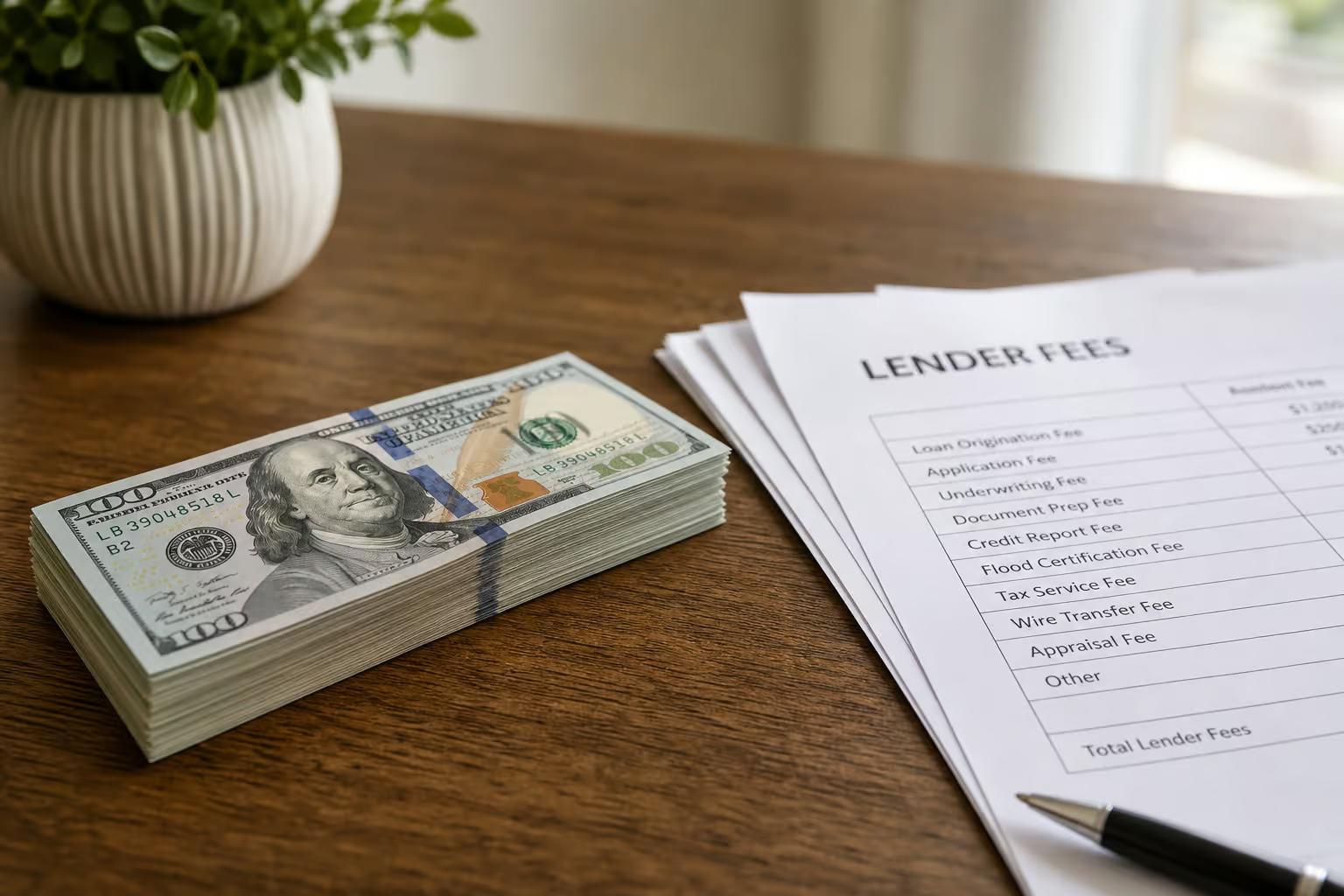
Beyond interest, you skip a whole pile of lender fees: origination (0.5-1% of the loan), appraisal ($400-600), credit report ($30-50), processing ($300-500), underwriting ($500-1,000), and discount points (0-3%). On a $450,000 loan, that adds up to $4,000 to $22,000. Plus closing costs are lower: 1-3% for cash buyers versus 3-6% for financed purchases.
Speed, certainty, and negotiation leverage
Cash purchases close in about 1-2 weeks, compared to 30-45 days for financed deals — that’s 14 days faster on average, per Zillow. And cash deals close at rates above 95%, while financed deals close at 87-90% (NAR). Sellers know this, which is why they’ll often take a slightly lower cash offer over a higher financed one.
Chelsea Zhao at Redfin sums it up simply: cash buyers gain speed, cost savings, and negotiating leverage. Cash buyers pay about 11% less than financed buyers, on average. In a buyer’s market, you can often negotiate 5-10% below asking price. That’s real power.
Think about what that looks like on paper: you offer $475,000 on a $465,000 asking price — above list, with $20,000 earnest money, a 10-day close, and no financing contingency. The seller sees certainty and takes the deal. The financed buyer offering $470,000 with a 30-day close? They lose.
Immediate ownership, no credit hurdles, no monthly payments
No lender means no lien. The house is yours from day one. No credit check — which matters a lot when 34% of Americans have credit scores below 650 (16% below 600, another 18% between 600-649). No monthly mortgage payment of $2,994 at 7% on $450k. That frees up $1,000-$1,800 every month.
The mortgage side — what you preserve
Paying cash eliminates a monthly payment, but it also locks your money into an asset that historically appreciates more slowly than the stock market. The trade-off is worth examining closely.
The opportunity cost of paying cash
Here’s the number that makes you pause: $400,000 invested at a conservative 9% over 30 years yields roughly $6.58 million. The S&P 500 has historically returned about 10% annually over long periods; a balanced stock/bond portfolio returned about 8.8% from 1926 to 2023, per Vanguard. Meanwhile, homes appreciate about 3-5% annually.
The gap between what your money could earn in the market and what it earns sitting in your house is 5-7 percentage points per year. Over 30 years, that compounds into a difference. The $627,527 you saved in interest looks smaller next to $6.58 million in potential investment growth.
Of course, past performance doesn’t guarantee future returns, and that $6.58 million is gross of taxes and fees. But the core argument stands: if you have a long time horizon, financing and investing the difference can leave you far wealthier than paying cash.
Liquidity preservation and financial flexibility
Consider the Fidelity example: a couple sold their starter home for $250,000, added $200,000 in savings, bought a $450,000 home with cash — and then faced $31,500 in unexpected needs with only $5,000 left in savings. Roof repairs, foundation issues, medical bills, job loss, these happen, and they happen within the first two years.

About 37% of Americans cannot cover a $400 emergency, according to the Federal Reserve. If you drain your savings for a house, you become vulnerable. Home equity is illiquid — selling takes months and costs 8-10% in transaction fees. A HELOC takes 2-3 weeks and requires income verification. You can’t pay for groceries with your kitchen.
The mortgage interest deduction — why it probably doesn’t matter for you
Only about 10% of taxpayers itemize deductions because the Tax Cuts and Jobs Act nearly doubled the standard deduction. For 2026, the standard deduction is $15,750 for single filers and $31,500 for married couples filing jointly. Most people’s total itemizable deductions don’t exceed those thresholds, so the mortgage interest deduction is worth exactly $0 to them. The IRS notes that most taxpayers now take the standard deduction, making the mortgage interest deduction irrelevant for the majority.
Even if you do itemize, the deduction only reduces your mortgage interest cost by your marginal tax rate (22-37%) — it doesn’t erase it. And the deduction is capped at $750,000 in mortgage debt. For early loan years, it might save you $7,000-$15,000 annually, but that’s still far less than the interest you’re paying.
If you’re looking for tax savings, maxing out retirement accounts (IRA, 401(k), HSA) often yields more benefit than the mortgage deduction, especially when you consider the opportunity cost of tying up cash.
The liquidity trap — when cash leaves you house-poor
I’ve seen it happen: a family member bought a house outright, felt on top of the world, and then the HVAC died and the car needed major repairs — all within six months. They had to take out a high-interest personal loan because the house was paid off but empty of accessible cash.

That’s the pattern. Buyers who deplete savings for a cash purchase often face uncovered expenses like closing costs within the first two years. Home inspections typically cost $300-500 but routinely uncover $5,000-$50,000 in needed repairs. And that doesn’t account for life’s curveballs.
Due diligence cash buyers must not skip
Just because you’re paying cash doesn’t mean you skip the boring stuff. One cautionary tale: a cash buyer offered $475,000 on a home that appraised at $425,000 — overpaying by $50,000 because they skipped a $500 appraisal. Appraisals are optional with cash, but they give you negotiating leverage. Use them.
You need a home inspection. And a title search to verify there are no outstanding liens — without a lender handling that, it’s on you. Homeowners insurance isn’t required by lenders for cash buyers, but the national average premium is about $1,700 per year ($3,000-$6,000 in Florida). Get it anyway.
Also: wire fraud exists. The FBI’s IC3 reported $396 million in real estate wire fraud losses in 2023. Scammers send fake emails with fraudulent wiring instructions. Always verify payment details by phone using a number you looked up independently.
When sending a wire transfer for a cash purchase, double-check all instructions directly with the title company to avoid costly mistakes. For cash transactions over $10,000, the IRS requires Form 8300 reporting — ensure your funds come from documented, traceable sources to avoid scrutiny.
Strategic alternatives — the middle paths most articles miss
There are hybrid approaches that capture some of the advantages of cash while preserving liquidity.
The hybrid approach: large down payment, smaller mortgage
Put down $250,000 on a $450,000 home and finance the remaining $200,000. Your monthly payment would be around $1,331 — manageable. You keep $200,000 in savings for emergencies and investment opportunities. You’re still a strong buyer, but not everything is tied up in the house.
This balances seller appeal (you’re putting down over 50%), manageability, and liquidity. It won’t win every bidding war, but it keeps you safe.
Delayed financing: buy cash, then refinance
buy the house with cash to get the competitive edge, then do a cash-out refinance afterward. Under Fannie Mae guidelines, you can do a cash-out refinance as soon as the deed is recorded. That gives you the speed and negotiation leverage of a cash offer upfront, and the liquidity of a mortgage later.
Bridge loans are another alternative — short-term, higher interest (7-10% with 1-2% fees) for 3-12 months until your current home sells or you set up permanent financing. Not cheap, but an option if you need cash quickly.
Tax and legal dimensions often overlooked
Beyond the mortgage deduction, there are other legal protections and obligations that cash buyers should understand before committing their funds. State-specific tax regimes also matter: in California, Prop 13 caps annual property tax increases at 2%, making long-term holding more affordable whether you pay cash or finance — a factor that changes the cash vs. mortgage math locally.

The homestead exemption — what it protects and doesn’t
Most states protect some of your home equity from creditors. Limits range from $5,000 to $550,000. Florida completely exempts the house. That’s protection if you’re sued or face bankruptcy.
paying cash doesn’t protect you from losing the house if you stop paying property taxes. Tax liens can still force a foreclosure. And the homestead exemption doesn’t apply to tax liens or federal debts. But the homestead exemption does not protect against tax lien foreclosure for unpaid property taxes — so even without a mortgage, you can lose the house to the government if you don’t pay.
Cash buyers should still purchase title insurance to ensure clear ownership. So no, paying cash doesn’t mean the house is yours forever, it means you don’t have a mortgage, but you still have to pay the government.
How the mortgage deduction really works (and mostly doesn’t)
the mortgage interest deduction is irrelevant for 90% of taxpayers. If your total itemizable deductions (mortgage interest, state and local taxes up to $10,000, charitable contributions) don’t exceed $15,750 (single) or $31,500 (married), you’re better off taking the standard deduction. The IRS confirms that the standard deduction is now the most common choice, making the mortgage interest deduction a non-factor for most cash buyers.
Even if you itemize, the deduction caps at $750,000 in mortgage debt and only reduces your interest cost by your marginal tax rate. It’s a benefit, but not a game-changer. Don’t let the tax tail wag the dog. For those with a traditional IRA, contributing to retirement accounts may offer more meaningful tax savings than relying on the mortgage deduction.
How to decide — 5 questions for your situation
To help you weigh the trade-offs, here are five practical questions that cut through the theory and get to your personal numbers.
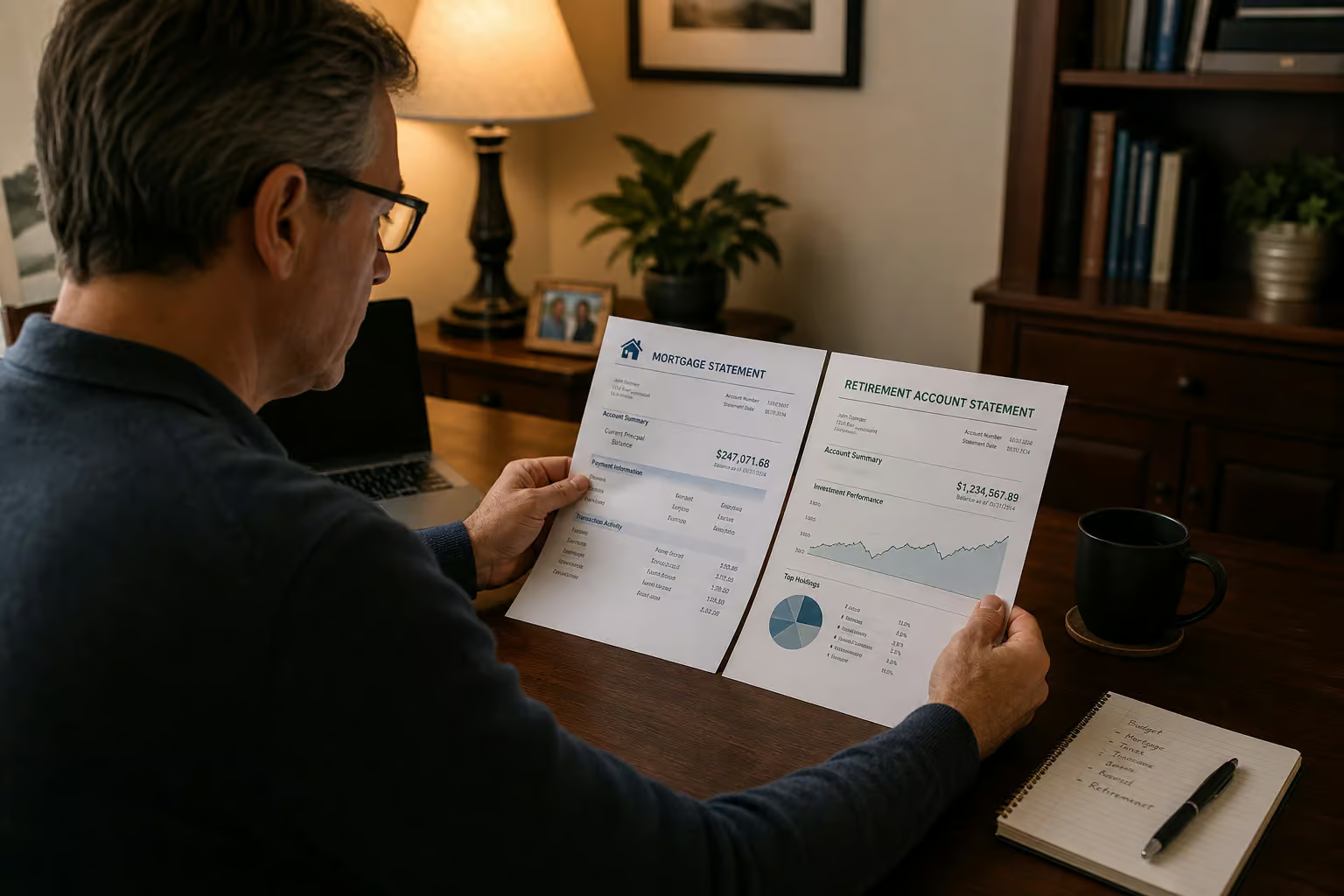
Liquidity check: how much will you have left?
If your monthly expenses are $5,000, keep $30,000-$60,000 in liquid savings (6-12 months) before any cash purchase. Don’t drain the emergency fund. If the cash purchase would leave you with less than that, you’re taking on liquidity risk.
Time horizon: are you under 50 with a long runway?
The younger you are, the more the opportunity cost matters. Over 30 years, market returns historically beat mortgage costs when rates are 6-7%. If you’re 30 years old, financing and investing the difference could mean millions more by retirement. If you’re 60 and retired, cash gives you peace of mind and eliminates a monthly payment that might strain a fixed income.
Credit score: can you qualify for a good rate?
Cash bypasses credit checks entirely. That’s huge if your score is below 620 (conventional loan minimum) or below 580 (FHA with 10% down). But if you have good credit, a mortgage at 6-7% might still be a better deal than draining your savings. FHA loans exist with 10% down for scores as low as 500 — cash isn’t your only option.
Itemization status: do you actually benefit from the mortgage deduction?
Quick test: add up your mortgage interest (if you had a loan), state and local taxes (capped at $10,000), and charitable donations. If that total is less than your standard deduction ($15,750 single, $31,500 married in 2026), the mortgage deduction is worth $0 to you. Period.
Market conditions: is it a buyer’s market or seller’s market?
With sellers outnumbering buyers by 43% as of March 2026, it’s a buyer’s market. That’s when cash buyers can negotiate 5-10% below asking and still close fast. The 11% average discount for cash buyers exists, but it matters most when inventory is high and sellers are desperate. In a hot market, cash gets you the house at list price; in a slow market, it gets you a deal.
The bottom line — when cash wins and when it doesn’t
Cash is optimal when you have 2-3 times the home value in liquid assets, are near retirement, have limited mortgage qualification, or are extremely risk-averse. The $1,000-$1,800 monthly cash flow gain from no mortgage payment is a benefit that emotional calculations often miss.
Financing is optimal when paying cash would consume 80% or more of your liquid assets, you’re under 50 with a long investment horizon, or you have other financial priorities (college savings, business capital, etc.).
Talk to a financial professional who can run your specific situation — income, savings, risk tolerance, time horizon, and give you personalized advice. This is one of the biggest financial decisions you’ll ever make. It’s worth getting right.
If you’re curious about related questions, check out our pieces on the advantages of buying a home with cash, whether paying cash raises red flags, and the tax implications of a cash home purchase.
Frequently Asked Questions
What is the 3 3 3 rule for home buying?
It’s not a formal rule, but a rough guideline some buyers use: look at three homes, in three neighborhoods, over three days before deciding. It’s meant to prevent rushed decisions, but it has no connection to financial analysis or cash-buying strategy — it’s more about avoiding emotional impulse buys.
Is buying a house with cash actually smarter than getting a mortgage?
It depends on your age, savings, and goals. Cash saves you hundreds of thousands in interest and gives you negotiating power, but it also locks your money into an asset that appreciates 3-5% annually while the stock market historically returns about 10%. If you’re under 50 with a long time horizon, financing and investing the difference often leaves you wealthier.
How much should you keep in savings after buying a house with cash?
At minimum, keep 6-12 months of living expenses in liquid savings — about $30,000-$60,000 if your monthly expenses are $5,000. Draining your savings for a cash purchase leaves you vulnerable to unexpected costs like roof repairs, HVAC failures, or medical bills, which can easily run $5,000-$50,000 in the first two years.