
At my house, the dining room table is buried under a mix of curricula, a laptop open to Beast Academy, a stack of nature journals next to a coffee mug, and a kid doing math on the living room floor. That’s the potpourri — and it’s not accidental.
My oldest, Isaac, went to public school for Grade 2 before I pulled him out, and over the years I’ve adopted Charlotte Mason, borrowed heavily from Montessori, and tossed in unit studies and traditional workbooks as needed.
Key Takeaways
Real spaces don’t need a dedicated classroom. Our school happens on a drop-leaf dining table, an IKEA Kallax shelf, and the living room floor.
Curriculum hopping is part of the plan. We’ve abandoned RightStart Math and Math Mammoth, and landed on Beast Academy online. Each switch had a specific reason tied to a kid’s needs, not random indecision.
A 4-week loop schedule is the only system that works for me. Core subjects daily, everything else on a rotating loop. No more “we never get to art.”
Table of Contents
Real homeschool spaces: where learning actually happens
Our school area is the dining room, right between the kitchen and the living room. I can start a science experiment on the kitchen counter, wash dishes while someone reads aloud, and keep an eye on the preschooler without leaving the room. We use a drop-leaf table that folds down when we need the space back — which is almost never during school hours. Each kid has their own cart with current books, copywork sheets, and math manipulatives. Other families use similar multi-functional rooms: Kim Sorgius of Not Consumed recommends a DIY whiteboard made from a $40 shower board, and Singing a New Song shows how a living room corner can hold all your school supplies without a dedicated classroom.
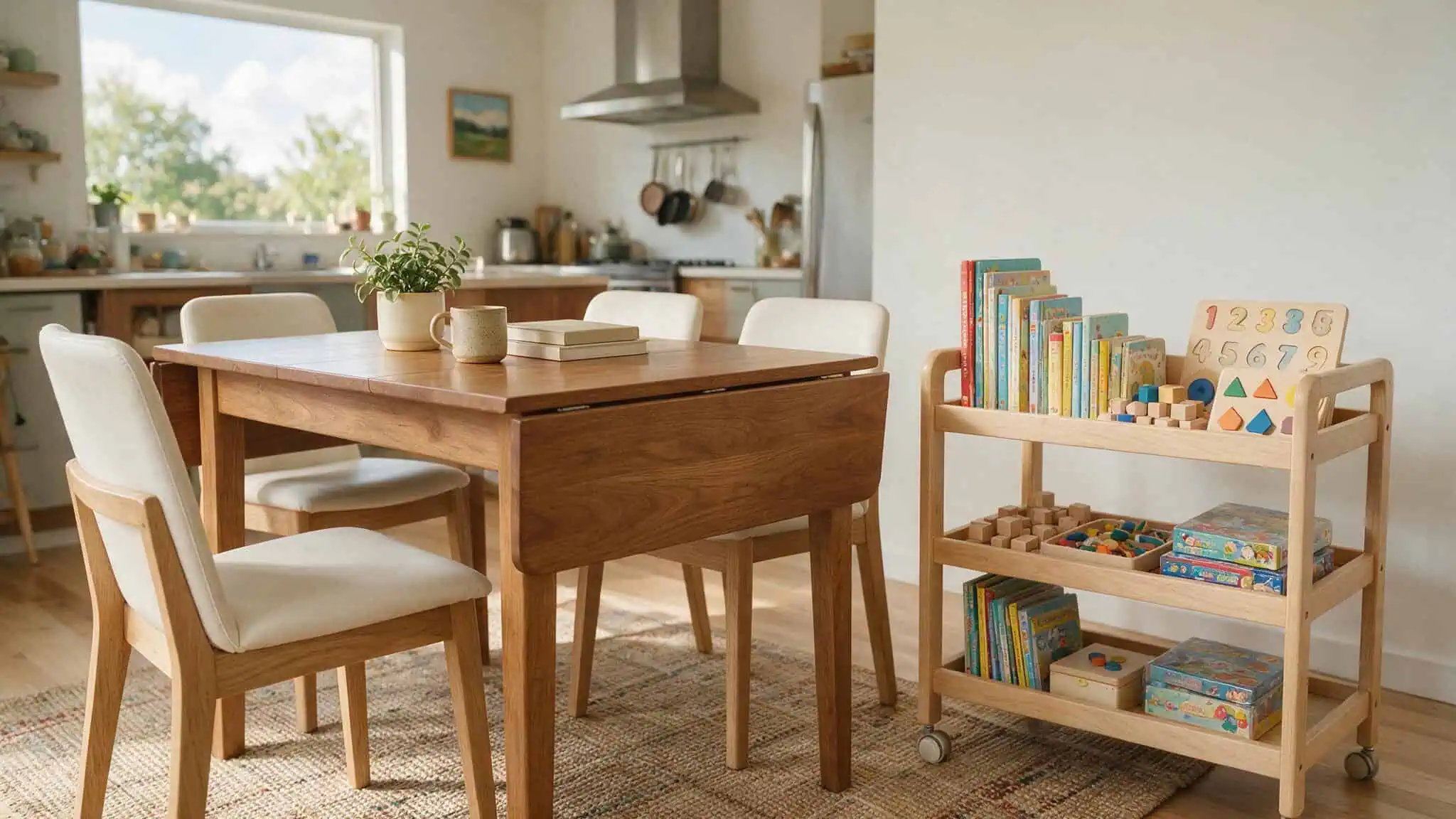
The dining table as command center
The table is where most of the direct instruction happens. It’s also where I drink my coffee, pay bills, and occasionally eat a meal.
Living room learning with the Kallax shelf divider
An IKEA Kallax with 25 cubes makes a natural room divider between the dining room and the living room. Each cube holds something specific: magazine files organize curriculum by subject, bins hold art supplies, a basket catches nature finds. The family room TV is used for educational content — composer performances, nature study videos, geography documentaries.
Nature treasures and real-life displays
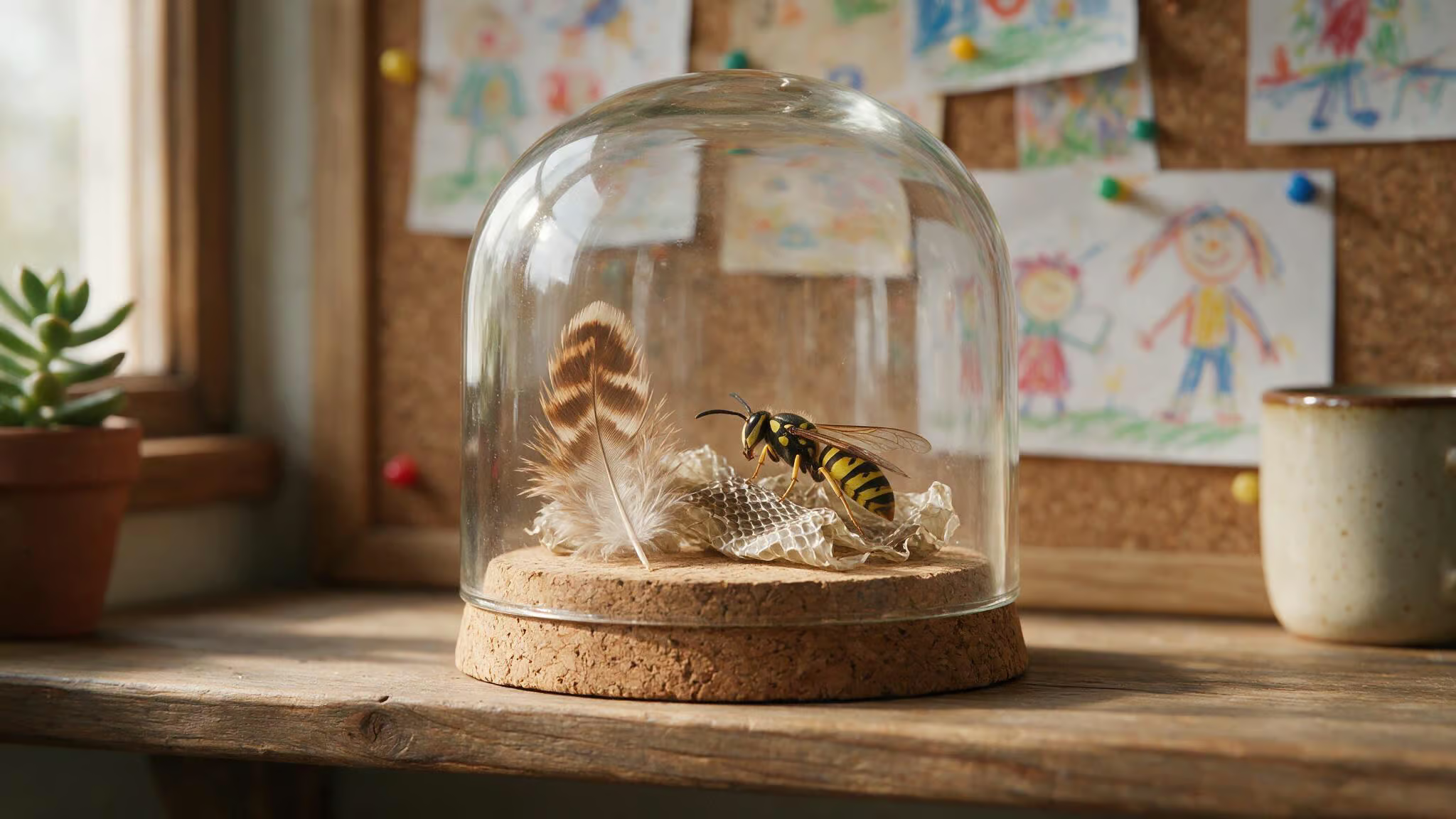
On top of the Kallax, we have glass domes holding feathers, a dead wasp, a grasshopper wing, snakeskin, and a moth carapace. There’s a rock my son identified as quartz during his geology unit. A large cork board holds posters and the kids’ work. Cavallini posters get swapped out with thumb tacks — cheap, easy, and more interesting than alphabet charts. A letter board displays quotes from Laying Down the Rails because I need the reminder as much as they do.
I’ve seen the Pinterest version — the custom shelving, the Pottery Barn Kids furniture, the perfectly color-coded shelves. Those rooms are beautiful. But the pattern I see among other eclectic homeschoolers is that they spend weeks setting up a perfect room, only to find the kids prefer the living room floor. The dedicated desk becomes a laundry dump.
The curriculum stack: how the potpourri comes together
Every curriculum on my shelf has a story, and most of those stories involve failure before finding the right fit.
Math — from hands-on to auto-scored
In 2017, I started with RightStart Math. When I returned to homeschooling in 2021, I switched to Math Mammoth, but it turned out to be too workbook-ish for a kid who already hated writing.
The game-changer was Beast Academy online. Isaac’s handwriting struggles — what an educational psychologist later identified as dysgraphia, made it impossible for him to write out math problems by hand. Beast Academy is auto-scored, puzzle-based, and requires no handwriting. Each lesson gives 1, 2, or 3 stars based on correct answers.
Our rule is he needs 2 or more to pass, or he redoes the lesson. I signed up for my own Beast Academy account to relearn Grade 4 math.
Language arts — quitting TGTB for Brave Writer
We used The Good & the Beautiful for two or three years. I had specific complaints: the worksheets felt like busywork, the art appreciation featured obscure pieces, the writing instruction was heavy on mechanics and light on actual craft, and the whole thing had a heavily American nationalistic, moralistic tone that didn’t fit our family. (It’s written by a Mormon using the King James Version, and that worldview runs through the whole curriculum.)
We switched to Brave Writer’s The Writer’s Jungle as a foundation, with stage-appropriate add-ons like Jot It Down and Partnership Writing. I make my own reading lists now, mixing classics like The Secret Garden and Harry Potter with lighter, fun reads. Poetry is casual — read-alouds, song lyrics, silly poems. Memorization is a rotating list of continents, Canadian provinces, Bible verses, and poems. Balancing that potpourri approach with a more Homeschool booksmart academic focus—using structured texts alongside hands-on, interest-led learning—has been key for a well-rounded education.
History and science — secular options and nature study
We use the Story of the World audiobook for read-aloud time — it’s great for that, but I found the activity book lacking in creativity. This year we’re trying Curiosity Chronicles, a secular history curriculum aimed at elementary kids. It has optional Minecraft activities, which helps with buy-in. Families looking for illustrated books that introduce younger readers to history, civics and economics can also shop The Tuttle Twins for children’s resources and curriculum materials.
For science, How to Teach Nature Journaling by John Muir Laws is the gold standard for getting kids to actually observe the world around them, and the PDF was free when I downloaded it. We also use Experience Astronomy for both elementary and upper levels, and the Skyview app for stargazing.
The extras — art, music, coding, and life skills
Bob Ross YouTube videos are our de facto art curriculum. A Humble Place (run by my old blogging friend Rebecca) has been a great source for free art appreciation resources. I bought a World’s Greatest Composers unit study in 2023 and plan to restart it in the upcoming year with all three older kids. Piano lessons were going well — the teacher came to the house, until everything shut down.
Tynker coding subscription was great until the kids’ interest waned; I’m hoping the assignments feature will get us back on track. In 2020, the first full year of homeschooling, chores were the main subject. My kids born in 2008, 2010, and 2012 can clean the kitchen, mop, sweep, vacuum, scrub a bathroom, do laundry, and bake. That’s worth more than a textbook, and it’s how we discovered the local Homeschool Potpourri Kirkland community.
For a closer look at how all these pieces fit together, check out the comprehensive guide with tips for organizing your homeschool curriculum.
Scheduling the potpourri: how loop scheduling makes it work
The loop schedule is my solution to my own tendency to let things slide.
The 4-week loop cycle
Core subjects — math, language arts, literature, typing, happen every day. Everything else goes on a 4-week loop. Some loop subjects take an hour, others five minutes. Week 1, Day 1 might start with core subjects plus music appreciation, then switch to history and faith the next day.
The custom student planner
I couldn’t find a planner that fit our loop schedule and multiple kids, so I made my own. The idea came from a Read Aloud Revival blog post about handwriting assignments in a paper notebook. Last year’s paper duo-tangs barely survived a year of daily use, so I upgraded to a binding machine with plastic covers for durability. I created a printable template to reduce handwriting, and I fill in assignments for a week every Sunday.
Last year’s version was simple — days of the week with blank lines. This year’s has the loop schedule built in. I also made my own teacher planner.
Tailoring the potpourri: the twice-exceptional reality
My oldest, Isaac, was identified by an educational psychologist as twice-exceptional: 98th percentile in visual-spatial reasoning, 10th percentile in working memory. Gifted, with inattentive ADHD and anxiety. That 88-point gap explains a lot about why school was such a struggle for him.
After pulling him out of public school in 2019, we deschooled for six months. No academics, just decompression and play. When we started formal learning, it was just math and reading — one or two things a day. In 2020, the first full year, chores and habits were the main curriculum, with academics as the minor subject.
The eclectic approach lets us customize subject by subject: online for math (no handwriting required), Brave Writer for writing (process over mechanics), nature study for science (no rigid curriculum).
Language and geography: when bilingualism shapes the potpourri
Bilingualism shapes our curriculum choices because we live in a French-speaking community near Quebec. Canada is officially bilingual, but in our town, French is the language of daily life. Our neighbor’s 8-year-old daughter attends French school and speaks no English. My daughter Aliza plays with friends next door exclusively in French.
She is 10 and fluent from three years in public school French immersion in Quebec. The boys and my husband Chris know only basic vocabulary. I did French immersion as a kid, but I’m rusty. We use Duolingo — it’s fine for vocabulary practice, but it won’t make anyone fluent on its own.
We don’t have a set geography curriculum. We focus on Canadian provinces and territories first, then branch out to world geography. There’s an illustrated map of Canada on the dining room wall. This year we’ll start with a book on Canadian government. Regional context shapes what we learn and why.
Conclusion: what the photos don’t show
The photos in this post show the potpourri in action: the dining table, the Kallax shelf, the nature finds on display. What they can’t show is the trial-and-error that built it.
Starting with just math and reading — and prioritizing chores, is a perfectly valid first year. The staged rooms on Pinterest are aspirational; the dining room with a coffee cup next to the math book is real.
For a deeper breakdown of the eclectic approach, read the full Homeschool Potpourri guide.
Frequently Asked Questions
What are some good picture books about homeschooling?
Picture books about homeschooling often focus on learning outside the classroom, family routines, and curiosity-driven exploration. Look for titles that celebrate self-directed learning, nature study, and the flexibility of a home-based education, rather than a single prescribed list.
What are some good books to read for homeschooling?
Good books for homeschooling include a mix of classics like The Secret Garden and Harry Potter, alongside nature journals, poetry, and living books that spark curiosity. The key is to choose engaging, well-written stories that align with your child’s interests and your educational approach, rather than sticking to a rigid reading list.
How does loop scheduling work for homeschooling multiple kids?
Loop scheduling involves rotating subjects on a flexible cycle rather than assigning them to specific days. Core subjects like math and language arts are done daily, while extras like art, music, and history rotate through a loop, ensuring nothing gets skipped. This system adapts to each day’s pace and prevents the feeling of falling behind.
Is Beast Academy online good for kids with dysgraphia?
Yes, Beast Academy online is an excellent fit for kids with dysgraphia because it is auto-scored and puzzle-based, requiring no handwriting. The program allows students to focus on math concepts through interactive lessons and earns stars based on correct answers, which reduces the frustration of writing out problems by hand.