
If you’ve been Googling “new hope surrogacy ukraine” and keep landing on the name Nova Espero-New Hope instead, you’re not losing your mind, they’re the same agency. Same organization, same team, same site at surrogacyukraine.com, directed by Oleg Marynenko. It’s also the same agency FOX Business profiled in the middle of the war. Before you hand over tens of thousands of dollars to anyone in a country at war, you want straight answers: Is this real?
Is it safe? And what are you actually paying for? Here’s what my research turned up.
Key Takeaways
New Hope Surrogacy and Nova Espero-New Hope are the same agency, directed by Oleg Marynenko, operating through surrogacyukraine.com, and profiled by FOX Business during the war.
Pricing starts at $35,000 without egg donation and $40,000 with it (medical and legal included), compared to typical Ukrainian programs at $43,000, $53,000 and U.S. surrogacy exceeding $150,000.
The agency still operates as of July 2026, coordinating programs in Kyiv or Lviv, but war-related logistics like transport and documentation are planned case by case, and its 95%/99% success rates are self-reported, not independently verified.
Table of Contents
Is New Hope Surrogacy a real agency? The credibility markers that actually matter
The first question anyone asks about a Ukrainian surrogacy agency is whether it’s legitimate. New Hope has been around since 2012, but the team’s real experience goes back further, they started with adoption work in 1999 before expanding into IVF and surrogacy. Julia Osiyevska, the CEO, has over a decade with the agency; coordinators bring nearly 20 years combined.

The detail that stood out to me: they don’t mix their adoption numbers with their surrogacy numbers. That kind of separation is a quiet sign of honesty.
Here’s what else looks credible:
- A real database. They maintain over 500 egg donor listings and over 600 surrogate candidates. Profiles shown publicly are anonymized, extra details only come after you’ve been verified as a client. Private information is never public.
- A staffed team, not a broker. The team includes coordinators for donors and surrogates, pregnancy coordinators, medical-document managers, a psychologist, and, notably, an in-house lawyer.
- One caveat on the numbers. The listing count is higher than the actual person count, since one candidate can qualify for multiple categories. Worth knowing, not worth panicking about.
And the obvious question: where are all the baby photos? You won’t find them. Many families keep the process private, and the agency respects that. No public baby pictures, no purchased reviews.
They’ll offer private references, but only with explicit client consent. If you’re used to Western agencies plastering smiling families across their homepage, the silence can feel odd, but it reads more like confidentiality than hiding something.
Why Ukraine? Legal framework and costs
Surrogacy has been legal in Ukraine since 1997, that’s a historical fact, not an argument. It’s governed under family law rather than a separate surrogacy statute, which keeps things simpler for international parents. No courts involved, no bureaucratic gauntlet.
The one rule that shapes everything: Ukrainian law requires that surrogate mothers have no genetic connection to the child they carry. So she can’t be the egg donor, ever. An egg donor is always used. That distinction protects everyone: no genetic link means no legal responsibility for the surrogate, and parental rights go straight to the intended parents. (If you’ve heard rumors that Ukraine is banning surrogacy altogether, that’s a separate question worth fact-checking.)
The cost math is where Ukraine wins decisively. New Hope starts at:
| Program | Price |
|---|---|
| Without egg donation | $35,000 |
| With egg donation | $40,000 |
Those figures include medical and legal costs. Typical surrogacy programs across Ukraine run $43,000, $53,000, while U.S. surrogacy regularly exceeds $150,000, making America 33-50% more expensive, according to expert estimates from Roger Shedlin of WINFertility.
The economic reality behind those numbers is blunt: the U.S. median household income was $67,521 in 2020, while Ukraine’s per-capita household income was $2,145 that same December. If you’re comparing agencies, it’s worth seeing how others in the Ukrainian market structure their programs too. But for most families, the price gap alone explains why Ukraine became a leading destination.
Standard vs. fixed-price: which program should you pick?
New Hope runs two pricing models, and they’re different enough that you need to know which one you’re signing up for.
Standard program. This is the pay-as-you-go option. Payments are tied to milestones along the journey, so you’re not handing over the full sum upfront. That’s reassuring, because you’re paying as things actually happen rather than writing one giant check and hoping.
Fixed-price donor-egg program. This bundles costs for a predictable total. It can be genuinely useful in particular medical circumstances where a cycle might otherwise run over budget. But here’s the honest part: many families don’t need to pay its additional premium. The fixed-price option isn’t automatically better, it’s situational.
One detail that impressed me: if you start on a fixed-price program and pregnancy happens after the first or second attempt, you can switch to the standard structure. Prices can go up or down depending on the agency used, the family planning package selected, and the surrogate mother’s personal fees, so the flexibility matters.
How the process works: six steps from application to birth certificate
The agency lays out a clear, six-step path:
- Eligibility review. A straightforward check of your circumstances: family situation, any relevant medical history, citizenship, whether you’re bringing existing embryos, and your home country.
- Medical pathway. They lay out the proposed treatment route: which doctor, which embryology team, the document requirements, the payment schedule, and possible additional scenarios.
- Candidate matching. This is controlled and private. You’re shown appropriate anonymized profiles from their database; fuller details come only after you’re verified as a client.
- Treatment and embryo transfer. Appointments, paperwork, communication coordination, and preparing the surrogate for transfer.
- Pregnancy coordination. Monitoring through the pregnancy, including psychological support for the surrogate. She’s not just a vessel; she’s cared for too.
- Birth and legal documentation. Your in-house lawyer handles the Ukrainian birth registration and paperwork. The agency also helps think through your home country’s rules for the journey back.
The support structure is built into the steps, not tacked on afterward.

The team behind the scenes: why “right combination” matters more than a clinic name
Ukrainian surrogacy is usually talked about in terms of which clinic you’ll use. New Hope frames it differently: they select the reproductive doctor, embryology team, and medical-document managers based on your specific case, rather than funneling everyone through one famously named clinic.
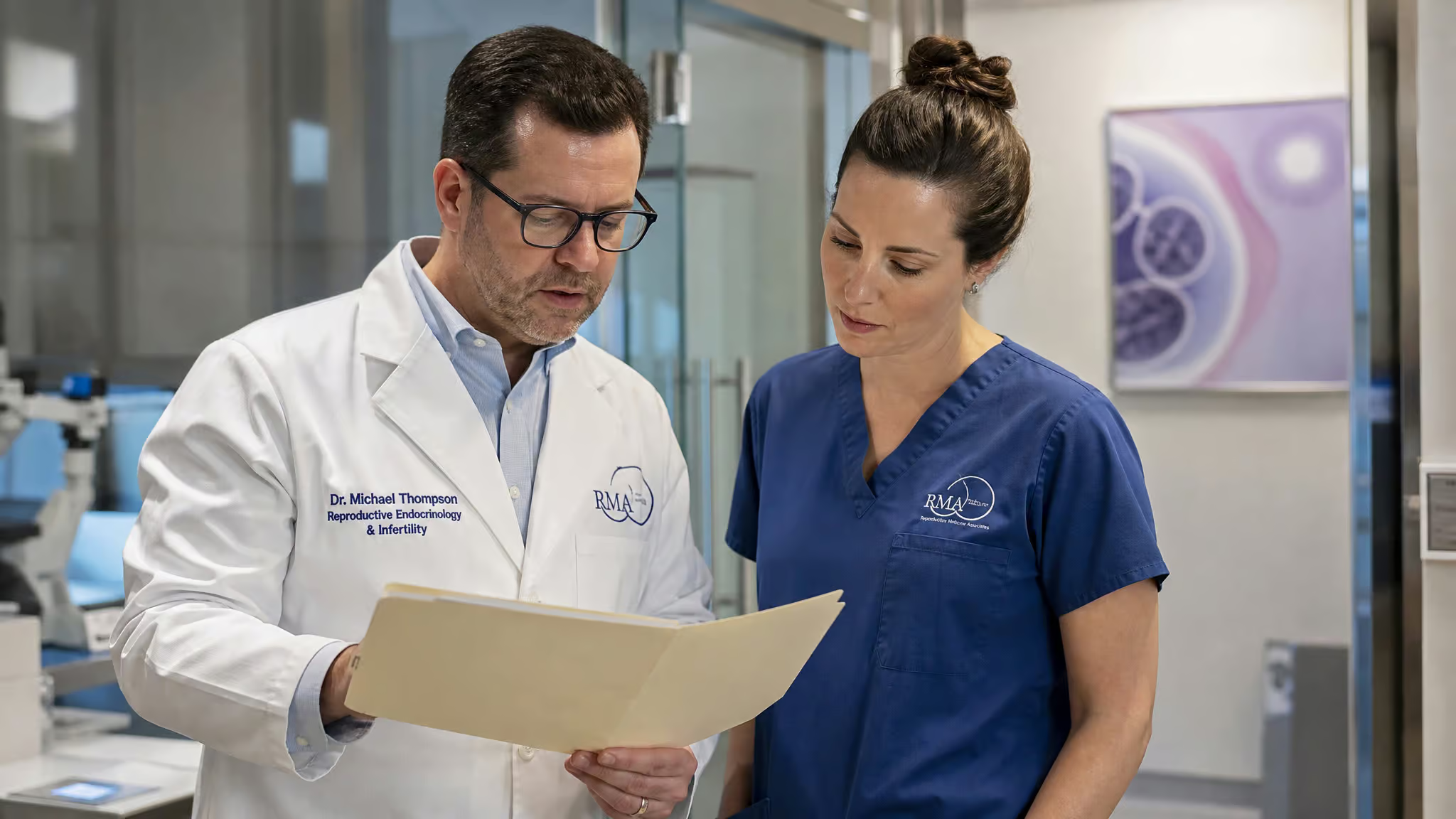
That matters more than it sounds. If you’re bringing embryos from abroad, or you need a donor-egg program, the people handling your case change. The medical-document managers are particularly important, they handle foreign records and coordination, which is where things get messy in cross-border surrogacy. Frozen embryo transfers get the same case-by-case treatment for transportation and logistics.
The agency is a coordinator, not a medical provider. Actual treatment is delivered by licensed physicians and specialists. But the coordination is a genuine service: they handle matching, contracts in both English and Ukrainian, and the heavy lifting when complications arise. And the coordinators stick around, over 15 years of experience on the team means they’ve seen the hard cases before, not just the smooth ones.
Two things worth knowing about how they operate:
- You can talk to your surrogate directly. Direct communication is allowed and encouraged. It’s your process.
- You can pay her directly if you want to. Direct payments are possible, and the coordinator keeps the financial picture clear either way.
What surrogacy in Ukraine actually costs in 2026
The sticker price isn’t the whole story. Here’s what I found about where the money actually goes.
What’s included. The $35,000, $40,000 starting figures cover medical costs and legal fees. That’s the anchor you’ll see on the site, but the final number depends on your specific situation. Your family planning package, the clinic involved, and the surrogate’s personal fees all push the total around.
What can move the price. Things like additional medical procedures, medication variations, and the specific donor situation (if you need a donor-egg program) affect the final figure. Prices can move up or down, this isn’t a fixed universe.
How payment works. Standard programs run on milestone-based payments, so you’re paying as you progress rather than front-loading the entire cost. Larger advance payments are possible if you prefer them, but they’re not expected.
Here’s the honest part: you won’t know your exact total until your case is assessed. But the starting range gives you a baseline for budgeting that’s roughly a quarter of what you’d pay in the U.S.
How safe is surrogacy in Ukraine during the war?
This is the question nobody can avoid in 2026, and the honest answer is: it’s complicated, and it depends on where things stand the week you’re reading this.
Where things stand now. As of July 2026, New Hope was still operating. The team was active, matching was ongoing, and treatment was happening in Kyiv or Lviv. Biomaterial transport and post-birth documentation are planned case by case rather than following a fixed wartime playbook, because there is no fixed wartime playbook.
The human cost of the war. FOX Business reported that 21 babies were sheltering in a bomb shelter during the height of the conflict. The Mariupol maternity hospital was struck on March 9th. Surrogates and intended parents alike carry enormous stress through this process, the agency evacuated surrogates to Lviv, with some moving further to Poland or the Czech Republic, while others stayed in place.
The legal and logistical reality. Glushchenko, a Ukrainian surrogacy expert, put it plainly: “The main problem is that intended parents cannot travel to Ukraine to collect their children.” That’s the hard truth of wartime surrogacy, the babies are born, but the parents can’t always travel. New regulations are still being sorted out for situations where surrogates have fled the country and births happen abroad. Documentation is the bottleneck: embassy requirements and DNA testing for parentage add layers that didn’t exist before the war.
Anyone considering Ukrainian surrogacy in 2026 needs to plan for the possibility that border situations change. It’s not a reason to write the whole option off, but it’s a reason to have a contingency plan the agency can walk you through.
Bringing baby home: the second half of the paperwork
Getting the baby born is one journey; getting the baby home is a separate project. The agency’s in-house lawyer handles the Ukrainian legal side, birth registration and the documents Ukraine controls.
Your home country is a different matter. Depending on where you live, you may need:
- DNA testing to establish parentage (this is the standard requirement for many countries with Ukrainian surrogacy births)
- A parentage order or court recognition in your home country
- Citizenship and passport applications for the child, which travel on their own timelines
- Embassy-specific requirements that vary by nationality
The agency is upfront that these requirements change and that each case differs. They’ll confirm the current route for your situation and suggest independent legal advice in your home country when needed, which is the right call. They serve families from North America, the United Kingdom, Ireland, Australia, and Europe, so they’ve navigated most of the major destination-country procedures before. But it’s genuinely helpful that they acknowledge the limits of what they can control: the Ukrainian side of the paperwork is theirs. The other side is yours.
Success rates and client experiences: what’s real?
What “95% success” actually means. New Hope reports a 95% success rate for journeys where the family brings a baby home, and 99% for families who complete two transfer attempts. More than 500 journeys have been completed. Placed in plain terms: the vast majority of families end up with a baby.
But it’s important to name what those numbers are: self-reported. There’s no independent verification or government registry of Ukrainian surrogacy births, genuinely, there’s no official public record of how many births happen. So treat the figures as a strong indicator from an experienced team, not a medical guarantee.
What clients actually say. The reviews that surface are generally positive about the human experience. Families describe Ukrainians as notably warm and hospitable throughout the process, a consistent theme that comes across as genuine rather than marketing. One client specifically praised Kyiv as a beautiful city to spend time in.
The most honest piece of feedback I found was about the apartment accommodation: it was close to the clinic, which families loved for practicality. But the amenities drew mild complaints, someone wanted a coffee maker, or better towels, or a sharper knife. That’s the entire scope of the negativity: a desire for better kitchen equipment. Not stories of lost money or vanished surrogates. In a category where horror stories are loud, that’s meaningful.
Inside the Kyiv client experience
The practical reality for families traveling to Ukraine is pretty specific. You’re not on vacation, you’re in a city under wartime conditions, cycling between the clinic, the apartment, and the paperwork. The apartment’s proximity to the clinic isn’t a luxury detail; it’s the difference between a manageable process and an exhausting one.
Clients consistently describe the people as the best part of the experience. That warmth matters more than it might seem, this is an intensely stressful process, happening in a country at war, and the human element is what carries families through it. Ukrainians are navigating the same war while helping strangers build families. The kindness isn’t a nice-to-have; it’s the thing families remember.
Who fits this program?
If you’re wondering whether you qualify, the eligibility review covers the basics: family circumstances, relevant medical history, citizenship, whether you have existing embryos, and your home country. The agency can also support you if you already have a surrogate in mind, that’s an option rather than a requirement.
The surrogate requirements tell you what they hold their side to: candidates must be over 21, have a BMI within the acceptable range (19-30), be fully vaccinated against COVID-19, have had at least one child, be willing to undergo fertility treatment, have a support system in place, and be a non-smoker for at least six months. It’s a screening process designed to protect the surrogate and the families.
The bottom line
New Hope Surrogacy, or Nova Espero-New Hope, depending on which page you land on, is a legitimate, long-running Ukrainian agency with real infrastructure, a transparent team structure, and pricing that makes the process financially accessible. The war adds genuine complications around travel and documentation that you have to plan around, not ignore. And the trust signals that matter, a real database, a staffed team, an in-house lawyer, confidentiality that respects families’ privacy, are all genuinely present.
The money is substantial. The logistics are real. But for families who would face $150,000+ price tags at home, the numbers make sense. Just go in with your eyes open, ask about the current border situation, and pack your own coffee maker.
Frequently Asked Questions
Can a single man become a father?
Yes, single men can pursue surrogacy in Ukraine, and the agency’s eligibility review covers family circumstances, citizenship, and home country requirements. The process includes using an egg donor and a surrogate, with parental rights going directly to the intended parent. However, you’ll need to check your home country’s legal recognition of the parentage, as requirements vary.
How much does surrogacy in Ukraine cost?
New Hope Surrogacy’s starting prices are $35,000 without egg donation and $40,000 with it, including medical and legal costs. Typical Ukrainian programs run $43,000–$53,000, while U.S. surrogacy often exceeds $150,000. The final price depends on your specific case, including clinic, medication, and the surrogate’s fees.