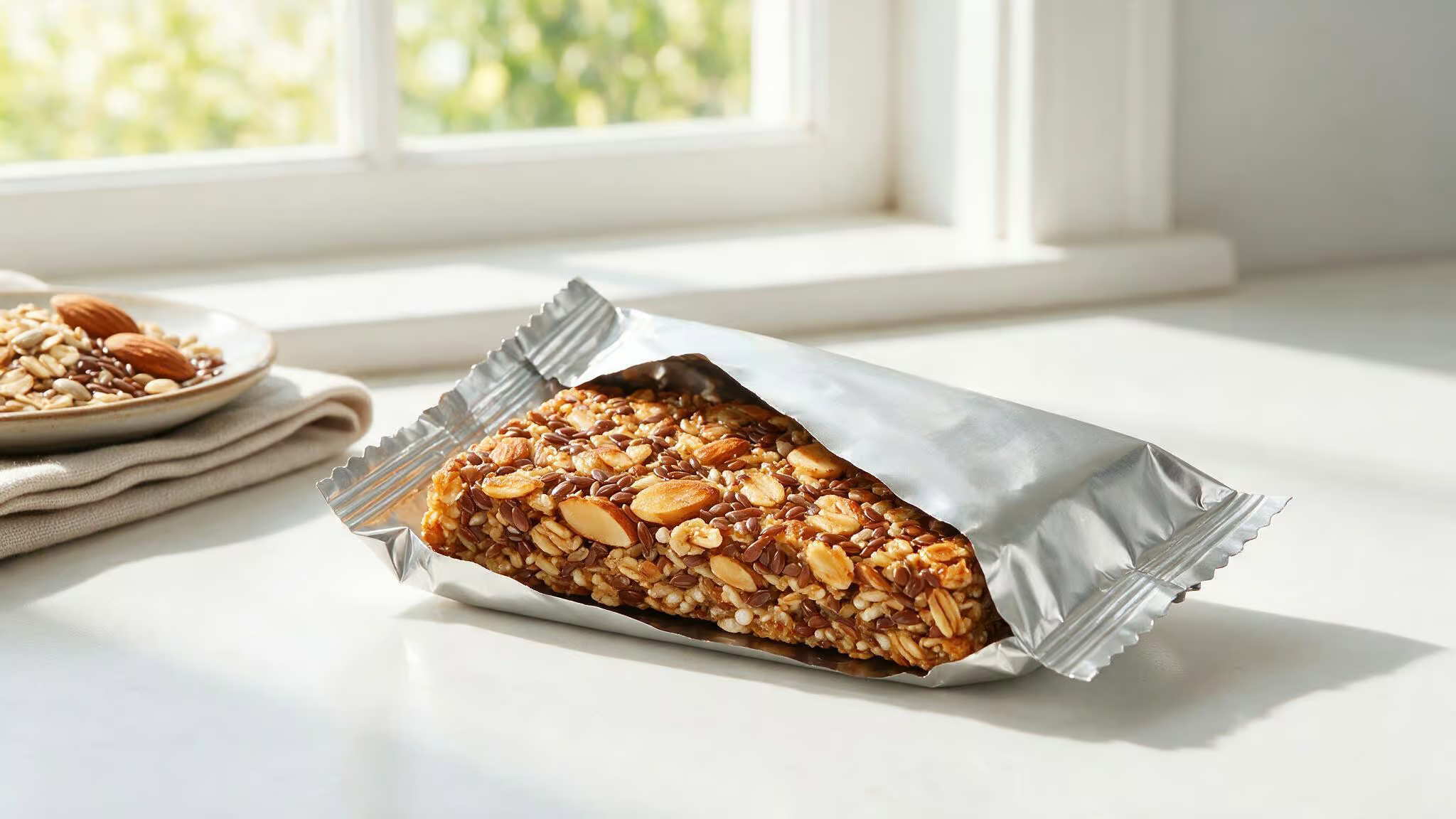
I’ve been a protein bar snob for years. I’ve tried dozens — the chalky ones, the ones that taste like cardboard, the ones that promise clean ingredients but deliver a sugar bomb. Most give me GI issues that make me regret my life choices. So when I first scanned an IQ Bar with the Yuka app and got two different scores, 51/100 (Bad) and 75/100 (Good), depending on which flavor I picked up, I had questions.
The same product. Same barcode family. One flavor scores 51 out of 100 — labeled “Bad”, and another gets 75 out of 100, which Yuka calls “Good.” That’s a 24-point swing. So I dug in.
Here’s what I found after testing these bars myself, cross-referencing the Yuka data, and comparing the ingredient list against what the app evaluates.
Key Takeaways
IQ Bar’s Yuka score ranges from 51/100 (Bad) to 75/100 (Good) depending on the flavor — sugar, fat, and ingredient profiles drive the swing
The app penalizes natural flavors and stevia while rewarding high fiber and the absence of seed oils — but it doesn’t evaluate the bar’s six cognitive enhancers (Omega-3, MCT, Lion’s mane, flavonoids, Vitamin E, choline) at all
In my own testing, I had zero GI issues (a first for me with protein bars), noticed cognitive benefits on sleep-deprived days, and rate the bar 4.5/5 overall with perfect scores for taste, essential nutrients, and ingredient quality
Table of Contents
The IQ Bar Yuka score that health-conscious moms can’t ignore
Let me set the scene. You’re standing in the grocery aisle (or more likely, scrolling online), trying to figure out if this bar is worth your money and your kid’s afternoon snack slot. You pull out Yuka, scan the barcode — 8775549554049, and the app spits back a score that makes you hesitate.
It’s 51 out of 100. Bad. Red circle. The app’s algorithm flags something.
But then you scan a different flavor of the same bar, and suddenly it’s 75 out of 100. Good. Green circle. What changed?
The ingredients are mostly the same. The box looks similar. The cognitive enhancers are the same.
I’m not a nutritionist or a health professional. I’m a mom who’s picky about what goes into my body — and my kids’ bodies, and I’ve learned that Yuka is a useful tool, but it’s not the story.
For context, I rate IQ Bar 4.5 out of 5 stars overall. Taste gets a perfect 5/5. Essential nutrients, ingredient quality, and health benefits all score 5/5. Price is a 4/5, and value is 5/5. These are bars I keep in my car and my desk drawer specifically so I don’t grab something worse when I’m hungry and tired.
But I also know that “my rating” and “Yuka’s rating” are measuring different things. That’s what we need to unpack.
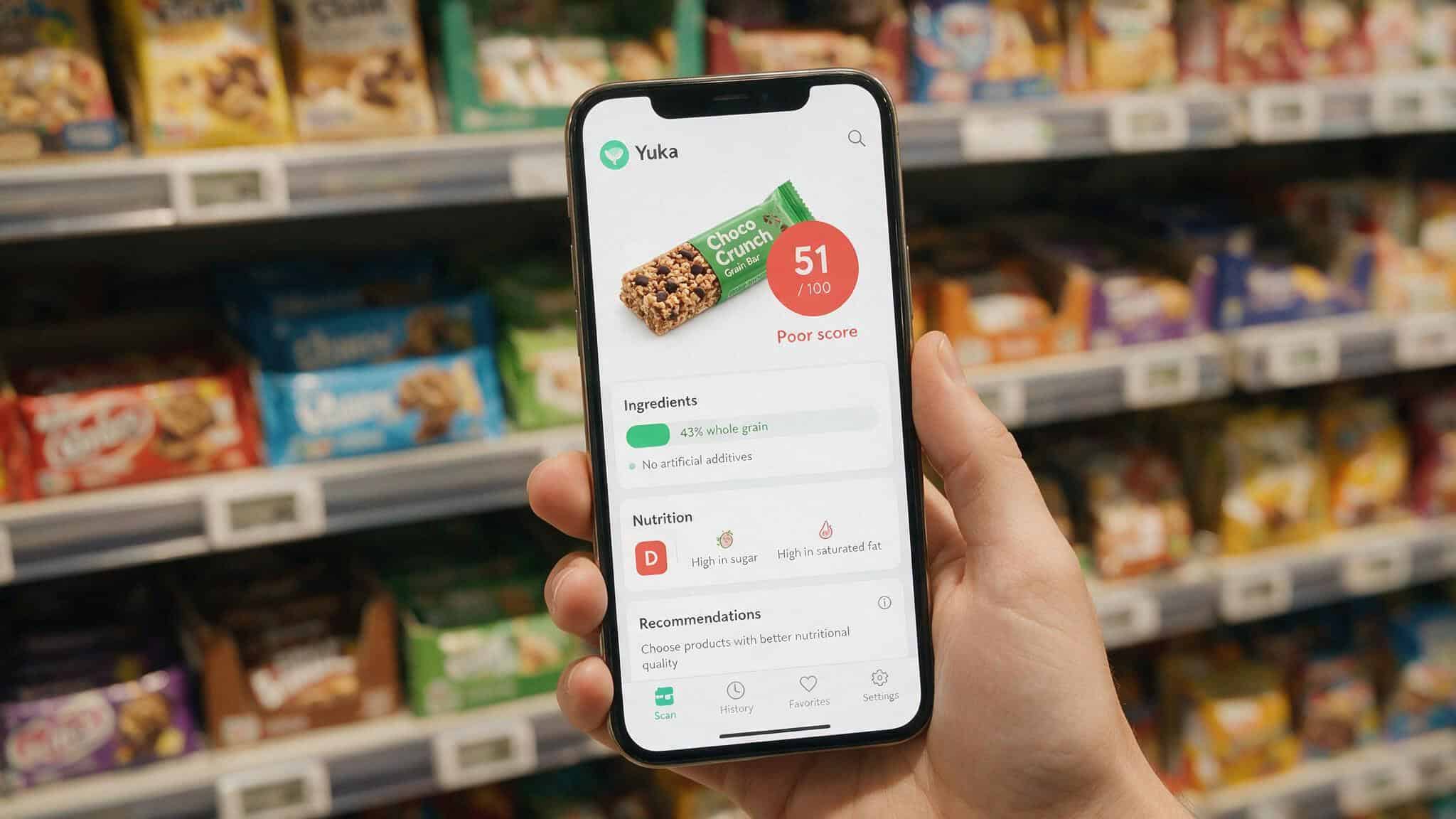
What the Yuka app actually looks at when it scans an IQ Bar
To understand the score you see, it helps to know how Yuka weighs different factors. The app evaluates three categories: nutritional composition, additives, and organic or eco-labels.
How Yuka calculates its 0–100 score
Yuka is straightforward in its approach. It scans a product’s barcode, then evaluates three categories: nutritional composition (positive and negative points), additives (penalties), and organic or eco-labels (bonuses). The final score gets a color code — green for good, yellow for fair, orange for poor, red for bad.
For IQ Bar specifically, the barcode 8775549554049 is what triggers the lookup.
The two Yuka scores for IQ Bar: 51/100 and 75/100
Here’s where it gets interesting. The same product line has two different Yuka scores in the database. One flavor scores 51 out of 100 — “Bad”, while another hits 75 out of 100, “Good.” That’s a gap.
I don’t know exactly which flavor maps to which score. The source data doesn’t specify. But the variation exists, and it’s not a glitch.
Why the same bar gets different scores by flavor
The score differences come down to what’s in each flavor. Some flavors have higher sugar content from fruit or chocolate. Some have more saturated fat from certain nut butters or cocoa butter. Yuka penalizes natural flavors and stevia — two ingredients that appear in IQ Bar, while rewarding high fiber, solid protein, and the absence of seed oils.
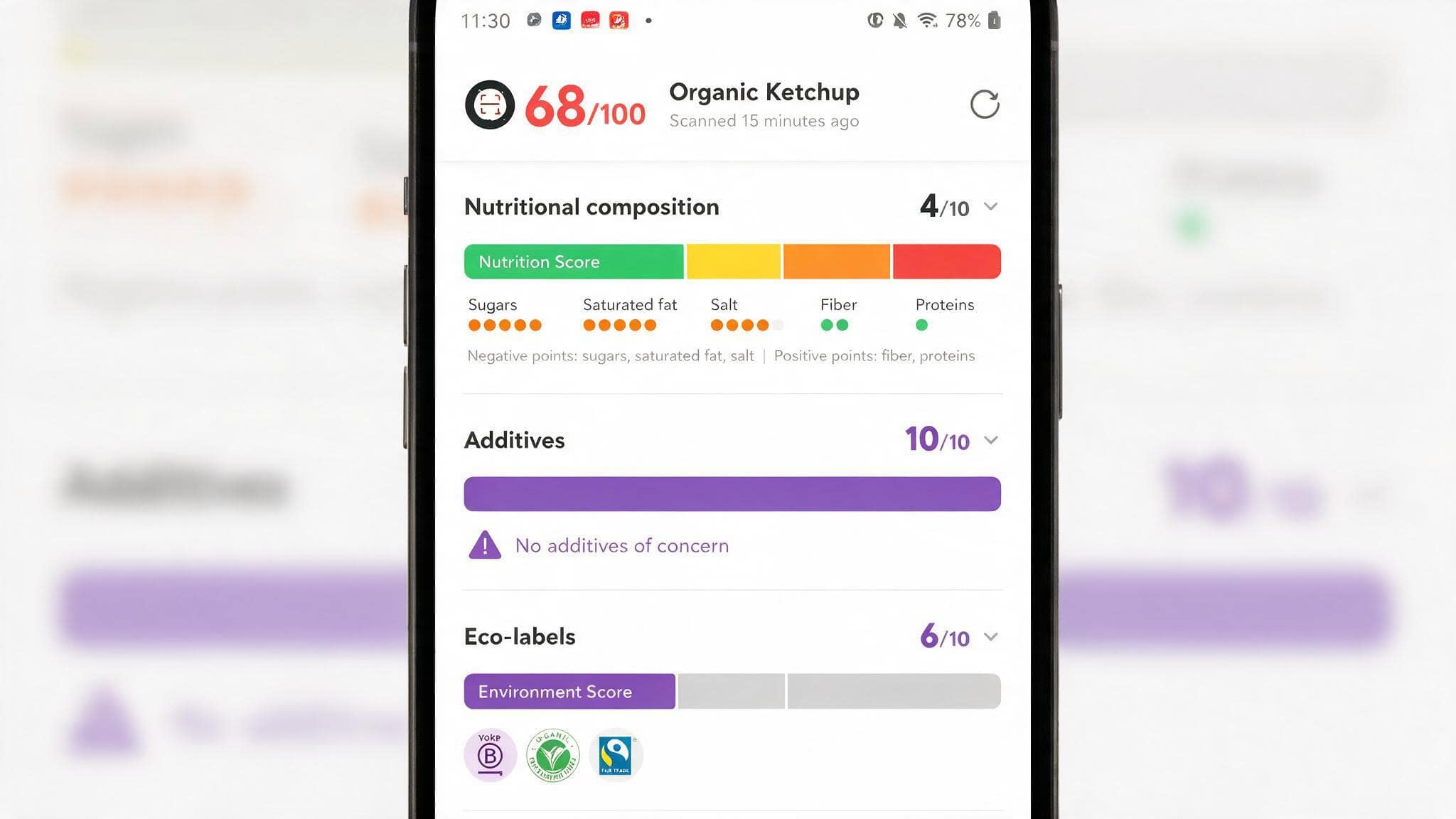
Yuka’s algorithm is designed to reward whole, minimally processed ingredients. IQ Bar uses natural flavors that are non-GMO, extracted from natural sources, and free of the Top 8 Allergens. They’re WONF flavors — “with other natural flavors”, which is a technical term meaning the flavor profile comes from natural sources rather than artificial compounds. Yuka flags them as additives.
The same goes for stevia and monk fruit, which IQ Bar uses instead of artificial sweeteners. Yuka penalizes non-nutritive sweeteners, even the plant-based ones many health-conscious eaters consider fine.
Ingredients deep dive: what Yuka sees and what it misses
Once you know how Yuka scores, the next step is looking at what’s actually inside the bar. Here’s the full ingredient list and what each component contributes.

Full IQ Bar ingredient list and nutritional breakdown
Let me walk through what’s in one of these bars. The key ingredients include almonds, soluble tapioca fiber, pea protein, allulose, flaxseeds, natural flavors, banana, gum acacia, coconut oil, sunflower lecithin, and sea salt. Some flavors also include protein crisps made from pea protein and tapioca starch.
Nutritionally, each bar delivers 1 to 2 grams of sugar, 3 grams of net carbs, 12 grams of protein, and 8 to 9 grams of fiber. That’s a macro profile for a snack bar. No seed oils — no canola, no sunflower, no soybean oil. Instead, the fats come from coconut oil, MCT oil, and almonds. No gluten, no dairy, no soy, no artificial sweeteners.
The bars are all gluten-free. Most are vegan-friendly. The Wild Blueberry flavor is explicitly keto-friendly.
What Yuka penalizes: natural flavors, stevia, and the score tradeoff
Yuka’s algorithm sees natural flavors and stevia and docks points. If you’re evaluating the bar purely through Yuka’s lens, that 51/100 score makes sense — the app is penalizing ingredients it categorizes as additives, even if those ingredients are clean by most standards.
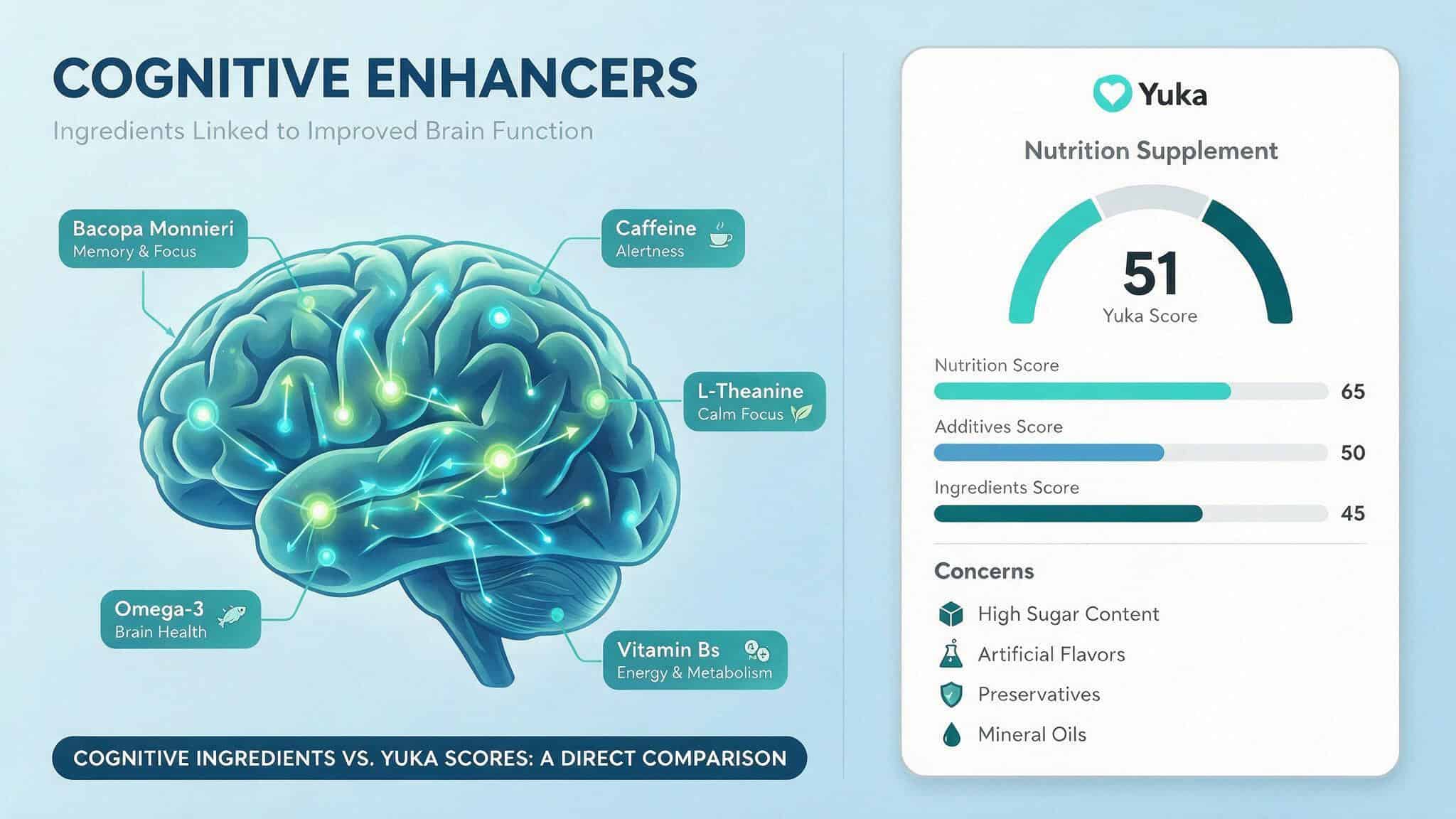
On the flip side, Yuka rewards the high fiber content (8-9 grams per bar), the solid protein (12 grams from plant sources), and the absence of seed oils. These are the factors that push the 75/100 score up.
Yuka’s system is a blunt instrument. It’s useful for catching products with artificial colors, preservatives, and industrial seed oils. But it’s less useful for evaluating a bar that uses clean-but-processed ingredients like stevia and natural flavors in service of a specific nutritional goal.
The cognitive enhancers Yuka doesn’t score: Omega-3, MCT, Lion’s mane, and more
Here’s the gap. IQ Bar includes six specific cognitive enhancers designed to support memory, focus, and brain function, but my IQ bars review explains why Yuka doesn’t evaluate any of them.
The six are: Omega-3 fatty acids, MCT oil, Lion’s mane mushroom, flavonoids, Vitamin E, and choline.
- Omega-3 is a brain-healthy fat that most of us don’t get enough of.
- MCT oil is a fast-acting fat that provides quick energy for the brain.
- Lion’s mane is a mushroom known for its cognitive-support properties — it’s the ingredient in the bar that gets people asking questions.
- Flavonoids are antioxidant compounds found in plants that protect brain cells.
- Vitamin E is a fat-soluble antioxidant that supports brain health.
- Choline is a nutrient critical for brain development and memory function.
Yuka’s algorithm doesn’t have a category for “cognitive enhancers.” It can’t weigh the benefits of Lion’s mane against the penalty for natural flavors. So the score you see reflects part of what the bar is doing.
How IQ Bar stacks up against other bars on Yuka
To put IQ Bar’s Yuka scores in context, it helps to compare them against other popular bars. Each competitor has its own strengths and tradeoffs that Yuka captures — or misses.
Lärabar: simple ingredients, ‘Good’ on Yuka
Lärabar’s fruit-and-nut flavors are a classic comparison. The ingredient list is short — dates, nuts, fruit, and Yuka rewards that simplicity. Most fruit-and-nut Lärabars score “Good.” The tradeoff is straightforward: you get clean ingredients, but no cognitive enhancers and lower protein per bar.
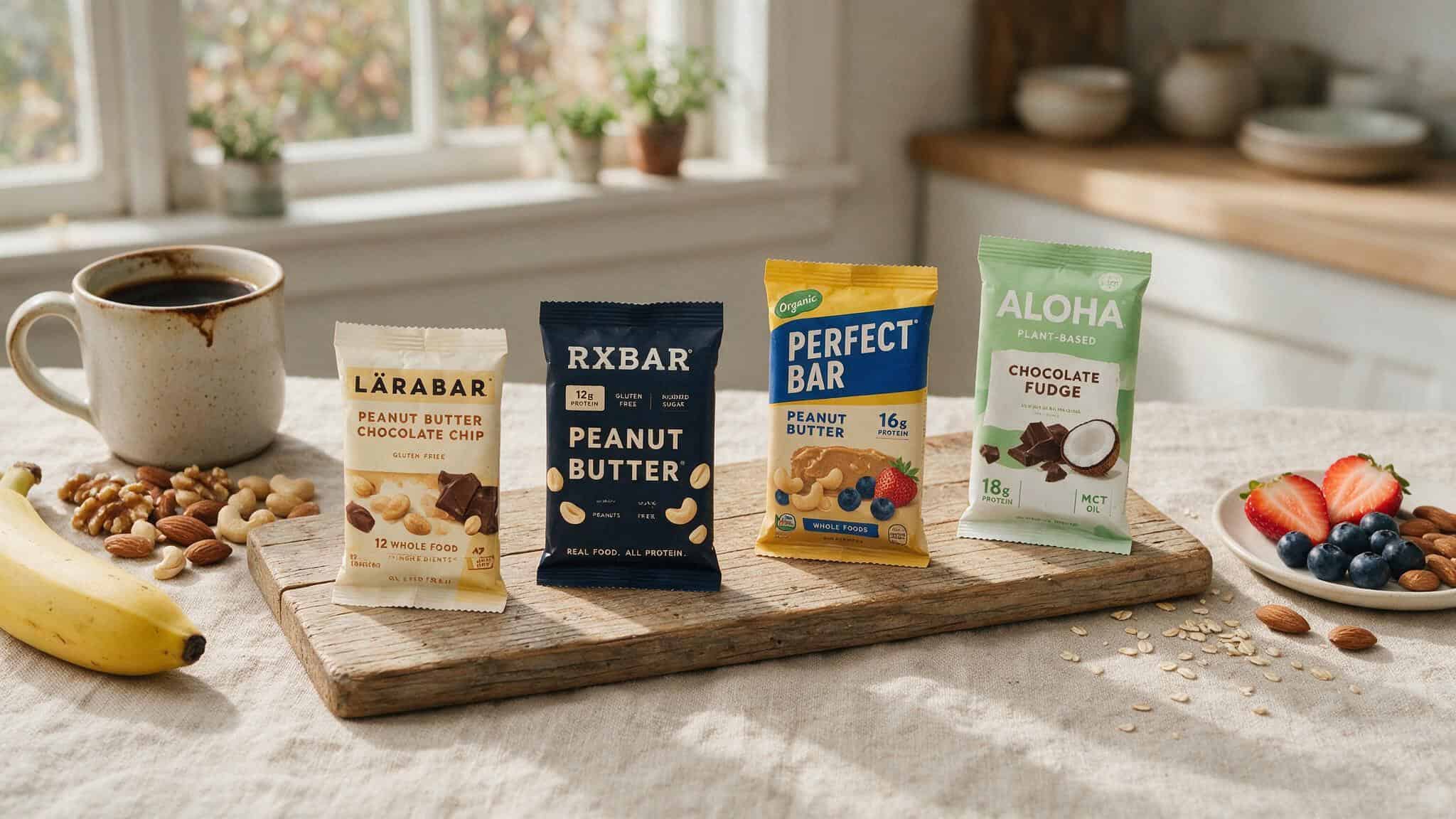
RXBAR: ‘no B.S.’ ingredients with varying Yuka scores
RXBAR built its brand on transparency — egg whites, nuts, dates, printed right on the front of the box. Yuka gives them “Good” to “Excellent” ratings depending on the flavor. Some flavors have higher sugar from fruit or chocolate, which pulls the score down. It’s a similar pattern to IQ Bar’s score variation, which raises the question: are IQ bars Bobby approved? But RXBAR doesn’t have the cognitive angle.
Perfect Bar: creamy and calorie-dense, 78/100 on Yuka
Perfect Bar’s green packaged flavor scores 78 out of 100 on Yuka — “Excellent.” The app praises the protein, fiber, and low saturated fat. But Perfect Bar is calorie-dense (often 300+ calories per bar) because of its nut butter base. It works best as a meal replacement or post-workout snack, not a grab-and-go between meals.
And if you’re looking for a different option, where can I buy IQ Bars? Your complete guide to buying them covers online retailers, local stores, and tips for finding the best deals.
Aloha Protein Bars: plant-based with frequent ‘Excellent’ scores
Aloha is a plant-based option with clean, organic ingredients and balanced macros. It earns “Excellent” Yuka scores. The tradeoff is the same as the others: no cognitive angle, and the price can be higher per bar.
If your top priority is a perfect Yuka score, Aloha or a simple Lärabar might be your pick. But neither of those bars includes Lion’s mane or MCT oil. They’re not designed to support cognitive function. That’s IQ Bar’s specific angle, and Yuka doesn’t measure it.
Is IQ Bar a healthy snack for your kids? A mom’s practical assessment
Before deciding whether IQ Bar fits your child’s snack rotation, it’s worth seeing what Yuka itself considers an ideal snack. That benchmark helps clarify where the bar fits in.

Yuka’s own perfect snack recommendation as a benchmark
Yuka has published its own ideal snack composition: 1 to 2.5 ounces of nuts (walnuts or almonds), two squares of dark chocolate (at least 70% cacao) or fruit, green or white tea steeped for five minutes or more, and optional good carbs. The app cites studies on nuts, tea, cocoa, and chocolate as the evidence base. Yuka also advises snacking 3-4 hours after lunch and at least an hour before physical activity.
Where IQ Bar aligns — and where it doesn’t
IQ Bar aligns with several of Yuka’s principles. It provides protein, fiber, and healthy fats. It includes almonds and flaxseeds. It has no seed oils. It’s low in sugar.
But it diverges in ways. The bar includes stevia and natural flavors, which Yuka penalizes. It’s a processed food — not a handful of nuts and a square of dark chocolate. Some flavors contain caffeine from matcha or cocoa, parents may want to limit that for kids.
The caffeine and stevia question for kids
Some IQ Bar flavors contain caffeine or stevia. Many parents I know limit both for their kids.
For younger children, a handful of almonds and a square of dark chocolate is a better fit. But for tweens and teens who need a filling after-school snack that won’t spike their blood sugar, IQ Bar could work in moderation. The key is checking the label on each specific flavor and making your own call.
Buying guide: flavors, price, shelf life, and where to find IQ Bar
If you’re ready to try IQ Bar, here’s everything you need to know about the flavors, pricing, and where to buy them. Start with the flavor lineup to find your best match.
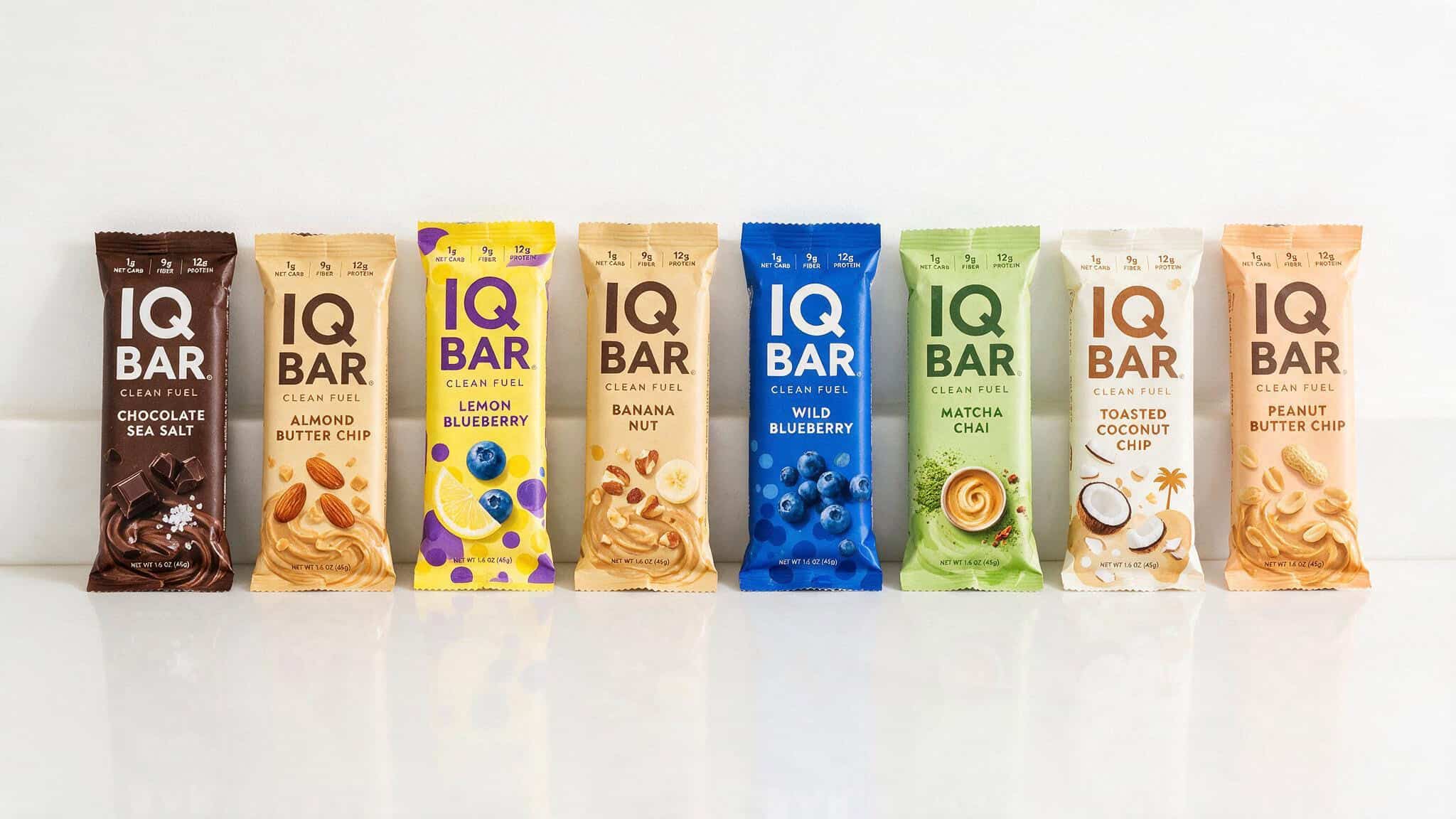
All eight IQ Bar flavors and how to choose
IQ Bar comes in eight flavors: chocolate sea salt, almond butter chip, lemon blueberry, banana nut, wild blueberry (which is keto-friendly), matcha chai, toasted coconut chip, and peanut butter chip. My favorite is peanut butter chip — it’s the one I keep coming back to.
All flavors are gluten-free. Most are vegan-friendly. The Wild Blueberry flavor is specifically formulated for keto dieters.
Price, discounts, and storage tips
Each bar runs around $2, which is reasonable for a premium product with this ingredient profile. You can get 15% off with the promo code MINDBODYDAD, or by buying in bulk. The same code also works for IQMIX, the brand’s electrolyte mix, which I’ll mention because I think it’s one of the best electrolyte products on the market.
Unopened bars have a 12-month shelf life, which makes bulk buying practical. Once opened, eat them within a few days — they don’t stay fresh forever.
IQ Bar is mostly sold online. Limited store availability is a drawback, so plan ahead if you want to keep them stocked.
My tips: I keep bars in my car and my desk drawer so I have a good option when hunger hits. I also crumble them over yogurt or oatmeal for a quick breakfast upgrade. If you’re trying them for the first time, get the sampler pack to find your favorite flavor before committing to a bulk box.
The bottom line: who should buy IQ Bar (and who might skip it)
If your top priority is a perfect Yuka score, Aloha or Lärabar may score higher and cost less. Yuka’s algorithm is useful, but it’s incomplete — it can’t weigh the cognitive benefits of Lion’s mane or MCT oil against the penalty for natural flavors.
If you want a bar that supports brain function, fits low-carb, keto, or vegan diets, and tastes good, IQ Bar is a solid choice. The 12 grams of protein is good for a plant-based bar but not the highest on the market. The limited store availability is an inconvenience. And some flavors aren’t suitable for kids due to caffeine or stevia content.
I’d recommend IQ Bar for: health-conscious people who want more than a protein bar, low-carb dieters, sleep-deprived individuals who need a cognitive boost, and time-crunched active people who need a reliable snack. I’d recommend skipping it if you want a whole-foods snack with no processed ingredients, need maximum protein per bar, or prefer to buy snacks at your local grocery store rather than ordering online.
Yuka gives you one data point. Your goals, your family’s needs, and your taste preferences give you the rest.
Frequently Asked Questions
How does Yuka rate IQ bars?
Yuka evaluates nutritional composition, additives, and organic labels. IQ bars get penalized for natural flavors and stevia, but rewarded for high fiber, solid protein, and no seed oils. That’s why different flavors of the same bar can score anywhere from 51/100 (Bad) to 75/100 (Good).
What is the most unhealthiest protein bar?
That depends on your criteria, but bars with high sugar, seed oils, artificial sweeteners, and low fiber tend to rank worst. IQ bars are not in that category — they have 1-2g of sugar, no seed oils, and no artificial ingredients — though Yuka flags some flavors as ‘Bad’ due to natural flavors and stevia.
How trustworthy is Yuka?
Yuka is a useful tool for catching artificial colors, preservatives, and seed oils, but it’s a blunt instrument. It penalizes clean ingredients like stevia and natural flavors while completely ignoring cognitive enhancers like Lion’s mane, Omega-3, and MCT oil. The score reflects only part of a product’s story.
Why do different IQ Bar flavors have different Yuka scores?
The score swing comes from variations in sugar, saturated fat, and ingredient profiles between flavors. Some flavors have more sugar from fruit or chocolate, or more saturated fat from nut butters, which Yuka penalizes. The high-fiber, no-seed-oil base keeps the better-scoring flavors in ‘Good’ territory.
Can kids eat IQ bars?
Some flavors contain caffeine from matcha or cocoa, and all use stevia, which many parents limit for younger children. For tweens and teens who need a filling, low-sugar after-school snack, IQ bars can work in moderation — just check the label on each specific flavor first.