
Yes, stripping can be a career. The catch is what “career” means here: not an open-ended job you drift through, but a performance career with a defined arc, a peak, and a real end date, closer to how ballet works than how office work works. The work itself is legitimate labor. It’s a job, legally and practically, performance-based, paid through stage sets, tips, and private dances.
The question worth asking isn’t whether it counts. It’s whether it lasts, and for how long.
Here’s the closest documented parallel we have: ballet careers average an exit around age 35, yet some performers stretch past 20 years through deliberate adaptation. That’s the structure worth borrowing.And we’ll be straight with you about method, because you deserve that: nobody has run a long-horizon dataset on stripping. No one has tracked hundreds of dancers across decades and published the injury rates, the exit ages, the savings outcomes.
So this article borrows the documented longevity playbook from dance-career research and flags it as a parallel model, not proof. It’s the best evidence that exists, and pretending otherwise would be worse than admitting the gap.
Whether your window lasts five years or fifteen comes down to four things: how you care for your body, how you save, whether you can keep doing it mentally, and how you evolve the job instead of just outlasting it. We’ll walk through each, with the numbers behind them, a body-care plan organized by career stage, a savings approach sized to a shorter earning span, and a plan for changing course mid-career most performers don’t get until it’s too late.
The stigma objection, head-on: the work is legitimate. The question isn’t whether it counts.It’s whether it lasts.
Key Takeaways
Dancers in the aDvANCE Project survey expected to perform into their 40s; former dancers actually stopped in their early to mid-30s. That’s a systematic overestimate of almost a decade, and it’s not unique to dance. Plan your savings against the earlier number.
The body can last past your 30s, but only with the boring stuff: two rest days a week, eight-plus hours of sleep, strength training twice weekly, and a care team built in your 20s before anything hurts.
The smartest second-act moves pay twice. Pilates, Gyrotonic, and personal-training certifications earn money now, double as self-care that extends the career, and become the landing pad after it.
Table of Contents
What sustains a 20-year performance career
What separates 20-year performance careers from 5-year stints is physical upkeep, mental tactics, technical adaptation, and artistic deepening, each one grounded in how a named veteran actually trains and works. The three dancers here have each done it: Noelani Pantastico of Pacific Northwest Ballet, Guillaume Côté of the National Ballet of Canada, and Crystal Brothers of Ballet Memphis. Think of them as friends who’ve been in it a long time, not a panel.
Côté, 37, cross-trains with Gyrotonic, a movement system done on specialized equipment that builds balance and flexibility, does cardio, takes daily class, and says plainly that staying at this level takes more effort every year. Major knee surgery and a herniated disc changed how he works: he feels he wasted energy when he was young, and now he emphasizes what reads onstage, musicality and choreographic intent.Brothers’ daily routine is the most striking detail: a hot bath on waking, icing her feet, exercise bike while doing makeup, Pilates mat and reformer, a second hot bath, and a full self-directed barre before company class, every day, no shortcuts. What worked at 19 doesn’t work at 42. Pantastico, who spent 7 years with Les Ballets de Monte-Carlo, flips the whole frame: dance sustains her, not the reverse.
She had serious anxiety as a kid and dance saved her, and she walks into the studio each day as a new dancer.Côté re-danced Balanchine’s Apollo at 37, not the way he’d have danced it at 21. You decide what version of the work you’re doing.
Translate that to club work, with the obvious caveat that this is a parallel, not equivalent evidence. In both fields your body does the work, the way an instrument does for a musician, and the emotional labor of club work runs on the same sustainability tactics.The job changes; the people who last change the job with it.
The body over a decade: a stage-by-stage maintenance plan
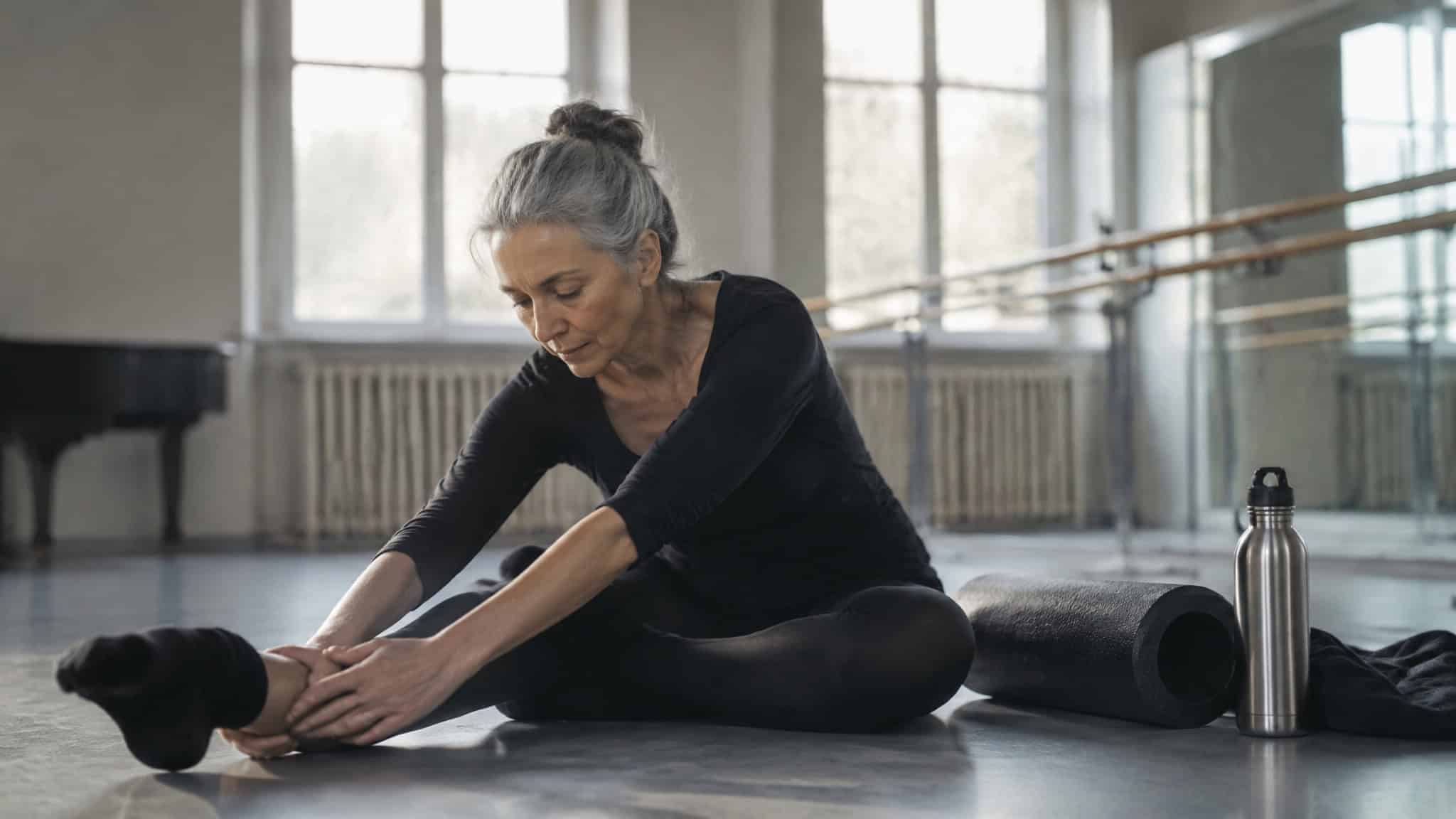
Yes, the work can last past your 30s, but only with steady physical upkeep, because injuries accumulate and flexibility fades on a predictable timeline. Julia Iafrate, the sports medicine physician who founded Columbia Dance Medicine in NYC, says the myth that you have to stop in your 30s is pretty much gone. The catch: only with the boring, non-negotiable stuff.
In your 20s: build your people. Kendall Alway, a dance physical therapist, says the minimum is three people: a doctor for primary care, a physical therapist, and someone to support your mental health; massage and acupuncture may help too. Don’t wait for pain to show up first. Getting to know a dance physical therapist early pays off enormously, especially if you’re hypermobile (extra-flexible joints, harder to control).
Watch undernutrition: not enough fuel for what you’re asking your body to do can lead to RED-S, formerly the female athlete triad, renamed because it affects all sexes. It means hormonal imbalance, slow healing, and low bone density.
In your 30s: injuries stack. One leads to a second, then a third.Iafrate’s image is an onion: peel back one layer at a time. This is the decade where pushing through stops being free, and strength becomes critical for joint stability as hypermobility ages.
In your 40s and 50s: flexibility generally declines in the late 30s to early 40s, arthritis can limit mobility, and pain tolerance drops, which Iafrate describes as your body shouting at you. From the 50s, menopause lowers estrogen, which lowers bone density and muscle mass.Strength training addresses both, and bone scans are worth considering.
The non-negotiables, in one place: two rest days per week, eight-plus hours of sleep, strength training twice weekly.
One honest tension we won’t pretend away: money pressure can force skipped care and bad nutrition. That’s real, and naming it matters more than pretending the plan works for everyone on every night.And the gap, stated plainly: no published injury-rate data exists for exotic dancers. This is a documented parallel, not stripper-specific medicine.
The expectation gap: plan for the earlier end date
Performers systematically overestimate how long they’ll work by almost a decade, and knowing it doesn’t fix it. The aDvANCE Project found active dancers expect to perform well into their 40s, almost 10 years longer than is likely, while former dancers actually stopped in their early to mid-30s.
The country gaps, compactly:
- US dancers: expected ~41, actually stopped ~34. About a 7-year gap.
- Australian dancers: expected ~46, actually ~32. About a 14.5-year gap, the most optimistic cohort. Everyone thinks they’ll be the exception.
- Swiss dancers: expected ~41, actually ~35.
About a 6-year gap.
Then the harder finding: most current dancers claim awareness of transition challenges, yet many former dancers concede they were ill-prepared. Awareness without action, the same way we all know sleep matters and nobody does it. A fair caveat so we’re not selling you a tidy stat: the study compared different cohorts surveyed at the same time, so generational differences might explain part of the awareness gap.
And name the avoidance honestly, without judgment: some dancers consciously skip exploring other options for fear it’ll jeopardize the current income, and doubt they’d succeed elsewhere.That fear is the real blocker. Set your saving and exit plans against the documented earlier end date, not the felt one. Knowing the real timeline is a kindness, not a discouragement.
Money: saving against a known end date
Saving for this career means treating your peak-earning years as a compressed retirement-contribution period, sized against the earlier documented end of the window rather than the optimistic one.

Start with the income reality. Most dancers are independent contractors, often paying a house fee or shift fee to work rather than collecting a set hourly rate, taking home what they earn in tips and paid dances. That means no employer retirement plan, no benefits, cash-heavy and irregular income. Nobody’s withholding taxes for you, so taxes get handled like a business because that’s what the structure demands.If you’re mapping out the earning side in detail, our breakdown of how much money a stripper can make covers the stage-fee and slow-night realities honestly.
Now the reframe that does the actual work. The earning window is compressed, so set your saving horizon by the documented actual-exit ages from the expectation-gap data, which cluster around 32 to 35. Not by the version of yourself that feels like she’ll do this forever.Your peak years aren’t just “good years.”
They’re the whole contribution period. Every dollar saved at 24 is doing the work a salary-based retirement plan would spread across 40 years.
The failure pattern is documented in performance-career research, and it’s a composite pattern rather than one person’s story: lifestyle upgrades in the peak years, then the early-30s realization that the window is closing faster than expected.The dancers who saved aggressively from year one describe that choice as unpopular among peers. That’s worth knowing going in, because the social pressure to spend is part of the job’s economics, not a personal weakness.
Here’s where our own vantage point fits: at Tidbits of Experience, we write for people building real lives around work that comes with tradeoffs, and this work comes with tradeoffs by design. The plan isn’t glamorous.Self-funded retirement, aggressive contributions while the window is open, taxes handled quarterly like a business, and a saving horizon set by the data rather than the feeling. One boundary we’ll hold: no sourced stripper-specific earnings statistics exist in the evidence we have, so we’re keeping this structural.
No invented dollar figures, no fake before-and-after outcomes. The architecture is the useful part.
How long can it last? Longevity, limits, and tradeoffs
Yes, the work can stretch into the 40s and 50s, but the typical window ends earlier, and the long version is purchased with adaptation, not luck. Sadler’s Wells has run its Company of Elders, performers in their 60s to 80s, since 1989, while ballet’s typical retirement sits in the early 30s because of physical demands, perfectionism-driven burnout, and injuries with lengthening recoveries. The costs of choosing the long version are real: compounding wear, stigma, no benefits, the “one more year” trap that keeps deferring transition prep, and résumé gaps that get harder to explain.
Life after the club: what leaving actually feels like
Leaving is identity work, not just job hunting. The career was the structure of daily life, and losing it means losing the community and the rhythm. Isabel Mortimer, director of coaching at Dancers’ Career Development (founded in 1973 as the world’s first transition organization, and still one of relatively few), describes transition as “reaching an abyss” and losing the show rhythm as “like flatlining.” Natasha Oughtred, a former Birmingham Royal Ballet principal, stopped at 31 and resigned by posting a letter through a letterbox on Putney High Street; it took her about six months to come to terms with it, and her line is that no one tells you at the beginning.Years later, her 15-month-old daughter played the Prokofiev Romeo and Juliet balcony music, and the muscle memory did the rest. What the career builds, discipline, resourcefulness, confidence, doesn’t retire when the dancer does.
Second acts: fitness, entrepreneurship, and what transfers
The durable assets of the work, body expertise, client management, performance presence, map onto documented adjacent fields, and the smartest version starts mid-career, not after. The five documented transition routes: choreography; teaching and coaching; studio ownership; dance administration and production; alternative careers while staying connected through workshops and guest teaching. None of these paths outranks the others, and no single one is the guaranteed happy ending.
Pilates, Gyrotonic, and personal-training certifications pay twice: they earn money now, keep your body working longer, and become the landing pad after the career ends. That’s the direct antidote to the avoidance pattern from the expectation-gap section, because it’s exploring other options without threatening the current income. Teaching fitness or running your own business both draw directly on what performers already know about the body and about managing clients.If you’re weighing the entry side of this, our guide to becoming a stripper with no experience covers the beginner path, and how to become a stripper walks the full route from auditions on.
Former dancers go on to choreograph and to teach. When a performance career ends, something else begins. That’s not a poster; it’s just what the record shows.
Frequently Asked Questions
Is stripping a good career choice?
It can be, if you treat it as a performance career with a defined arc rather than an open-ended job. The work is legitimate labor — paid through stage sets, tips, and private dances — but the earning window is compressed, so it works best when you plan your body care, savings, and exit around a real end date instead of assuming you’ll do it forever.
Is stripping a hard job?
Yes, on multiple fronts. It’s physically demanding, with injuries accumulating and flexibility fading on a predictable timeline, and the emotional labor runs on the same sustainability tactics that long performance careers require. The people who last treat the body like an instrument and adapt the job as it changes.
Does stripping make good money?
The income is real but structurally unusual: most dancers are independent contractors who often pay a house fee or shift fee to work, taking home tips and paid dances with no benefits or employer retirement plan. The money can be strong during peak years, but it’s cash-heavy and irregular, which means handling taxes quarterly like a business and saving aggressively while the window is open.