
You’ve probably heard the term “3-3-3 rule” floating around—maybe on Reddit, from a friend, or buried in a blog post. It sounds like a simple formula, but when you start digging, it turns out there are two different frameworks using those numbers, and most articles don’t bother to sort them out.
Here’s the short version: the 30/30/3 rule (introduced by Financial Samurai in 2009 during the global financial crisis) is a conservative guideline to prevent overextension. The 3-3-3 rule is a separate, less common framework focused on emergency reserves and comparison shopping. This article is about the 30/30/3 version, because that’s the one most people are looking for—and I’ll cover the other one later so you know the difference.
Let’s break it down.
Key Takeaways
The 30/30/3 rule was introduced by Financial Samurai in 2009 as a conservative check against overextending: monthly housing costs ≤ 30% of gross income, save 30% of the home price before buying (20% down + 10% buffer), and the home price shouldn’t exceed 3x your annual gross income.
Violating the rule in practice can mean buying 7x your income with only a 10% down payment, leaving you with a $15,000 buffer and a $5,025 monthly payment—half your gross income.
Following the rule on a $100,000 income with $120,000 cash means buying a $300,000 home with 20% down, leaving a $60,000 cash buffer and a monthly payment of just $1,012—12% of your gross income.
Table of Contents
What Is the 3-3-3 Rule? (Two Frameworks to Know)
The confusion starts because the same numbers get used for two different things.
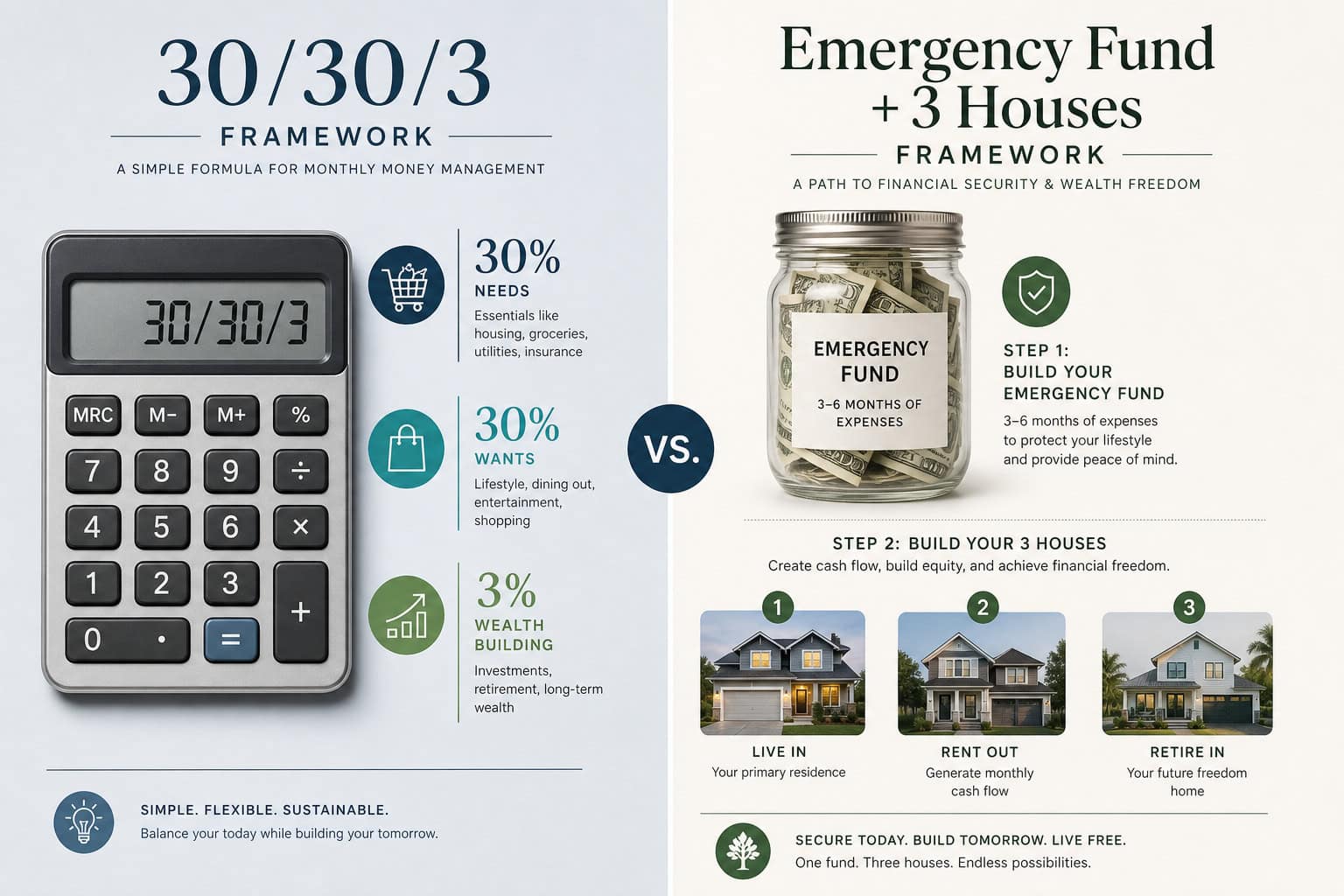
The 30/30/3 rule is the one you’ll see most often. It’s a three-part test: your monthly housing costs shouldn’t exceed 30% of your gross income, you should have 30% of the home price saved before you buy (20% down plus a 10% buffer), and the home’s price shouldn’t be more than three times your annual household income. It was introduced by Financial Samurai in 2009, during the global financial crisis, and it’s been picked up by CNBC and plenty of other outlets since then.
The 3-3-3 rule is a different animal. It focuses on reserves and comparison: an emergency fund covering three months of living expenses, a separate reserve for three months of mortgage payments, and a requirement to compare at least three similar homes before making an offer. It’s less about the size of the mortgage and more about making sure you don’t buy emotionally.
Both exist. Both are worth knowing. But the 30/30/3 is the heavy lifter, so that’s where we’ll spend most of our time.
Bottom line: Know which rule you’re using. The 3 important rules for buying a business prevent overextension; the 3-3-3 prevents emotional buying.
Rule #1 – Monthly Housing Costs ≤ 30% of Gross Income
This one is straightforward: the total cost of keeping a roof over your head—mortgage payment (principal and interest), property taxes, homeowners insurance, and any HOA fees—shouldn’t eat more than 30% of your gross monthly income. That’s your income before taxes come out, so keep in mind your take-home pay is lower than that number.
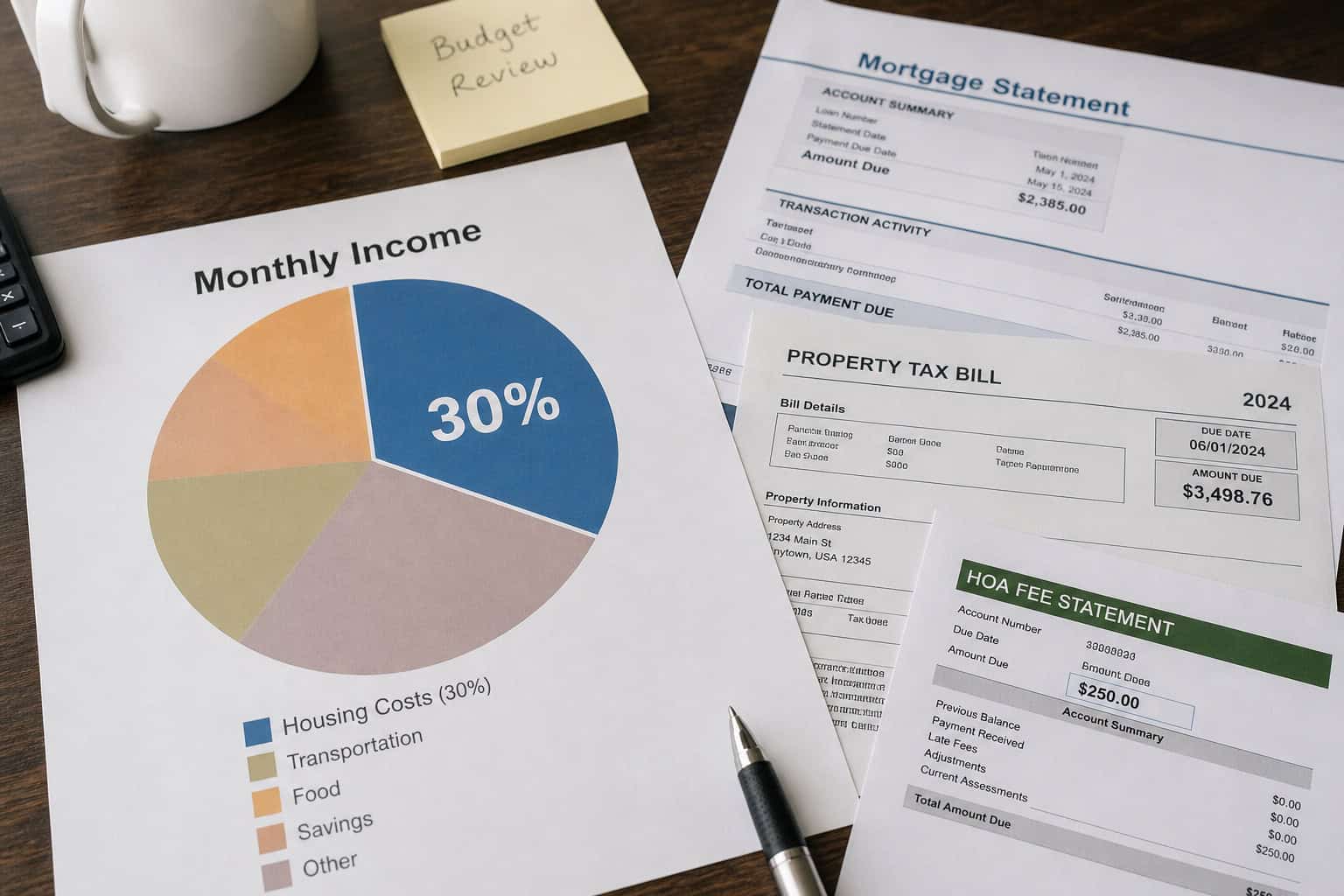
A lot of people think this rule is about the mortgage, but it’s not. If you’ve got an HOA, that counts. If your property taxes are high, that counts. All of it.
Middle to lower income people are most at risk of breaking this rule. Middle- and lower-income families have less wiggle room when something goes sideways, and this rule is designed to keep you from being one surprise repair away from a disaster. Lower mortgage rates tempt people to increase spending percentage, which is dangerous.
For comparison, the 28/36 rule (used by lenders) says housing can be up to 28% of your income and total debt up to 36%. Slightly more flexible than 30/30/3. On the other end, the FI home-buying rule (for people prioritizing financial independence) says keep housing under 10% of your income. The 30% here is a middle ground—more conservative than what a bank will approve, but realistic enough that you’re not living in a studio to hit FI numbers.

Rule #2 – Save 30% of the Home Price Before You Buy
This sounds like a lot, and it is. But here’s the breakdown: 20% of the home price goes to your down payment, and the other 10% is a buffer for closing costs and emergencies.
Putting 20% down means you skip PMI—private mortgage insurance, a monthly fee that protects the lender, not you. It also gets you the best mortgage rate. That’s two reasons to hit the 20% mark.
The 10% buffer is where people get tripped up. They save for the down payment and forget about closing costs, which typically run 2–5% of the loan amount. That covers appraisal, title insurance, legal services, and loan origination—not pocket change. The rest of that buffer is your emergency fund, because owning a house means things break. The water heater will die at the worst possible time, and you want cash on hand when it does.
There’s a reason for this: during the 2008–2012 crash, people who put almost nothing down walked away when things went south. Minimal down payments led to walkaways during 2008-2012, causing missed recovery. During times of maximum uncertainty, a larger financial cushion is better.
Here’s something I’ve noticed that most articles don’t cover: if you’re buying with cash, the 20% down part doesn’t apply to you—you’re putting 100% down. But that 10% buffer still applies. You still need closing costs (title insurance, inspections, the works), and you still need an emergency fund. Cash doesn’t mean houses don’t break. So don’t skip the cushion just because you’re not writing a mortgage check.

Rule #3 – Home Price ≤ 3x Annual Gross Income
This is the quickest gut check of the whole rule. If your household brings in $100,000 a year, you don’t even look at houses over $300,000. If you make $150,000, your ceiling is $450,000.
Simple math, but it accounts for your down payment. Even if you put a huge pile of cash down, the ongoing costs—taxes, insurance, maintenance—scale with the price of the house. A $500,000 house cash is still a $500,000 house to maintain.
Lenders may pre-approve for 4x-5x income, but the 3x rule prioritizes borrower safety. That doesn’t mean you should take it. The 3x rule is about keeping you safe, not what the bank is willing to sell your loan for.
There’s a variant called the 30/30/3-5 rule that lets you stretch to 5x income, but only under specific conditions: mortgage rates need to be declining, and your income growth needs to be bullish. The rule’s creator recommends not exceeding 3x if your mortgage rate is over 6%. 5x larger salary means more absolute debt, higher property taxes, maintenance expenses. It’s a riskier play, not a loophole.
What Happens When You Ignore the Rule
Let’s get specific.

Bad example: You make $120,000 a year, you’ve got $100,000 in cash, and you’re looking at an $850,000 home. That’s 7x your income. You put 10% down—$85,000—leaving you with a $15,000 buffer and a $765,000 mortgage. Your monthly payment is $5,025, which is about 50–60% of your gross income.
That’s violating all three rules. Lose your job? You’ve got three months before the cash is gone.
Terrible example: You make $70,000 a year, you inherit $500,000, and you buy a $1,000,000 home. You put $500,000 down, so your monthly payment is $2,316—40% of your gross income. Then you get furloughed and don’t get rehired. There’s no cash buffer because you dumped it all into the house. Foreclosure follows, and it drags down property values for the whole neighborhood.
Here’s the kicker: the person who foreclosed on that house later became a finance columnist at The New York Times. Even experts make mistakes. Life is weird.
More broadly, ignoring the rule can mean being house-poor—struggling to cover groceries, healthcare, or retirement because everything goes to the house. Higher risk of missed payments, late fees, and foreclosure. No emergency savings means a broken furnace or a job loss becomes a crisis. You lose flexibility—less money for travel, starting a business, or taking a breath.

What Happens When You Follow the Rule
Again, let’s use numbers.
Success example: You make $100,000 a year, you’ve got $120,000 in cash, and you buy a $300,000 home with 20% down—$60,000. That leaves you with a $60,000 cash buffer, which is five years of mortgage payments. Your monthly payment is $1,012—12% of your gross income. That’s breathing room.
Or you could go for a $400,000 home with 20% down: $320,000 mortgage, $40,000 buffer, monthly payment at 24% of your income. Still comfortable.
Following the rule keeps your budget balanced. You have room for daily expenses, savings, and the unexpected. You build financial resilience—you can handle a job loss, a medical emergency, or a market downturn without hitting the panic button. Lower foreclosure risk, less stress. You might not make as much in a hot market, but you’ll sleep better and build wealth steadily.
The Alternative 3-3-3 Rule (Reserves & Comparison)
This is the other framework I mentioned, and it’s worth knowing as a complement to the 30/30/3.
- An emergency fund covering three months of living expenses before you buy. This is your emergency fund—the money that keeps you afloat if life throws a curveball.
- A separate reserve for three months of mortgage payments, separate from your emergency fund. Job loss doesn’t pause the mortgage, so you need that extra layer.
- Compare at least three similar homes before making an offer. Think Goldilocks: one needs too much work, one lacks yard space, one is just right. This prevents emotional purchases and buyer’s remorse.
This framework is applicable to cash buyers, too. You still need emergency funds, and you should still compare multiple homes. It’s a different tool for a different purpose, but it works alongside the 30/30/3.

How the 30/30/3 Rule Applies to Cash Buyers
The rule was designed for people taking out a mortgage, but that doesn’t mean cash buyers can ignore it. You need to reinterpret it.

Rule #2: The 20% down part is irrelevant—you’re putting 100% down. But the 10% buffer for closing costs and emergency reserves still matters. I’ve seen cash buyers skip this and end up with no liquid cash, which is a dangerous position.
Rule #1: Instead of a mortgage payment, your ongoing costs are property taxes, insurance, HOA fees, and maintenance. On a high-priced home, those can easily exceed 30% of your income. The rule still applies.
Rule #3: The 3x income cap helps you avoid tying up too much of your net worth in one asset. If you buy a $1 million house cash, that’s a lot of wealth in one place. You lose liquidity, and if the market dips, you’re sitting on a paper loss with no easy way out.
The 3-3-3 alternative framework is fully applicable—you still need emergency funds and should compare multiple homes. And you can also choose to put more than 30% of your savings toward the home to lower ongoing costs, like buying a cheaper house cash to keep taxes and insurance low.
Cost check: Cash buyers still need a 10% buffer for closing costs and repairs. Liquid cash after closing matters more than a paid-off house.
Comparison to Other Affordability Guidelines
The 30/30/3 isn’t the only game in town. Here’s how it stacks up against other common rules:
- 28/36 rule: Housing ≤ 28% of gross income, total debt ≤ 36%. Used by lenders. A bit more flexible than the 30/30/3.
- 50/30/20 rule: 50% of income for needs, 30% for wants, 20% for savings. Broader budgeting approach, not home-buying specific.
- Income-based guideline (2.5–4x income): Keep the purchase price between 2.5 and 4 times your annual income. Broader, but doesn’t factor in savings or emergency funds.
- FI home-buying rule (≤10%): Strictest option, for those aiming for financial independence. Aggressive but powerful.
The 30/30/3 is more conservative than most of these, which is the point. It’s not about maxing out what you can borrow—it’s about making sure you don’t buy a house that owns you.
What to Do If the Rule Feels Too Strict
If you’re looking at the numbers and thinking there’s no way I can buy a house in my area with these limits, you’re not alone. The rule is conservative, and high-cost markets like California or Florida can make it feel impossible. But there are workarounds, each with trade-offs.
- House hacking: Rent out a room or a basement apartment to bring in extra income. That extra cash can improve your ratios. It’s a solid strategy for buyers with lower incomes.
- Bank of Mom and Dad: Many families get down payment help from relatives. Just make sure you’re not putting your parents in a tough spot financially.
- 30/30/3-5 stretch: Already covered—only when rates are declining and your income is growing. It’s riskier, but it’s an option.
- Side business: A legitimate home office deduction can change the math if you’re self-employed or have a side hustle.
- Passive income: Build other income streams before you buy. Even a small amount of passive income can improve your position.
- Fundrise: Real estate crowdfunding platform for people who aren’t ready to buy. You can start with as little as $10. I’ve invested over $400k there myself, so I’m not just talking—it’s a real option if you want real estate exposure without the hassle of being a landlord. They have about $3 billion in assets and over 350,000 investors.
- HomeFundIt: A down payment gifting program that can help you reach that 20% mark.
None of these are risk-free, but they’re ways to make the numbers work.

Additional Homebuying Tips (Complementary)
Beyond the rule itself, there are standard steps that are easy to forget in the chaos of house hunting:
- Get pre-approved before you start looking. You need to know your ceiling.
- Never skip the home inspection. It’s the best money you’ll spend.
- Partner with a real estate agent who knows the area.
- Budget 2–5% of your loan for closing costs—they add up fast.
- Ask about the roof’s age, the HVAC condition, and historical property taxes. Those are future costs that can break your budget.
Putting It All Together – Examples for Different Incomes
Let’s see how this shakes out with numbers.
Baseline (100k income): $300,000 home, $90,000 saved, $2,500/month max payment.
Higher income (150k): $450,000 max home price.
Success scenario: $100,000 income, $120,000 cash. Buy a $300,000 home with 20% down ($60,000), leaving $60,000 in cash—almost five years of mortgage payments. Monthly payment $1,012 (12% of gross income).
Alternative success: $400,000 home, 20% down, $40,000 buffer, payment at 24% of income. Still comfortable.
The rule works if you let it. It’s not about being perfect—it’s about not overextending in a moment of excitement. That’s the point.
People Also Ask
What’s the difference between the 30/30/3 rule and the 3-3-3 rule?
The 30/30/3 rule focuses on preventing financial overextension with caps on housing costs, savings requirements, and price-to-income limits. The 3-3-3 rule is a separate framework about emergency reserves and emotional buying: three months of living expenses saved, three months of mortgage payments in reserve, and comparing at least three similar homes before making an offer.