
When I met my now-husband all those years ago, we started dating and pretty quickly he told me, very politely, that I’m a bit uptight. That stung. But honestly, it stuck with me, and I took that message to heart in a big way. I realized I desperately needed actionable strategies to relax, lower my inhibitions, and actually enjoy social spaces without just faking it or stressing about my kids at home.
Over on our parenting blog, Tidbits of Experience, we talk a lot about these tiny, practical life pivots. If you want to stop feeling constantly self-conscious and finally learn how to let loose, you don’t need a total personality transplant. You just need a few deliberate mental shifts.
Key Takeaways
Making “two commitments” (being present and leaving when ready) creates the structure needed to completely let your guard down.
True relaxation doesn’t require “liquid courage,” as alcohol biologically numbs your sensory inputs rather than increasing connection.
Leaving a party before “the second drink” ensures you avoid watching friends turn into sloppy versions of their true selves.
Table of Contents
Overcoming the Uptight Label and Learning How to Let Loose
You feel stiff and awkward in social situations because you are actively putting effort into performing an expected version of relaxation rather than doing what actually makes you comfortable. Trying to prove you aren’t rigid takes an immense energetic toll.

When my husband pointed out my rigidity, my first instinct was to just act louder and busier. But the most awkward behavior stems from trying too hard to seem chill when you are internally panicking. To genuinely shake off that uptight conditioning, you have to honor your own version of low-stakes recreation. For me, that meant curling up with an amazing thriller, or spending a few bucks online while reading about how to win at casino slots. I realized unwinding doesn’t require becoming a wild extrovert on a Saturday night. It starts by finding what legitimately lowers your internal guard.
We can learn a lot from Elizabeth’s Naked Life, a powerful story proving that shedding external diagnoses is a private, deeply personal process. To shed that conditioning, the first step is redefining what a “relaxed” version of yourself actually looks like on your own terms.
Redefine Relaxation Away From Extroverted Expectations
You stop worrying about what other people think by establishing absolute boundaries around your comfort zone and accepting that your downtime is meant to recharge you, not entertain them. Once you stop apologizing for how you rest, external opinions stop mattering completely.

Dropping the High-pressure Roles
Many of us carry ridiculous mental weight without realizing it. In the book This Naked Life, you meet Elizabeth. She had spent a lifetime holding the heavy mantle as the strong one. She was the mother, the business owner, the civic volunteer, trying to figure out why drinking felt different as she got older. It is an entirely exhausting load to carry.
When she tried to figure out how to genuinely unwind, she realized she had to completely untangle those demanding roles from her limited downtime. Introverts especially feel forced to adopt loud, extrovert habits just to prove they are fun at a neighborhood barbecue or school fundraiser. But forcing it paradoxically increases your tension and inevitably ruins your night. You have to drop the facade to get anywhere.
Finding Psychological Safety First
Shedding your inhibitions is completely impossible without a firm baseline of emotional security. That security looks different for every single person. It works because feeling physically and emotionally safe naturally turns off your brain’s threat response.
By practicing unyielding boundary setting around your personal time, you create the exact conditions necessary for uninhibited joy. Establishing a boundary that protects your preferred method of relaxing (even if it means staying home in your pajamas) is vital for your sanity. You have to define what makes you feel safe before you can experience real relief. Often, the societal shortcut to forcing this extroverted energy is alcohol, but biology tells a completely different story.
Separate Nervous System Regulation From Social Lubricants
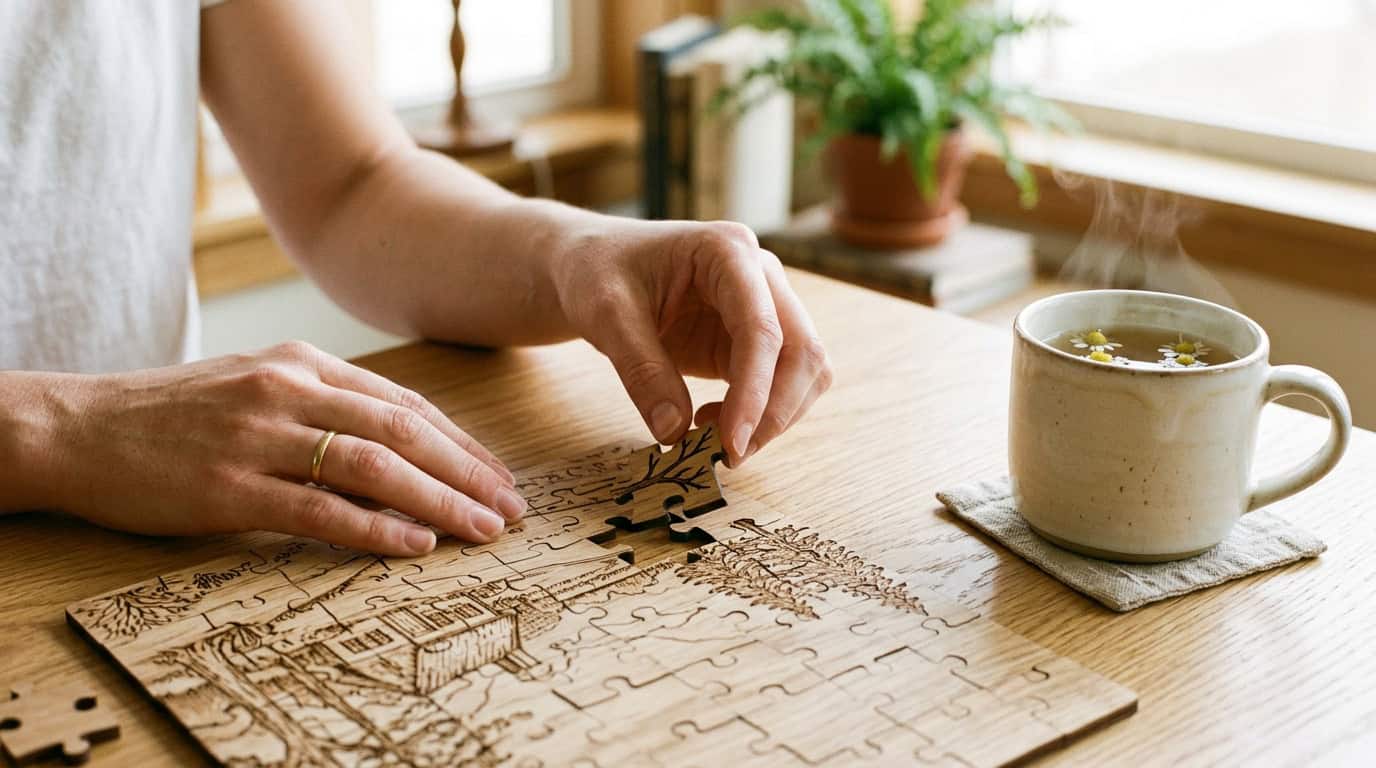
The healthiest alternatives to alcohol for calming your nerves are solitary cognitive activities—like puzzle games, physical stretching, or deep breathing—that actively soothe your brain instead of shutting it down. Alcohol functions purely as a chemical barrier, not an actual biological relaxant.
The Biological Reality of Numbing
We lean heavily on the cultural myth of “liquid courage” at the end of a long parenting week. But you have to audit your relaxation habits directly. You need to know if your go-to social lubricant is genuinely providing nervous system regulation or just temporarily pulling the plug on the operation.
Author Annie Grace breaks this reality down clearly. Alcohol numbs the brain’s ability to function and to receive information from your senses to think. You feel looser simply because your brain is temporarily offline. True connection and lowered inhibitions require sharp sensory awareness, not dulled reactions.
If you ever pause and ask Am I an Alcoholic?, understanding this biological math is a crucial first step. Start exploring The Naked Mind to fully grasp the mechanics of what is happening inside your body.

Why Alcohol Actually Drives Disconnection
The biggest misconception we carry into weekend gatherings is that passing around a nice bottle of wine automatically brings us closer together. The science paints a starkly different reality entirely. The fundamental truth is alcohol drives us apart.
“The fundamental truth is alcohol drives us apart.”
It makes a person entirely disconnected and significantly less present with the exact people they supposedly came to see. Books exploring these dynamics, like Buzz to Kill, show that assuming drinking creates closeness is scientifically flawed from the ground up. When you finally realize numbing yourself isn’t actually the goal, you can seamlessly swap it for activities that soothe your brain naturally and leave you feeling rested.
Lean Into Solitary Hobbies for Cognitive Unwinding
It is not harder for introverts to be uninhibited; they simply require different, usually solitary, environments to lower their guard compared to extroverts who feed on crowded rooms. The raw noise of a loud party often triggers an immediate defensive retreat for an introvert.

Mainstream advice insists that letting loose means acting wild in public. That is nonsense. Quiet, solitary recreation is a highly effective and totally valid method for dropping your defenses. Engaging in a brilliant novel or casual gaming can perfectly regulate your baseline tension.
When you intentionally substitute a chemical substance crutch with a 20-minute session of purely private cognitive unwinding, you achieve a natural flow state. You don’t need the performance pressure of a crowded living room to let go. Whether the crutch involves a heavy pour of cabernet or reaching for nicotine, the solution is often found in gentle, unjudged hobbies. Resources like The Alcohol Experiment clearly show that you don’t need to be social at all to unwind properly.
Finding great hobbies for moms that exist solely for your own private enjoyment is often the missing puzzle piece. But for the times you do want to venture out, you need a different toolbox.
Design Self-directed Commitments for Social Settings
The best strategy to overcome social anxiety before attending a party is to write down two firm personal commitments regarding exactly how long you will stay and what you will do while there. Having a pre-planned exit strategy completely removes the paralyzing fear of being trapped.
Building a Fail-safe Framework
Walking into a chaotic social environment without a plan is a recipe for instant regret. You need concrete rules established before you ever open the host’s front door or step out of your car.
This Naked Mind’s Naked Life Stories series highlights this beautifully. Take Tim, for example. Tim had been through every form of structured, external programming. Multiple DUIs.
Kicked out of places trying to figure it out. His compelling story, TIM’S naked life, details how he moved away from exhausting external expectations to reclaim his sanity. He created internal, non-negotiable rules that gave him the absolute agency to navigate difficult environments without reverting to old panic responses.

Why Internal Rules Beat External Pressure
When you make the rules entirely by yourself, you actually possess the freedom you have been blindly chasing. By shifting from the rigid pressures of traditional recovery models to fully self-directed commitments, you gain total social autonomy.
It sounds deeply contradictory, but pre-planning your limits instantly removes your anxiety. Knowing exactly when you will walk out the door grants you the psychological safety to finally let your guard down and just enjoy the appetizers. Write down your two personal commitments before entering the next high-stress social event on your calendar. The first of those foundational commitments is the easiest to say, but hardest to execute properly.
Discover How to Let Loose Through Physical Presence
You can have fun and let your guard down without drinking alcohol by physically removing distractions like your phone and fully anchoring your attention on the people right in front of you. Stripping away those modern escape hatches forces a level of true presence that genuinely lowers your internal defenses.

The first of your essential “two commitments” involves intentionally rooting yourself in the present moment for the benefit of your closest friends and family. Real presence is genuinely the most gratifying way to unwind. It demands that you physically separate yourself from all external distractions. Putting the phone in another room or actively ignoring the television fundamentally shifts your energy in a room.
This simple, deliberate act transforms exhausting performative socializing into genuine, anchored presence. You stop pretending to have fun and start actually having it. My greatest memories are from the evenings when I allowed myself to enjoy my family completely untethered. Resources compiling 6 Tips For Taking a Break often highlight this exact physical framework. True presence is powerful, but it relies heavily on your absolute willingness to enforce the second necessary commitment.
Execute a Graceful Exit Before Friends Mentally Check Out
You physically release tension in your body by removing yourself from chaotic environments the exact moment they no longer serve your peace, which immediately drops your heart rate and muscle stiffness. Honoring your internal clock to leave a space actively halts your biological stress response.

Recognizing the Tipping Point
There is a very precise moment at any gathering where the atmosphere notably degrades. The old tired saying claims nothing good happens after midnight, but in biological reality, nothing good happens after the second drink.
Your companions inevitably turn into sloppy versions of their true selves. Staying past this specific threshold directly drains your emotional energy and completely undermines your intention to genuinely relax. Pre-plan a basic exit script and leave the next event the precise moment you detect this shift in the room. Recognizing the mental check-out of your peers makes executing a graceful exit incredibly easy and entirely guilt-free.
Reframing an Early Departure as Self-respect
Walking to your car while the music is still blaring feels incredibly strange the first few times you do it. But giving yourself absolute, unapologetic permission to leave is incredibly liberating for a burnt-out parent.
It is an act of profound self-respect across the board. You are not missing out on any meaningful conversations, because meaningful conversations stop entirely when a party devolves into noise. Practical guides focusing on 6 Things About Moderation consistently reinforce that preserving your peace is vastly superior to desperately proving your stamina. The party officially ends for you the second your friends drift away mentally. And the ultimate reward for honoring that boundary reveals itself immediately the next day.
Trade the Hangover for Energized Mornings and Authentic Joy
It generally takes a few weeks of consistent practice to retrain your brain to enjoy socializing sober, as you learn to replace chemical reliance with organic morning energy. The timeline accelerates dramatically once you wake up remembering your conversations and immediately feel the tangible physical benefits.
Forced socializing invariably ends with a chaotic aftermath—namely shame, deep regret, physical illness, and extreme weekend restlessness. But when you unwind organically and honor your limits, you get a vastly different morning. Letting loose on your own terms means waking up totally clear-headed, actually remembering your jokes from the night before, and feeling deeply enthused to begin a brand new day.
You can track this exciting progress tangibly. Download the This Naked Mind Companion App or manually journal your energy levels the morning after pulling the plug on a late night early. Seeing the physical evidence on paper proves that ditching sensory numbing for authentic connection actually works wonders. You survive the party, but you physically and mentally capitalize on the energized, remorse-free morning that immediately follows.
Frequently Asked Questions
Why does “liquid courage” actually cause social disconnection?
Alcohol biologically functions as a chemical barrier that numbs your brain’s sensory inputs rather than genuinely regulating your nervous system. By temporarily pulling the plug on your mental operations, drinking actively prevents you from being fully present with the people around you. True connection and lowered inhibitions require sharp sensory awareness, not dulled reactions.
How does setting a strict exit strategy actually make a party more fun?
Walking into a chaotic environment without a game plan instantly triggers your brain’s defensive threat response. By explicitly committing to an exit time before you even leave your car, you establish absolute psychological safety and remove the paralyzing fear of being trapped. Knowing exactly when you are allowed to escape grants you the mental freedom to finally drop your guard and just enjoy the appetizers.
What is the “second drink” rule for deciding when or how to leave a gathering?
It is the specific, recognizable threshold where a party’s atmosphere degrades and companions inevitably turn into sloppy versions of their true selves. Walking out the door right before this shift happens preserves your peace and directly halts your biological stress response. Leaving early isn’t missing out; it’s a profound act of self-respect that prevents you from draining your emotional energy.
Can I really let loose as an uptight introvert without faking an extroverted personality?
Absolutely. Shedding your inhibitions does not require a total personality transplant or acting wild in a crowded room. Introverts can effectively lower their internal guard through low-stakes, solitary recreation like reading a brilliant thriller or casual gaming. You just need to drop the exhausting performative facade and honor whatever legitimately makes you feel safe.
What’s the difference between actual nervous system regulation and using a social lubricant?
Real nervous system regulation relies on solitary cognitive activities, physical stretching, or anchored presence to actively soothe your brain’s tension without impairing it. Social lubricants like alcohol just temporarily shut your brain offline to simulate relaxation. Relying on organic regulation instead of a numbing agent means you actually get to wake up clear-headed and remember the conversations you had.
How much time does it take to retrain your brain to enjoy socializing sober?
It generally takes a few weeks of consistent practice to get used to navigating crowds without relying on a chemical crutch. However, this timeline accelerates dramatically once you start experiencing the tangible physical benefits. Waking up hangover-free, highly energized, and without weekend shame provides immediate proof that the mental shift is actually working.