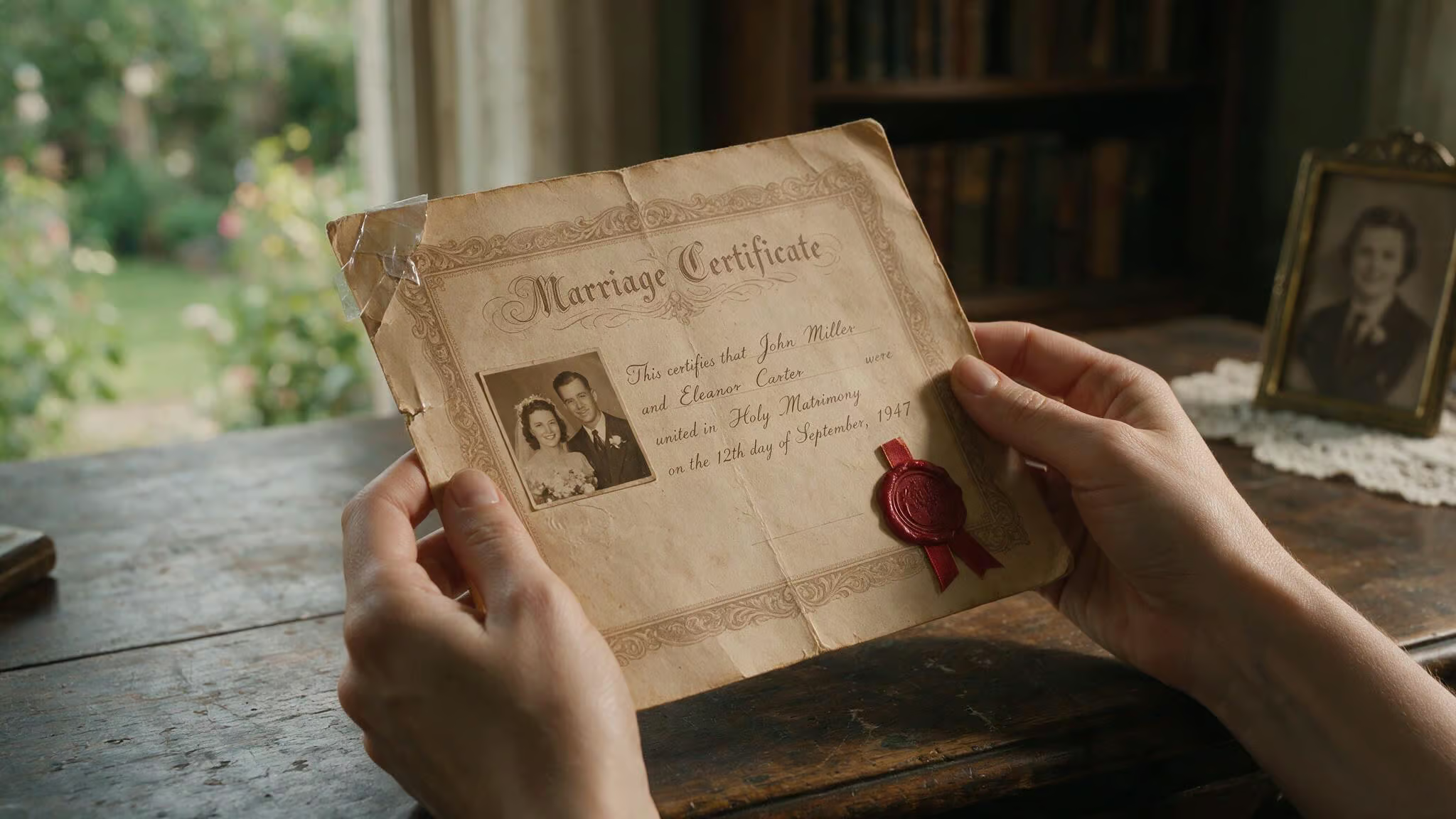
The direct answer: wife is the feminine counterpart of husband. If you’re here because you’re learning English and needed to fill in a blank on a worksheet, you’ve got it. Move along.
But most people searching “feminine word for husband” aren’t doing homework. They’re navigating something else. Maybe you’re writing wedding invitations and wondering if “wife” still fits. Maybe you’re filling out a form and the boxes don’t match your relationship. Maybe you’re part of a couple figuring out what to call each other, and the old words feel heavy in a way you can’t name.
Key Takeaways
About 80% of women still take their husband’s last name after marriage (Pew Research, 2023), while 14% keep their own and 5% hyphenate
The legal doctrine of coverture, codified in 1765, meant married women were legally “dead” as independent persons — and some legal scholars argue its effects linger today
In the U.S., there’s no fee to change your name to your husband’s upon marriage, but there is a fee to change it back after divorce — an asymmetry that reveals how the system favors the default
Table of Contents
Where “Wife” Gets Complicated
Under English common law, there was a doctrine called coverture. William Blackstone codified it in 1765, and the basic idea was this: when a woman married, her legal identity disappeared into her husband’s. Husband and wife became one person under the law — and that person was the husband.

A married woman couldn’t own property. She couldn’t sign contracts. She didn’t have legal rights to her own children. She couldn’t control her own body. In the eyes of the law, she was legally dead.
The first crack in that system in the U.S. appeared with the Married Women’s Property Act of 1848, which let married women own property separately. But it took until the 1970s for the rest to fall apart. Marital rape wasn’t illegal in every state until the 1970s — yes, the 1970s. Before that, women in many states couldn’t get a driver’s license, passport, or even vote without using their husband’s last name.
The names in The Handmaid’s Tale — Offred, Ofglen, are “of Fred,” “of Glen.” Margaret Atwood was dramatizing a legal concept that actually existed.
Abigail Adams wrote to John Adams about this during the Constitutional Convention. “Remember the Ladies,” she said, asking him to consider married women who were legally erased. The Married Women’s Property Act of 1848 was the first step toward fixing it.
The One-Way Rule: Not Saying His Name
In parts of rural India, women cannot say their husband’s name. It’s not rude — it’s a deep cultural taboo. The thinking is that a husband is regarded as a god and provider, so saying his name feels disrespectful, too familiar. Men face no such restriction. It’s a one-way rule.
So what do women call their husbands instead? They get creative. In Hindi-speaking areas, you’ll hear “baba-ji” — literally “father.” Or they’ll use his job title.
Or they’ll refer to him through his relationship to others: “the kid’s dad.” Whatever works to avoid saying the forbidden word.
An activist group called Video Volunteers actually filmed women saying their husbands’ names out loud in public for the first time. The reactions were genuine — embarrassment, laughter, a sense of release. It wasn’t a revolution, but it was observable.
Field note: In parts of rural India, avoiding a husband’s name isn’t politeness — it’s a one‑way cultural rule that women navigate with creative workarounds like job titles or “the kid’s dad.”
What People Actually Do Today
Pew Research asked in 2023. Roughly 80% of women took their husband’s last name. 14% kept their own. 5% hyphenated.
Portland State University looked at it from the other side in 2018. They found that 97% of men kept their name. 87% of men said their wife took his name. Only 3% of men changed their name (mostly to the wife’s). And 6% of couples said neither spouse changed.
The tradition is still dominant. But the reasons women give for their choices are all over the map — and that’s the part worth attention.
The Reasons Women Give
Jennifer Lopez took Ben Affleck’s name after their July 2022 wedding. She told Vogue that People are still going to call them Jennifer Lopez. But their legal name will be Mrs. Affleck because they’re joined together.
Ivy Solomon of Philadelphia had a simpler reason: she wanted a last name people could spell. Her maiden name was tough.
Sarah Bradshaw from Greenville, South Carolina — she thought his name was prettier.
Sophie Zeigler from St. Michaels, Maryland wanted the same last name as her future kids. If kids weren’t in the picture, she says she might have kept hers.
Ashley Paul from Simpsonville, South Carolina sees it as joining his family — his parents become her “bonus parents.”
Dana Staab of Philadelphia changed her name with pride and excitement specifically to honor her mother, a single parent who loved the husband’s family. Her mom passed away just 63 days after the wedding.
Danielle Sykes from Kittery, Maine has been happily married for seven years — but she’s reverting to her maiden name. Having a child made her want to reclaim her identity.
Wynne Dillon Nevis from New York moved her maiden name to the middle name slot, then gave it to her daughter as a middle name. A generational link.
Leah Gallo from Philadelphia — her husband took her last name after a surprise pregnancy changed how they thought about names.
Your Options (If You Decide to Go Another Way)
You don’t actually have to change your name. There’s no law requiring it.

But if you want to do something different, here’s what’s out there:
Keep your name. Saves you a mountain of paperwork — Social Security, DMV, passport, the whole circus. Some people feel it preserves their identity.
Make your maiden name a middle name. Wynne’s approach. Keeps both names, just reorders them.
Hyphenate. Fuses the two family names. Government forms generally have a box for it. It just makes your name longer on the line.
Your husband takes your name. Rare, but it happens. Marco Perego took Zoe Saldana’s last name and faced accusations of being “emasculated.” Saldana posted about the backlash on Facebook. The double standard is observable.
Create a new name together. Starting fresh as a new family unit. More legal steps than the standard process, but some couples love it.
Cost check: There’s a legal fee to change back to your birth name after divorce — but no fee to change to your husband’s name upon marriage. The system makes it easy to take his name and costly to undo it.
One thing to know about fees: A reader from New Mexico pointed out in The Atlantic that there’s a legal fee to change back to your birth name after divorce — but no fee to change to your husband’s name upon marriage. The system makes it easy to take his name and costly to undo it. That’s a choice the system made.
What LGBTQ+ Couples Teach Us About This
Same-sex marriage reframes the naming question.
Luke Boso, a law professor at Savannah Law School, makes the point that many LGBTQ+ couples reject name-changing because it’s rooted in a model where women became property. Same-sex marriage shifts the concept from ownership to partnership — both people remain separate, independent individuals. There’s no default, so the decision is more intentional.
That doesn’t mean LGBTQ+ couples never share a name. Some do, especially for legal protection in a society that isn’t always welcoming. But the starting point is different. For same-sex couples who want a shared family name without the patriarchal baggage, options include combining both surnames, creating a new name together, or each keeping their own name while giving children a hyphenated surname.
And here’s a historical wrinkle from Stephanie Coontz: back in the 12th century, the spouse with higher social status had their name take priority — even if that spouse was a woman. Gender wasn’t always the deciding factor. Status trumped it.
The Bureaucracy Nobody Warns You About
The naming system isn’t cultural. It’s structural. Laws and forms enforce the default.
In India, for example, there’s something called Annexure J — a self-declared affidavit from the Ministry of External Affairs that lets you add a spouse’s name to your passport without a marriage certificate. This is useful in states like Uttar Pradesh and Bihar, where marriage registration isn’t always enforced. You submit a joint photo, names, addresses, birth dates, a marital declaration, your Aadhaar number, voter ID or passport number, signatures, and the place and date.
But here’s the catch: to delete a spouse’s name after divorce or death, or to change the name on the passport, you still need the actual marriage certificate (or divorce decree, death certificate, or re-marriage certificate). The bureaucracy makes it easy to add a spouse’s name and harder to remove it.
And India recently added a new rule: if you were born on or after October 1, 2023, you must provide an official birth certificate under the Registration of Births and Deaths Act of 1969 to get a passport. Older applicants can use school certificates or other government IDs.
So What Do You Call Your Partner?
“Wife” is the direct feminine counterpart of “husband.” But the word carries history — some heavy, some personal, some cultural. The 80% who still take their husband’s name aren’t wrong. The 14% who keep their own aren’t rejecting marriage. The 5% who hyphenate aren’t making a statement.
Some women actively cherish being called “wife.” It’s not submission — it’s identity.
Some people prefer “partner” or “spouse” for neutrality. Some couples create their own terms. Some use “husband” and “wife” and love every syllable. For non-binary and genderqueer individuals, terms like ‘enby’, ‘joyfriend’, or ‘theyfriend’ are emerging as respectful alternatives that avoid gendered assumptions.
Frequently Asked Questions
What can I say instead of my husband?
You can use ‘partner,’ ‘spouse,’ or ‘other half’ for a more neutral or modern term. In some cultures, women use workarounds like job titles, ‘baba-ji’ (father), or ‘the kid’s dad’ to avoid saying the husband’s name directly.
What’s a fancy word for husband?
‘Spouse’ is the standard formal term that applies to both partners. ‘Partner’ also works for a more modern or egalitarian feel, and it avoids the gendered assumptions of ‘husband’ or ‘wife.’
What is a gender neutral term for husband?
‘Spouse’ and ‘partner’ are the most common gender-neutral alternatives. They cover the same legal relationship without assuming a specific gender, making them useful for LGBTQ+ couples or anyone who prefers non-gendered language.
What is coverture?
Coverture was a legal doctrine from English common law that erased a married woman’s independent legal identity, merging it into her husband’s. She couldn’t own property, sign contracts, or have rights to her own children. The system began to break down with the Married Women’s Property Act of 1848.
Why do some women avoid saying their husband’s name?
In parts of rural India, a cultural taboo treats the husband as a god-like provider, making it disrespectful to say his name aloud. Women get around it by using honorifics like ‘baba-ji,’ job titles, or referring to him as ‘the kid’s dad.’