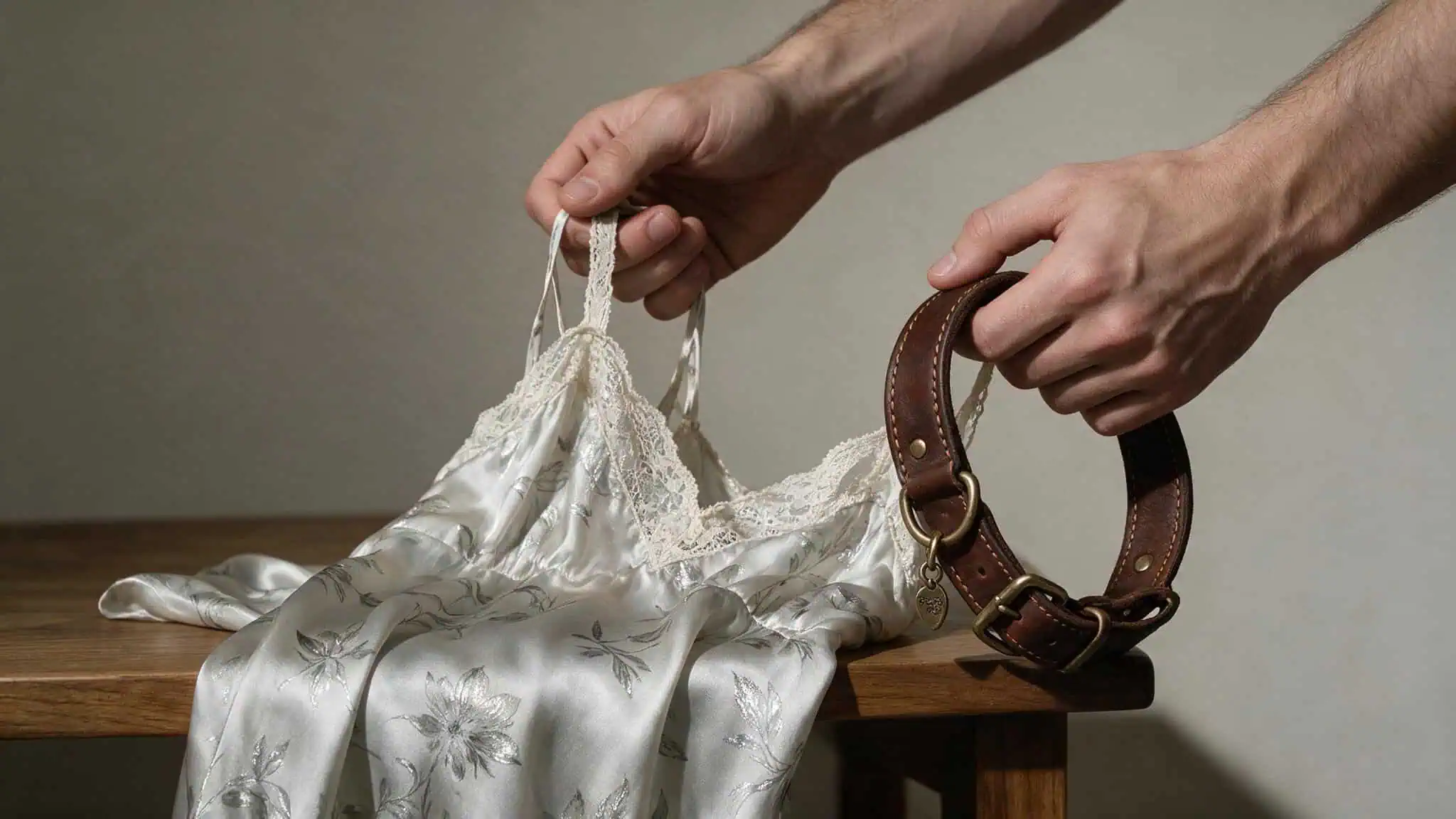
I was scrolling a parenting forum the other night — the kind of thread where someone’s kid said something and now the whole comment section is arguing about terms nobody’s actually defined. Two words kept popping up, used like they mean the same thing: cross-dressing and sissification. And I realized I wasn’t entirely sure myself. I didn’t know if they meant the same thing.
Turns out, this isn’t an obscure niche question. When sociologist Danielle Lindemann surveyed 305 sex worker clients for her book Dominatrix, about a third said they were interested in being made to cross-dress. HuffPost has called forced feminization one of the most common fantasies among sex workers’ clients. One dominatrix told HuffPost that a majority of her clients want to be sissified. So these terms describe real experiences that a lot of people are navigating — and getting them straight matters.
Here’s what I found after digging into the research and talking to the people who study this.
Key Takeaways
Cross-dressing is a clothing-focused behavior, while sissification is a power-exchange practice that includes cross-dressing but goes beyond it into submission, roleplay, and often humiliation.
About one-third of sex worker clients in a 305-person study expressed interest in forced cross-dressing, and HuffPost reports it’s one of the most common fantasies — so this isn’t a fringe topic.
Neither cross-dressing nor sissification means someone is transgender; cross-dressers and sissies typically maintain their male identity and don’t experience gender incongruency.
Table of Contents
What Cross-Dressing Actually Means
Let’s start with the simpler one. Cross-dressing means wearing clothes that society associates with another gender. A man puts on a dress, a woman wears a suit — that’s the basic act.
But the reasons people do it vary wildly. Dr. Z, a YouTuber who explains these distinctions, says people cross-dress to feel good, to feel comfortable, or for sexual arousal. Some do it for personal expression or for fun. The key point is that cross-dressing itself doesn’t have anything inherently sexual about it. For many people, it’s about comfort or identity exploration in the same way anyone picks clothes that feel right.
What cross-dressing is not
This is where the confusion starts. Cross-dressing is not a sexual orientation. It’s not a gender identity. And it’s not automatically a fetish.
Some cross-dressers keep it subtle — loose-fitting pants, minimal makeup, no roleplay, no submission involved. They’re just wearing what they want to wear.
The transgender distinction
Here’s the crucial line. Dr. Z puts it: cross-dressers do not have gender incongruency, meaning they don’t feel a disconnect between their biological sex and their internal sense of self. Transgender people do. A cross-dresser might enjoy wearing a dress, but they still identify as male. They’re not claiming to be a woman.
Now, some transgender people do cross-dress as part of exploring their gender. But the underlying identity is different. Sexual arousal during cross-dressing doesn’t mean someone is trans, and the absence of arousal doesn’t guarantee they’re cis. The clothes are just clothes.
What Sissification Actually Means
Sissification is a different animal. It’s a specific practice within BDSM where a submissive man takes on a feminine role — and it’s about power exchange, not fabric.

The term “sissy” in this context refers to a man who adopts a feminine role that is submissive and sexual. A sissy might wear dresses, heels, and lingerie, but they also take on traditional feminine roles: cooking, cleaning, giving sensual massages, being sexually submissive. They might use a feminine name during scenes or roleplay as a “damsel in distress.”
What actually happens in a sissification scene
The HuffPost feature on dominatrixes gives concrete examples. One described sessions as “parading them around” in high heels, makeup, and lingerie. Another was described as “cheerleading” men into exploring femininity. The sessions can include spanking, pegging, and bondage. The core is that the feminized partner — the sissy, is in a submissive position.
Why the humiliation is part of it
You might wonder why humiliation is central to sissification. Sabrina P. Ramet, who wrote Gender Reversals and Gender Cultures, has an interesting take. She argues that the humiliation comes from the cultural taboo of men wearing women’s clothing — not from the femdom dynamic itself. In other words, it’s about violating a gender boundary, not about devaluing women. Violet Blue, author of Fetish Sex, adds that the submissive partners in these dynamics often have respect for women.
Bottom line: The humiliation in sissification targets the gender rule, not women — it’s about breaking a taboo, not misogyny.
Not all sissies are into the BDSM side
The practice exists on a spectrum. Some participants are purely into the aesthetic — they like how a dress feels, how makeup looks, and they aren’t interested in power dynamics or humiliation at all. But for most, sissification involves exploring hyper-femininity as part of a kink context, with submissiveness, roleplaying, and BDSM elements, a dynamic that can be playful, deeply meaningful, or both, much like the evolving understanding of what it means to be a sissy husband in modern relationships.
The Key Difference Comes Down to One Thing
So here’s the answer: the divide isn’t the clothing. A cross-dresser and a sissy might wear the same dress. The difference is submission.
A cross-dresser focuses on the clothes. They might wear them for comfort, expression, or arousal, but they’re not adopting a submissive role or performing femininity as a power-exchange gesture. In contrast, a sissy husband adopts a submissive feminine role with explicit power dynamics, often including humiliation, domestic roleplay, and BDSM elements.
Here’s how it breaks down side by side:
| Dimension | Cross-Dressing | Sissification |
|---|---|---|
| Focus | The clothing itself | The submissive feminine role |
| Motivation | Comfort, expression, exploration, arousal | Submission, power exchange, humiliation |
| Submission | Not inherently present | Central to the practice |
| Sexual context | Can be entirely non-sexual | Usually sexual or kink-oriented |
| Gender identity | Male; no incongruency | Male; maintains male identity |
| BDSM involvement | Not required | Often included, but not always |
How common is forced feminization?
This isn’t a rare fantasy. Lindemann’s study found about a third of 305 clients wanted forced cross-dressing. HuffPost calls forced feminization one of the most common fantasies among sex workers’ clients. And it’s mostly heterosexual, cisgender men who are the submissive partners — guys who aren’t questioning their gender, exploring a specific dynamic.
That said, the community is more diverse than stereotypes suggest. Vice covered a feminization meet-up and found bisexual, pansexual, genderfluid, and transgender people in attendance. It’s not one type of person.
Can You Be Both a Cross-Dresser and a Sissy?
Yes. According to Roanyer, a source that writes about these identities, it’s possible to identify as both. Some people start as cross-dressers and evolve into a sissy identity over time. The defining question comes down to clothes versus the power-exchange role.
The community is more diverse than you’d think
Not all cross-dressers or sissies identify as LGBTQ+. Some do, some don’t. But cross-dressers and sissies encounter discrimination and misunderstanding similar to what the LGBTQ+ community deals with. The people involved span a range of identities and experiences.
Three Myths That Need Busting
Let’s clear up some common misconceptions about cross-dressing and sissification.
Myth: “It’s just a fetish”
For many people, cross-dressing is not about sexual desires. And even within sissification, not everyone treats it as a fetish. Some participate for aesthetic enjoyment, comfort, or personal expression.
Myth: “They’re confused about their gender”
Dr. Z’s framework: cross-dressers have no gender incongruency. Sissies maintain a male identity. Ana Valens, writing for The Daily Dot, notes that forced feminization is a fantasy some trans women have — but that relates to exploring identity, not confusion. The presence of sexual arousal doesn’t mean someone is trans, and the absence doesn’t guarantee they’re cis.
Myth: “It’s just a phase”
For many people, these are stable, long-term identities. The source material promotes celebrating diversity through education, inclusivity, and respectful language. This isn’t something people “grow out of.”
How This Differs from Being Transgender
This is the distinction that matters for parents trying to understand what their kid might be talking about. Cross-dressing and sissification are about behavior and fantasy. Being transgender is about identity.
Dr. Z’s clinical distinction is the anchor: cross-dressers do not have gender incongruency; transgender people do. Sissies do not identify as transgender or as women; they keep a male identity.
Ana Valens adds a layer. She writes that forced feminization is a common fantasy among trans women because it allows them to meet the stigmatized need to be women before they’re ready to admit it. But that doesn’t mean every trans woman has this fantasy, or that every person who has it is trans. The overlap exists, but the categories remain distinct.
Some transgender people cross-dress as part of gender exploration — trying on clothes to see how they feel. But the underlying driver is identity, not roleplay.
How Media Gets It Wrong
Mainstream media doesn’t handle these topics well. Law & Order: Criminal Intent had an episode featuring feminization that Helen Boyd, author of My Husband Betty, called unrealistic. It’s a pattern — media either sensationalizes or ignores the topic.

On the art side, there’s more work. Río Sofia created a 2019 self-portrait series called “Forced Womanhood!” inspired by a magazine of the same name that circulates in kink communities.
The Marlow Moss story
But the cultural case might be Marlow Moss — a British artist born Marjorie Jewel Moss in London in 1889. She changed her name to Marlow, cut her hair short, wore men’s suits, and moved to Paris in the late 1920s. At Cafe de Flore, she met her lifelong partner Netty Nijhoff. They wore men’s suits and hats.
Here’s where it gets wild. Moss joined the Abstraction-Creation group — a collective of abstract artists, and experimented with neoplasticism. You know Piet Mondrian, the Dutch painter whose grid paintings sell for $51 million? Moss may have influenced his double-line technique.
Curator Clairie Hondtong at the Kunstmuseum believes the double line evolved from exchanges between them. Mondrian wrote to Moss asking about her approach. She saw his single-line grid as “a conclusion and restriction.”
But Moss was shunned. The Tate wasn’t interested in her work. When she moved to Cornwall after World War II — she’d fled Nazi-occupied territory because of her Jewish ancestry, she tried to contact artists Barbara Hepworth and Ben Nicholson. They ignored her. Her house in Normandy was bombed by the Allies in 1944, destroying much of her artwork.
Only recently has Moss been rediscovered. Her 1944 painting “White, Black, Blue and Red” sold for £609,000 at Sotheby’s — double its estimate. The Kunstmuseum in The Hague now displays her work prominently, with a Mondrian piece hidden behind a pillar. A suitcase of her sketches was acquired by the museum in 2025. Some LGBTQ+ commentators suggest her double lines were a response to a society that offered no place for a gay woman in masculine attire.
Moss’s story shows how cross-dressing — or any gender-nonconforming expression, can lead to cultural erasure, even when the person’s work is historically significant. She was featured in all five Abstraction-Creation journals, the only Briton and the only woman to do so. But the art world still wrote her out.
Getting It Straight
So here’s the bottom line. Cross-dressing is about the clothes. Sissification is about the role — the submission, the power exchange, the humiliation that comes from breaking a gender taboo. They look similar on the surface, but the motivations and behaviors are different.
Cross-dressing and sissification are valid, and neither means someone is confused about their gender. These are real people with stable identities, not phases or fetishes to dismiss. The best thing any of us can do is use the right words and treat people with the same respect we’d want for ourselves. At Tidbits of Experience, we do the research so you don’t have to — and sometimes, getting the terms right is the first step toward understanding someone better.
Frequently Asked Questions
What is cross-dressing called now?
The term ‘cross-dressing’ is still widely used, though some people prefer ‘gender non-conforming’ or simply describe the behavior without labeling it. The key is that cross-dressing refers specifically to wearing clothes associated with another gender, not to a sexual orientation or gender identity.
What is the difference between cross-dressing and sissification?
Cross-dressing is about the clothes — wearing garments society associates with another gender, for comfort, expression, or arousal. Sissification goes further: it’s a power-exchange practice within BDSM where a submissive man adopts a feminine role that includes submission, roleplay, and often humiliation. Same dress, different motivation.
Why is humiliation part of sissification?
The humiliation in sissification comes from violating a cultural taboo — men wearing women’s clothing — not from devaluing women. It targets the gender boundary itself, and many submissive partners in these dynamics actually have respect for women. The shame is about breaking a rule, not about femininity being inferior.