
Maybe you’ve been staring at your laptop in a coffee shop, wondering if you could really trade the carpool line for a tuk-tuk ride to school. I used to ask myself the same thing. Is it actually possible to balance Zoom meetings and homeschooling without losing your mind?
You aren’t the only one asking.
In 2025, more families than ever are packing up their lives to travel full-time. I’m going to share exactly how we made it work, from the nitty-gritty of digital nomad visas to finding reliable Wi-Fi in the jungle.
So, grab a cup of coffee, and let’s go through it together. I’ll show you everything you need to know.
Key Takeaways
Digital nomad visas are more family-friendly in 2025. Spain now sets the income requirement for a family of three around €4,150 per month, while Malaysia’s De Rantau program requires just $24,000 annually.
Financial buffers are non-negotiable. I recommend saving at least $10,700 to cover your first three months, plus a separate emergency fund for return flights.
Schooling has evolved beyond simple homeschooling. Boundless Life offers education hubs in places like Sintra and Bali, while platforms like Outschool connect kids to live teachers globally.
Community is your safety net. Use Facebook groups like “Digital Nomad Families” to find playdates, or check Nomad List to see where other families are clustering.
Technology upgrades are essential for 2025. Tools like Starlink Roam ensure connectivity in remote areas, and GPS watches like the XPLORA X5 Play give parents peace of mind in crowded cities.
Table of Contents
What Does Being a Digital Nomad Family Mean?
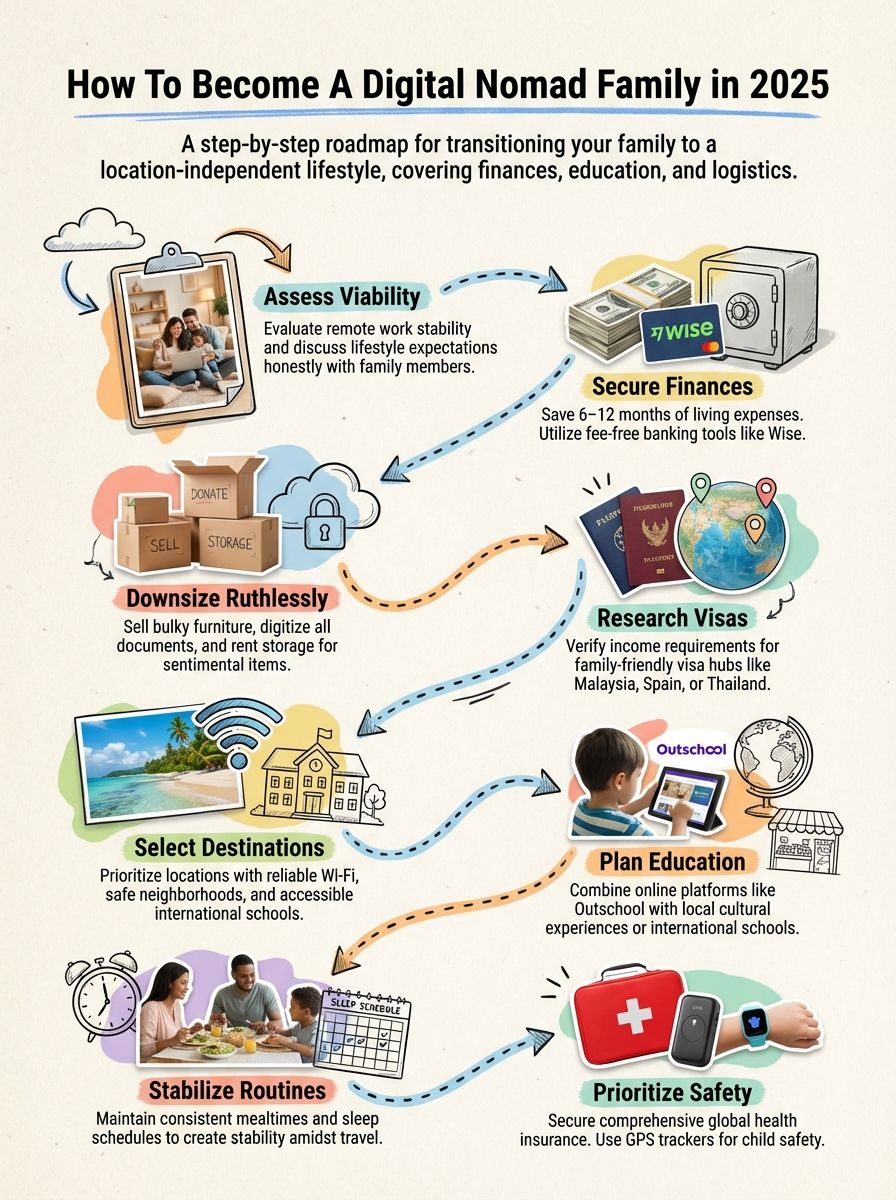
Moving from a daydream to real life taught me that being a digital nomad family is less about constant vacation and more about mobile stability. Parents work location-independent jobs—think software engineering, graphic design, or SEO consulting—while the kids continue their education on the road.
It’s a blend of routine and adventure. One month, your “school run” might be a walk down a Portuguese cobblestone street; the next, it’s logging into a virtual classroom from a beach bungalow in Thailand. We aren’t just tourists; we live in these places, buying groceries and dealing with laundry just like everyone else.
Years ago, the TraveLynn Family showed me what was possible by spending a year in Bangalore. Today, the infrastructure is even better. Co-living spaces like Selina or Outsite now often feature family suites and communal kitchens, solving the isolation problem many parents fear.
My partner, Jay, left his corporate engineering role to manage our blog full-time, which gave us the freedom to travel slower. But freedom requires logistics. To handle our team’s wages while we hopped borders, I used Global Payroll Solutions. It ensured my staff got paid on time, whether I was in Tokyo or Tulum.
Deciding to Become a Digital Nomad Family
Making the leap starts with a hard look at your finances, your career, and your family’s temperament. I sat down with my partner, opened up a spreadsheet, and asked the scary questions: Can we afford this? What if the kids hate it?
How do I know if this lifestyle suits my family?
The biggest indicator is how you handle the unexpected. When a flight gets canceled or the power goes out, does your family crumble or get creative? My kids learned to sleep in airports and find fun in layovers, which told me they were ready.
“If your savings can take a hit from an unexpected vet bill abroad, you’re off to a good start.” — Parent on Nomad List
Medical needs are another major factor. If you require specialized, ongoing care, you will need to stick to major cities with international hospitals, like Bangkok or Mexico City. We also tested our financial resilience. Nomad life is often more expensive than social media suggests, so we made sure we had a buffer.
How can I get my family members on board?
I found that transparency is the best policy. We held “kitchen table summits” where everyone, including the kids, could list their fears. My daughter was worried about missing her soccer team; we solved it by researching local leagues in our first destination.
We created a physical timeline on the wall:
- 12 Months Out: Assess remote work viability and start a “freedom fund.”
- 6 Months Out: Notify landlords or list the house; check passport expiration dates.
- 3 Months Out: Book the first one-way ticket and secure initial accommodation.
To really test the waters, we did a “dry run” in Portugal for two months. It was low-stakes practice for using Wise cards at the grocery store and handling time-zone math. By the time we hosted our farewell party, the fear had turned into excitement.
Preparing for the Transition
Planning the switch involves more than just packing suitcases. You are essentially moving your entire administrative life to the cloud. I tackled this one category at a time to keep the panic at bay.
How do I research destinations and visa requirements?
Getting your paperwork right is the difference between a smooth entry and a stressful flight home. I always check official government sources first, as blogs can be outdated.
- Verify Income Thresholds: In 2025, financial requirements for digital nomad visas vary wildly. For a family of three, Spain requires proof of around €4,150/month, while Malaysia (De Rantau) asks for $24,000/year.
- Check Tax Implications: Some countries, like Estonia, consider you a tax resident after 183 days. I consult with a cross-border accountant to ensure we don’t get double-taxed.
- Digitalize Everything: I keep high-resolution scans of birth certificates, marriage licenses, and vaccination records in an encrypted LastPass vault. You will need these for school enrollments and visa extensions.
- Healthcare Recon: Before booking a flight, I use GeoBlue or Allianz provider directories to locate the best hospitals near our potential Airbnb.
- Wi-Fi Reality Check: I don’t trust “high-speed internet” listings. I ask hosts for a screenshot of a speed test (using Ookla) before I commit to a month-long rental.
What should I consider for financial planning and budgeting?
Money moves differently when you don’t have a permanent address. I learned quickly that transaction fees can eat your budget alive if you aren’t careful.
I recommend opening a Charles Schwab High Yield Investor Checking account if you are from the US; they refund all ATM fees worldwide. For day-to-day spending, I use Wise (formerly TransferWise) to hold multiple currencies and get the mid-market exchange rate.
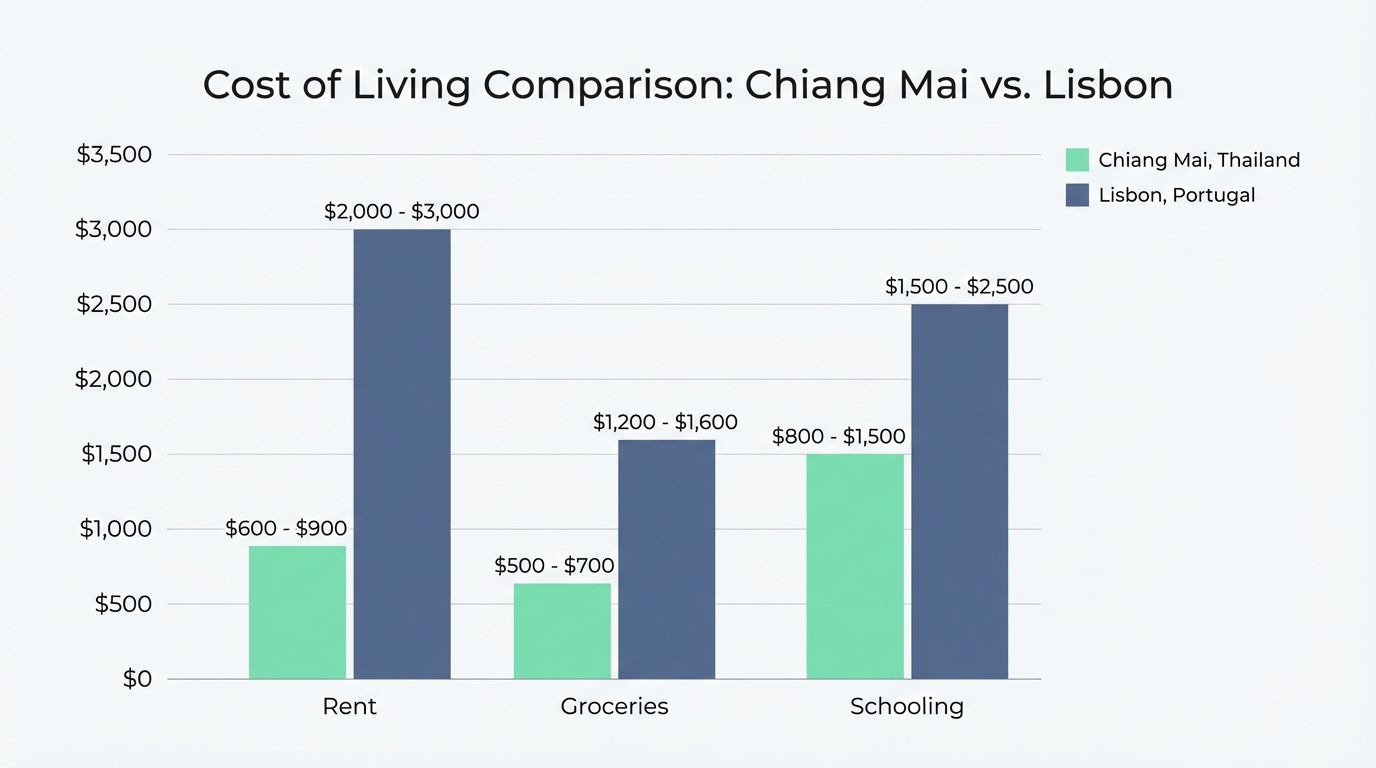
| Expense Category | Chiang Mai, Thailand | Lisbon, Portugal |
|---|---|---|
| Rent (2-3 Bedroom) | $600 – $900 | $2,000 – $3,000 |
| Groceries & Dining | $500 – $700 | $1,200 – $1,600 |
| Schooling/Hubs | $800 – $1,500 | $1,500 – $2,500 |
| Total Estimate | $1,900 – $3,100 | $4,700 – $7,100 |
We started with $10,700 in savings, which felt like a safe number for a three-month runway. Don’t forget the hidden costs: visa application fees can run $200-$800 per person, and establishing a new household (pantry staples, cleaning supplies) costs about $500 each time you move.
How do I downsize and declutter effectively?
Getting rid of your possessions is emotional, but it’s also liberating. We used the “four-pile method”—Keep, Store, Donate, Toss—to tackle our house room by room.
- The 3-Month Rule: Cancel subscriptions (gym, magazines, streaming) three months early. It stops the mail pile-up and saves cash for the trip.
- The “Keep” Limit: We rented a small 5×5 storage unit for irreplaceables like photo albums and heirlooms. If it didn’t fit, it didn’t stay.
- Digitize to Downsize: I scanned every piece of kid artwork and school report card. The physical papers went into the recycling bin.
- Capsule Wardrobes: I limited myself to clothing that all matched. This left room for my essential work from home outfits, because looking professional on Zoom is still a must, even from a balcony.
- The Kid Edit: We gave each child one packing cube for toys. They had to choose their absolute favorites. It taught them prioritization before we even left the driveway.
Choosing the Right Destination
I start my search by looking for the “Holy Trinity” of nomad family life: safety, reliable internet, and community.
What are the best destinations for digital nomad families?
Lisbon, Portugal is often the first stop for many. It offers a soft landing with high English proficiency, excellent healthcare, and a time zone that overlaps nicely with the US East Coast. However, rents have risen sharply in 2025.
For budget-conscious families, Chiang Mai, Thailand remains a top contender. The cost of living is 50-70% lower than in Western Europe, allowing you to afford luxuries like a pool and a housekeeper. The new Destination Thailand Visa (DTV) is a game-changer, offering a 5-year validity for remote workers.
Bali, Indonesia has evolved from a surfer’s paradise to a family hub. Areas like Ubud and Sanur now have “worldschooling hubs” where you can drop your kids off for educational activities while you work.
Which visa programs are family-friendly?
Not all visas are created equal. Spain’s Digital Nomad Visa is fantastic because it offers a path to residency and allows you to include children and spouses easily. The income requirement is indexed to the minimum wage, so do your math carefully before applying.
Malaysia’s De Rantau pass is specifically designed to build a digital nomad community. It’s one of the few government programs that actively certifies accommodation as “nomad-ready,” so you know the Wi-Fi will work.
Estonia was the pioneer, and their visa is still one of the fastest to process—often taking just 30 days. It’s perfect for families who love nature and don’t mind cooler weather.
Adapting to Life as a Digital Nomad Family
The first few weeks in a new country can be chaotic. We learned to rely on “anchors”—small, consistent habits that make any rental apartment feel like home.
How can we establish routines while traveling?
We treat the first week in a new city as an “acclimation week” with lighter work schedules. We find the local grocery store, the nearest playground, and the best coffee spot.
I use FamilyWall or Trello to keep everyone on the same page. We schedule “Deep Work” blocks for the adults and “School/Play” blocks for the kids. Having a visual schedule on the fridge (or iPad) helps reduce the anxiety of constantly changing environments.
How do I manage work-life balance on the road?
It’s easy to work more when you live where you work. I set strict boundaries: laptop shuts down at 5 PM local time, no exceptions. We use coworking spaces with childcare whenever possible. In 2025, places like Boundless Life in Sintra or Syros offer packages that include coworking desks and education for the kids in one monthly fee.
How can I create a sense of stability for my kids?
Stability comes from rituals, not places. We have “Taco Tuesday” no matter what country we are in. We bring their favorite bedsheets and a few beloved books to make their new room feel familiar instantly.
We also involve them in the planning. Before we move, we look at photos of the new apartment and the city together on Google Earth. This turns the unknown into something they can visualize and look forward to.
Schooling Options for Digital Nomad Families
Education is usually the biggest worry for parents, but it’s actually one of the biggest opportunities. The world becomes your classroom.
What is worldschooling and how does online learning work?
Worldschooling is the practice of using your travel experiences as the curriculum. If we are in Rome, we study the Roman Empire. If we are in Costa Rica, we study biology in the rainforest.
For core subjects like Math and English, we use online platforms to keep them on track:
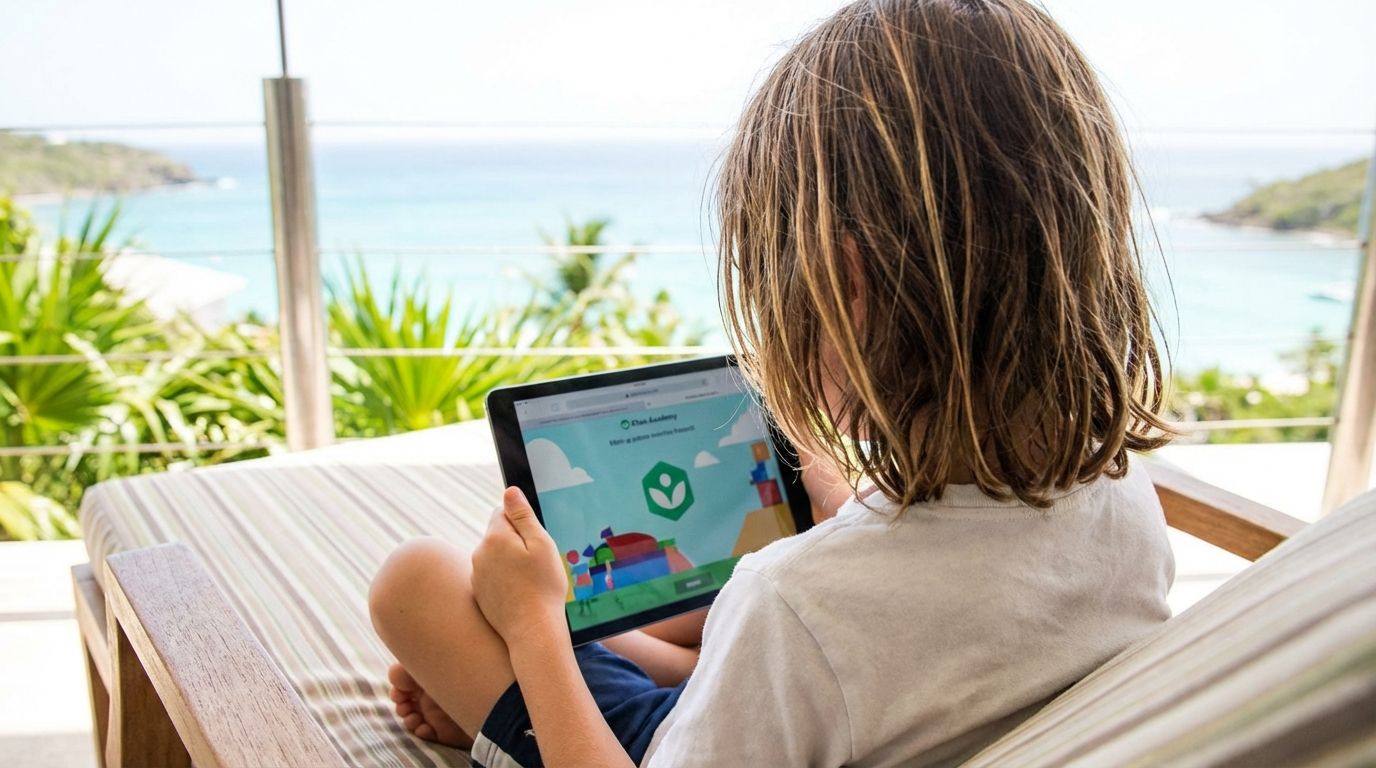
- Khan Academy: Free, high-quality lessons for math and science.
- Outschool: Live video classes on everything from coding to creative writing with passionate teachers.
- Synthesis: An innovative online school that teaches problem-solving through games, which my kids love.
Are there local schooling opportunities for nomad families?
Yes, and they are increasing. In Penang, Malaysia, international schools are very accustomed to transient families and offer short-term enrollment options. In Europe, Boundless Life has created “cohorts” where families live and learn together for 3-month blocks. It offers the social consistency of a regular school with the flexibility of travel.
Building a Support Network
Loneliness is the silent killer of the nomad lifestyle. You have to be proactive about making friends.
How do I connect with other digital nomad families?
I don’t wait for people to find me. I join the local “Expats in [City Name]” Facebook group before we even arrive. The “Worldschoolers” Facebook group is also a goldmine for finding families on similar routes.
Nomad List has a specific filter for “Family Safe” cities, and their Slack channel is great for real-time advice. A survey by Cloudwards in 2024 noted that 24% of US nomads are families, so the community is large—you just have to tap into it.
What platforms help find local communities?
- Meetup.com: Good for finding hiking groups or board game nights.
- Bumble BFF: Surprisingly effective for finding other moms to grab coffee with.
- Nomad Nest: A newer platform specifically for matching nomad families based on kids’ ages and interests.
Overcoming Challenges
Let’s be real: it’s not always sunsets and smoothies. Kids get sick, and Wi-Fi fails.
How can we maintain health and safety abroad?
I switched from my standard US corporate plan to SafetyWing’s Nomad Insurance. It’s designed for travel, covers you in multiple countries, and—crucially—covers one child under 10 for free per adult.
For peace of mind in crowded cities, my kids wear the XPLORA X5 Play watch. It allows them to call me and has a GPS tracker, but no open internet access. We also sew AirTags into their backpacks for travel days.
How do I handle criticism and skepticism?
You will get comments. “Aren’t they missing out on a normal childhood?” My answer is always the same: they are gaining a global one.
I handle the skepticism by sharing our wins—the day they ordered lunch in Spanish, or the history lesson they learned standing inside the Colosseum. But mostly, I rely on my support group of other nomad parents who just “get it.”
Benefits of Becoming a Digital Nomad Family
Despite the logistics, the payoff is massive. We have slowed down. We eat three meals a day together. I know what my kids are learning because I’m there to see it.
How can this lifestyle increase quality family time?
Without the commute and the extracurricular rat race, we have reclaimed hours of our day. We spend afternoons hiking or visiting museums instead of sitting in traffic. The shared challenge of navigating a new country brings us closer together—we are a team on a mission.
How does it help broaden family perspectives?
My children don’t just read about diversity; they live it. They have played tag with kids who don’t speak their language and learned that kindness is universal. They are adaptable, resilient, and curious. These are soft skills that no classroom can teach, and they will serve them for the rest of their lives.
How Will the Digital Nomad Family Lifestyle Change in 2025?
In 2025, the friction is disappearing. Governments are actively competing for us with better visas and tax breaks. Hybrid schooling—mixing online learning with physical hubs—is becoming the norm.
AI tools like ChatGPT are making it easier for parents to act as teachers, generating lesson plans or explaining complex math problems in seconds. The world is opening up, and there has never been a better time to show it to your children.
People Also Ask
How do you start living as a digital nomad family in 2025?
First, I recommend checking the income requirements for popular options like Spain’s Digital Nomad Visa, which currently asks for around €2,500 a month. You might also want to look into Japan’s new 6-month visa if your family is dreaming of Asia this year. Once you choose a spot, prioritize booking housing that guarantees high-speed internet.
What jobs let parents support their family while traveling?
I have seen many moms find success as Editors or Copywriters, roles that Resume Genius reports can pay over $35 an hour. If you need flexibility, I suggest creating a profile on FlexJobs to find reputable remote work that fits around your family’s schedule.
How can children keep up with school on the road?
For schooling, I love Prisma because their cohort-based model connects your kids with friends, solving the social isolation piece. If you just need to supplement homeschooling with fun electives, Outschool is a fantastic resource for everything from coding to art.
What challenges should families expect as digital nomads?
Loneliness is the hardest part, so I always urge families to join specific Worldschoolers Facebook groups to line up playdates before you even pack your bags.