If you are trying to figure out how to set an engagement ring budget, you are likely looking for clear guidelines, average costs, and practical advice on what is actually appropriate to spend. The truth about navigating these financial expectations is that establishing your own affordability matters far more than following industry-invented budget formulas.
Before you drain your savings account or dive into debt, you need real data on what couples actually pay today.
Table of Contents
How much should a man spend on an engagement ring?
Search the internet for ring advice and you hit an immediate wall of extremes. On one side, you have the crushing societal pressure to drop five figures to prove your commitment. On the other side, Reddit is packed with 99.99% of commenters laser-focused on saving money, with some smug frugalista inevitably bragging about how they bought a ring for $0.32 and have been happily married for 43 years.
Neither extreme is helpful. Furthermore, asking “how much should a man spend on an engagement ring?” assumes the man is always the one doing the buying and the surprising. It completely ignores modern relationship dynamics.
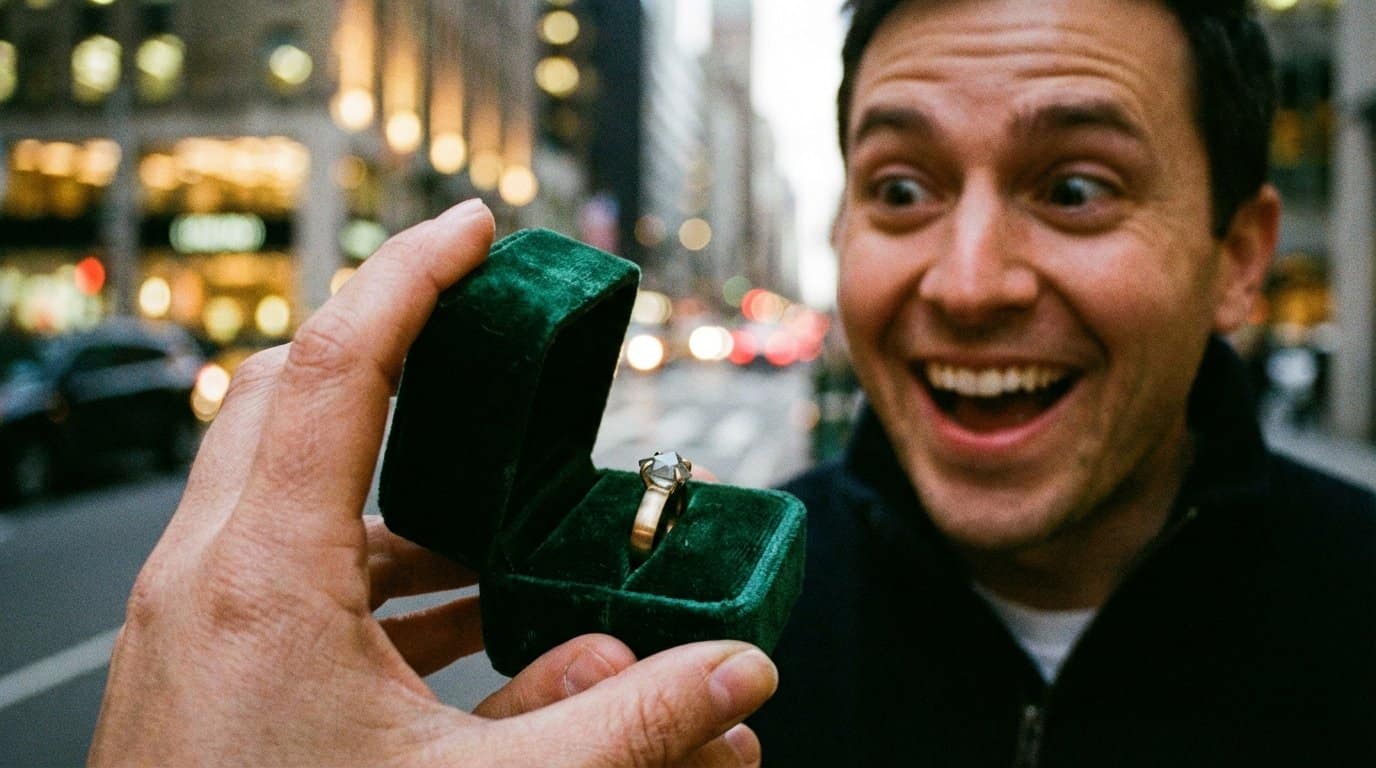
Take my own marriage. I fully admit I was dragging my feet for a few years. My girlfriend, Crystal, got tired of waiting. She completely tossed out the socially conditioned Disney-esque invisible script that dictates the man must orchestrate a total surprise. Instead, she flipped the dynamic and executed a brilliant female-led proposal.
Suddenly, I was the one wearing the ring. By the way, the demand for men’s engagement rings is expanding rapidly today. To truly understand what you should spend, we first have to dismantle the fake rules the jewelry industry invented to tell you what to spend.
Average ring costs and the origin of standard budget rules
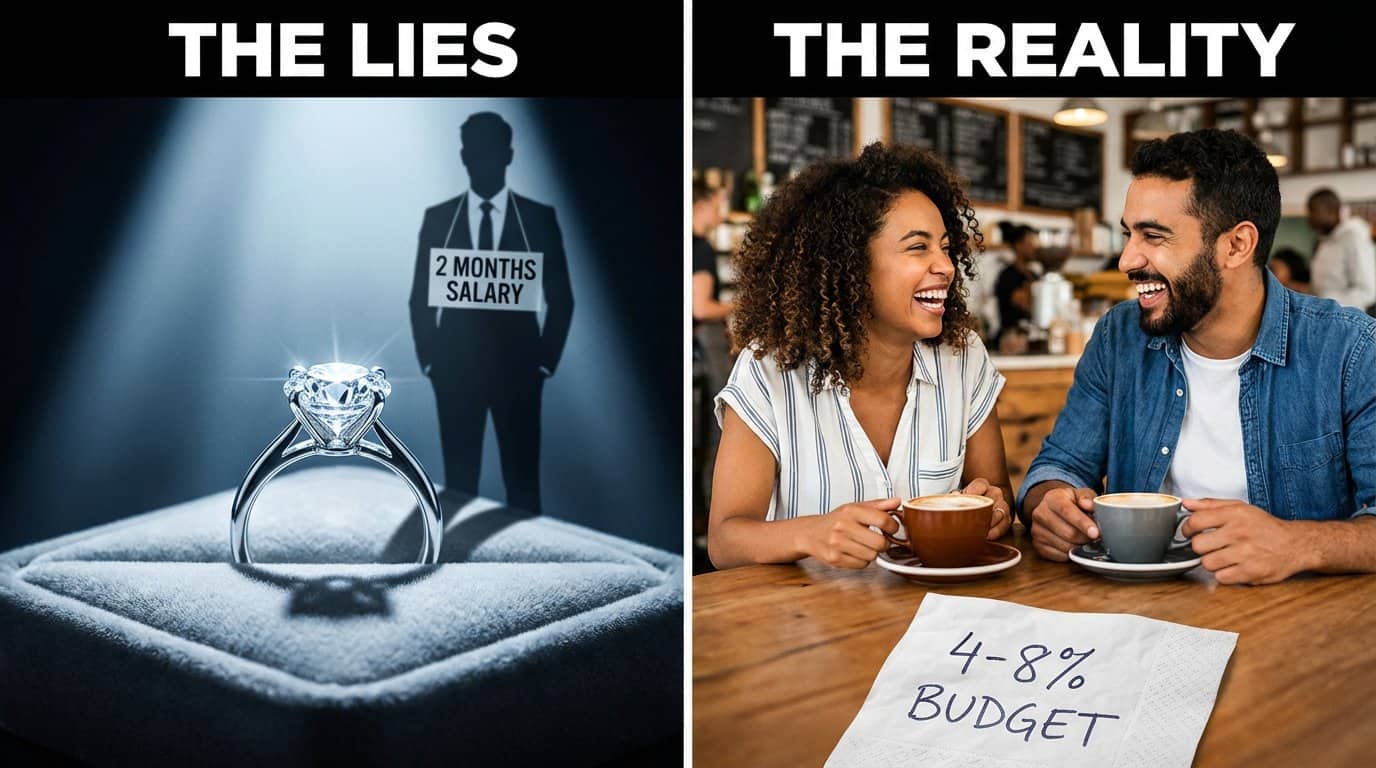
The most famous financial benchmark for a proposal is the “two months salary” rule. Let us be incredibly clear: this mathematically demands a massive 16% of your annual income, and it is pure marketing nonsense.
This was never a historical tradition. It was invented in the mid-20th century by De Beers to move inventory. It is just one of many artificial frameworks the industry built to convince average people to buy an expensive rock. In a comprehensive guide updated on Jun 07, 2024, Ramit Sethi—host of Netflix’s How to Get Rich, author of a New York Times bestseller, and voice behind the I Will Teach You To Be Rich Podcast—repeatedly points out how toxic these benchmarks are. Sethi, who has spent over 20 years sharing personal finance strategies, notes that the industry literally created its own set of rituals and phrases specifically to maximize your spend.
Another massive illusion is that a diamond ring is a safe financial harbor. People justify draining their savings because they view the stone as an asset. The reality is that diamonds operate in a highly saturated commodity market. Your stone depreciates the second you leave the store. If you ever actually try to sell it, you will find that the industry standard is a brutal 15% resale value.
Once that marketing illusion fades, you can stop feeling guilty about ignoring the corporate expectations. You are free to look at what actual couples are spending.
Building a customized budget based on financial reality
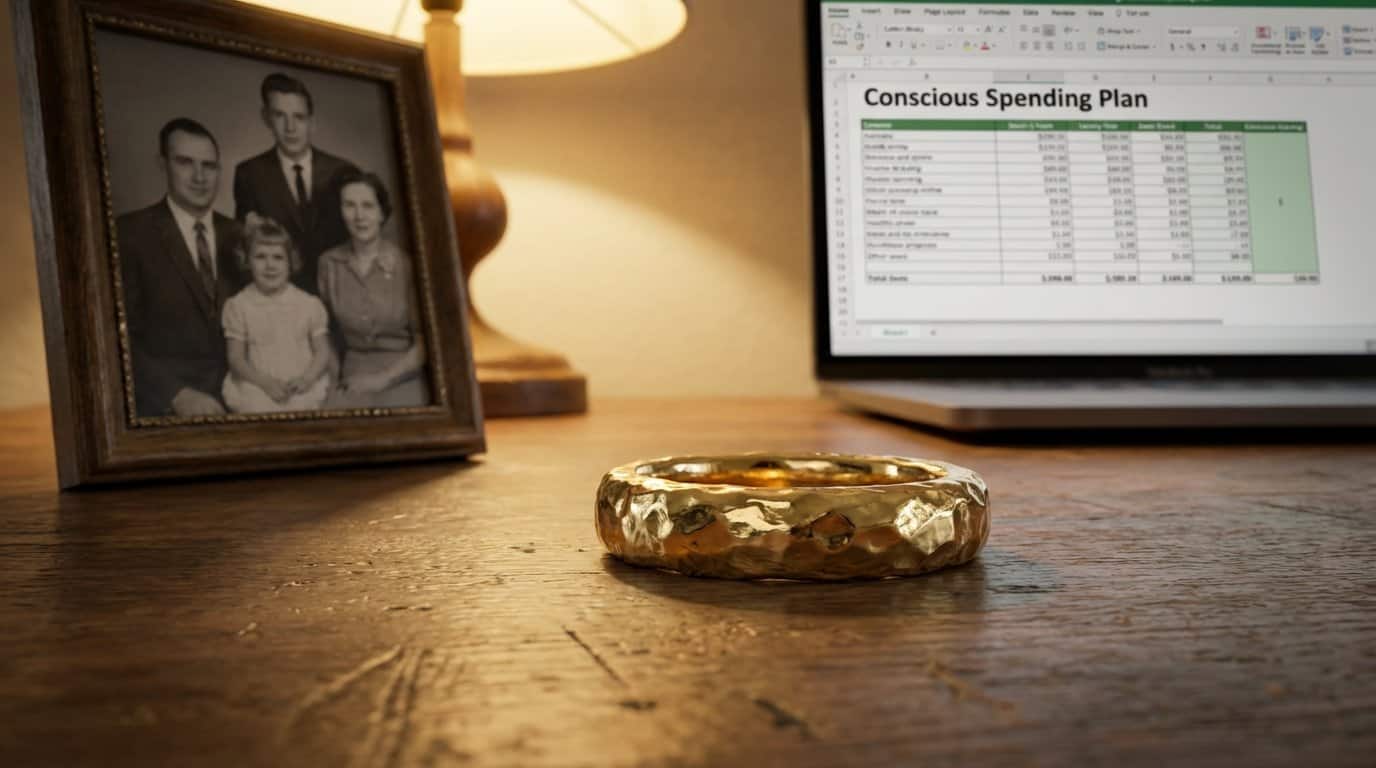
Drop the guilt and look at the actual math. According to a survey of 1,500 readers by I Will Teach You To Be Rich, the actual national averages are incredibly reasonable. Depending on their income bracket, real people typically use a conscious spending plan that accounts for a 4-8% average spend of their yearly income. This entails actively choosing to cut back on other areas to comfortably afford the established 4-8% range without going into debt.
That is half of what the De Beers formula demands. Knowing this gives you a baseline grounded in reality, not sales copy.
To tackle this without losing your mind, treat this highly emotional societal milestone as an emotionally detached logistical buy initially. You do not have to participate in the false internet dichotomy. You do not have to spend $10,000 to prove you love your partner, nor do you have to be the guy boasting about an aunt’s cousin’s brother who got a ring for $2.59 and has been happily married for 80 years.
Instead, look at your distinct financial picture. Sethi notes a guy he knows who spent $300 on an engagement ring and has a great marriage, alongside another guy who spent $100,000 and also has a great marriage. Establish your range. Maybe your comfort zone is $1,000 to $3,000, with room to stretch to $3,500 for the perfect band. Maybe you have ten years of savings and decide on a firm $10,000, or even $40,000 to $60,000. Whatever that number is, lock it in before you ever walk into a jewelry store.
But a calculated budget is only half the battle. Knowing what physical features actually drive value is where most buyers get manipulated.
Weighing public social statements against private meaning
Rings are sold entirely differently than how they are worn. The jewelry industry pushes the 4 Cs (cut, color, clarity, and carat) by waving official-looking diamond reports from the GIA (Gemological Institute of America) to justify inflated prices. While the GIA provides legitimate scientific gradings, jewelers often weaponize these strict laboratory metrics to upcharge thousands of dollars for micro-blemishes that nobody can actually see.
Clarity is the biggest financial trap. This grade specifically measures tiny internal “inclusions” or external flaws—but to even spot them, you are pushed to judge the stone’s visual appeal by squinting through a jeweler’s loupe at 10x magnification. Out in the real world, nobody is inspecting your partner’s hand with a magnifying glass. As one bachelor party conversation famously concluded among married guy friends: size and the bling are the only things that matter.
This is the reality of the modern Instagrammization of rings. When a friend grabs your fiancé’s hand to look at the ring, they are looking for surface area and sparkle. I have seen two oval diamonds priced within $2,000 of each other where one looked $20,000 more expensive simply because it maximized sparkle over paper grades.
If you go to the NYC Diamond District, you will endure consultative sales tactics where jewelers try to wow you with the deep heritage of a specific diamond cut. An honest NYC Diamond District jeweler broke the industry down perfectly: buying a diamond based rigidly on cut and clarity grades is like “buying a calculator based on its length and width.” You also have to sidestep the guilt traps—you don’t need to panic over Leonardo DiCaprio’s Blood Diamond movie narrative if you opt for lab-grown or responsibly sourced alternatives.
Or, you can take the ultimate contrarian approach and bypass the diamond market entirely. You can reject the pressure of a public social statement and create profound private symbolism using unconventional heirlooms. When Crystal proposed to me, she had a completely custom ring crafted out of dental gold recovered from her deceased father’s fillings. It cost almost nothing in new raw materials, yet it carries more emotional weight than any flawless stone ever could.
Deciding on the ring’s core meaning is impossible, however, without abandoning the biggest trap of all: the element of surprise.
Avoiding proposal anxiety through explicit communication
The number one cause of bad ring purchases is not a tight budget. It is the forced adherence to the idea that the ring has to be a total surprise generated purely from the buyer’s imagination.
If your partner has to wear this item every single day for the rest of their life, guessing what they want is a terrible strategy. Sethi outlines this perfectly when sharing the specific word-for-word script he used to ask his now-wife, Cass, about her preferences without bringing his own budget anxieties into the discussion. In response, Cass proactively sent an email with exact examples of rings she liked, rings she hated, and her specific band preferences.
“If your partner has to wear this item every single day for the rest of their life, guessing what they want is a terrible strategy.”
This level of communication guarantees success. Whether it is a traditional proposal or a female-led timeline, explicit alignment removes the anxiety of mismatched expectations. Between finalizing guest lists and choosing wedding songs, you will have plenty of stressful surprises. The ring should never be one of them.
You can execute this seamlessly by following a simple progression:
- Have the awkward, honest budget conversation with your partner early.
- Ask them to send you an email with exact links and photos of styles they love.
- Lock in your exact spending limit based on your personal savings, not marketing formulas.
- Email jewelers your parameters before you ever walk through their doors.
- Leverage this email technology to make jewelers bid against each other, driving home the reality that diamonds are a commodity to negotiate price drops.
- Bring email proof of these competing quotes or specific commodity benchmarks into the store, which is what actively puts you in that “position of strength.”
This sequence naturally implements the 80% prep rule. Doing all this upfront alignment and research ensures that when you do finally walk into a store, you operate from a position of strength. The jeweler works for you, not the other way around.
Defining an engagement ring’s value on your own terms
True ring value is not found in an outdated 16% salary formula, and it certainly is not found in paying a premium for flawless GIA clarity gradings that are entirely invisible to the naked eye. The industry needs you to believe there is a universally correct amount to spend so they can protect their profit margins.
Whether you decide to spend $50,000 on a massive, flawless oval diamond or $0 on melted dental heirloom gold, the “right” price is entirely subjective to the boundaries of your own relationship. The most romantic thing you can do for your partner is to protect your shared financial future while honoring their aesthetic tastes. Have the honest style and budget conversation tonight, drop the expectations of the internet, and reclaim the power of your purchase.
Frequently Asked Questions
How much do people actually spend on an engagement ring today?
Forget the outdated ‘two months salary’ rule, which is a toxic marketing gimmick invented by De Beers to move inventory. Real couples typically use a conscious spending plan that accounts for 4% to 8% of their annual income. The smartest move is to look at your distinct financial picture and lock in a firm budget before you ever step foot inside a jewelry store.
Is it worth paying a premium for a flawless GIA clarity grade?
Absolutely not. Jewelers often weaponize strict GIA laboratory metrics to upcharge thousands of dollars for microscopic blemishes that nobody can see without a 10x jeweler’s loupe. Out in the real world of everyday wear, prioritizing surface area and sparkle over a perfect paper grade will net you a visually superior ring for far less money.
Why does a diamond engagement ring lose its value instantly?
Despite the long-standing illusion that a diamond is a safe financial harbor, the stones actually operate in a highly saturated commodity market. The moment you walk out of the store, the value tanks. If you ever try to liquidate that asset, you will face an industry-standard resale value of a brutal 15%, meaning you should never view a ring as a replacement for a savings account.
How does forcing the ‘element of surprise’ ruin a proposal purchase?
The pressure to conjure up the perfect ring purely from your imagination ignores the reality that your partner has to wear this specific item every single day for life. Forcing a total surprise is the fastest way to suffer crippling anxiety and mismatched aesthetic expectations. Having an explicit, upfront conversation where your partner provides exact links to styles they love guarantees success and removes the stress.
What is the 80% prep rule in ring shopping?
The 80% prep rule means finalizing all of your logistical and aesthetic parameters before you ever engage a salesperson. You dictate your budget, gather exact photo examples from your partner, and email these constraints to jewelers in advance. Doing this upfront research ensures that when you finally enter a store, the jeweler works for you and cannot easily manipulate you into an upsell.
Can I propose with an unconventional heirloom instead of a new diamond?
Yes, bypassing the traditional diamond market is the ultimate contrarian approach to avoiding corporate pricing traps. Rejecting the pressure of making a massive public statement allows you to create profound private symbolism with unique materials, like reclaimed family metals or lab-grown alternatives. These choices usually cost a fraction of the price of a flawless diamond while carrying significantly more emotional weight.