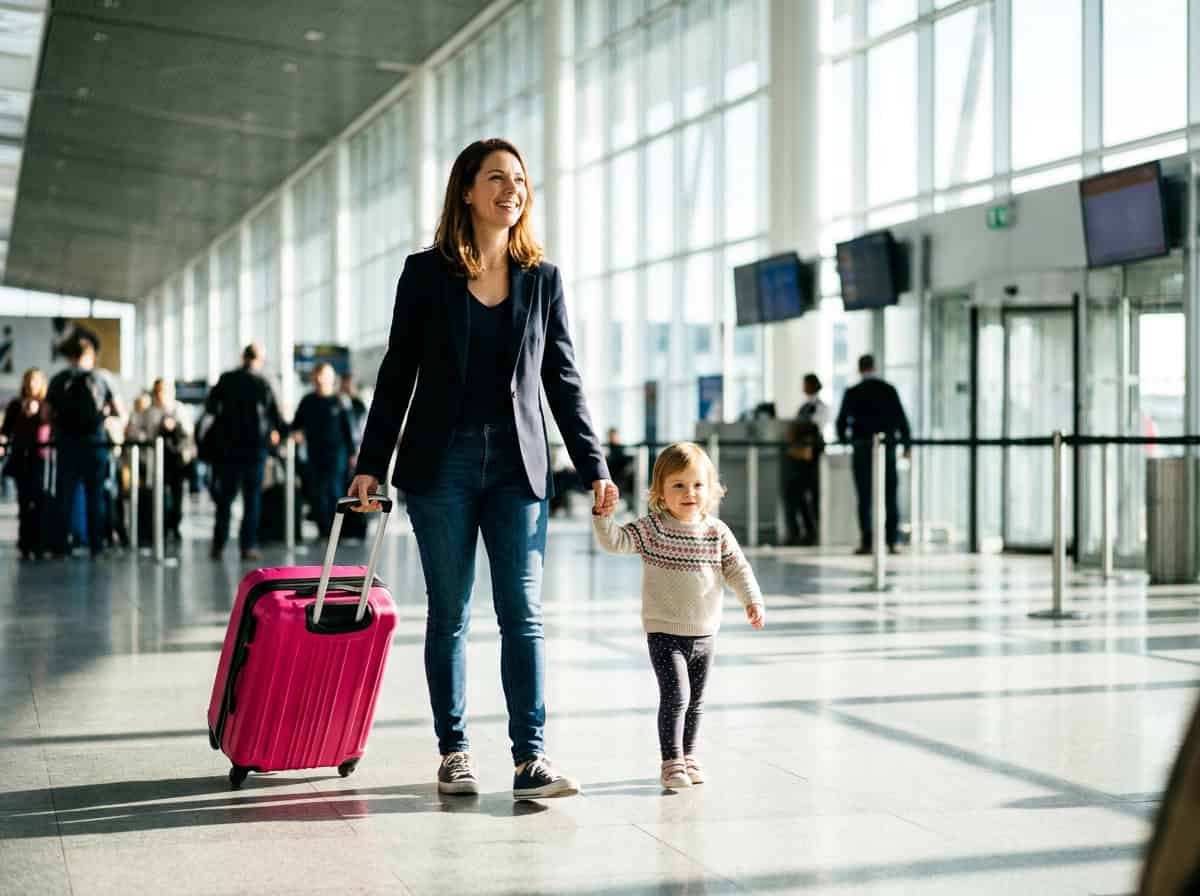
Kids are incredible, and raising them is deeply rewarding, but flying with them can trigger a very specific brand of anxiety. The dread of unpredictable travel chaos, public terminal tantrums, and shattered nap schedules is easily enough to make you reconsider a family vacation altogether. Surviving travel days requires rigorous mechanical planning mixed with the total abandonment of your normal parenting rules the second you enter the terminal. Here at Tidbits of Experience, we’ve learned through trial and error that you simply have to lean into the logistics.
By adopting the transit strategies trusted by users of the Little Ones Smart Sleep App (who have saved over 800,000 families from sheer exhaustion), you can eliminate the worst unpredictability of flying with children. A successful trip doesn’t start at the gate; it begins with how you pack and how strategically you plan your arrival.
Key Takeaways
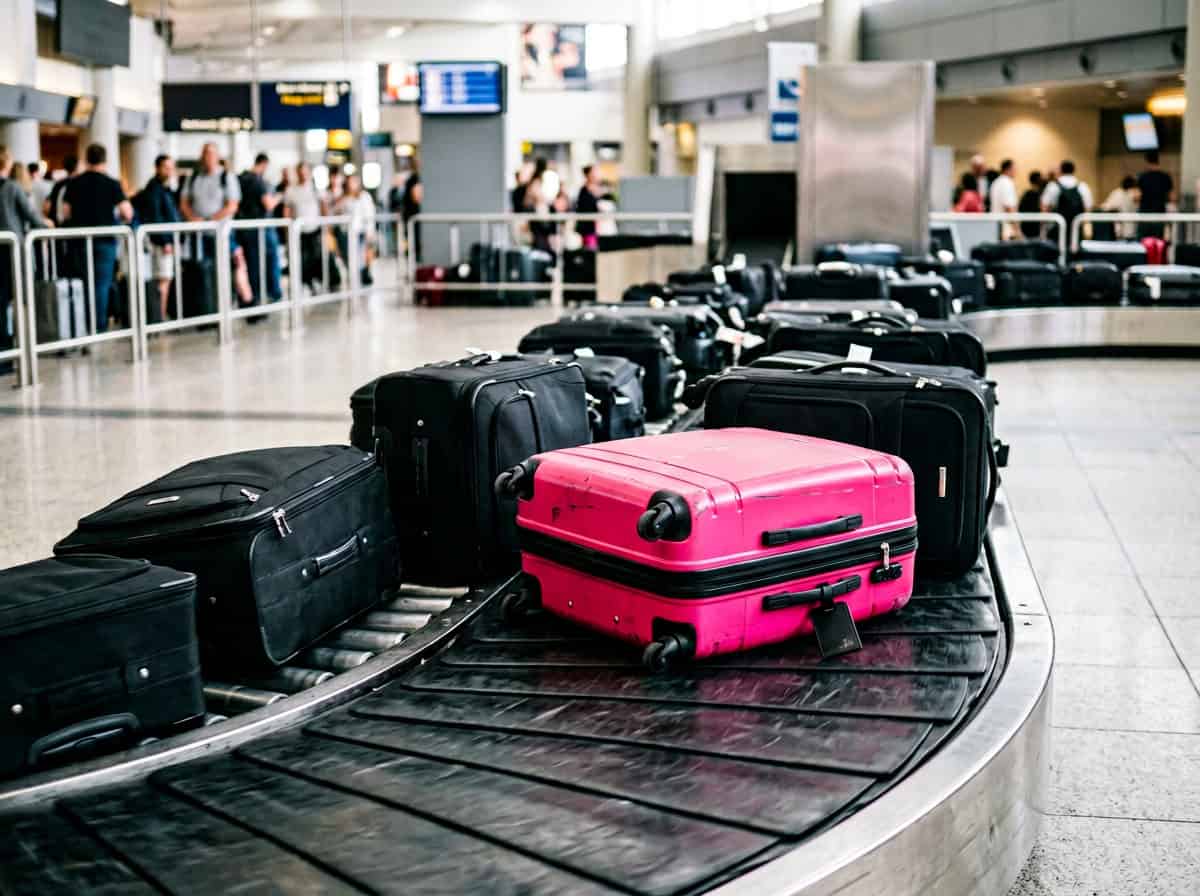
Checking visually striking luggage, like a vivid pink or patterned suitcase, easily saves 15–20 minutes of agonizing waiting at the arrival carousel.
Initiating transit sleep at your child’s exact biological nap time prevents systemic overtiredness, even if it means breaking every established environmental sleep rule you have at home.
Placing naturally potty-trained kids under 5 years old in pull-ups acts as necessary insurance against being trapped in their seats by prolonged >1 hour seatbelt warnings.
Table of Contents
Pre-flight Prep: Airport Survival Tips for Parents
When traveling with unpredictable young children, families should arrive at the airport a full three hours before domestic flights and four hours before international departures. This massive time buffer painlessly absorbs the inevitable sluggish pace of walking with toddlers, sudden bathroom emergencies, and security line delays without triggering a parental panic attack.
Pre-booked Car Services to Reduce Cognitive Load
Outsourcing the drive to the airport is the single easiest way to eliminate the extreme friction of navigating parking shuttles and wrangling heavy gear alone. A pre-booked car service radically delivers cognitive load reduction before your vacation even officially begins. Instead of fighting departure traffic and wrestling car seats into long-term parking while calming a crying baby, you step straight out at the curb. Using a reliable LAX car service—or an equivalent in your departure city—ensures you start your travel day feeling firmly in control.
Visual Luggage Optimization for Fast Carousel Exits
A carefully planned aesthetic luggage strategy drastically cuts down the agonizing time spent loitering around the baggage carousel with exhausted kids. After a long flight, you completely lack the patience to closely inspect fifty identical rolling black suitcases. Pack a visually striking bag—like a vivid pink hard-shell or a plaid grey and white checked bag—to guarantee absolute, immediate recognition. You can simply snatch your baggage as soon as it drops down the chute and walk immediately out of the crowded terminal.
Automated Check-in Counters and Baggage Weight
Averaging your total family’s luggage weight across multiple suitcases fails spectacularly nowadays because most airlines rely strictly on automated check-in kiosks. A computer will not care in the slightest that your toddler’s bag weighs five pounds while your own suitcase weighs sixty. Every single piece must fall completely within the individual baggage allowance purchased for that ticket. Check and distribute the weight fairly on a reliable scale at home. Otherwise, you’ll end up feverishly unpacking underwear on the busy terminal floor while your kids sprint off in opposite directions.
Terminal Mobility and Security Checkpoints
TSA rules thankfully allow parents to bring breast milk, formula, and baby snacks in quantities greater than 3.4 ounces through security, provided you declare them to officers for separate X-ray screening. Pack these specific fluids in an easily accessible top pocket so you can decouple them quickly without tearing the contents of your whole bag apart at the belt.
Aircraft-compatible Travel Prams Vs. Check-in Strollers
Trusting the airline to safely return your stroller exactly at the aircraft door upon landing is a proven logistical risk. According to seasoned flight attendants, relying on a classic umbrella stroller under the airline’s gate-check system carries a staggering 50% delay or misplacement rate. Actively bypass this flawed system. Invest in an aircraft-compatible travel pram, like the Mountain Buggy Nano, that compacts seamlessly into a standard overhead bin for any child under 4 years old. Keep your wheels securely in your physical possession the entire trip.
TSA Fluid Allowances and Security Line Preparation
Navigating the noisy X-ray scanner requires smooth emotional transitions, especially when detaching a toddler from their favorite comfort blanket or toy. Explain the scanning process before you actually reach the plastic bins. Let your kids place their own stuffed animal gracefully onto the belt so they feel like deeply involved helpers rather than victims of the process. Keep your liquid exemptions clearly visible and organized in clear, easily grabbable bags to accelerate the secondary swabbing procedure without stalling the queue.
Front and Back Carriers for Hands-free Transport
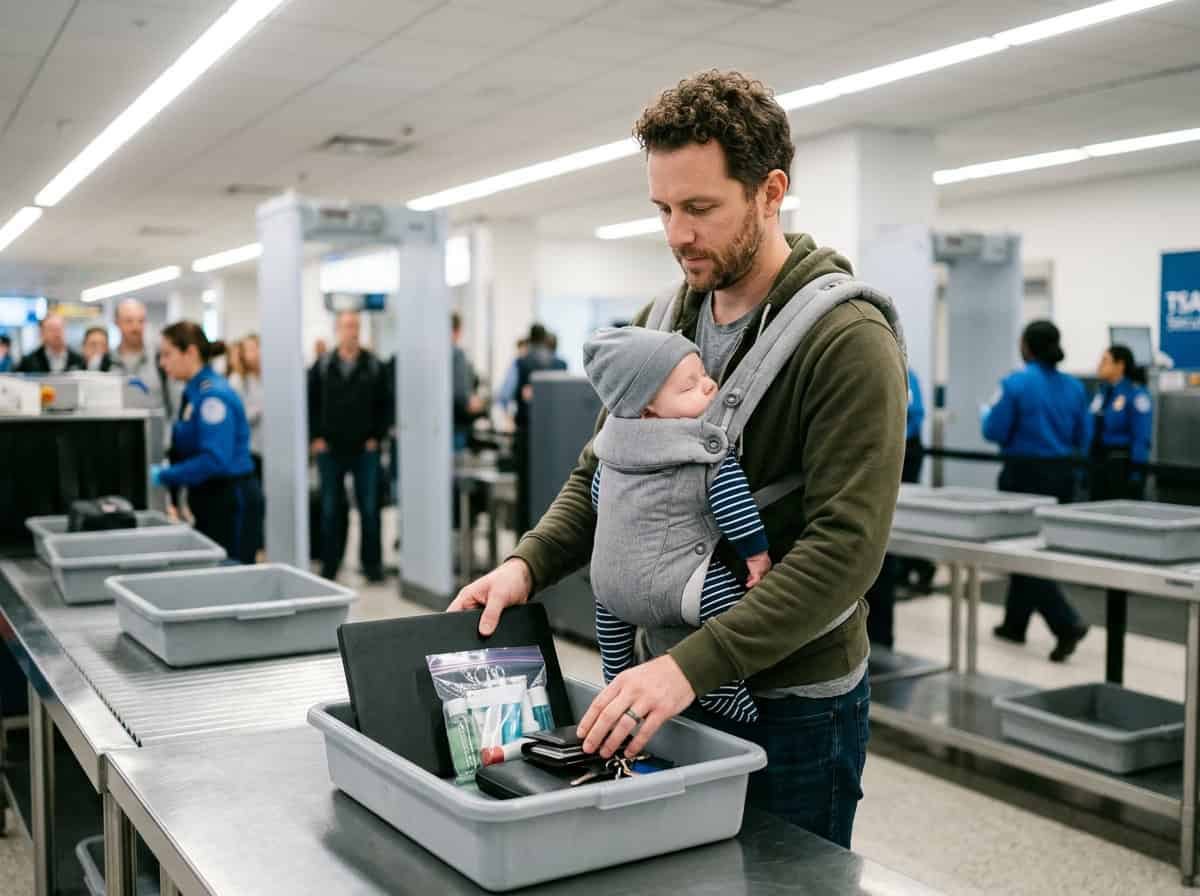
Soft-structured body carriers offer guaranteed physical control and deep comfort for infants during the incredibly chaotic security phase. Having any child under 2 years old securely strapped to your chest or back automatically gives you two free hands to collapse the pram, grab bins, and safely sort passports. It keeps a baby physically grounded and safe from frantic terminal foot traffic while you focus entirely on spatial awareness and instructions from TSA agents.
Gate Waiting, Sleep Logistics, and the Boarding Process
The secret to successfully maintaining a baby’s sleep schedule during exhausting flight delays involves rigorously enforcing the exact biological time of the nap—while completely abandoning their typical physical sleep environment rules. Aggressively follow the clock using walking motion, feeding, or carrying to save that critical nap window.
Biological Sleep Timing Vs. Physical Sleep Rules
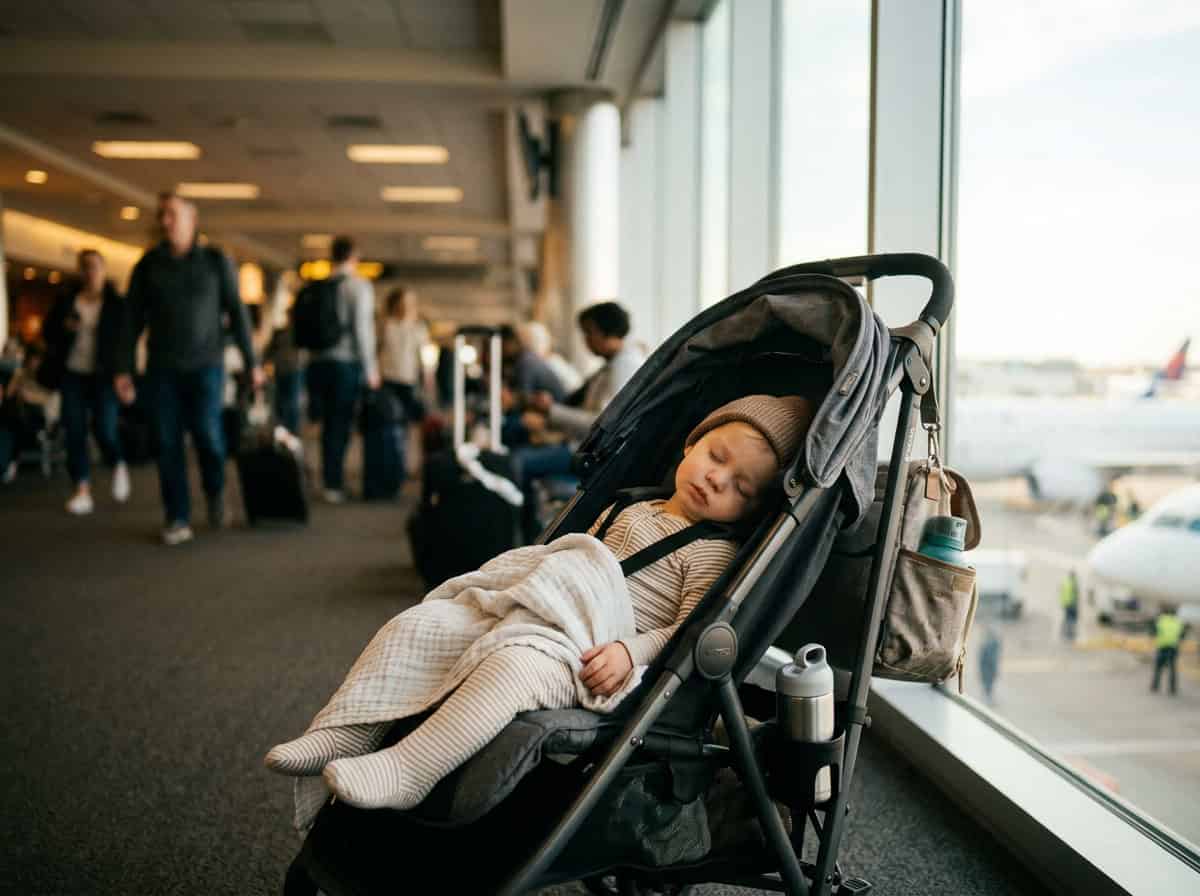
Protecting a child’s delicate circadian rhythm during travel relies heavily on enforcing strict sleep timing while feeling absolutely zero guilt about temporarily breaking environmental sleep associations. A fantastic example comes from pediatric sleep specialist Amanda Snedden. While waiting in a brightly lit, noisy Fiji airport terminal, she confidently put her 2.5-year-old child down for a nap at exactly 12:30 PM. The toddler fell asleep effortlessly, despite a 1.5-year gap since they had last slept in a pram. When biological sleep pressure peaks naturally, doing absolutely anything necessary to facilitate rest prevents a massive, vacation-ruining crash.
“When biological sleep pressure peaks naturally, doing absolutely anything necessary to facilitate rest prevents a massive, vacation-ruining crash.”
The Split Boarding Tactic for Energetic Toddlers
To board effectively, separate the family immediately at the gate rather than rushing the whole group onto the plane early. Execute “split boarding,” a brilliant strategy where one parent pre-loads the physical cabin while the other actively maximizes the child’s terminal energy burn. Parent A boards first to secure highly contested overhead bin space and thoroughly sanitize the tray tables. Parent B stays back in the open seating area, letting the toddler run laps right up until the final boarding call. This shaves off precious time the child spends physically restrained in an unmoving metal tube.
Bassinet Rows Vs. Overhead Storage Access
Securing a heavy-duty bassinet row offers critical floor and leg space for wrangling an active infant, but it comes with a strict overhead storage penalty. Bulkhead rows lack the standard seats directly in front of them, meaning you cannot comfortably stash a diaper bag at your feet. Every piece of your survival gear must go straight up into the closed overhead bins during both takeoff and landing. You must pack a tiny, immediate-access zip pouch for bottles, pacifiers, and wipes just to survive the initial twenty minutes of ascent without access to your main bag.
In-flight Cabin Physiology and Constraint Management
Managing an airplane cabin with children directly involves proactively preparing for unyielding physical constraints, from tightly locked seatbelts to violent atmospheric pressure shifts.
Synchronous Feeding to Offset Ear Barotrauma
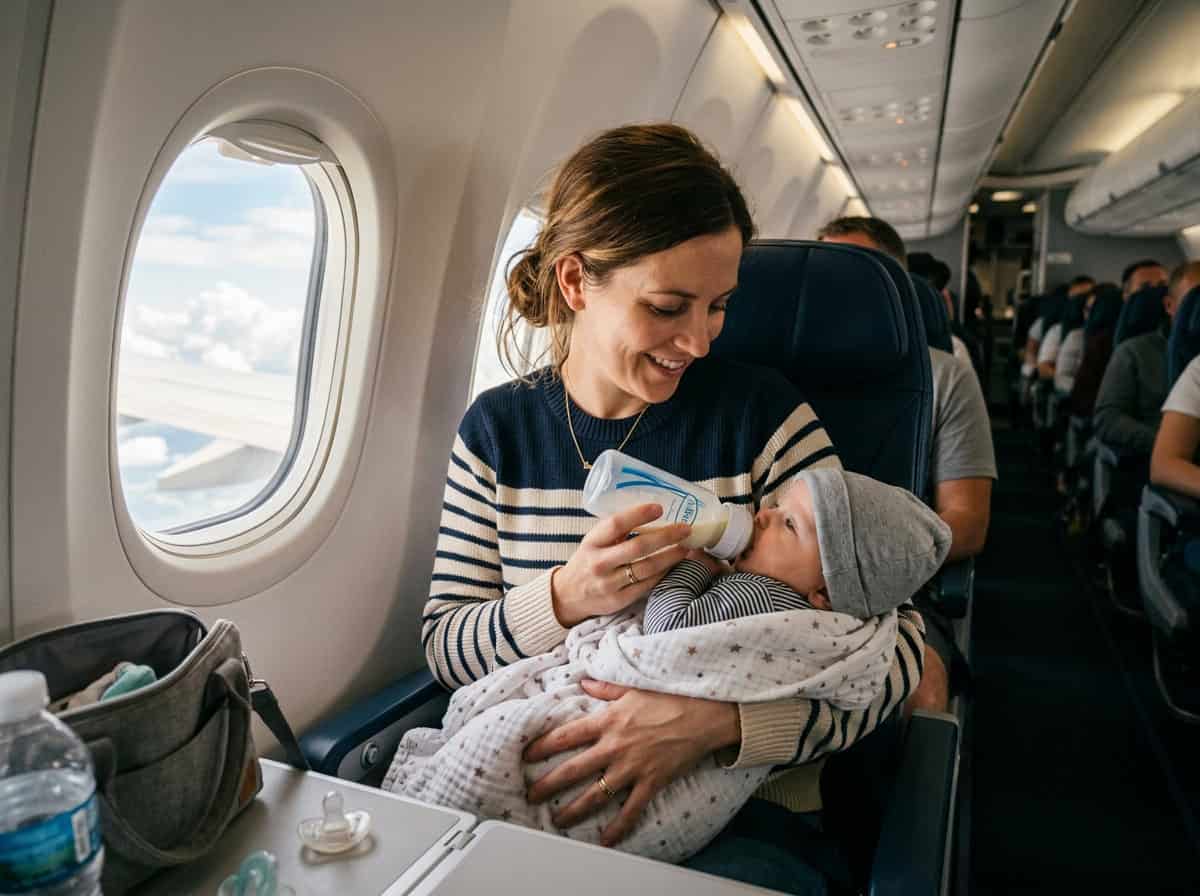
Timing a bottle or breastfeeding perfectly with the initial ascent and final descent sequence is a mechanical, highly effective tactic to offset infant ear barotrauma. The repeated physical act of Synchronous feeding forces the baby’s jaw and throat muscles to swallow constantly, naturally equalizing the intense barometric pressure changes deep inside their tiny ears. If a baby still screams through the descent, hold tight—crying serves as another highly effective, natural biological mechanism babies use to stretch and powerfully pop their ear canals.
Pre-schooler Pull-ups for Seatbelt Constraints
Reverting fully potty-trained children under 5 years old back into pull-up diapers temporarily serves as a vital tactical defense against unpredictable turbulence and rigid seatbelt constraints. When the captain turns on the seatbelt sign due to rough air or an extended meal cart service, passengers can easily be locked in their seats for well over an hour. A pull-up acts as an essential, common-sense insurance policy against a highly stressful, entirely unavoidable in-seat accident.
Thermos Workarounds and Airplane Restroom Hooks
Commercial aircraft fundamentally lack microwaves to heat up baby food or chilled milk safely. Bring a sturdy thermos of hot water from home to bypass the agonizing wait for flight attendants to slowly warm a bottle inside a jug of borrowed tap water. Additionally, aggressively study the tiny bathroom setup early on. Most cramped airplane restrooms feature a small hook high on the back of the heavy folding door. Use it to keep your bulky diaper bag safely suspended and completely off the universally unsanitary, perpetually wet floor.
Physical Transitions for Screen-time Shutdowns
Tantrums inevitably spike when flight attendants announce the mandatory collection of larger electronics immediately before landing preparation. Address the strict screen-time shutdown protocol well before the physical descent actually starts. Give a firm five-minute verbal warning, and keep a physical, high-value transition item ready to swap right out of your bag—a brand new sticker book, a rare candy, or a tactile sensory toy. Removing a glowing tablet with absolutely zero physical replacement guarantees immediate tears.
Post-flight Arrival and Biological Synchronization
Transitioning a tired child into a new destination environment begins the moment you leave the sliding airport doors, requiring immediate alignment with the local clock and guarding against unexpected local illness.
Immediate Circadian Synchronization at Your Destination
Gradual, delicate sleep shifts rarely work seamlessly with stubborn toddlers. Immediate circadian synchronization proves far faster than incremental adjustments, forcing their small bodies to adopt the local time routine instantly. If your child wakes up at 7 AM at home, boldly ensure they wake up at 7 AM local time on day one. This aggressive strategy quickly turns minor timezone disruptions into unique family scheduling advantages. The messy first day forces a rapid physical reset, allowing everyone to enjoy the remainder of the vacation on a highly predictable, manageable schedule.
Pre-packing Emergency Formularies for Specialized Health
Never assume foreign island pharmacies or hotel clinics carry the exact medical treatments your kid easily tolerates. Pre-pack highly specific childhood antibiotics—like a course of liquid amoxicillin prescribed by your pediatrician—alongside familiar pain relievers like paracetamol and ibuprofen. Local doctors might only routinely stock cheap, bitter-tasting medications your specific child will physically reject or is naturally resistant to. Treating a sudden overnight travel fever or a nasty ear infection using your own verified medical supply delivers profound peace of mind.
Embracing Flexibility for Stress-free Family Travel
The overriding philosophy of surviving air travel with your children involves rigorous mechanical preparation up front, followed instantly by an immediate willingness to throw the rulebook completely away once in motion. Lower your personal expectations completely. Once the basic necessities of feeding, sleep timing, and security navigation are secured, cut yourself immense slack.
Air travel should never feel like a high-stakes parenting exam. Sometimes there is crying, sometimes you inevitably feed them heavily processed plain crackers for dinner, and that is perfectly okay. If you want continued, detailed strategies on maintaining your children’s delicate routines through massive life disruptions—whether you are dealing with daily drop-off transitions for Child Care, graduating from local Preschool directly into formal Kindergarten, or handling a major cross-country holiday—tune into The Sleep Manual Podcast or connect directly with the experts at Little Ones. You can easily find more sanity-saving strategies scattered across Facebook, Instagram, and Pinterest, or listen in on Spotify, YouTube, and TikTok while managing your evening routine. Just remember: you will survive the transit, and the actual vacation memories are always worth the flight.
Frequently Asked Questions
Is it worth putting a completely potty-trained preschooler back in pull-ups for a flight?
Absolutely. When turbulence hits or the meal cart blocks the aisle, the captain can lock passengers in their seats for well over an hour. A pull-up acts as a totally necessary insurance policy against a highly stressful, unavoidable in-seat accident.
What’s the difference between checking an umbrella stroller at the gate and using a travel pram?
Relying on a standard umbrella stroller under the airline’s gate-check system carries a staggering 50% delay or misplacement rate. An aircraft-compatible pram, like the Mountain Buggy Nano, folds down completely to fit directly inside a standard overhead bin. You bypass the airline’s flawed baggage system entirely and keep your wheels securely in your physical possession.
How does the ‘split boarding’ strategy actually work for energetic toddlers?
Instead of dragging the whole family onto the plane early, separate at the gate. One parent boards first to secure highly contested overhead bin space and sanitize the tray tables. The second parent stays back in the terminal, letting the toddler run laps right up until the final boarding call to minimize their time physically trapped in the cabin.
Can I pool my family’s total luggage weight across several shared suitcases?
No, doing this will inevitably cause a spectacular failure at the check-in area. Most airlines now use automated kiosks that strictly enforce individual baggage allowances, meaning the computer doesn’t care if your toddler’s bag is incredibly light while yours is heavy. Weigh and distribute everything fairly at home to avoid furiously unpacking underwear on the busy terminal floor.
Why should I abandon my established environmental sleep rules during a layover?
Protecting a kid’s exact biological sleep timing is vastly more important than replicating their physical bedroom environment. If their natural circadian nap window hits, do whatever it takes—walking, wearing, or feeding—to facilitate rest. Securing that sleep exactly when biological pressure peaks prevents a massive, vacation-ruining overtired crash later.
How does synchronous feeding prevent ear barotrauma during takeoff and landing?
Timing a bottle or nursing session exactly with the plane’s ascent and descent forces your baby’s jaw and throat muscles to swallow continuously. This mechanical movement naturally equalizes the intense barometric pressure changes deep inside their ear canals. If they still end up crying, don’t panic—screaming is actually another highly effective biological mechanism babies use to stretch and pop their ears.